



IEC62471-2006(CIE S009) Photobiological Safety of Lamps and Lamp System and IEC TR62471-2(2009) Guidance on Manufacturing Requirements Relating to Non-laser Optical Radiation Safety have be published addressing hazard to human (mostly eye and skin), and are completely suitable to assess the optical radiation safety of non-laser sources, such as LED products, UV radiation in general lighting products and etc.
The hazard exposure level of optical radiation may be related from 200nm to 3000nm. It is based on the measurement of spectral irradiance and spectral radiance in specified measuring geometry relating with exposure duration.
معيار:
IEC62471-1/EN62471-1 "السلامة البيولوجية الضوئية للمصابيح وأنظمة الإضاءة"“
CIE S009 / GB/T 20145” Photobiological Safety of Lamps and Lamp Systems”
IEC62471-6:2022 “"السلامة البيولوجية الضوئية للمصابيح وأنظمة الإضاءة - الجزء 6: منتجات مصابيح الأشعة فوق البنفسجية"”
IEC62471-7:2023 “"السلامة البيولوجية الضوئية للمصابيح وأنظمة الإضاءة - مصادر الضوء ووحدات الإضاءة التي تنبعث منها في المقام الأول إشعاعات مرئية"”
IEC/EN 60598/GB 7000.1 “"وحدات الإضاءة - الجزء الأول: المتطلبات العامة والاختبارات"”
IEC/EN 60432 "المصابيح المتوهجة - مواصفات السلامة - الجزء 1: مصابيح خيوط التنجستن للأغراض المنزلية وما شابهها من أغراض الإضاءة العامة"“
IEC60335-2-27 "الأجهزة الكهربائية المنزلية وما شابهها؛ السلامة - الجزء 2-27: متطلبات خاصة للأجهزة المتعلقة بتعرض الجلد للأشعة فوق البنفسجية والأشعة تحت الحمراء"“
IEC60335-2-59 "الأجهزة الكهربائية المنزلية وما شابهها - السلامة - الجزء 2-59: متطلبات خاصة لأجهزة قتل الحشرات"“
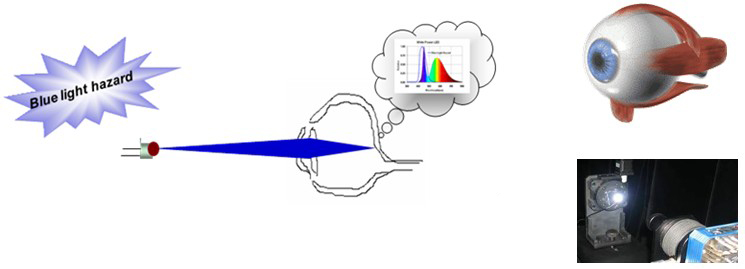
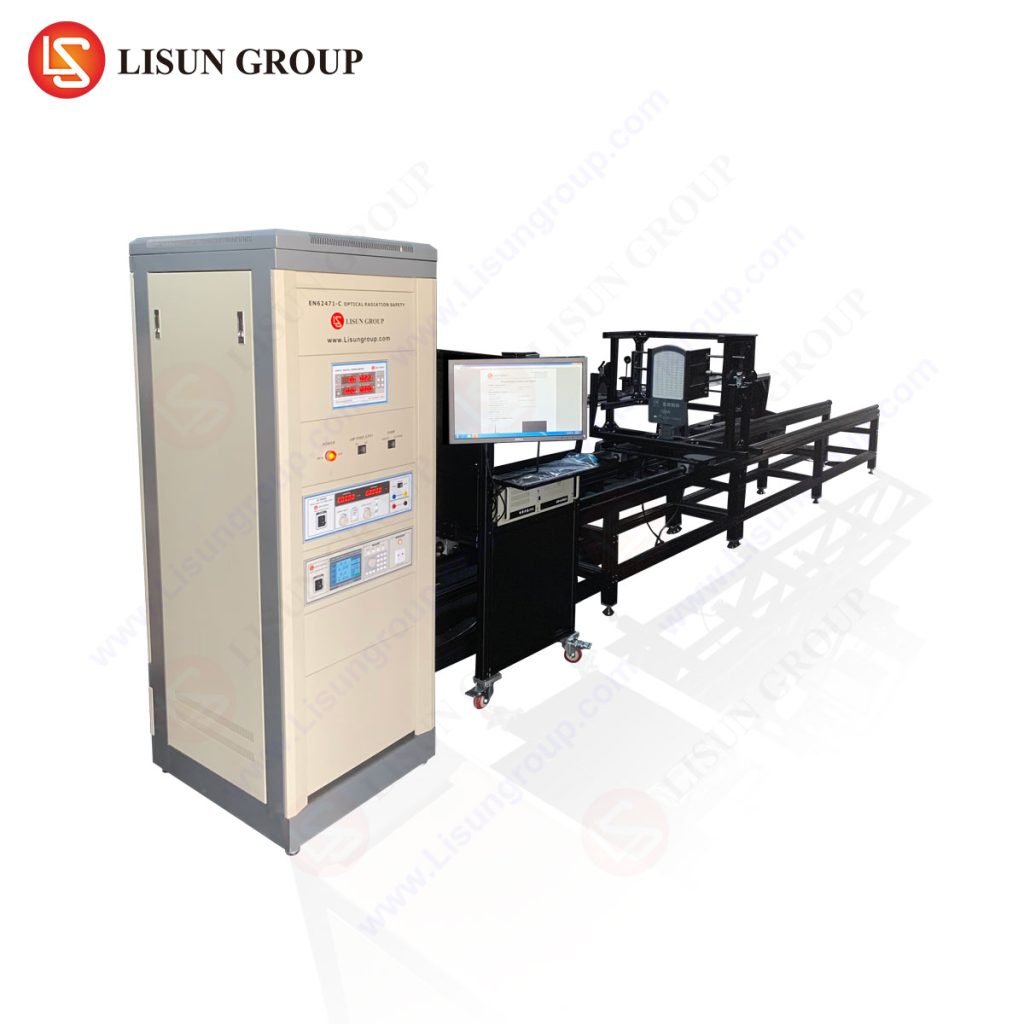
The IEC 62471 measurement equipment is specialized for the optical radiation hazard exposure level measurement in IEC 62471.
• Actinic UV hazard exposure (weighted irradiance from 200nm to 400nm) for the skin and eye
• Near-UV hazard exposure (irradiance from 315nm to 400nm) for the eye
• Retinal blue light hazard exposure (weighted radiance from 300nm to 700nm)
• Retinal blue light hazard exposure(weighted irradiance, 300-700nm) – small light source
• Retinal thermal hazard exposure (weighted radiance from 380nm to 1400nm)
• Retinal thermal hazard exposure (weighted radiance; 780-1400nm) – weak visual stimulus
• Infrared radiation hazard exposure (irradiance from 780nm to 3000nm) for the eye
• Thermal hazard exposure (irradiance from 380nm to 3000nm) for the skin
مواصفة:
• Wavelength range: 200nm to 800nm (EN62471-A), 200-1500nm (EN62471-B) and 200-3000nm (EN62471-C)
• Wavelength accuracy: 0.1nm(UV), 0.2nm(VIS), 0.4nm(IR)
• Optical path design: Simulate the imaging optical path of the human eye to accurately evaluate the effective radiation of the human eye’s retina
• Incident aperture: Φ7mm light-receiving aperture, suitable for measurement requirements in all scenarios
• Measuring field of view (fully meeting the standard requirements according to the radiation duration):
1) Effective radiant luminance measurement: 1.5mrad~110mrad (1.7mrad, 11mrad, 100mard)
2)Effective irradiance measurement: 100mrad, 1.4rad and 2πsr
• Testing distance: 200mm~20.0m (optional) with a constant field of view FOVs and input aperture
• 16-bit scientific-grade camera: Resolution 2048*1536, High-precision programmable electric focus
• Calibration traceability: Traceable to the National Institute of Metrology (NIM)
• Maximum exposure scanning range: 2π-space
• Dynamic range: 10^8
• Pulse measurement function (optional): The highest sampling speed is 100kS/s
• High-precision double monochromator spectrometer (optional): PMT/InGaAs/Si/PbS (optional)
 English
  Spanish
  Russian
  Portuguese
  Turkish
  Arabic
  German
  Polish
  Italian
  French
  Korean
  Japanese
  Indonesian