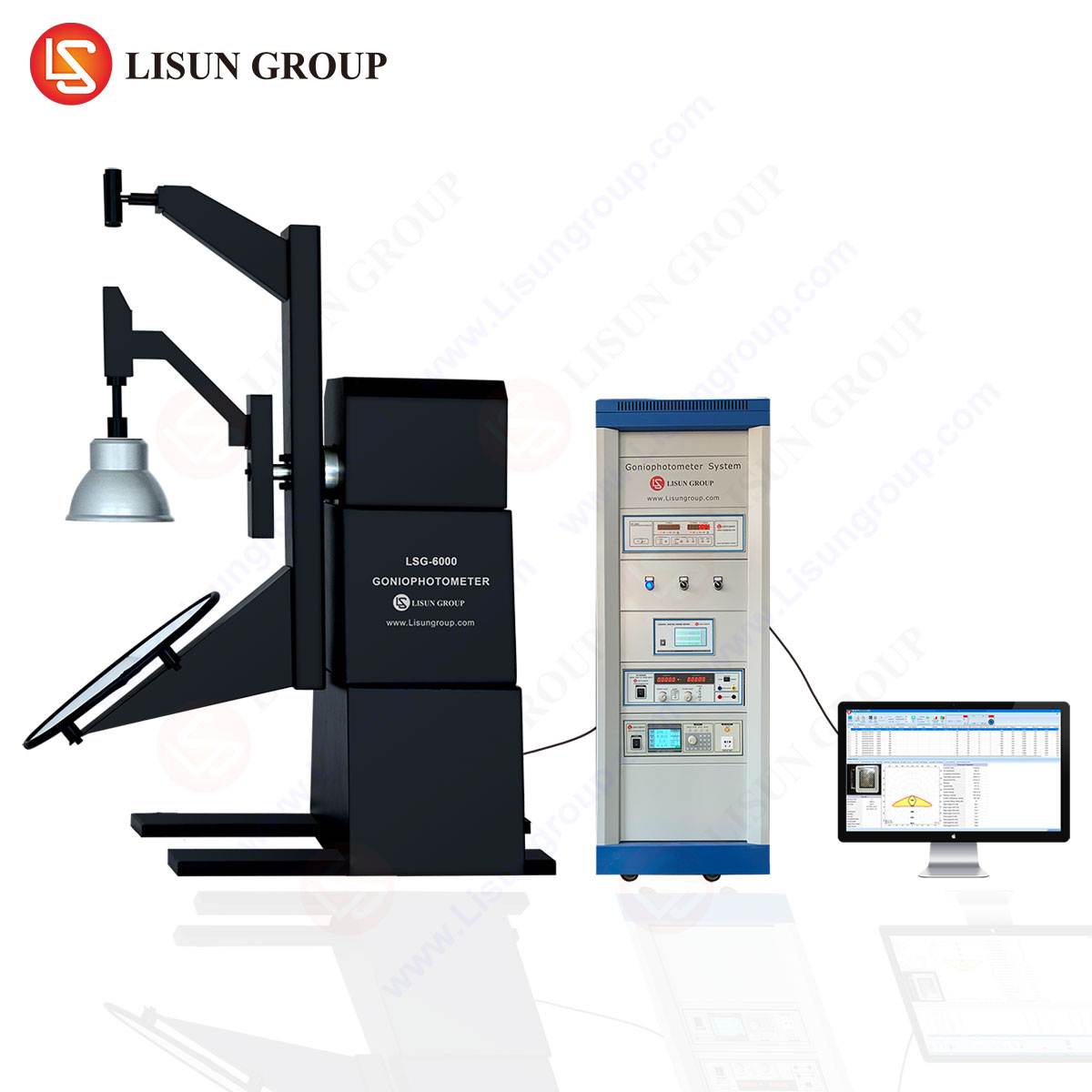



A Comprehensive Technical Analysis of Goniophotometry: Principles, Instrumentation, and Industrial Applications
Abstract
Goniophotometry represents a cornerstone methodology in the precise characterization of spatial light distribution. This technical treatise delineates the fundamental operating principles of the goniophotometer, its critical design features, and its extensive applications across diverse industrial and scientific sectors. A detailed examination of a representative high-precision system, the LISUN LSG-1890B Goniophotometer Test System, provides a concrete framework for understanding contemporary implementation, adherence to international standards, and the resultant data critical for product development, quality assurance, and regulatory compliance.
Fundamental Principles of Goniophotometric Measurement
A goniophotometer is a sophisticated photometric instrument engineered to measure the luminous intensity distribution of a light source or luminaire as a function of angular displacement. The core principle involves the precise rotation of either the light source under test (SUT) or a photodetector around one or more axes, thereby capturing luminous intensity data across a spherical or hemispherical coordinate system. This process generates a comprehensive dataset that is typically rendered as an intensity distribution curve (polar plot) or a full three-dimensional luminous intensity matrix.
The mathematical foundation relies on the definition of luminous intensity (I), measured in candelas (cd), which is the luminous flux (Φ, in lumens) per unit solid angle (ω, in steradians): I = dΦ/dω. By systematically measuring intensity at numerous discrete angular positions (C-γ or C-θ planes as per convention), the instrument constructs a complete photometric profile. This profile is indispensable for deriving key performance metrics such as total luminous flux, beam angle, field angle, luminance distribution, and coefficients of utilization (CU) for lighting design calculations.
Architectural Components and System Configuration
The physical architecture of a modern goniophotometer is defined by several integrated subsystems. The primary mechanical structure is the goniometric arm or frame, which provides the rotational axes. Systems are categorized as Type A (luminaire rotates in the vertical direction), Type B (luminaire rotates in the horizontal direction), or Type C, which utilizes two concurrent rotations for full 4π steradian measurement. A high-sensitivity spectroradiometer or photometer, mounted on a fixed or moving arm, serves as the detector. This detector is often positioned at a sufficient distance to satisfy far-field conditions, typically facilitated by a long optical bench or an integrating sphere for near-field measurements. Environmental control, including darkroom conditions and thermal management, is crucial to eliminate stray light and stabilize the SUT’s thermal and electrical operating conditions, as mandated by standards such as IES LM-79 and LM-80.
Precision stepper motors, encoders, and motion control software govern the angular positioning with arc-minute accuracy. Data acquisition hardware synchronizes the angular position with the detector’s readings, feeding information into specialized photometric software for real-time analysis, visualization, and report generation in standardized formats (e.g., IESNA LM-63 IES files, EULUMDAT, or CIE files).
The LISUN LSG-1890B: A Paradigm of Modern Goniophotometric Testing
The LISUN LSG-1890B Goniophotometer Test System exemplifies a Type C configuration, designed for full three-dimensional spatial photometry. Its design prioritizes precision, automation, and compliance with stringent international standards.
Specifications and Testing Principles:
The system operates on a dual-axis rotation principle. The SUT is mounted on a rotating arm that varies the vertical γ-angle (0° to 360°), while the entire arm assembly rotates horizontally to vary the C-plane angle (0° to 180° or 360°). This enables the collection of data across the entire sphere surrounding the luminaire. The detector, a high-accuracy spectroradiometer or photometer, is fixed at a distance compliant with the inverse square law requirement for far-field measurements. The LSG-1890B typically features a large measurement radius (variable based on configuration) to accommodate luminaires of significant size and luminous output.
Its testing principle strictly adheres to the CIE 70, CIE 121, and CIE S025 standards for the measurement of luminous flux and spatial distribution. The system software automates the scanning trajectory, collects intensity data at user-defined angular intervals, and corrects for background noise and system errors.
Industry Use Cases and Standards Compliance:
The application of the LSG-1890B spans numerous industries, guided by relevant international and national standards.
- Lighting Industry & LED Manufacturing: It is critical for verifying performance claims per IES LM-79-19 (Electrical and Photometric Measurements of Solid-State Lighting Products) and ANSI/IESNA RP-16-17 (Nomenclature and Definitions for Illuminating Engineering). It certifies parameters like zonal lumen output, efficacy (lm/W), and intensity distribution for commercial and industrial luminaires.
- Display Equipment Testing: For backlight units (BLUs) and direct-lit displays, the system assesses spatial uniformity and angular luminance characteristics, referencing standards like IEC 62547 (Guidelines for the measurement of high-power LED arrays) and VESA Flat Panel Display Measurement Standard.
- Urban Lighting Design: It enables the generation of IES files essential for simulation software (e.g., Dialux, Relux). Designers rely on this data to model roadway illumination, public space lighting, and obtrusive light (uplight) compliance with standards such as EN 13201 (Road lighting) and IDAS/IDA Model Lighting Ordinance.
- Stage and Studio Lighting: The system characterizes the beam spread, field angle, and “softness” of profiles, fresnels, and LED stage lights, with metrics aligned to ESTA ANSI E1.9 (Protocol for the Measurement of Luminaire Photometry).
- Medical Lighting Equipment: For surgical and examination lights, it validates critical photobiological safety per IEC 60601-2-41 (Particular requirements for the basic safety and essential performance of surgical luminaires and diagnostic luminaires) and IEC 62471 (Photobiological safety of lamps and lamp systems), ensuring precise beam control and absence of hazardous glare.
- Sensor and Optical Component Production: It calibrates and characterizes the angular response of photodiodes, ambient light sensors, and optical filters.
Competitive Advantages:
The LSG-1890B’s advantages include its fully automated operation, reducing human error and increasing throughput. Its robust mechanical design ensures stability for heavy or large luminaires. The integration with high-precision spectroradiometers allows for both photometric and colorimetric (chromaticity, CCT, CRI) measurements simultaneously. The software’s ability to directly output standard-compliant data formats streamlines workflow for certification bodies and design engineers.
Critical Metrics Derived from Goniophotometric Data
The raw angular-intensity data serves as the basis for computing all other relevant photometric quantities. Total luminous flux is obtained by integrating the intensity distribution over the entire spherical solid angle. Beam patterns are quantified by identifying the angles at which intensity falls to 50% (beam angle) and 10% (field angle) of the maximum central candela value. For area and street lighting, zonal lumen summaries and utilization factors are calculated. Luminance maps, crucial for glare evaluation (e.g., UGR – Unified Glare Rating), are derived from intensity data combined with the known geometry of the luminaire’s luminous surface.
Table 1: Key Photometric Metrics Derived from Goniophotometry
| Metric | Symbol/Unit | Derivation Method | Primary Application |
| :— | :— | :— | :— |
| Luminous Intensity Distribution | I(θ,φ) [cd] | Direct measurement | Core performance profile |
| Total Luminous Flux | Φ [lm] | ∫ I(θ,φ) dω | Energy efficiency (efficacy) |
| Beam & Field Angles | θ₁/₂, θ₁/₁₀ [°] | Angular width at 50%/10% of I_max | Optical beam control |
| Zonal Lumen Summary | Φ_zone [lm] | ∫ I(θ,φ) dω over defined zone | Lighting design calculations |
| Coefficient of Utilization (CU) | Ratio | Derived from zonal flux and room geometry | Architectural lighting design |
| Luminance Distribution | L(θ,φ) [cd/m²] | I(θ,φ) / (projected area) | Glare analysis (UGR, TI) |
Applications Across Scientific and Industrial Disciplines
The utility of goniophotometry extends beyond traditional lighting.
- Photovoltaic Industry: While primarily for light emission, the reciprocal principle allows goniophotometers to be adapted for measuring the angular dependence of light incidence on solar cells and modules, assessing performance under varying solar angles.
- Optical Instrument R&D & Scientific Research Laboratories: Researchers employ goniophotometers to study bidirectional reflectance distribution functions (BRDF) and transmittance (BTDF) of materials, develop advanced optical systems, and characterize novel light sources like micro-LEDs and laser diodes.
- OLED Manufacturing: For large-area or flexible OLED panels, goniophotometry is essential for measuring angular color shift and luminance uniformity, key quality indicators for display and lighting panels.
Standardization and Compliance Framework
Goniophotometric measurements are meaningless without traceable calibration and adherence to published standards. Primary international references include:
- CIE 70:1987 – Measurement of Absolute Luminous Intensity Distributions
- CIE 121:1996 – The Photometry and Goniophotometry of Luminaires
- CIE S 025/E:2015 – Test Method for LED Lamps, Luminaires and Modules
- IES LM-79-19 – Approved Method for the Electrical and Photometric Testing of SSL Products
- IEC 60598-1 (Luminaires – Part 1: General requirements and tests)
- ANSI/IESNA RP-16-17 – Addendum a
National standards from bodies like DIN (Germany), JIS (Japan), and UL (United States) often harmonize with or reference these core international documents, making compliance with IEC and IES standards a global benchmark.
Conclusion
Goniophotometry remains an indispensable, rigorous methodology for the complete spatial characterization of light emission. The evolution from manual to fully automated systems, such as the LISUN LSG-1890B, has enhanced accuracy, repeatability, and integration into modern digital workflows. The data generated forms the empirical foundation for innovation in lighting technology, ensures regulatory and safety compliance across continents, and enables optimized application-specific design in fields ranging from urban infrastructure to medical diagnostics and consumer electronics. As light source technologies continue to advance, the role of precise goniophotometric analysis will only increase in significance.
Frequently Asked Questions (FAQ)
Q1: What is the primary difference between using an integrating sphere and a goniophotometer for total flux measurement?
An integrating sphere provides a rapid, single-value measurement of total luminous flux but offers no spatial distribution data. A goniophotometer measures flux by angular integration, which is more time-consuming but yields the complete intensity distribution, enabling the derivation of all other photometric parameters. For complex or asymmetric luminaires, goniophotometry is the prescribed method per standards like IES LM-79.
Q2: How does the LSG-1890B system ensure accuracy when testing luminaires with significant thermal dependence, such as high-power LEDs?
The system incorporates strict thermal management protocols. The SUT is operated at stabilized ambient temperature within a controlled environment. It is powered and preconditioned at its rated operating current until thermal equilibrium is reached (as per IES LM-80 guidelines) before measurement commencement. The automated scan is then executed efficiently to minimize changes in junction temperature during the test sequence.
Q3: Can the LSG-1890B measure the photobiological safety metrics outlined in IEC 62471?
Yes, when equipped with a spectroradiometric detector, the system can measure spectral irradiance at multiple angles. This spectral and spatial data can be processed by specialized software modules to calculate the actinic UV hazard, near-UV hazard, retinal blue light hazard, and thermal retinal hazard exposure limits defined in IEC 62471 and IEC TR 62778, which is crucial for medical and high-intensity lighting.
Q4: What file formats can the system generate, and how are they used in industry?
The system software typically exports standard formats including IES (IESNA LM-63), EULUMDAT (LDT), and CIE. These files contain the intensity distribution matrix and metadata. Lighting designers import these files directly into illumination simulation software (e.g., Dialux, AGi32) to accurately model lighting scenes, calculate illuminance levels, and perform glare analysis before physical installation.
Q5: For a Type C system like the LSG-1890B, what determines the required measurement distance?
The distance must satisfy the photometric far-field condition, where the detector is at least five times the maximum dimension of the SUT (the 5x rule), as per CIE 121. This ensures that measurements approximate luminous intensity rather than illuminance, and that the inverse square law is applicable for accurate flux calculation. Larger or more complex luminaires require a longer measurement radius.