


An Analytical Examination of Goniophotometry and Advanced Luminous Intensity Distribution Measurement
Abstract
Goniophotometry represents a cornerstone methodology in the field of photometry, providing the most comprehensive characterization of a light source’s spatial radiation properties. This technical treatise delineates the fundamental principles of goniophotometric systems, their critical components, and their indispensable role across a spectrum of industries reliant on precise photometric data. A detailed analysis of a representative state-of-the-art system, the LISUN LSG-6000, is presented to illustrate the practical application of these principles, its adherence to international standards, and its operational advantages in demanding testing environments.
Fundamental Principles of Spatial Light Measurement
A goniophotometer is a precision electromechanical instrument designed to measure the spatial distribution of luminous intensity, more commonly known as the light distribution curve, of a light source or luminaire. The term itself is derived from the Greek words ‘gonia’ (angle) and ‘phos’ (light), effectively describing an “angle-light-measurer.” The core operational principle involves rotating either the light source under test or a high-accuracy photodetector through a series of spherical coordinates—typically the vertical gamma (γ) and horizontal C (or C-γ system) planes—while simultaneously recording photometric data at discrete angular increments. By systematically capturing luminous intensity values across a full or partial sphere surrounding the device under test (DUT), the instrument constructs a complete three-dimensional model of its photometric performance. This data set is fundamental for deriving all key photometric parameters, including total luminous flux (lumens), efficacy (lm/W), luminance distribution, and beam angles.
Architectural Configuration of a Modern Goniophotometric System
Contemporary goniophotometers are sophisticated systems integrating mechanical, optical, and electronic subsystems. The primary mechanical structure is a large, rigid frame that defines the measurement geometry. Two dominant optical configurations are employed: the type C system, where the detector is fixed and the DUT rotates in two axes, and the type B system, where the DUT rotates around its vertical axis while the detector moves along a great circle in the vertical plane. The system’s heart is a high-sensitivity, spectrally corrected photodetector, typically a silicon photodiode, housed in a temperature-stabilized enclosure to minimize drift. This detector is connected to a precision photometer or spectroradiometer, which converts the optical signal into a calibrated photometric or radiometric quantity. The entire apparatus is controlled by dedicated software that orchestrates the movement sequences, data acquisition, and subsequent data processing to generate standardized reports and IES/LDT files.
The LISUN LSG-6000: A Paradigm of Large-Scale Luminaire Testing
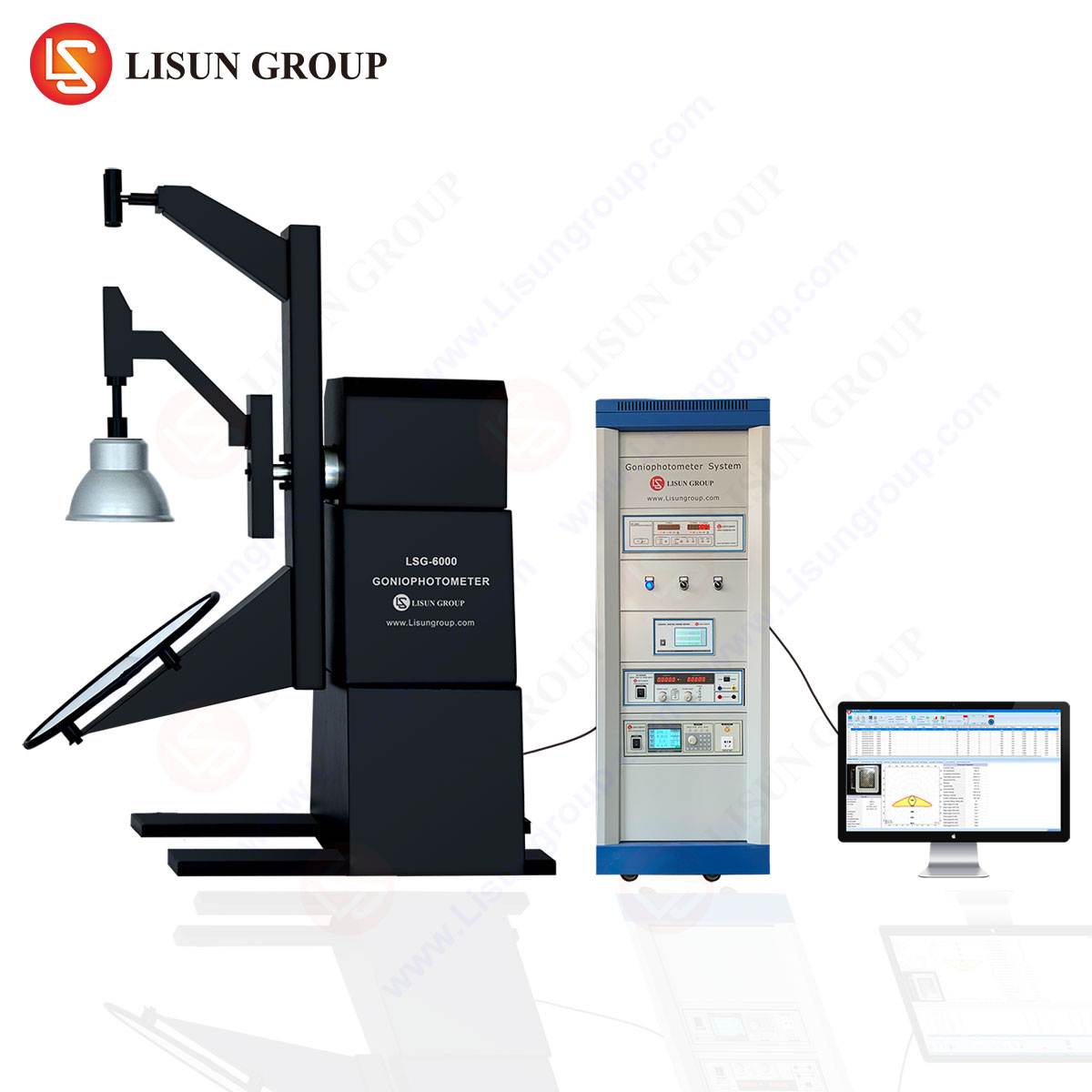
The LISUN LSG-6000 exemplifies a Type C, moving-DUT, double-arm goniophotometer engineered for the characterization of large and heavy luminaires, such as high-bay industrial lighting, streetlights, stadium floodlights, and horticultural lighting systems. Its design prioritizes measurement accuracy, operational stability, and automation to meet the stringent requirements of international certification and quality control.
Key Specifications of the LSG-6000:
- Measurement Geometry: Type C (DUT rotates in both γ and C planes).
- Maximum DUT Dimensions: Varies by model, typically accommodating luminaires up to 2000mm in length and 1000kg in weight.
- Angular Resolution: ≤ 0.1°.
- Measurement Distance: 5m to 30m (variable, based on the required photometric distance for the DUT).
- Photodetector: High-precision, V(λ)-corrected silicon cell photometer head or integrated spectroradiometer.
- Standards Compliance: Designed to comply with IEC 60598-1, IEC 60630, IESNA LM-79, LM-80, CIE 70, CIE 121, CIE S025, and EN 13032-1.
Operational Workflow and Data Acquisition Protocols
The testing procedure with a system like the LSG-6000 is a meticulously controlled process. The luminaire is securely mounted on the rotating fork of the goniophotometer within a darkroom environment to eliminate stray light. The system is calibrated using a standard reference lamp of known luminous intensity. The test sequence is initiated via the control software, which commands the goniophotometer to position the DUT at a specific set of spherical coordinates. At each position, the luminaire is powered by a stable, programmable AC/DC power supply, and the photodetector records the illuminance. Using the inverse-square law, the illuminance measurement at a known distance is converted to luminous intensity. This data matrix is then processed to compute the total luminous flux by integrating the intensity distribution over the entire sphere.
Adherence to International Standards and Normative Compliance
The design and operation of the LSG-6000 are intrinsically linked to a framework of international standards that ensure consistency and reliability of photometric data. For the lighting industry, IEC 60598-1 (Luminaires – General requirements and tests) mandates specific photometric testing to verify safety and performance claims. IESNA LM-79 (Electrical and Photometric Measurements of Solid-State Lighting Products) is a critical standard for the LED industry, prescribing the methods for measuring total flux, efficacy, and chromaticity. The LSG-6000’s capability to perform spatial color uniformity measurements aligns with ANSI/IES TM-30-20, which evaluates the color fidelity and gamut of light sources. In the European context, EN 13032-1 is the equivalent standard for the measurement and presentation of photometric data for luminaires. Compliance with these standards is not merely a feature but a fundamental requirement for manufacturers seeking CE, UL, or DLC certification for their products in North American and European markets.
Diverse Industrial Applications of Goniophotometric Data
The utility of goniophotometry extends far beyond basic lumen output verification.
- LED & OLED Manufacturing: For LED package and module producers, goniophotometers are essential for binning components based on spatial flux and color consistency. In OLED manufacturing, they characterize the Lambertian emission profile and angular color shift, which are critical for display and lighting panel quality.
- Display Equipment Testing: The evaluation of backlight units (BLUs) for televisions and monitors requires precise measurement of viewing angle, luminance uniformity, and contrast ratio, all derived from goniophotometric scans.
- Photovoltaic Industry: While used for light sources, the principle is inverted for solar panels. Goniophotometers can be used to measure the angular response of photovoltaic cells, which determines their efficiency in capturing light from various sun positions.
- Optical Instrument R&D and Sensor Production: The development of lenses, reflectors, and diffusers relies on goniophotometric data to validate optical designs and simulate performance. Similarly, the angular sensitivity of optical sensors is a key parameter measured using these systems.
- Urban Lighting Design: For street and architectural lighting, the intensity distribution is paramount. Data from a goniophotometer is imported into lighting design software (e.g., DIALux) to simulate illuminance levels, uniformity, and glare on roads and facades before installation, ensuring compliance with standards like ANSI/IES RP-8 for roadways.
- Stage and Studio Lighting: The performance of profile spots, fresnels, and moving heads is defined by their beam shape, field angle, and fall-off. Goniophotometry provides the precise data needed for lighting designers to select fixtures and predict their output on stage.
- Medical Lighting Equipment: Surgical and diagnostic lights have stringent requirements for shadow reduction, field uniformity, and color rendering. Goniophotometric analysis verifies that these critical medical devices meet standards such as IEC 60601-2-41.
Comparative Advantages in High-Accuracy Testing Environments
The LISUN LSG-6000 incorporates several design features that confer distinct advantages in a production or laboratory setting. Its dual-arm Type C configuration provides exceptional stability for heavy luminaires, minimizing vibration and deflection that could introduce measurement error. The integration of a spectroradiometer option allows for simultaneous photometric and colorimetric measurement (e.g., CCT, CRI, Duv) across all angles, a critical capability for assessing angular color uniformity in modern LED luminaires. The system’s software automation streamlines the testing workflow, from fixture calibration and data capture to the generation of standardized IES files, directly enhancing laboratory throughput and reducing operator-dependent variability.
Frequently Asked Questions (FAQ)
Q1: What is the primary distinction between a Type B and a Type C goniophotometer, and why is the LSG-6000 a Type C system?
Type B systems rotate the DUT horizontally while moving the detector vertically, which can cause gravitational sag in large fixtures, affecting beam orientation. Type C systems, like the LSG-6000, rotate the DUT in both axes, ensuring the optical axis of the luminaire remains fixed relative to gravity. This is crucial for accurate testing of asymmetrical luminaires like streetlights, where the beam orientation is critical.
Q2: How does the goniophotometer account for the thermal stabilization requirements of LED luminaires during testing?
The control software of advanced systems like the LSG-6000 includes programmable stabilization routines. The luminaire is powered on and allowed to reach thermal equilibrium at a specified ambient temperature before measurement commences. The software monitors the photodetector’s signal over time and only begins the angular scan once the output has stabilized to within a user-defined tolerance, as prescribed by standards like IES LM-79.
Q3: Can the LSG-6000 measure the flicker percentage of a luminaire?
While a standard goniophotometer measures time-averaged illuminance, when equipped with a high-speed photometer or a spectroradiometer capable of high-frequency sampling, the system can perform temporal light modulation (TLM) or flicker measurements at various angles. This allows for the characterization of spatial variations in flicker, which is an emerging area of concern in lighting quality.
Q4: What are the environmental requirements for installing a large goniophotometer like the LSG-6000?
The system requires a dedicated darkroom with dimensions sufficient to accommodate the specified measurement distance (e.g., 5m to 30m). The environment must have stable, low-vibration foundations and precise control of ambient temperature (typically 25°C ±1°C) to ensure the thermal stability of both the DUT and the measurement electronics, as mandated by international standards.