







Fundamental Principles of Photometric and Radiometric Measurement
The accurate characterization of Light Emitting Diodes (LEDs) and other solid-state lighting (SSL) devices is a cornerstone of modern photonics and illumination engineering. Unlike traditional incandescent sources, LEDs are highly directional, spectrally specific, and their performance is intrinsically linked to thermal and electrical operating conditions. Two primary instrumental systems have emerged as the global standards for comprehensive LED testing: the goniophotometer and the integrating sphere. Each system serves a distinct yet complementary role in quantifying the total luminous flux, spatial distribution, and chromaticity of light sources. The selection between these methodologies is dictated by the specific parameters under investigation and the required degree of measurement precision, governed by international standards such as those from the International Electrotechnical Commission (IEC) and the Illuminating Engineering Society (IES).
Spatial Light Distribution Analysis with Goniophotometry
A goniophotometer is a sophisticated electromechanical instrument designed to measure the spatial distribution of light emitted from a source. The fundamental principle involves rotating the light source under test (or a mirror reflecting its output) through a series of spherical coordinates—typically azimuth (C-planes) and elevation (γ-planes)—while a fixed, highly calibrated photodetector captures luminous intensity data at each point. This process generates a comprehensive three-dimensional intensity distribution, known as the luminous intensity distribution curve. For LEDs and LED modules, this data is critical as it quantifies the beam angle, identifies hotspots, and calculates the total luminous flux by mathematically integrating the intensity over the entire solid angle of 4π steradians. This method is considered the most accurate for total flux measurement when high angular resolution is achieved, as it directly samples the light in all directions.
The LSG-6000 Goniophotometer Test System: Architecture and Operation
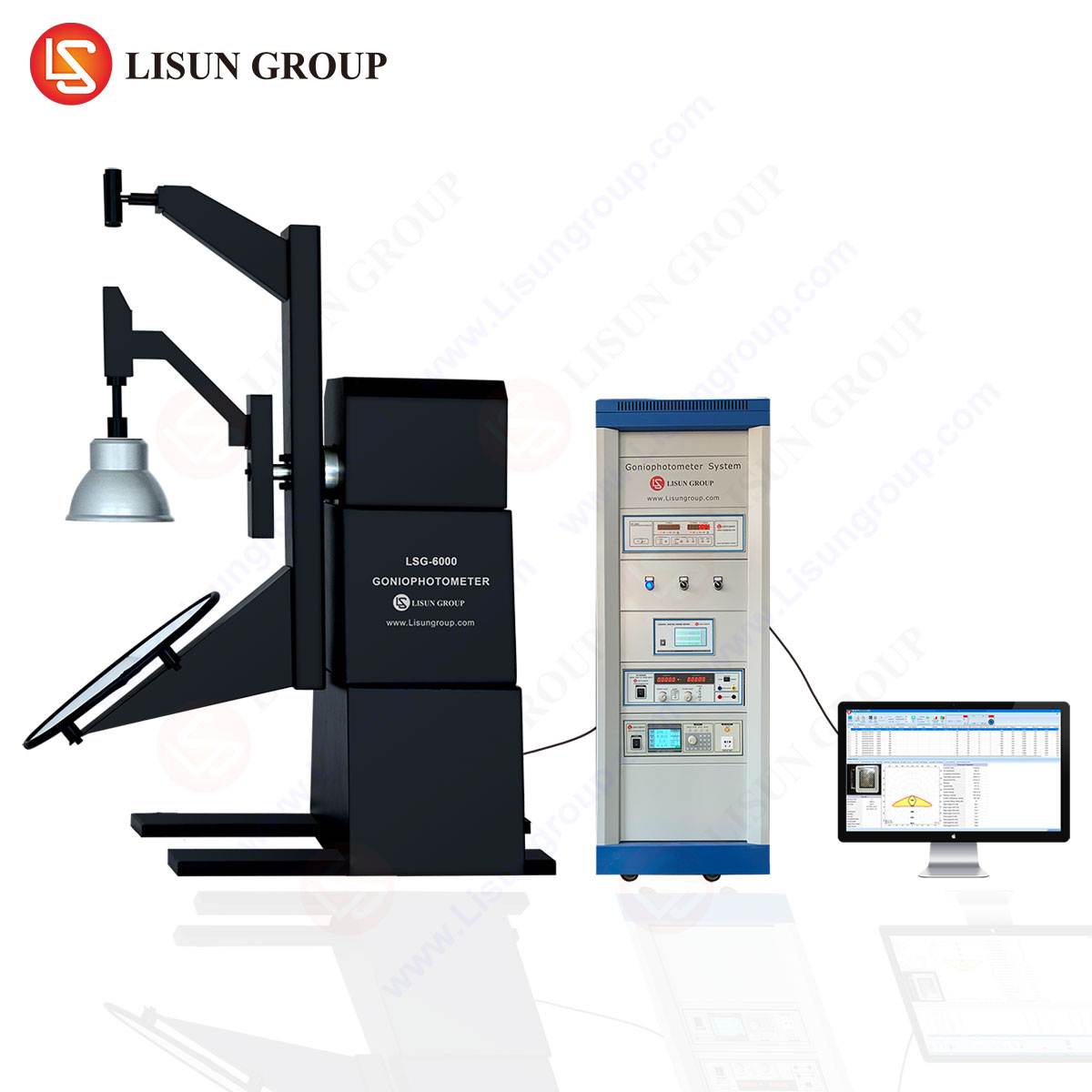
The LSG-6000 Goniophotometer Test System exemplifies the application of this principle for high-precision testing. This system employs a Type C, moving-detector, variable-distance configuration, which is advantageous for testing large luminaires and ensuring accurate photometry at far-field conditions. The system’s architecture consists of a robust mechanical arm that pivots the photodetector around the fixed light source across a vertical plane, while the entire detector assembly rotates horizontally. This dual-axis motion allows for the collection of data across the full sphere. The LSG-6000 is engineered with a large working distance to comply with the far-field measurement criteria stipulated in standards like IES LM-79 and IEC 60598, which require the detector to be at a distance of at least five times the maximum dimension of the luminaire to approximate a point source.
Key Specifications of the LSG-6000:
- Measurement Geometry: Type C (Moving Detector, Variable Distance)
- Luminous Intensity Range: 0.001 to 2,000,000 cd
- Total Luminous Flux Range: 0.1 lm to 2,000,000 lm
- Angular Resolution: Up to 0.1°
- Goniometer Radius: Variable, typically configurable for specific far-field requirements
- Compliance Standards: IEC 60598-1, IES LM-79, IES LM-63, EN 13032-1, CIE 121, CIE S025, and ANSI C78.377.
The testing principle relies on a coordinated motion control system and a high-dynamic-range spectroradiometer or photometer. As the detector moves, it captures intensity values at predefined angular intervals. The resulting data set is processed to generate a wide array of photometric reports, including Isocandela plots, polar diagrams, and 3D luminous intensity distributions. This is indispensable for industries such as Urban Lighting Design, where the light pollution and spill-light characteristics of a streetlamp must be precisely modeled, and for Stage and Studio Lighting, where the beam profile and field angle of a spotlight are paramount to its performance.
Total Luminous Flux Measurement via Integrating Spheres
In contrast to the spatial analysis provided by a goniophotometer, the integrating sphere is a device designed for measuring the total radiant or luminous flux from a light source. The principle is based on the creation of a uniform, diffuse radiance field within a spherical cavity. The interior surface is coated with a highly reflective, spectrally neutral diffuse material, such as Barium Sulfate (BaSO4) or Polytetrafluoroethylene (PTFE). When a light source is placed inside the sphere, its light undergoes multiple diffuse reflections, resulting in a uniform illuminance on the sphere’s inner wall. A baffle, positioned between the source and the detector port, prevents first-reflection light from directly striking the detector. The detector, typically a spectroradiometer, then measures this uniform illuminance, which is directly proportional to the total flux emitted by the source.
This method is exceptionally fast and is widely used for production-line testing and rapid spectral analysis. However, its accuracy is contingent on several correction factors, most notably the self-absorption effect. Since the object being measured displaces a portion of the sphere’s reflective surface, it alters the sphere’s multiplier constant. This necessitates the use of an auxiliary lamp and a calibrated reference standard to determine and apply a correction factor, as detailed in standards like CIE 84 and IES LM-78.
Comparative Analysis of Measurement Methodologies
The choice between a goniophotometer and an integrating sphere is a strategic one, dictated by the required data and application context.
| Parameter | Goniophotometer | Integrating Sphere |
|---|---|---|
| Primary Output | Spatial intensity distribution, beam angle, far-field pattern | Total luminous flux, spectral power distribution, chromaticity |
| Measurement Speed | Slow (hours for high-resolution scans) | Fast (minutes) |
| Accuracy for Total Flux | Very High (direct measurement) | High (requires self-absorption correction) |
| Suitability for Directional Sources | Excellent | Good, but requires careful procedure |
| Application Focus | R&D, Design Validation, Regulatory Compliance | Quality Control, Production Batch Testing, Spectral Analysis |
| Industry Use Case | Automotive Headlamp design, Display Equipment backlight uniformity analysis | LED & OLED Manufacturing binning, Sensor calibration |
For Scientific Research Laboratories and Optical Instrument R&D, the goniophotometer’s ability to provide full spatial data is invaluable for developing new optical systems and validating theoretical models of light propagation. Conversely, in Photovoltaic Industry applications, a spectroradiometer coupled with an integrating sphere is used to measure the total spectral flux of a solar simulator to ensure its spectrum matches the AM1.5G standard.
Industry Applications and International Standards Compliance
The LSG-6000 system is engineered to meet the rigorous demands of global markets, adhering to a comprehensive suite of international standards. This compliance is not merely a feature but a fundamental requirement for manufacturers exporting products worldwide.
- Lighting Industry & LED Manufacturing: For compliance with the European Union’s ERP Directive and ENERGY STAR® program in the United States, the LSG-6000 performs testing per IEC 62301 for standby power and IES LM-79 for electrical and photometric measurements. Its data is used to generate the photometric data files (IES/LDT) required by lighting design software.
- Medical Lighting Equipment: The accurate spatial distribution data is critical for ensuring compliance with standards such as IEC 60601-2-41 for surgical luminaires, which specifies requirements for field diameter, depth of illumination, and shadow dilution.
- Display Equipment Testing: The system can characterize the angular luminance and color uniformity of displays and their backlight units (BLUs), essential for meeting the specifications of standards like ISO 9241-307 for visual display requirements.
The system’s competitive advantages lie in its high-precision motion control, which minimizes vibration for stable readings, its software that automates complex standard-specific test sequences, and its robust construction that ensures long-term measurement repeatability. This makes it a preferred tool for national metrology institutes and third-party testing laboratories that require auditable and traceable measurement data.
Advanced Data Outputs and Photometric Reporting
The raw data acquired by a system like the LSG-6000 is processed into a multitude of critical photometric and colorimetric parameters. Beyond basic polar curves, the software generates EULUMDAT and IES files, which are the de facto standards for architectural and outdoor lighting simulation software. It calculates efficacy in lumens per watt (lm/W), color coordinates (CIE 1931 x,y and CIE 1976 u’v’), correlated color temperature (CCT), and color rendering index (CRI). Furthermore, for Urban Lighting Design, it can calculate illuminance and luminance grids on virtual surfaces, enabling designers to predict the performance of a luminaire in its intended environment before installation. For the Stage and Studio Lighting industry, parameters such as beam angle (to 50% intensity) and field angle (to 10% intensity) are automatically derived, providing critical performance metrics for lighting designers.
Frequently Asked Questions
What is the primary distinction between a Type A, Type B, and Type C goniophotometer?
The classification refers to the axis of rotation. Type A rotates the luminaire about a vertical axis (for azimuth) and a horizontal axis (for elevation), which is suitable for symmetrical sources. Type B rotates about a vertical and a horizontal axis tilted by 90 degrees. The LSG-6000 is a Type C system, where the luminaire remains stationary and the detector moves about two horizontal axes. This is ideal for large, heavy, or thermally sensitive luminaires whose photometric properties might change with orientation.
Why is self-absorption correction necessary in integrating sphere measurements, and is it required for goniophotometers?
Self-absorption correction is required because the test sample absorbs a portion of the light reflected within the sphere, altering the sphere’s efficiency. This effect must be quantified using an auxiliary lamp and a reference standard. Goniophotometers, which measure flux by direct angular integration in a large, open space, do not suffer from this effect and thus do not require such a correction.
Can the LSG-6000 system be used to test the spectral and colorimetric properties of a light source?
Yes, the system is typically equipped with a high-precision array spectroradiometer mounted on the moving detector arm. This allows it to capture not only photometric intensity at each angle but also the full spectral power distribution. Consequently, it can generate spatial maps of CCT, CRI, and chromaticity coordinates (Duv), which are essential for evaluating color consistency across the beam of a luminaire.
How does the LSG-6000 ensure measurement accuracy for luminaires with significant thermal dependence?
The system is designed to allow the luminaire to be powered and stabilized at its rated operating conditions during the test. Since the luminaire remains stationary in a Type C configuration, its thermal characteristics are not artificially influenced by movement. The test software includes stabilization monitoring, only initiating the scan once the photometric output has reached a steady state, as defined by relevant standards.
