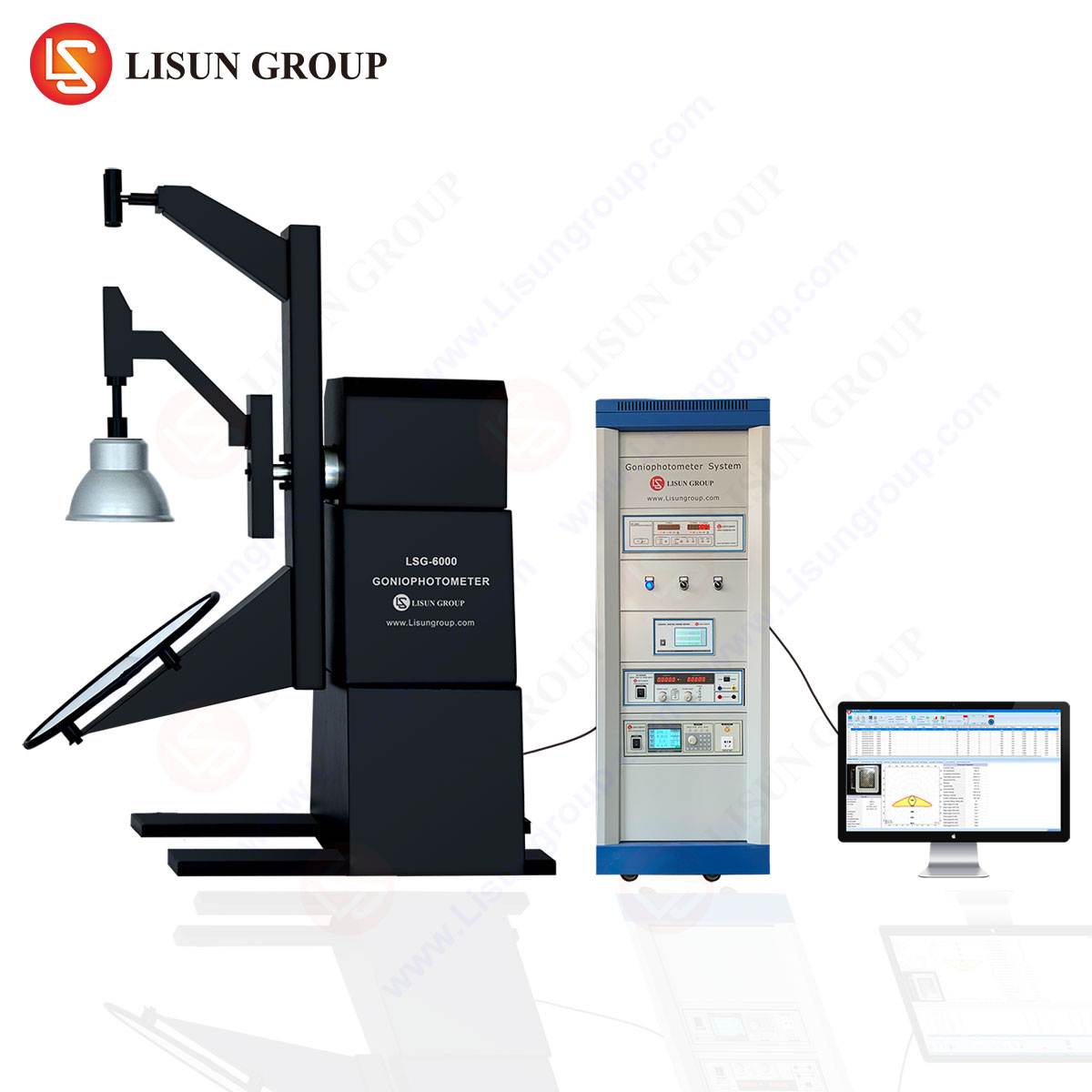



Understanding Goniophotometer Variants for Lighting Measurement
Introduction to Photometric Spatial Distribution Analysis
The accurate characterization of a luminaire’s luminous intensity distribution is a fundamental requirement across numerous scientific and industrial disciplines. A goniophotometer serves as the primary instrument for this task, enabling the precise measurement of luminous flux, intensity distribution, and derived photometric quantities by rotating the device under test (DUT) through spherical coordinate angles. The selection of a specific goniophotometer variant is dictated by the DUT’s physical characteristics, required measurement accuracy, applicable standards, and operational efficiency needs. This analysis delineates the principal variants, their operational principles, and their alignment with international standardization frameworks, with particular reference to the implementation exemplified by the LISUN LSG-1890B goniophotometer system.
Architectural Classifications: Type C versus Type B Goniophotometry
Goniophotometers are architecturally classified under two principal schemes defined by CIE 70: The Measurement of Absolute Luminous Intensity Distributions and subsequent standards like IEC 61341:2010. The classification hinges on the coordinate system used for rotating the luminaire.
A Type C system employs a photometer that moves along a meridian (constant C-plane) while the luminaire rotates about its vertical axis (γ-axis). This configuration is historically prevalent and often utilized for smaller, rotationally symmetric luminaires. The movement traces circles of latitude on the imaginary sphere surrounding the DUT.
Conversely, a Type B system rotates the luminaire about its horizontal axis (β-axis, tilt) and its vertical axis (γ-axis, rotation). The photometer remains stationary. This architecture is frequently preferred for larger, asymmetrical, or heavy luminaires, as it typically requires less physical space for the DUT’s movement arc and can simplify the mechanical support structure. The LSG-1890B is engineered as a Type B system, offering a robust solution for testing large-scale commercial and industrial luminaires, streetlights, and high-bay fixtures where maintaining the DUT’s orientation relative to gravity (e.g., for thermal management simulation) is often critical.
Mechanical Implementation: The Mirror Goniophotometer Paradigm
A significant evolution in goniophotometer design is the incorporation of a moving mirror. In this paradigm, the luminaire remains stationary, while a highly reflective, spectrally neutral mirror rotates around it on a multi-axis gantry. A fixed, high-precision photometer or spectroradiometer measures the light reflected from this mirror. This design, often seen in Type C mirror configurations, presents distinct advantages: it eliminates errors induced by moving the DUT’s power and data cables, ensures stable thermal conditions during measurement, and is indispensable for testing luminaires with directional thermal dependencies, such as certain high-power LEDs or OLED panels. While the LSG-1890B utilizes a direct-moving luminaire (Type B) approach optimized for its target applications, understanding the mirror-based variant is essential for applications in Optical Instrument R&D and Scientific Research Laboratories, where absolute thermal stability during measurement is non-negotiable.
Dimensional and Operational Scale: Bench-Top versus Large-Scale Systems
The physical scale of the goniophotometer is a direct function of its intended application domain. Bench-top systems are designed for small light sources, LED modules, sensor and optical components (e.g., lenses, diffusers), and display equipment backlight units. They offer high-speed measurement in a controlled, compact environment, adhering to standards like IEC 61341 for intensity distributions.
Large-scale systems, such as the LSG-1890B, are engineered for complete, fully integrated luminaires. Key specifications for these systems include a large photometric distance (e.g., 5m, 10m, or greater) to satisfy the far-field condition, and a substantial load capacity for heavy fixtures. The LSG-1890B, for instance, features a photometric distance of 5m, 8m, or 10m, with a load capacity of 50kg on its main rotation axis and 30kg on its auxiliary axis. This capacity accommodates products from the Lighting Industry and Urban Lighting Design, such as roadway luminaires, floodlights, and architectural lighting fixtures, which must be tested per standards including ANSI/IESNA LM-79, EN 13032-1, and IES LM-63.
The Integration of Spectroradiometric Capabilities
Modern advanced goniophotometers transcend basic photometry by integrating spectroradiometers. This transforms the system into a goniospectroradiometer, capable of measuring the complete spectral power distribution (SPD) at each angular position. This capability is paramount for calculating colorimetric quantities—chromaticity coordinates (CIE x,y; u’,v’), Correlated Color Temperature (CCT), and Color Rendering Index (CRI)—as a function of angle. This is critical for:
- LED & OLED Manufacturing: Assessing spatial color uniformity and angular color shift.
- Medical Lighting Equipment: Validating spectral distribution requirements for surgical or therapeutic lights across the field.
- Stage and Studio Lighting: Ensuring consistent color output across beam angles.
- Photovoltaic Industry: Characterizing the angular emission of solar simulators and LED-based light sources for panel testing.
Systems like the LSG-1890B can be equipped with array spectroradiometers, enabling rapid, high-resolution spectral capture at each goniometric position, compliant with standards such as IEC 62663 (LED light sources) and IES TM-30 (color rendition).
Data Acquisition Modalities: Scanning versus Imaging
The method of data capture defines system speed and application suitability. Traditional scanning goniophotometers measure light intensity point-by-point as the DUT or mirror moves incrementally. This method offers high dynamic range and precision, suitable for Scientific Research Laboratories and standards development.
Imaging goniophotometers (or camera-based systems) utilize a CCD or CMOS camera with a fish-eye or telecentric lens to capture a wide angular distribution of light from a single fixed DUT position. While potentially faster for certain applications, they may trade off absolute photometric accuracy and dynamic range. The LSG-1890B employs a high-precision scanning methodology, ensuring traceable accuracy for regulatory and certification purposes, which is a fundamental requirement for compliance testing against international and national standards.
Application-Specific Analysis: The LISUN LSG-1890B Goniophotometer System
The LISUN LSG-1890B exemplifies a large-scale, Type B, scanning goniophotometer designed for comprehensive photometric and colorimetric evaluation of full-scale luminaires. Its design philosophy centers on versatility, precision, and adherence to global compliance frameworks.
Technical Specifications and Testing Principles
The system operates on the moving luminaire, stationary detector (Type B) principle. The DUT is mounted on a dual-axis robotic arm, performing precise rotations in β (0° to 360°) and γ (0° to 180° or 360°) angles. A photometer or spectroradiometer is fixed at a defined photometric distance. The system software coordinates mechanical movement with synchronous light measurement, constructing a complete spatial intensity matrix. Key specifications include an angular resolution as fine as 0.1°, a wide dynamic measurement range facilitated by auto-ranging photometers, and software that directly calculates total luminous flux, efficacy, intensity distribution curves (LID), and iso-candela/iso-lux diagrams.
Standards Compliance and Industry Use Cases
The LSG-1890B is engineered to facilitate testing in accordance with a multitude of international and national standards, including:
- IEC 61341:2010: Method of measurement of center beam intensity and beam angle(s) of reflector lamps.
- IESNA LM-79: Approved Method for the Electrical and Photometric Testing of Solid-State Lighting Products.
- EN 13032-1: Light and lighting – Measurement and presentation of photometric data of lamps and luminaires.
- CIE S025/E:2015: Test Method for LED Lamps, Luminaires and Modules.
- ANSI C82.77 & DOE ENERGY STAR: For harmonic current emissions and luminaire efficacy reporting.
- AS/NZS, JIS, and other national standards for regional market access.
This standards alignment supports diverse industry applications:
- Urban Lighting Design & Lighting Industry: Generating IES/LDT files for lighting simulation software to design roadways, tunnels, and public spaces.
- LED & OLED Manufacturing: Quality control of spatial light output and color consistency for high-value commercial luminaires.
- Scientific Research Laboratories: Studying the photometric performance of novel optical designs and materials.
Competitive Advantages in Operational Context
The LSG-1890B system presents several distinct operational advantages. Its Type B architecture with a large load capacity is optimally suited for the heaviest and bulkiest luminaires common in industrial and outdoor applications. The integration of spectroradiometry as a core option provides future-proofing for increasingly stringent color quality metrics. Furthermore, the system’s software typically includes advanced features for automatic calculation of zonal lumens, luminance limitations (as per roadway lighting standards), and direct export to standard file formats (IES, EULUMDAT, CIE), streamlining the workflow from laboratory to application design.
Considerations for System Selection and Implementation
Selecting an appropriate goniophotometer variant requires a systematic evaluation. Key decision parameters include the maximum size and weight of the DUT, the required photometric distance to achieve far-field conditions (typically 5x the largest luminaire dimension), the necessity of spectral data, the required measurement speed versus accuracy, and the specific standards mandated for the target markets. Environmental control—maintaining a stable ambient temperature—is also critical for repeatable measurements, especially for LED-based products whose output is temperature-sensitive. The infrastructure, including a darkroom with non-reflective surfaces and a stable power supply, forms an integral part of a reliable measurement facility.
Conclusion
Goniophotometry remains an indispensable technology for the objective quantification of light’s spatial behavior. The evolution from simple Type C photometers to sophisticated, spectrally enabled Type B and mirror-based systems reflects the increasing complexity and performance demands of modern light sources across industries from biomedical to entertainment. A system such as the LISUN LSG-1890B, with its specific alignment to large-luminaire testing within rigorous international standardization frameworks, demonstrates how engineered variants of this core technology meet the precise and varied needs of global lighting development, quality assurance, and regulatory compliance.
FAQ Section
Q1: What is the primary difference between a Type B and Type C goniophotometer, and why would I choose the LSG-1890B (Type B) for streetlight testing?
A1: The primary difference is the axis about which the luminaire first rotates. A Type B system rotates the luminaire about its horizontal (tilt) axis, which often corresponds more intuitively to how a streetlight is aimed in practice. The Type B architecture, as used in the LSG-1890B, typically requires less ceiling height for the same photometric distance and maintains the luminaire’s natural orientation relative to gravity throughout most of the measurement, promoting thermal stability. This makes it mechanically advantageous and thermally representative for testing large, heavy outdoor luminaires.
Q2: Can the LSG-1890B measure the Color Rendering Index (CRI) and other color metrics at different viewing angles?
A2: Yes, when equipped with the optional integrated array spectroradiometer, the system becomes a goniospectroradiometer. It captures the full spectral power distribution at each angular measurement point. The software subsequently calculates angular-dependent colorimetric data, including CIE chromaticity coordinates, Correlated Color Temperature (CCT), CRI (Ra), and the more modern IES TM-30 (Rf, Rg) metrics, which is essential for evaluating spatial color uniformity in high-quality LED luminaires.
Q3: Which international standards can be complied with using the data generated by the LSG-1890B?
A3: The system is designed to perform tests in accordance with numerous key standards, including IEC 61341, IESNA LM-79, CIE S025, EN 13032-1, and ANSI standards referenced by the DOE ENERGY STAR program. The output data (IES, LDT files) is directly usable for lighting design simulations compliant with global engineering practices. It is imperative for the operator to ensure the test setup (photometric distance, ambient conditions) and procedures adhere strictly to the specific requirements of the target standard.
Q4: What are the infrastructure requirements for installing a large-scale goniophotometer like the LSG-1890B?
A4: Key requirements include a dedicated darkroom with dimensions significantly larger than the photometric distance (e.g., for a 10m system, a room length of >15m is typical) to allow for equipment and baffles. Walls, ceiling, and floor should have non-reflective, matte black finishes. A stable, vibration-isolated foundation is crucial. Environmental control (temperature stability of ±1°C or better) is necessary for repeatable LED measurements. A clean, stable AC power supply with appropriate grounding is also essential.
Q5: How is total luminous flux derived from goniophotometric measurements, and is it comparable to measurements from an integrating sphere?
A5: Total luminous flux (in lumens) is calculated by mathematically integrating the measured luminous intensity over the entire 4π steradian solid sphere. This is considered an absolute, direct method of flux measurement. It is comparable to integrating sphere measurements but is often preferred for large, directional, or thermally sensitive luminaires because it measures the luminaire in its operational orientation and allows for thermal stabilization in free air, avoiding the thermal and spatial constraints of a sphere. Discrepancies between the two methods can inform understanding of thermal and optical effects.