


The Role of Goniophotometry in Quantifying LED Luminaire Performance
The accurate characterization of light distribution is a cornerstone of modern photometric science. As solid-state lighting technologies, particularly Light Emitting Diodes (LEDs), continue to dominate the global lighting market, the need for precise and comprehensive performance data has never been greater. Unlike traditional incandescent or fluorescent sources, LEDs are inherently directional and their optical performance is critically dependent on complex secondary optics, thermal management, and driver electronics. A goniophotometer serves as the principal instrument for obtaining the complete spatial luminous intensity distribution of a luminaire, providing data that is indispensable for design validation, regulatory compliance, and application-specific performance prediction. This article delineates the functional principles of goniophotometry, with a specific examination of the LISUN LSG-6000 system, and explores its multifaceted applications across diverse technological sectors.
Fundamental Principles of Spatial Light Measurement
A goniophotometer functions by rotating a luminaire through a series of spherical coordinates—typically azimuth (C-plane) and elevation (γ-plane)—while a fixed, spectrally calibrated photodetector measures luminous intensity at each discrete angular position. This process maps the luminaire’s luminous intensity distribution, effectively creating a three-dimensional “fingerprint” of its light output. The foundational principle is governed by the inverse square law, which states that the illuminance (E) at a point on a surface is proportional to the luminous intensity (I) of the source in that direction and inversely proportional to the square of the distance (d) between the source and the point: E = I / d². By maintaining a sufficiently large fixed distance between the luminaire under test and the detector, the instrument ensures that the measurement is performed in the photometric far-field, where the luminaire can be treated as a point source.
The raw data collected, known as the Intensity Distribution Curve, is subsequently processed to derive all other critical photometric parameters. These include total luminous flux (in lumens), luminaire efficacy, zonal lumen distribution, coefficients of utilization (CU), and glare indices. The accuracy of these derived quantities is entirely contingent upon the precision and angular resolution of the goniophotometric measurements.
Architectural Configuration of a Modern Goniophotometer System
Modern goniophotometers are categorized by their mechanical configuration, which directly influences their measurement capabilities, throughput, and suitability for different luminaire types. The two primary architectures are the Type C and Type B systems. In a Type C system, the luminaire rotates around its vertical and horizontal axes, while the detector remains stationary. This configuration is well-suited for luminaires whose light distribution is referenced to the luminaire itself, such as streetlights and downlights. Conversely, in a Type B system, the luminaire rotates around its horizontal axis and the entire structure rotates in azimuth, keeping the detector’s orientation relative to gravity constant. This is advantageous for measuring sources whose performance is gravity-dependent, such as certain HID lamps or pendent luminaires.
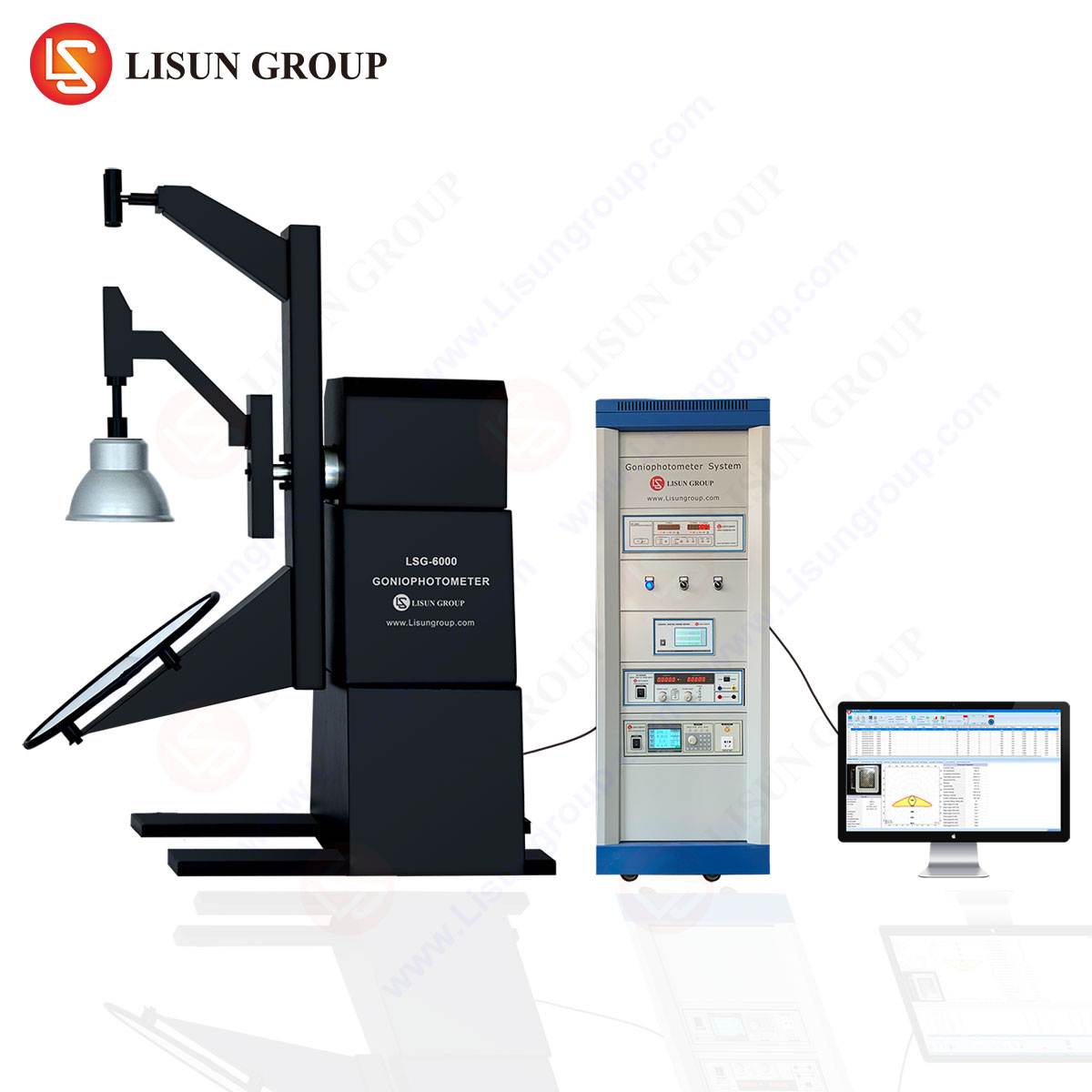
The LISUN LSG-6000 is a state-of-the-art moving-detector Type C goniophotometer, a design optimized for high-precision testing of LED luminaires. Its robust construction features a large integrating sphere or a planar mirror photometer system for the detector, which traverses a circular path around the test sample. This design minimizes the moment of inertia associated with moving the test luminaire, a critical factor when testing heavy or bulky fixtures common in commercial and industrial lighting. The system’s rigid mechanical arm ensures that the detector maintains a constant distance and alignment throughout the rotation, a prerequisite for measurement integrity.
The LSG-6000 Goniophotometer: System Specifications and Operational Workflow
The LISUN LSG-6000 is engineered to meet the rigorous demands of international testing standards, including IEC 60598-1, IEC 60529, IES LM-79-19, and EN 13032-1. Its design incorporates features that address the specific challenges of LED testing, such as thermal stability and fast measurement cycles.
Key Specifications of the LSG-6000:
- Measurement Distance: Configurable for 5m, 10m, 15m, 20m, or 30m, accommodating various luminaire sizes and ensuring far-field conditions.
- Angular Resolution: High-precision encoders enable a resolution of up to 0.001°, allowing for the capture of fine details in the intensity distribution.
- Luminous Flux Range: Capable of measuring from 0.001 lm to 2,000,000 lm, covering everything from miniature indicator LEDs to high-bay industrial lighting systems.
- Detector System: Utilizes a high-sensitivity, spectrally corrected silicon photodiode coupled with a V(λ) filter to match the CIE standard photopic observer function. The system can be integrated with a spectroradiometer for full chromaticity measurements (CCT, CRI, Duv).
- Software Control: A comprehensive software suite automates the measurement process, data acquisition, and report generation, providing outputs in standardized formats such as IES (.ies) and EULUMDAT (.ldt) files.
The operational workflow begins with the secure mounting and thermal stabilization of the luminaire. For LEDs, it is critical to operate the device at its rated thermal and electrical conditions, as specified in standards like IES LM-80 and TM-21. The LSG-6000 system interfaces with a programmable DC power supply or an AC source to provide the specified drive conditions. Once stabilized, the automated scan initiates. The detector arm sweeps across the predefined spherical coordinates, capturing intensity data at high angular density. The software then constructs the 3D model, corrects for background noise, and computes all derived photometric values.
Adherence to International Standards for Compliance and Benchmarking
Compliance with international standards is not merely a regulatory hurdle but a guarantee of data consistency, repeatability, and comparability across different laboratories and manufacturers. The LSG-6000 is designed to facilitate testing in accordance with a comprehensive suite of global standards.
- IEC 60598-1: This standard covers the general requirements and tests for luminaires. Goniophotometric data is essential for verifying safety and performance claims related to light output and distribution.
- IES LM-79-19: An approved method for the electrical and photometric testing of solid-state lighting products. It mandates the use of goniophotometry for measuring total luminous flux and spatial distribution of luminaires.
- EN 13032-1: The European standard for the measurement and presentation of photometric data for luminaires, which specifies the requirements for goniophotometer accuracy and measurement procedures.
- ANSI/IES RP-16-17: Provides the nomenclature and definitions for illuminating engineering, forming the terminological basis for all photometric reporting.
By adhering to these standards, data generated by the LSG-6000 is recognized by certification bodies such as UL, DLC (DesignLights Consortium), and Energy Star in North America, and by CE-marking authorities in Europe, thus enabling global market access for lighting products.
Cross-Industry Applications of Goniophotometric Data
The utility of goniophotometry extends far beyond basic lumen output verification, enabling innovation and quality assurance across numerous high-technology fields.
Lighting Industry and LED Manufacturing: This is the primary application, where goniophotometers are used for R&D, quality control, and production batch testing. Manufacturers use the data to optimize optical designs for efficiency and specific beam patterns, ensuring product consistency and performance claims are met.
Display Equipment Testing: For backlight units (BLUs) in LCDs and the pixel-level performance of OLED displays, goniophotometry is used to measure viewing angle characteristics, including luminance uniformity, color shift, and contrast ratio at off-axis angles. This is critical for ensuring a high-quality visual experience.
Urban Lighting Design: In street and architectural lighting, goniophotometric data is used in lighting design software (e.g., DIALux) to simulate installations. This allows designers to predict and optimize illuminance levels on roadways, minimize light trespass, and control obtrusive light, ensuring compliance with standards such as ANSI/IES RP-8 for roadways.
Stage and Studio Lighting: The performance of profile spots, fresnels, and wash lights is defined by their beam shape, field angle, and falloff. Goniophotometers provide the precise data needed to create photometric data files that are used in pre-visualization software, allowing lighting designers to plan complex shows virtually.
Medical Lighting Equipment: Surgical and diagnostic lighting requires extremely specific photometric properties, including high illuminance with low shadowing and strict limits on UV/IR radiation. Goniophotometric verification ensures these critical devices meet the stringent requirements of standards like IEC 60601-2-41.
Photovoltaic Industry and Sensor Production: While not for emitted light, goniophotometers are adapted to measure the angular response of photovoltaic cells and optical sensors. Understanding how a sensor’s responsivity varies with the angle of incident light is vital for calibrating environmental light sensors, IR receivers, and for optimizing the performance of solar panel arrays.
Comparative Advantages of the LSG-6000 in a Competitive Landscape
The LSG-6000 system incorporates several design and functional features that confer distinct advantages in operational efficiency, measurement accuracy, and application versatility.
- Thermal Management Integration: Recognizing that LED performance is highly temperature-sensitive, the LSG-6000 is designed to integrate with temperature monitoring systems. It can trigger measurements only after the luminaire’s case or solder point temperature has reached a stable state, as per IES guidelines, ensuring data reflects real-world performance.
- High-Speed Automated Operation: The system’s servo motors and optimized motion control algorithms enable rapid positioning and scanning. This high throughput is essential for production environments where time-to-data is a critical factor, without compromising the precision required for R&D applications.
- Versatile Fixturing and Power Integration: The system accommodates a wide range of luminaire sizes, shapes, and weights. Its integrated power supply interface allows for automated control of drive current/voltage, enabling sophisticated testing protocols like lumen maintenance projections and flicker analysis.
- Comprehensive Data Output and Traceability: The software does not merely generate standard IES files; it provides deep-dive analytical tools for evaluating beam symmetry, far-field simulations, and compliance with specific zonal lumen requirements for standards like DLC. All data is tagged with environmental and electrical conditions, ensuring full traceability.
FAQ Section
What is the required stabilization time for an LED luminaire before testing on the LSG-6000?
Stabilization time is not fixed; it is determined by the thermal mass and design of the luminaire. The LSG-6000 should be used in conjunction with a temperature monitoring system. Testing should commence only after the luminaire’s critical temperature, as defined by the standard or specification, has stabilized to within ±2°C over a 15-minute interval, typically requiring 30 minutes to several hours.
Can the LSG-6000 measure the flicker percentage of a luminaire?
Yes, when equipped with a high-speed photodetector and the appropriate software module, the LSG-6000 can capture temporal light output waveforms. This allows for the calculation of flicker metrics such as percent flicker and flicker index, in accordance with standards like IEEE 1789.
What file formats does the system generate, and how are they used?
The primary output formats are IES (Illuminating Engineering Society) and EULUMDAT (European standard). These files contain the complete spatial intensity distribution data and are imported into lighting design and simulation software (e.g., DIALux, Relux, AGi32) to create accurate photometric visualizations and performance calculations for real-world lighting layouts.
How does the system handle the measurement of very narrow beam angle luminaires?
For luminaires with extremely narrow beam distributions (e.g., < 5°), the LSG-6000's high angular resolution (up to 0.001°) is critical. The measurement protocol involves increasing the angular sampling density within the critical beam region to accurately capture the peak intensity and the steep falloff at the beam's edge, ensuring the generated distribution file is a faithful representation.