


A Comprehensive Technical Examination of the Type C Goniophotometer for Precision Photometric Characterization
Abstract
The accurate measurement of luminous flux is a cornerstone of photometric science, essential for quantifying the performance and efficiency of lighting products. The goniophotometer, an instrument designed for this purpose, measures the spatial distribution of light intensity from a source. Among the various classifications, the Type C goniophotometer, characterized by its moving detector and fixed lamp geometry, represents a highly precise and versatile configuration. This article provides a detailed technical analysis of the Type C goniophotometer, with a specific focus on the implementation and capabilities of the LISUN LSG-6000 system. We will explore its operational principles, adherence to international standards such as IEC, CIE, and IESNA, and its critical applications across diverse industries including LED manufacturing, optical R&D, and urban lighting design.
Fundamental Principles of Type C Goniophotometry
Type C goniophotometry is defined by the coordinate system it employs, as standardized by the International Commission on Illumination (CIE). In a Type C system, the photometer (detector) moves along a path that traces lines of longitude (C-planes) on an imaginary sphere surrounding the light source under test (LUT). The angles are defined as follows: the vertical angle (γ) ranges from 0° at the nadir to 180° at the zenith, and the horizontal angle (C) ranges from 0° to 360°. The key mechanical distinction is that the LUT remains fixed in position while the detector traverses the spherical surface.
The measurement principle involves moving the detector to a specific (γ, C) coordinate and measuring the illuminance, E(γ, C), at that point. According to the inverse-square law approximation valid for far-field conditions, the luminous intensity, I(γ, C), of the source in that direction is calculated as I(γ, C) = E(γ, C) * r², where r is the distance from the photometric center of the LUT to the detector. By systematically measuring illuminance across the entire sphere, the total luminous flux (Φv) can be computed by integrating the intensity distribution over the solid angle of the sphere. This is mathematically represented as:
Φv = ∫∫ I(γ, C) sin(γ) dγ dC.
This fixed-lamp configuration offers significant advantages for testing heavy, large, or thermally sensitive luminaires, such as high-bay industrial LED fixtures or streetlights, as their orientation and thermal equilibrium remain undisturbed throughout the measurement process.
Architectural and Mechanical Design of the LSG-6000 System
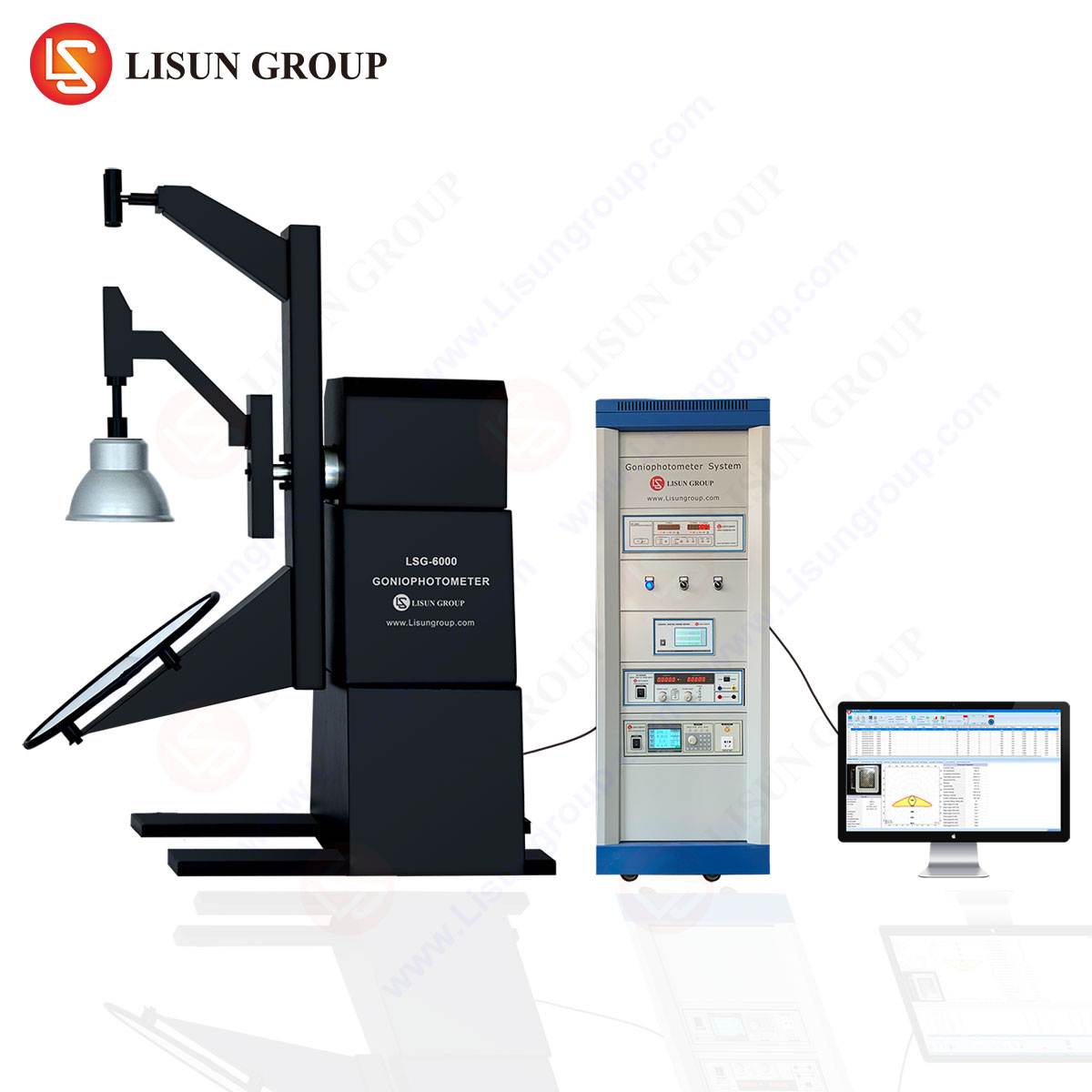
The LISUN LSG-6000 embodies a state-of-the-art implementation of the Type C principle, engineered for maximum precision, operational flexibility, and long-term stability. Its architectural design addresses key challenges in goniophotometry, including vibration dampening, precise angular positioning, and maintaining a constant measurement distance.
The system is constructed around a robust dual-arch framework. A stationary horizontal base arch provides the foundation, while a vertically oriented moving arch rotates around the LUT. The photodetector is mounted on this vertical arch, allowing it to access any point on the measurement sphere. This design ensures that the critical distance r remains constant regardless of the detector’s angular position, a fundamental requirement for accurate intensity calculations. The entire structure is typically manufactured from high-strength, anodized aluminum or steel to minimize deflection and resonance.
Drive systems employ high-precision stepper or servo motors coupled with optical encoders to achieve angular resolutions finer than 0.1°. This level of precision is mandatory for characterizing luminaires with sharp beam cut-offs or complex optical systems. The LSG-6000 is designed with a large photometric distance (e.g., 5 meters, 10 meters, or larger), ensuring measurements are conducted in the photometric far-field, which is critical for compliance with standards like LM-79 and CIE 70. An integrated temperature-controlled chamber or environmental monitoring system is often an optional or integrated feature, allowing for testing under specified ambient conditions (e.g., 25°C ± 1°C) as required by many IEC standards for LED product testing.
Photometric Data Acquisition and Spectral Considerations
The core of the LSG-6000’s measurement capability lies in its photometric detector and data acquisition system. A Class L (or better) photometer head with a V(λ)-corrected filter is standard, ensuring spectral responsivity that closely matches the CIE standard photopic observer. For applications requiring colorimetric data, such as Chromaticity Coordinates (CIE x, y) and Correlated Color Temperature (CCT), a high-resolution spectroradiometer can be integrated into the system.
The data acquisition process is fully automated. The system controller moves the detector to a predefined grid of measurement points. At each point, the signal from the detector is sampled and recorded. The density of this grid is configurable, allowing for a trade-off between measurement speed and angular resolution; a 5° x 5° grid is common for general testing, while a 1° x 1° or finer grid may be used for highly directional sources like spotlights or for detailed optical research. The system software performs real-time calculations to convert the raw illuminance data into luminous intensity values and generates the intensity distribution curve.
For the most accurate measurement of LED sources, which often have a non-continuous spectrum, the use of a spectroradiometer is strongly recommended. This avoids the potential errors associated with spectral mismatch when using a broadband photometer head alone. The LSG-6000’s software can synchronize data from both detectors, providing a comprehensive photometric and colorimetric dataset in a single automated sequence.
Adherence to International Photometric Standards
Compliance with international standards is non-negotiable for any instrument used in product certification or competitive benchmarking. The Type C goniophotometer, and specifically the LSG-6000, is designed to meet or exceed the requirements of a comprehensive suite of global standards.
- IEC Standards: The system is fully compliant with IEC 60598-1 (Luminaires – General requirements and tests) and IEC 60529 (Degrees of protection provided by enclosures – IP Code), as it can test luminaires in their operational orientation. For solid-state lighting, it adheres to IEC 62663 (LED light sources and modules) and the test methods outlined in IEC 62717 (LED modules for general lighting – Performance requirements).
- CIE Publications: The methodology follows CIE 70 (The Measurement of Absolute Luminous Intensity Distributions), which is the foundational document for goniophotometry.
- IESNA Standards: In North America, the system is aligned with IESNA LM-79-19 (Approved Method: Electrical and Photometric Measurements of Solid-State Lighting Products), which mandates the use of goniophotometry for total luminous flux measurement of integrated LED luminaires. It also supports the data format required for IESNA LM-63 (Standard File Format for the Electronic Transfer of Luminaire Photometric Data), enabling the creation of .ies files for lighting simulation software.
- Other National Standards: It conforms to directives such as the European EN 13032-1 (Light and lighting – Measurement and presentation of photometric data of lamps and luminaires) and other regional equivalents like ANSI/IES standards in the United States.
This standards-based approach ensures that data generated by the LSG-6000 is recognized and accepted by testing laboratories, certification bodies, and lighting designers worldwide.
Industrial Applications and Use Cases
The precision and versatility of the Type C goniophotometer make it indispensable across a wide spectrum of industries.
- LED & OLED Manufacturing: Manufacturers use the LSG-6000 for quality control, performance grading (binning), and R&D of new LED packages, modules, and complete luminaires. It is critical for verifying parameters like efficacy (lm/W), spatial color uniformity, and beam shape.
- Urban Lighting Design: For streetlights, area lights, and architectural floodlights, the system provides the data necessary to evaluate glare control, light trespass, and roadway luminance patterns, ensuring compliance with dark-sky ordinances and safety standards like ANSI/IES RP-8.
- Stage and Studio Lighting: Theatrical and broadcast luminaires have complex beam shapes with sharp edges and variable fields. The goniophotometer accurately maps these distributions, providing essential data for lighting designers to plan scenes and for manufacturers to validate product claims.
- Medical Lighting Equipment: Surgical lights and medical examination lamps require extremely uniform illumination with minimal shadowing and strict color rendering indices. The LSG-6000 can verify these critical parameters against standards such as IEC 60601-2-41.
- Optical Instrument R&D and Sensor Production: The instrument is used to characterize the angular output of lasers, lenses, diffusers, and optical sensors, providing vital data for the development of new optical systems and components.
Comparative Advantages of the LSG-6000 Configuration
The LSG-6000’s Type C design confers several distinct competitive advantages over other goniophotometer types (such as Type A or Type B).
- Stable Thermal and Electrical Conditions: By keeping the LUT stationary, the thermal state of the luminaire—especially critical for LED performance—remains consistent throughout the test. There is no risk of altering convective cooling or causing solder joint stress due to movement.
- Ability to Test Large and Heavy Luminaires: The fixed position of the LUT means there are no weight limitations imposed by a moving armature. The LSG-6000 can accommodate very large and heavy products, such as industrial high-mast luminaires weighing over 100 kg.
- Measurement of Luminaires in Operational Orientation: Many luminaires, particularly those with non-symmetrical distributions or liquid coolants, are designed to operate in a specific orientation. The Type C system measures them in this exact orientation, providing the most accurate and representative data.
- High Precision and Reduced Uncertainty: The rigid dual-arch structure minimizes vibration and positional errors. The constant measurement distance simplifies flux calculation and reduces a source of systematic error.
Technical Specifications of the LSG-6000 Goniophotometer
The following table outlines the typical specifications for a standard LSG-6000 configuration.
| Parameter | Specification | Notes |
|---|---|---|
| Goniophotometer Type | Type C (Moving Detector, Fixed Lamp) | Compliant with CIE 70. |
| Photometric Distance | 5m, 10m, or custom | Ensures far-field measurement conditions. |
| Luminaire Size/Weight | Up to 2000mm x 2000mm / 100kg (customizable) | Suitable for large commercial and industrial fixtures. |
| Angular Resolution | ≤ 0.1° | High precision for detailed beam mapping. |
| Angle Accuracy | ± 0.2° | Verified with calibrated reference sources. |
| Detector | Class L (or Class A) Photometer Head, V(λ) corrected. Optional Spectroradiometer. | Ensures accurate photopic measurements. |
| Standards Compliance | IEC, CIE, IESNA LM-79, EN, ANSI, GB | Globally recognized testing methodologies. |
| Software Output | IES File (LM-63), EULUMDAT, CIE, XML | Direct import into major lighting design software (Dialux, Relux, etc.). |
| Measured Quantities | Luminous Flux, Luminous Intensity Distribution, Efficacy, CCT, CRI, Chromaticity Coordinates, Beam Angle, Zonal Lumens. | Comprehensive photometric and colorimetric report. |
Frequently Asked Questions (FAQ)
Q1: What is the primary difference between a Type A and a Type C goniophotometer, and when should I choose the Type C?
A Type A goniophotometer rotates the luminaire around its horizontal and vertical axes (moving lamp), while a Type C rotates the detector around a fixed luminaire. The Type C (LSG-6000) is the preferred choice when testing heavy, large, or thermally sensitive luminaires that must be measured in their operational orientation, such as streetlights or high-bay industrial fixtures. Type A is often used for smaller, symmetrical sources like bare lamps or bulbs.
Q2: Why is a long photometric distance (e.g., 5m or 10m) necessary?
A long distance ensures that the measurement is taken in the “photometric far-field,” where the light waves are approximately planar and the inverse-square law holds true for accurate intensity calculation. For larger luminaires, a longer distance is required to meet the far-field criterion (typically 5 times the maximum dimension of the light-emitting area).
Q3: Can the LSG-6000 measure the absolute luminous flux of an LED lamp without an integrating sphere?
Yes, that is one of its primary functions. A goniophotometer is recognized by standards like IES LM-79 as a primary method for measuring total luminous flux. It does so by integrating the luminous intensity over the entire 4π steradian solid angle. This method can be more accurate than an integrating sphere for luminaires with asymmetric distributions.
Q4: How does the system handle the measurement of colorimetric properties across different angles?
When equipped with an integrated spectroradiometer, the LSG-6000 can measure the spectral power distribution (SPD) at each angular position. This allows for the calculation of angular color uniformity, including CCT and CRI as a function of angle, which is critical for assessing the quality of LED luminaires and display backlighting units.
Q5: What are the critical factors for maintaining the accuracy of the LSG-6000 over time?
Regular calibration of the photometer head against a standard source traceable to a national metrology institute (NMI) is paramount. Additionally, periodic verification of the mechanical angular accuracy and the alignment of the photometric center is essential. The system software typically includes routines to facilitate these verification checks.