








An Examination of the Type A Goniophotometer for Advanced Luminous Flux Measurement in Solid-State Lighting
Abstract
The accurate characterization of the total luminous flux and spatial radiation distribution of light sources is a cornerstone of photometric science. With the proliferation of solid-state lighting (SSL), particularly Light Emitting Diodes (LEDs) and Organic LEDs (OLEDs), the limitations of traditional integrating sphere methods for measuring total luminous flux have become increasingly apparent. These limitations necessitate the use of goniophotometry, the definitive method for determining the total luminous flux of a light source by measuring its luminous intensity distribution in three-dimensional space. This technical article provides a comprehensive analysis of the Type A goniophotometer, with a specific focus on its operational principles, adherence to international standards, and its application across diverse technological fields. A detailed examination of a representative system, the LISUN LSG-6000, will be presented to illustrate the practical implementation of these principles.
Fundamental Principles of Goniophotometric Measurement
Goniophotometry is predicated on the precise measurement of a light source’s luminous intensity as a function of direction. A goniophotometer achieves this by systematically altering the angular position of the light source under test (LUT) relative to a fixed, highly accurate photodetector. The fundamental equation governing this measurement is the integration of the luminous intensity distribution over the entire solid angle of 4π steradians to yield the total luminous flux (Φv):
Φv = ∫ I(θ, φ) dΩ
Where:
- Φv is the total luminous flux in lumens (lm).
- I(θ, φ) is the luminous intensity in candelas (cd) as a function of the vertical angle (θ) and horizontal angle (φ).
- dΩ is the element of solid angle in steradians (sr).
The Type A goniophotometer, as classified by the International Commission on Illumination (CIE) Publication 70 and standardized in IEC 61341:2010, is characterized by the photodetector moving along a circular path around a fixed LUT. This configuration is particularly advantageous for maintaining a constant distance between the detector and the LUT, which simplifies the inverse-square law correction and is exceptionally well-suited for measuring luminaires with significant weight or complex thermal management requirements, as the LUT remains stationary.
Architectural Configuration of a Type A Goniophotometer System
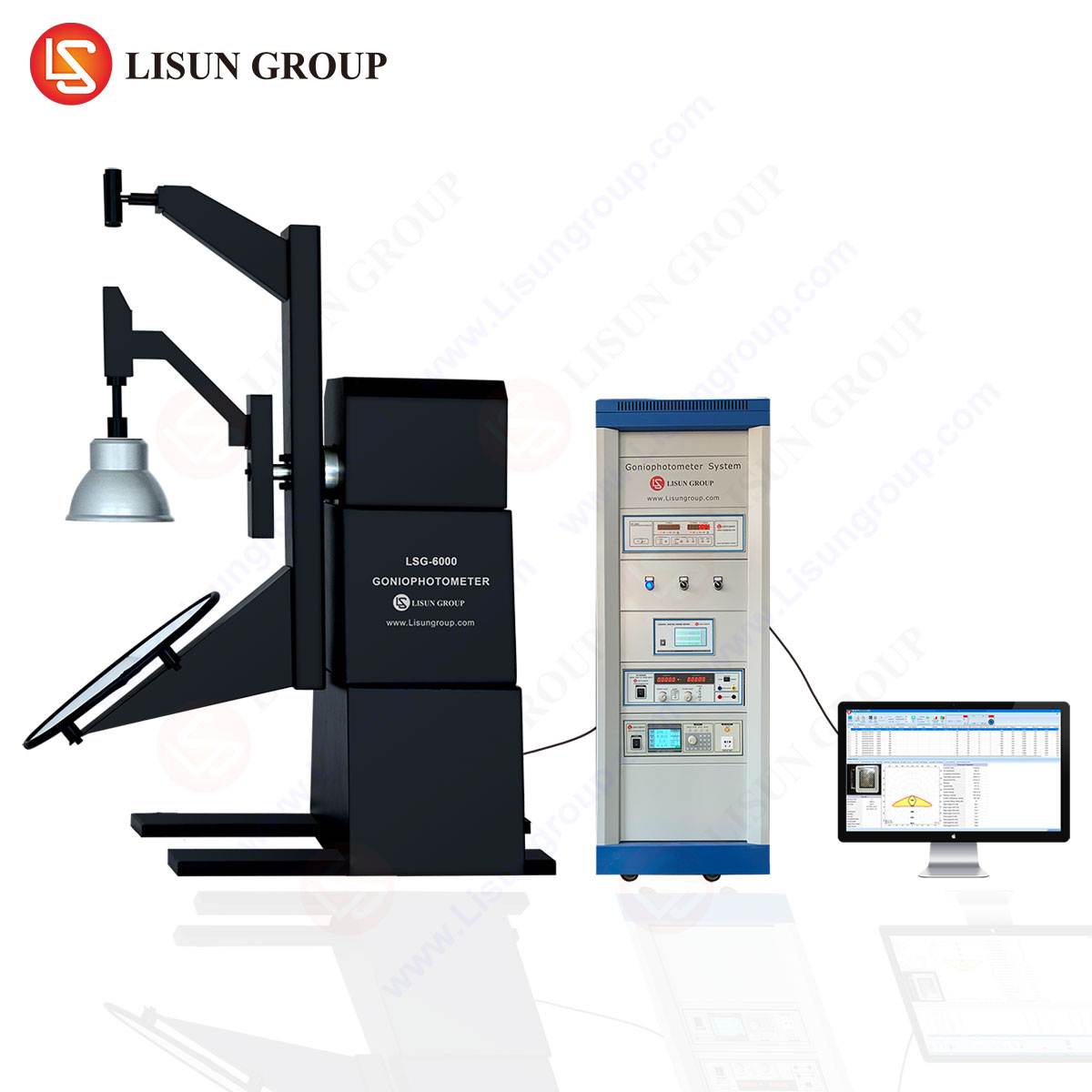
A modern Type A goniophotometer, such as the LISUN LSG-6000, is an integrated system comprising several critical subsystems that work in concert to achieve high-precision measurements. The primary mechanical structure is a robust, machined aluminum or granite arch upon which the photodetector carriage traverses. This arch rotates around a vertical axis (C-axis), defining the γ angle, while the detector moves along the arch, defining the C angle. This dual-axis motion allows for the sampling of the entire 4π steradian spatial distribution.
The photometric detector is typically a high-precision, V(λ)-corrected silicon photodiode connected to a digital photometer. The V(λ) correction ensures the spectral responsivity of the detector matches the CIE standard photopic observer function, a prerequisite for accurate photometric measurements. For applications requiring spectral data, a high-resolution spectroradiometer can be integrated, enabling the measurement of chromaticity coordinates (CIE x, y), correlated color temperature (CCT), and color rendering index (CRI).
The LUT is powered by a programmable, stabilized DC power supply or an AC source, which is crucial for maintaining constant electrical input conditions throughout the potentially lengthy measurement cycle. Environmental control is another critical consideration; the entire system is often housed within a darkened, non-reflective chamber to eliminate the influence of stray light. For LED testing, an optional temperature-controlled mounting fixture may be employed to maintain the LUT at a specific junction temperature, replicating real-world operational conditions.
The LISUN LSG-6000: A System for Reference-Grade Photometry
The LISUN LSG-6000 represents a state-of-the-art implementation of the Type A goniophotometer design, engineered to meet the stringent requirements of international standards such as LM-79-19, IESNA LM-78-20, CIE 121, IEC 61341:2010, and EN 13032-4. Its design prioritizes mechanical stability, measurement accuracy, and operational efficiency for a wide range of lighting products.
Key Specifications of the LSG-6000:
| Parameter | Specification |
|---|---|
| Goniometer Type | Type A (Moving Detector) |
| Measurement Distance | 5m to 30m (customizable) |
| Luminous Intensity Range | 0.001 cd to 2,000,000 cd |
| Angular Resolution | ≤ 0.1° |
| Total Luminous Flux Accuracy | Class L (≤ 3.0%) per CIE 121:1996 / DIN 5032-6 |
| C-Axis (Detector Vertical) | 0° to 360° (or ±180°) |
| γ-Axis (Arch Horizontal) | -180° to +180° (or 0° to 360°) |
| Maximum LUT Weight | 100 kg (standard), higher capacities available |
| Maximum LUT Dimensions | 2000mm x 2000mm x 2000mm (customizable) |
| Photodetector | High-precision, V(λ)-corrected photometer head |
| Spectral Option | Integrated CCD spectroradiometer |
The system’s competitive advantages are derived from its precision engineering. The use of high-torque, low-vibration servo motors coupled with absolute encoders ensures precise and repeatable angular positioning. The rigid arch construction minimizes deflection and vibration, which are critical sources of measurement uncertainty. Furthermore, the system’s software provides comprehensive control, data acquisition, and analysis, automating the measurement process and generating industry-standard reports, including IES (.ies) and EULUMDAT (.ldt) files for lighting design software.
Adherence to International Standards and Metrological Traceability
Compliance with internationally recognized standards is not merely a feature but a fundamental requirement for any instrumentation used in regulatory testing, product certification, and research. The Type A goniophotometer’s design and operational protocols are governed by a suite of standards that ensure measurement consistency and accuracy across global laboratories.
- IEC 61341:2010: This standard specifically addresses the method of measurement of centre beam intensity and beam angles for reflector-type lamps using a goniophotometer.
- IESNA LM-79-19: An approved method for the electrical and photometric testing of SSL products. It explicitly endorses goniophotometry as the preferred method for measuring total luminous flux and spatial distribution of luminaires, as it accounts for self-absorption and thermal effects more accurately than an integrating sphere.
- CIE 121:1996: The seminal guide to the photometry and goniophotometry of luminaires, defining accuracy classes (e.g., Class L) and detailing measurement procedures and uncertainty budgets.
- EN 13032-4: A European standard that specifies the requirements for the measurement of luminous flux and luminous intensity distribution of LED lamps and modules.
The LSG-6000 is calibrated using standards that are traceable to national metrology institutes (NMIs) such as NIST (USA) or PTB (Germany), establishing a direct chain of metrological traceability. This is paramount for laboratories involved in product development and quality assurance for markets in North America, Europe, and other regions with stringent lighting efficiency regulations.
Industrial and Research Applications of Type A Goniophotometry
The versatility of the Type A goniophotometer makes it an indispensable tool across a broad spectrum of industries where precise light measurement is critical.
- LED & OLED Manufacturing: In SSL production, verifying total luminous flux (lumens per watt efficacy) and angular color uniformity is essential. The LSG-6000 can identify spatial variations in chromaticity that are invisible to an integrating sphere, a critical quality metric for high-end LED modules and OLED panels used in display and architectural lighting.
- Display Equipment Testing: For backlight units (BLUs) in LCDs and direct-view LED displays, the spatial luminance distribution directly impacts viewing angle performance. Goniophotometric data is used to optimize optical films and diffuser plates.
- Urban Lighting Design: The design of roadway, area, and architectural luminaires relies on accurate IES files. The LSG-6000 generates these files, which are imported into software like Dialux or Relux to simulate lighting scenes, predict illuminance levels, and ensure compliance with municipal lighting standards (e.g., ANSI/IES RP-8 for roadways).
- Stage and Studio Lighting: The performance of profile spots, Fresnels, and moving head lights is defined by their beam shape, field angle, and falloff. Goniophotometry provides the precise beam data required for lighting designers to plan productions and for manufacturers to validate product specifications.
- Medical Lighting Equipment: Surgical and diagnostic lights have stringent requirements for homogeneous illuminance, shadow reduction, and color rendering. The Type A system can map the illuminance distribution at a simulated operating plane, providing objective data to certify compliance with standards like IEC 60601-2-41.
- Sensor and Optical Component Production: The angular response of photodiodes, light-dependent resistors (LDRs), and other optical sensors can be characterized. Similarly, the transmittance, reflectance, and scattering properties of lenses, filters, and diffusers can be measured as a function of incidence angle.
- Photovoltaic Industry: While primarily for photometry, the system can be configured with a radiometric detector to measure the angular dependence of light emission from photovoltaic modules under electroluminescence (EL) testing, aiding in the detection of micro-cracks and material defects.
- Scientific Research Laboratories: In optical R&D, the system is used to characterize novel light sources, such as lasers with diffusing optics, micro-LED arrays, and advanced light guides, providing foundational data for academic publications and patent applications.
Comparative Analysis with Integrating Sphere Systems
While integrating spheres offer speed and simplicity for measuring the total luminous flux of simple, low-power LED packages, they suffer from significant limitations when applied to complex luminaires. The spatial distribution of the light source can cause errors due to the non-uniform spatial response of the sphere’s internal coating. More critically, the phenomenon of self-absorption—where the luminaire absorbs a portion of its own light—leads to an underestimation of total flux. This error is exacerbated with large, asymmetrical, or thermally massive luminaires. A Type A goniophotometer eliminates these errors by measuring the light output in the far-field, providing a direct and absolute measurement of the luminous intensity distribution from which total flux is calculated, making it the reference method for standardized testing of finished lighting products.
Optimizing Measurement Accuracy and Uncertainty
Achieving high accuracy in goniophotometry requires meticulous attention to numerous factors. The alignment of the LUT’s photometric center with the center of rotation of the goniometer is paramount; even a minor misalignment introduces significant errors, especially at shorter measurement distances. Stray light must be minimized through the use of baffles and a non-reflective chamber. The stability of the LUT’s electrical and thermal conditions throughout the measurement cycle is critical for LEDs, whose output is highly temperature-dependent. The LSG-6000 addresses these challenges through features like laser-assisted centering, a fully black anodized chamber, and programmable power sources that log electrical parameters in real-time. A comprehensive measurement uncertainty budget, accounting for factors such as detector linearity, distance measurement, angular positioning accuracy, and environmental conditions, is essential for validating the system’s performance against Class L requirements.
Frequently Asked Questions (FAQ)
Q1: For what types of light sources is a Type A goniophotometer like the LSG-6000 mandatory, as opposed to an integrating sphere?
A Type A goniophotometer is strongly recommended or mandated by standards like LM-79 for any luminaire where self-absorption is significant, or where spatial distribution data (e.g., beam angle, IES file) is required. This includes large or asymmetrical LED luminaires, downlights, streetlights, high-bay industrial lights, and any fixture with an integrated housing or heatsink that can trap light. For bare LED packages and small lamps, an integrating sphere may be sufficient for total flux measurement.
Q2: How does the system handle the thermal stabilization requirements of high-power LED luminaires during testing?
The measurement process for high-power LEDs must account for thermal stabilization. The LSG-6000’s software can be programmed to initiate the goniophotometric scan only after the photometric reading from a fixed monitor detector has stabilized, indicating that the LUT has reached a steady-state thermal condition. This ensures that the spatial distribution data reflects the performance of the luminaire under its normal operating temperature.
Q3: What is the typical measurement time for a full 4π steradian scan, and what factors influence its duration?
The measurement time is highly variable, ranging from 20 minutes to several hours. It depends on the required angular resolution (finer resolution increases time), the speed of rotation of the axes, the need for thermal stabilization, and the integration time of the photodetector at each point. A typical scan with a 1° resolution in both axes might take approximately 1-2 hours.
Q4: Can the LSG-6000 be used to measure the far-field intensity distribution of a light source intended for a very long throw distance?
Yes. The system’s design, with a large adjustable measurement distance (5m to 30m), ensures that the detector is in the photometric far-field of the LUT. This is a prerequisite for applying the inverse-square law to calculate illuminance at a distance, which is essential for accurately characterizing the performance of searchlights, projectors, and other long-throw optical systems.
Q5: What file formats does the system output, and how are they used in the lighting industry?
The primary output formats are IES (.ies) and EULUMDAT (.ldt). These are standardized data files that contain the measured luminous intensity distribution of the luminaire. Lighting designers and engineers import these files into photometric simulation software (e.g., AGi32, Dialux) to perform lighting calculations and visualizations for architectural, roadway, and interior lighting projects, enabling accurate and efficient lighting design.
