


Advancing Photometric and Radiometric Verification: Integrated Sphere and Spectroradiometer Systems for Comprehensive LED Quality Assurance
Introduction: The Imperative for Precision in LED Metrology
The proliferation of Light Emitting Diode (LED) technology across diverse industrial and scientific domains has necessitated a parallel evolution in verification methodologies. Unlike traditional light sources, LEDs are characterized by narrow-band emission, directional output, and sensitivity to thermal and electrical drive conditions. These attributes render conventional testing apparatus insufficient for accurate characterization. Consequently, professional LED testing solutions must deliver absolute photometric, colorimetric, and radiometric data traceable to international standards, ensuring not only product performance but also regulatory compliance and market access. This article delineates the technical framework for such verification, focusing on the integrative application of Ulbricht sphere and array spectroradiometer systems, with specific reference to the LISUN LPCE-3 Integrated Sphere Spectroradiometer System as a paradigm for modern testing infrastructure.
Fundamental Principles of Integrating Sphere-Based Spectroradiometry
The core of accurate LED measurement lies in the precise capture of total luminous flux and spectral power distribution (SPD). An integrating sphere, based on the principle of multiple diffuse reflections, functions as a spatial irradiance averaging device. Light emitted from the source under test (SUT) is scattered uniformly across the sphere’s interior, which is coated with a highly reflective, spectrally neutral material such as barium sulfate (BaSO₄) or polytetrafluoroethylene (PTFE). A baffle, strategically positioned between the SUT port and the detector port, prevents first-reflection light from reaching the detector, ensuring measurement of only diffusely reflected light. This process homogenizes the spatial and angular distribution of the source’s output, allowing a detector at a single point to measure the total flux.
Coupled to the sphere is a spectroradiometer, which decomposes the captured light into its constituent wavelengths. Modern systems utilize CCD or CMOS-based array spectrometers, which capture the entire spectrum from approximately 350nm to 1050nm in a single integration period. This is critical for LEDs, as it allows for simultaneous measurement of all photometric (luminous flux, efficacy), colorimetric (chromaticity coordinates, CCT, CRI, CQS, TM-30 metrics), and radiometric (radiant flux, peak wavelength, dominant wavelength, spectral half-width) parameters. The system must be calibrated using a standard lamp of known luminous intensity and spectral distribution, establishing a direct traceable chain to national metrology institutes.
Architectural Overview of the LPCE-3 Integrated Testing System
The LISUN LPCE-3 system exemplifies a fully integrated solution designed for laboratory-grade accuracy. Its architecture comprises several synchronized components:
- Integrating Sphere: Constructed with a mold-injected BaSO₄ coating, offering >95% reflectance from 380nm to 780nm and superior durability compared to sprayed coatings. Multiple port configurations accommodate self-absorption correction for auxiliary LED drivers or thermal management hardware placed outside the sphere.
- High-Precision Array Spectroradiometer: Equipped with a high-linearity CCD sensor and a fast, thermally stabilized optical bench. Its wavelength accuracy is typically within ±0.3nm, with a photometric repeatability of ≤0.3%, which is essential for discerning subtle batch-to-batch variations in LED manufacturing.
- Programmable AC/DC Power Supply & Precision Multimeter: Provides stable, software-controlled power to the SUT while simultaneously monitoring forward voltage and current, enabling precise calculation of luminous efficacy (lm/W).
- Thermal Management Interface: Integrates with external temperature control chambers or heat sinks, allowing for testing under specified thermal conditions (e.g., 25°C junction temperature as per IES LM-85).
- Comprehensive Software Suite: The system is governed by specialized software that automates test sequences, performs self-absorption correction calculations, and generates reports compliant with CIE, IES, DIN, and other international standards.
Critical Testing Parameters and Relevant International Standards
A professional testing regimen evaluates LEDs against a matrix of parameters, each governed by specific standards.
| Parameter Category | Specific Metrics | Key Applicable Standards | Industry Relevance |
|---|---|---|---|
| Photometric | Total Luminous Flux (lm), Luminous Intensity (cd), Luminous Efficacy (lm/W) | CIE 127:2007, IES LM-79-19, IES LM-85-14 | Lighting, Automotive, Aviation, Photovoltaic (solar simulator calibration) |
| Colorimetric | Chromaticity (x,y; u’v’), CCT (K), CRI (Ra), R9, CQS, TM-30 (Rf, Rg) | CIE 13.3-1995, CIE 15:2018, ANSI C78.377 | Display, Stage/Studio, Medical, Urban Lighting, LED/OLED Manufacturing |
| Radiometric | Radiant Flux (W), Peak/Dominant Wavelength (nm), Spectral Half-Width (FWHM) | CIE S 017/E:2020 | Optical Instrument R&D, Scientific Research, Marine/Navigation |
| Electrical & Temporal | Forward Voltage, Current, Flicker (Percent, Index), PWM Characteristics | IEEE 1789-2015, IEC TR 61547-1 | Automotive, Aerospace, Display, Medical (phototherapy) |
Application-Specific Testing Protocols Across Industries
- LED & OLED Manufacturing: In production environments, the LPCE-3 system is deployed for binning based on flux, chromaticity, and forward voltage. Its high-speed spectral capture allows for 100% production line testing, ensuring consistency and yield. For OLEDs, which are Lambertian surface emitters, the sphere’s spatial averaging is particularly critical.
- Automotive Lighting Testing: Beyond flux and color, automotive standards (SAE, ECE) mandate precise chromaticity boundaries for signal functions (stop, turn, position). The system verifies compliance under various drive currents and after thermal stabilization. It also assesses the performance of adaptive driving beam (ADB) LED modules.
- Aerospace and Aviation Lighting: Compliance with FAA TSO-C33e or EUROCAE ED-14 mandates rigorous testing for cockpit displays, cabin lighting, and external navigation lights. The system tests for luminance, color under dimming, and electromagnetic interference resilience via controlled power supply sequencing.
- Display Equipment Testing: For backlight units (BLUs) in LCDs or direct-view LED modules, color gamut coverage (e.g., DCI-P3, Rec.2020) is paramount. The spectroradiometer measures the SPD of primaries to calculate gamut area and uniformity.
- Medical Lighting Equipment: Surgical and diagnostic lighting must meet stringent color rendering (particularly R9 for tissue differentiation) and flicker-free requirements (IEC 60601-2-41). The integrated system performs flicker analysis in tandem with spectral measurements.
- Marine and Navigation Lighting: Testing for compliance with International Association of Lighthouse Authorities (IALA) and COLREGs involves verifying luminous range, which is derived from precise intensity measurements at specified vertical and horizontal angles, calibrated via sphere-based flux measurements.
Competitive Advantages of an Integrated System Approach
The integration of sphere, spectrometer, power control, and software into a single cohesive system, as seen in the LPCE-3, offers distinct advantages over piecemeal solutions. Firstly, it eliminates calibration drift between disparate instruments, as the spectroradiometer serves as the sole detector for all optical parameters. Secondly, automated self-absorption correction—where a reference lamp measurement is taken with and without the SUT’s ancillary equipment inside the sphere—is seamlessly executed by the software, correcting for errors caused by light blocking. Thirdly, such systems provide superior repeatability and reproducibility, as all environmental and drive conditions are software-scripted and controlled. This reduces operator-induced variance and is essential for audit trails in compliance testing.
Data Integrity and Traceability in Compliance Reporting
For regulatory submission or quality assurance documentation, measurement uncertainty must be quantified and reported. A professional system like the LPCE-3 includes a built-in uncertainty analysis module per the ISO/IEC Guide 98-3 (GUM). It calculates the combined standard uncertainty for each parameter by considering contributions from sphere multiplier calibration, spectrometer wavelength and responsivity, standard lamp uncertainty, power supply stability, and geometric alignment. This formal metrological approach is required for testing laboratories seeking accreditation under ISO/IEC 17025.
Future Trends: Addressing UV, IR, and Horticultural Lighting
The testing paradigm is expanding beyond visible light. Near-UV LEDs for curing and sterilization, IR LEDs for sensing, and specific spectral recipes for horticultural lighting (PPFD, PFD, phytochrome photostationary state) demand extended spectral range capabilities. Advanced systems now offer spectrometer ranges from 200nm to 1100nm, with dedicated calibrations for actinometric quantities. The modular design of systems like the LPCE-3 allows for the integration of these extended-range spectrometers, future-proofing the investment.
Conclusion
The assurance of LED product quality, performance, and regulatory compliance is fundamentally dependent on metrological rigor. An integrated sphere and spectroradiometer system represents the state-of-the-art solution, providing the necessary accuracy, repeatability, and comprehensive parameter set required by advanced industries. By implementing such a system, organizations across the lighting ecosystem—from semiconductor fabrication to end-use application engineering—can achieve a robust, standardized, and defensible verification protocol, thereby mitigating risk, enhancing product value, and driving innovation through reliable data.
FAQ Section
Q1: Why is an integrating sphere necessary for LED flux measurement instead of a goniophotometer?
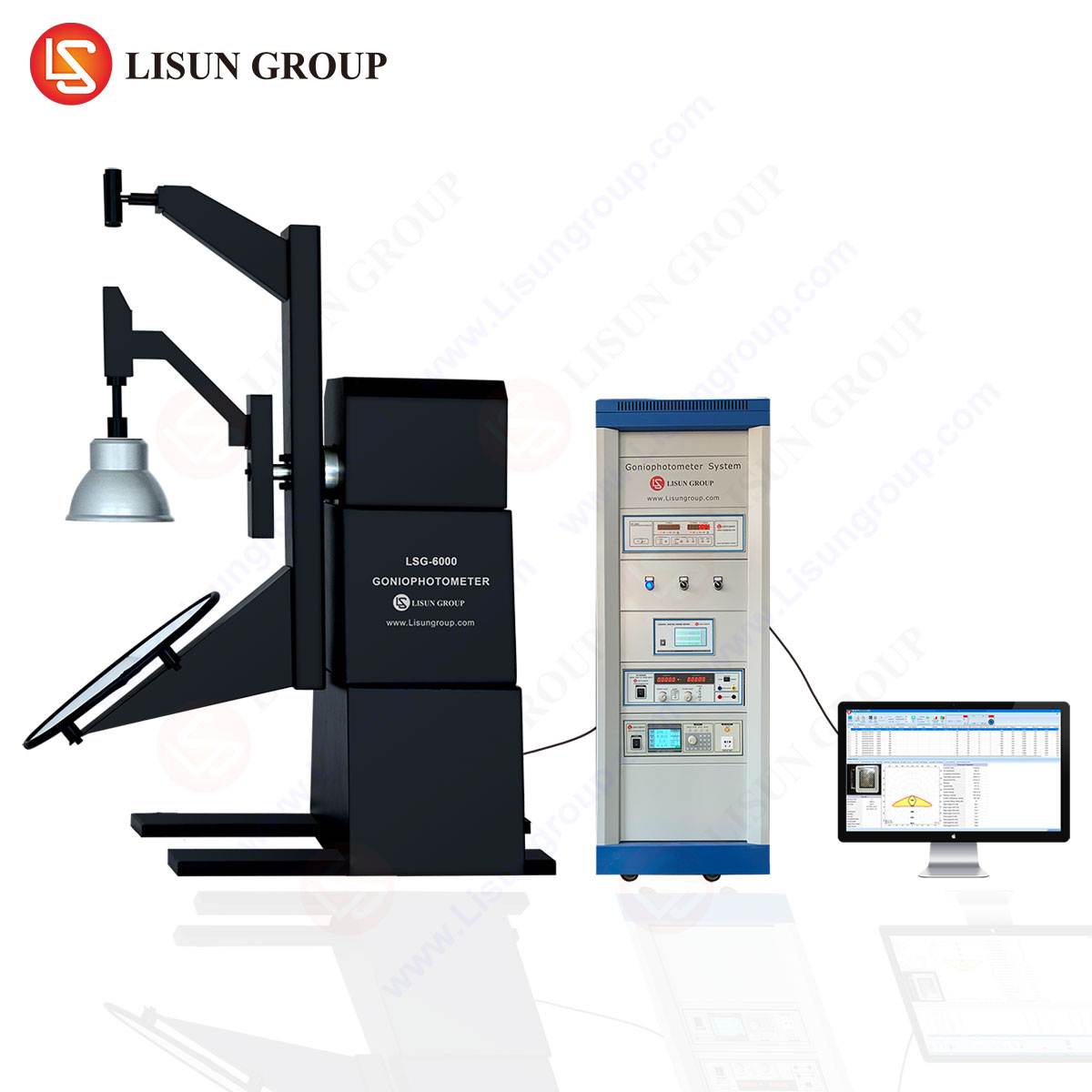
A goniophotometer measures angular intensity distribution and computationally integrates to derive total flux, which is accurate but time-consuming. An integrating sphere provides a direct measurement of total luminous flux in seconds, making it ideal for production testing and rapid quality checks. For complete spatial intensity data (IES files), a goniophotometer is required, but for total flux and spectral data, the sphere is the efficient and standard tool.
Q2: How does the system account for the heat generated by high-power LEDs during testing, which can affect output?
Professional systems incorporate thermal management protocols. The LPCE-3 software can synchronize with an external temperature-controlled chamber or a thermally stabilized mount. Testing is conducted only after the LED’s junction temperature, inferred from forward voltage or directly measured via a thermal couple, has stabilized at a set point (e.g., 25°C as per IES LM-85), ensuring consistent and comparable data.
Q3: What is “self-absorption correction” and when is it required?
Self-absorption occurs when the LED under test, its heat sink, or driver physically blocks light from the sphere’s internal surface that would have been reflected to the detector during the calibration with the standard lamp. This causes a negative measurement error. The correction procedure involves measuring the standard lamp with and without the non-emitting SUT (or its ancillary equipment) inside the sphere. The software uses this ratio to correct the subsequent measurement of the powered SUT.
Q4: Can the system test flashing or PWM-dimmed LEDs?
Yes, advanced spectroradiometers in systems like the LPCE-3 support synchronous triggering. The spectrometer’s integration period can be synchronized with the LED’s drive pulse via an external trigger signal. This allows for the measurement of the optical output during the active pulse, enabling accurate characterization of pulsed or dimmed signals critical for automotive, aviation, and display applications.
Q5: How is the system calibrated for absolute measurements, and what is the calibration interval?
The system is calibrated using a standard lamp traceable to a National Metrology Institute (NMI). The calibration establishes a spectral responsivity curve for the entire sphere-spectrometer combination. The recommended recalibration interval is typically one year, based on the stability of the standard lamp and the spectrometer’s optical bench, though this may be shortened in high-accuracy laboratory environments.