



Comprehensive Performance Evaluation of LED Lamps: Principles, Methodologies, and Advanced Instrumentation
Abstract
The proliferation of Light Emitting Diode (LED) technology across diverse industrial and consumer applications has necessitated the development of sophisticated, standardized testing methodologies. Accurate quantification of photometric, colorimetric, and electrical parameters is critical for ensuring product performance, regulatory compliance, and end-user satisfaction. This technical article delineates the essential requirements for a professional LED lamp testing system, with a detailed examination of integrating sphere spectroradiometry as the benchmark methodology. A focused analysis of the LISUN LPCE-3 Integrated Sphere Spectroradiometer System illustrates the implementation of these principles in a high-precision instrument, highlighting its application across multiple industrial sectors.
Fundamental Photometric and Colorimetric Parameters for LED Evaluation
The performance of an LED lamp is characterized by a multidimensional set of parameters beyond simple luminous flux. A professional tester must provide traceable measurements for a comprehensive suite of metrics. Photometric quantities, rooted in the standardized luminosity function V(λ), include Luminous Flux (lumens), which measures total perceived light output; Luminous Intensity (candelas), indicating directional brightness; and Illuminance (lux), for incident light on a surface. Colorimetric analysis is equally critical, requiring precise measurement of Chromaticity Coordinates (CIE x, y; u’, v’), which define the point of a color in a standardized color space. Correlated Color Temperature (CCT, in Kelvin) describes the warmth or coolness of white light, while Color Rendering Index (CRI, Ra) quantifies the fidelity with which a light source renders a set of standard colors compared to a reference illuminant. For modern applications, the Fidelity Index (Rf) and Gamut Index (Rg) from the IES TM-30-18 standard offer a more nuanced evaluation of color rendition. Furthermore, electrical parameters such as Input Power (Watts), Power Factor, and Supply Current are integral to assessing energy efficiency and compatibility with electrical systems.
Limitations of Conventional Testing and the Integrating Sphere Solution
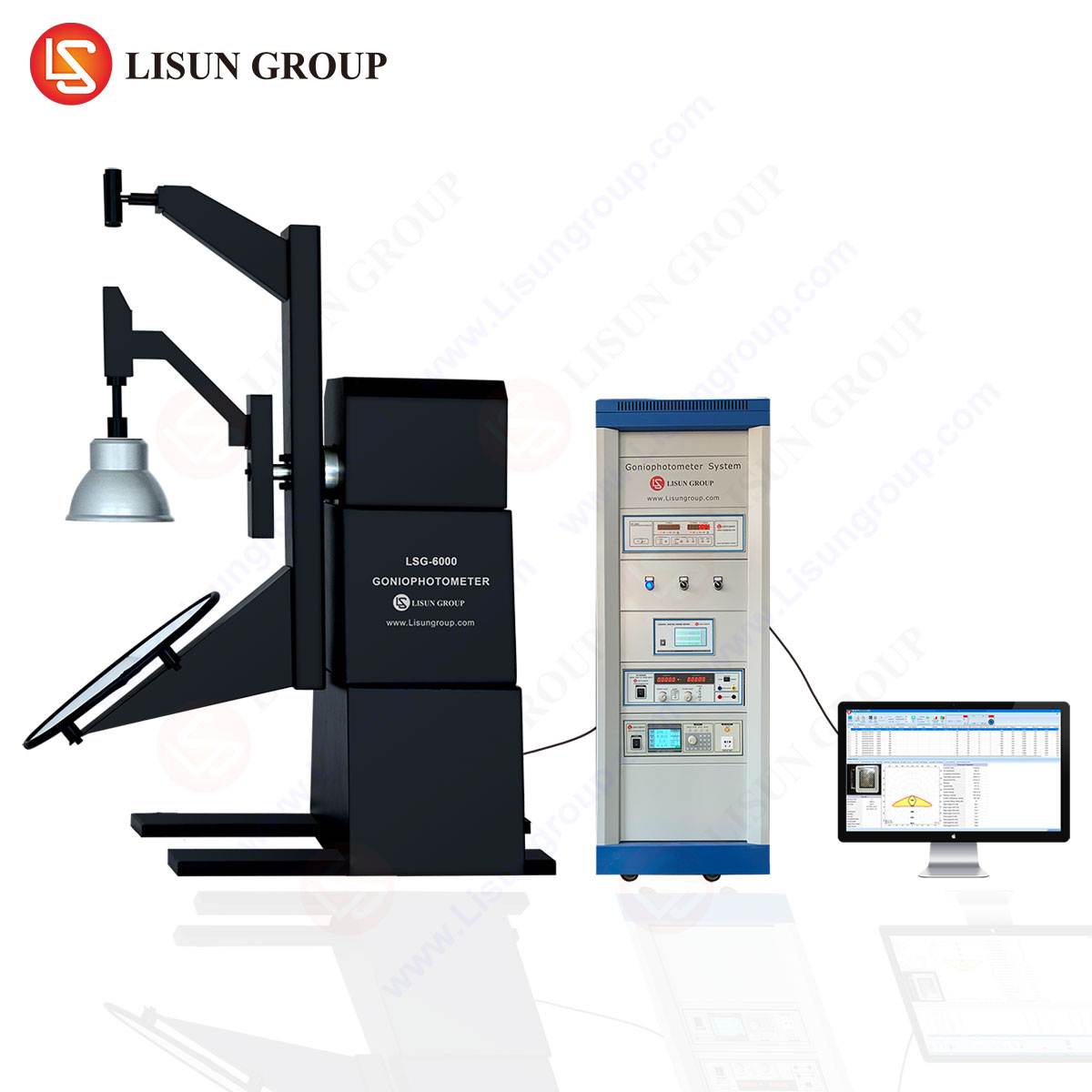
Simplified testing approaches, such as using basic lux meters or goniophotometers in isolation, present significant limitations for total flux measurement. Lux meters only measure illuminance at a specific point and orientation, failing to capture omnidirectional output. While goniophotometers provide highly accurate spatial distribution data, measurements are time-intensive and require controlled, darkroom environments. The integrating sphere, based on the principle of multiple diffuse reflections, provides a robust solution for total luminous flux measurement. An optically coated sphere interior creates a uniform radiance distribution; the light from the lamp under test (LUT) is integrated, and a spectrometer mounted on a port measures a small, representative sample of the total flux. This method allows for rapid, accurate measurement of total flux and, when coupled with a high-resolution array spectroradiometer, simultaneous full-spectrum data capture for all colorimetric computations.
Architecture and Operational Principles of the LPCE-3 Integrated System
The LISUN LPCE-3 system embodies a turnkey solution for compliance with international standards such as CIE 84, CIE 13.3, IES LM-79, and EN13032-1. Its architecture integrates several key subsystems. The core is a molded integrating sphere, typically available in diameters of 2 meters or larger, coated with a highly reflective, spectrally neutral diffuse material (e.g., BaSO4). A baffle system, strategically positioned between the LUT and the detector port, prevents first-reflection light from reaching the detector, ensuring measurement integrity. The optical heart of the system is a high-precision CCD array spectroradiometer. This instrument disperses the incoming light via a fixed grating and projects it onto a cooled CCD array, capturing the entire spectrum from approximately 380nm to 780nm in a single acquisition. This spectral power distribution (SPD) is the foundational data from which all photometric and colorimetric values are mathematically derived. The system is completed by a reference standard lamp for absolute calibration, a precision power analyzer for electrical characterization, and dedicated software that controls the hardware, manages calibrations, performs calculations per relevant standards, and generates comprehensive test reports.
Technical Specifications and Calibration Traceability
The metrological performance of the LPCE-3 is defined by its specifications. The spectroradiometer typically offers a wavelength accuracy of ±0.3nm and a high signal-to-noise ratio, crucial for measuring low-intensity spectral lines. The system’s overall photometric uncertainty for luminous flux can achieve levels below 3% (k=2), contingent on proper calibration and sphere size relative to the LUT. Electrical measurement accuracy for power is typically within ±0.1% of reading. Calibration traceability to national metrology institutes (NMIs) is paramount. The process involves using a standard lamp of known luminous intensity and chromaticity, calibrated by an NMI, to establish the absolute responsivity of the sphere-spectrometer combination. This ensures measurements are part of an unbroken chain of comparisons, granting them international recognition for compliance and quality assurance purposes.
Industrial Applications and Sector-Specific Testing Protocols
The versatility of a professional LED tester is demonstrated by its application across disparate industries, each with unique requirements.
-
Lighting Industry & LED Manufacturing: This is the primary application, focusing on verifying datasheet claims, benchmarking against competitors, and ensuring batch-to-batch consistency. Testing per LM-79 and LM-80 standards is routine for product development and quality control.
-
Automotive Lighting Testing: Beyond flux and color, automotive standards (SAE, ECE) demand precise measurements of luminous intensity distribution for headlamps, signal lights, and interior lighting. While a sphere measures total flux, the system’s spectral data is vital for assessing the color compliance of rear tail lights and turn signals within stringent chromaticity boundaries.
-
Aerospace and Aviation Lighting: Testing for cockpit displays, cabin mood lighting, and external navigation lights requires extreme reliability and adherence to standards like RTCA DO-160. Measurements must account for performance under varying voltage conditions and temperature extremes, often integrated with environmental chambers.
-
Display Equipment Testing: For LED backlight units (BLUs) in LCDs or direct-view LED signage, color uniformity and gamut are critical. The sphere system can measure the spectrally resolved output of BLUs to calculate color gamut coverage (e.g., DCI-P3, Rec. 2020) and assess white point stability.
-
Photovoltaic Industry: LED solar simulators used for testing PV cells require a spectral match to the AM1.5G standard. The spectroradiometer component is essential for characterizing and calibrating these simulators, ensuring their spectrum accurately replicates sunlight.
-
Urban Lighting Design: For smart city applications, designers must evaluate the spectral impact of LED streetlights. Measurements of SPD allow for calculations of melatonin-suppressive melanopic flux, supporting human-centric lighting designs that consider circadian rhythms.
-
Stage, Studio, and Medical Lighting: In these fields, color rendering and consistency are paramount. A spectroradiometer-based system is the only tool capable of verifying the high CRI/Rf values claimed for surgical luminaires or the tunable white light and saturated colors used in broadcast and entertainment.
Comparative Advantages of Integrated Sphere Spectroradiometry
The primary advantage of a system like the LPCE-3 is the simultaneous acquisition of all key optical data from a single measurement. This eliminates errors introduced by using multiple, un-synchronized instruments. The speed of measurement enhances throughput for quality control. The system’s software automates complex calculations and standard-specific reporting, reducing operator error. Furthermore, the possession of the full SPD provides future-proofing; as new metrics (e.g., TM-30, melanopic ratio) gain adoption, they can be computed from archived spectral data without requiring re-testing.
Data Acquisition, Analysis, and Compliance Reporting
Professional testing culminates in actionable data. The system software not only controls the hardware but also provides sophisticated analysis tools. It can plot SPDs, display chromaticity points on CIE diagrams with relevant tolerance quadrangles (e.g., ANSI C78.377), and generate tabular summaries of all parameters. For compliance, the software can automatically compare measured values against user-defined limits or standard requirements, flagging non-conformities. Report templates allow for the generation of formal test certificates that include instrument identification, calibration dates, environmental conditions, and measured results, which are essential for audit trails and regulatory submissions.
FAQ Section
Q1: Why is an integrating sphere with a spectroradiometer preferred over a system using a photopic filter and a photometer head for LED testing?
A photopic filter attempts to mimic the V(λ) curve but has inherent mismatches, leading to spectral mismatch errors. This error can be substantial for LEDs with narrow or spiky spectral distributions. A spectroradiometer measures the complete SPD; the V(λ) weighting and all colorimetric functions are applied mathematically in software with perfect accuracy, eliminating this fundamental error source.
Q2: How does the size of the integrating sphere affect measurements?
Sphere size must be appropriate for the physical size and total flux of the LUT. A sphere that is too small leads to spatial non-uniformity and increased self-absorption error, where the LUT absorbs a significant portion of its own reflected light, skewing results. Standards recommend a sphere diameter at least 5-10 times the largest dimension of the LUT. Larger spheres minimize these errors for a wider range of lamp types.
Q3: Can the LPCE-3 system measure the flicker percentage of an LED lamp?
While the primary spectroradiometer measures steady-state light, flicker analysis requires high-speed temporal measurement. Many professional systems, including optional configurations of the LPCE-3, can integrate a dedicated flicker analyzer or a high-speed photodiode module. This allows measurement of percent flicker, flicker index, and waveform characteristics per standards like IEEE PAR1789.
Q4: Is it possible to test LED modules or arrays that require active thermal management?
Yes. Professional testing often involves auxiliary equipment. The LUT can be powered by an external, programmable DC or AC source. For modules requiring a heatsink, a thermal interface plate can be mounted on the sphere, allowing the LED to be tested under its intended operating temperature conditions, which is critical for accurate performance data.
Q5: How often should the system be calibrated, and what does calibration entail?
Full system calibration should be performed annually or as dictated by quality procedures to maintain traceability. Routine verification using a working standard lamp should be conducted weekly or daily based on usage. Calibration involves using an NMI-traceable standard lamp to establish the absolute spectral responsivity of the entire sphere-spectrometer system, correcting for any drift in sensitivity over time.