



The Imperative of Metrological Precision in Photometric and Radiometric Characterization
The accurate quantification of light—encompassing its perceived brightness, spectral composition, and geometric distribution—is a foundational requirement across a diverse array of scientific and industrial disciplines. Precision light measurement instruments serve as the critical nexus between empirical observation and quantifiable data, enabling the validation of performance, compliance with international standards, and the advancement of optical technologies. This treatise examines the technical principles, applications, and specifications inherent to high-fidelity spectroradiometry, with a detailed analysis of a representative instrument: the LISUN LMS-6000 series spectroradiometer.
Foundations of Spectroradiometric Measurement Methodology
Spectroradiometry distinguishes itself from simpler photometric techniques by resolving optical radiation into its constituent wavelengths. This spectral decomposition allows for the derivation of all photometric, colorimetric, and radiometric quantities through computational integration against standardized human visual response functions (e.g., the CIE V(λ) photopic luminosity function) or other action spectra. The core principle involves the dispersion of incident light via a diffraction grating or prism within a monochromator, directing discrete wavelength bands onto a sensitive detector, typically a charge-coupled device (CCD) or photomultiplier tube (PMT).
The metrological chain demands rigorous calibration traceable to national standards institutes (e.g., NIST, PTB, NIM). Key calibration procedures include wavelength calibration using spectral line sources (e.g., mercury-argon), and irradiance/responsivity calibration using a standard lamp of known spectral power distribution. The instrument’s optical design must minimize stray light, polarization sensitivity, and nonlinearity to ensure fidelity across a dynamic range that can span from the faint luminescence of materials to the intense irradiance of solar simulators.
Architectural Analysis of the LISUN LMS-6000 Series Spectroradiometer
The LISUN LMS-6000 platform represents a modular family of spectroradiometers engineered for laboratory and production-line environments. While variants such as the LMS-6000F (fast scanning), LMS-6000S (high sensitivity), LMS-6000P (portable), LMS-6000UV (extended ultraviolet response), and LMS-6000SF (super-fast) cater to specific application niches, the foundational LMS-6000 model exemplifies the core technological approach. Its architecture is predicated on a symmetrical Czerny-Turner optical system with a holographic concave grating, a design chosen for its inherent reduction of astigmatism and stray light.
The system employs a 2048-pixel linear silicon CCD array detector, facilitating rapid full-spectrum capture without mechanical scanning. This is critical for measuring transient phenomena or for high-throughput testing. The wavelength range spans from 200 nm to 800 nm, covering the ultraviolet, visible, and near-infrared regions pertinent to most lighting and display technologies. A key specification is its wavelength accuracy of ±0.3 nm and a half-width optical resolution of approximately 2.5 nm, parameters that directly influence the precision of color coordinate calculation and narrow-band emission analysis.
The instrument’s software integrates CIE 1931/1976 color matching functions, enabling direct computation of chromaticity coordinates (x, y; u’, v’), correlated color temperature (CCT), color rendering index (CRI, including the extended R96a method), and luminous flux. For radiometric applications, it calculates spectral power density (SPD) in W/nm, irradiance in W/m², and illuminance in lux when coupled with cosine correctors or integrating spheres.
Validation and Compliance in the Lighting and LED Manufacturing Sectors
Within the lighting industry and LED/OLED manufacturing, spectroradiometers are indispensable for quality control and performance benchmarking. The LMS-6000 series is employed to verify compliance with standards such as ANSI/IES LM-79, IEC 62612, and ENERGY STAR requirements. Manufacturers utilize these instruments to measure key parameters: luminous efficacy (lm/W), ensuring energy efficiency claims are valid; chromaticity consistency across production batches, critical for maintaining brand quality; and the spectral power distribution of white LEDs, which determines both CCT and CRI.
For OLED panels and advanced solid-state lighting (SSL) products, the instrument’s ability to measure at very low luminance levels is essential for characterizing efficiency roll-off and spectral shift at different drive currents. The high-speed variant, LMS-6000SF, is particularly suited for in-line production testing, where measurement throughput of hundreds of units per hour is required without sacrificing accuracy.
Automotive and Aerospace Lighting Certification Protocols
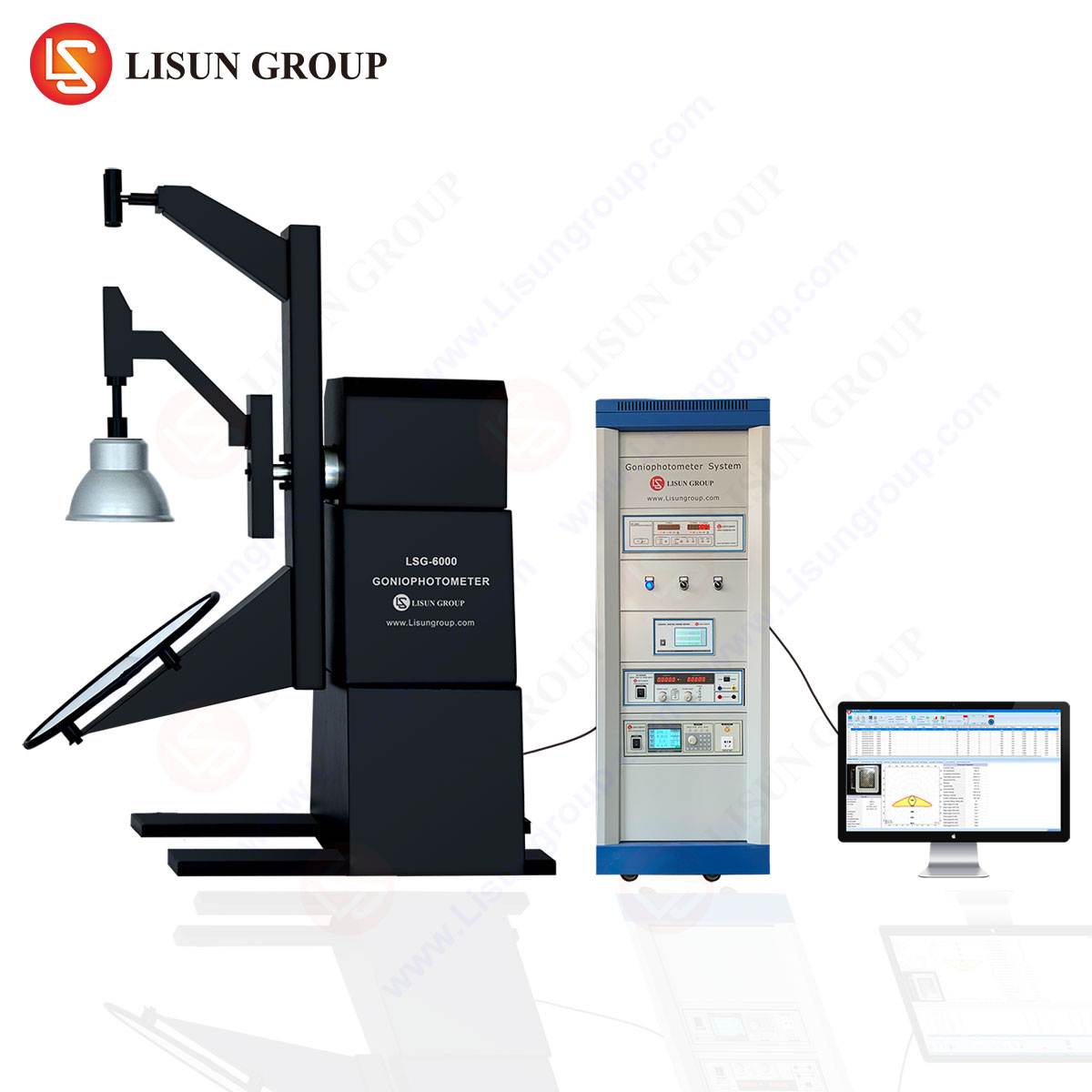
Automotive lighting testing imposes stringent requirements defined by regulations such as ECE, SAE, and FMVSS 108. The LMS-6000, when configured with a goniophotometer, measures the photometric intensity distribution of headlamps, signal lamps, and interior lighting. Spectral measurements are crucial for assessing the color of rear turn signals (required to be within specific chromaticity boundaries) and for evaluating the performance of adaptive driving beam (ADB) systems, where glare must be meticulously controlled.
In aerospace and aviation, lighting must perform reliably under extreme environmental conditions. The spectroradiometer is used to test cockpit displays, navigation lights, and emergency lighting for compliance with FAA TSO-C96a and RTCA DO-160 standards. The LMS-6000UV variant, with its enhanced response in the 200-400 nm range, can be applied to study the degradation of materials and coatings due to ultraviolet radiation exposure at high altitudes.
Display Metrology and Photovoltaic Device Characterization
The display industry relies on spectroradiometry for calibrating and grading screens for televisions, monitors, smartphones, and virtual reality headsets. Measurements include white point balance, color gamut coverage (e.g., sRGB, DCI-P3, Rec. 2020), gamma curve validation, and viewing angle performance. The instrument’s high wavelength accuracy ensures precise calculation of color differences (Δu’v’), which must be minimized for premium displays.
In the photovoltaic industry, spectroradiometers like the LMS-6000 are integral to the calibration of solar simulators per IEC 60904-9 standards, which classify simulators based on spectral match, spatial non-uniformity, and temporal instability. Accurate measurement of the simulator’s spectral irradiance is necessary to correctly determine the performance parameters of solar cells, including short-circuit current and spectral responsivity.
Supporting Advanced Research and Specialized Applications
In optical instrument R&D and scientific research laboratories, the instrument serves as a primary tool for characterizing light sources, detectors, and optical components. Applications range from measuring the emission spectra of lasers and LEDs to evaluating the transmittance or reflectance of filters and materials. Its programmability allows for automated long-term stability tests and environmental stress testing.
Urban lighting design projects utilize spectroradiometric data to model and assess the spectral impact of outdoor lighting on human circadian rhythms, skyglow, and ecological systems. For marine and navigation lighting, the instrument verifies compliance with International Association of Lighthouse Authorities (IALA) recommendations and COLREGs, ensuring proper chromaticity for buoy lights and lighthouse beacons to avoid maritime confusion.
In stage and studio lighting, consistency of color temperature and rendering across multiple fixtures is paramount. The LMS-6000P portable variant enables technicians to profile and match luminaires on location. Finally, in medical lighting equipment, such as surgical lights and phototherapy devices, spectroradiometry validates that spectral output meets therapeutic specifications (e.g., for neonatal jaundice treatment using blue light) and ensures the absence of harmful UV or IR emissions.
Competitive Advantages of High-Resolution Spectroradiometric Systems
The technical superiority of a system like the LMS-6000 is manifested in several distinct areas. First, its dual optical path design and high-performance grating yield an exceptionally low stray light level (<0.05%), which is critical for accurately measuring LEDs with narrow emission peaks or sources with deep spectral valleys. Second, the thermoelectrically cooled (TEC) CCD detector stabilizes the sensor temperature, dramatically reducing dark noise and enabling stable measurements of low-light signals over extended durations. Third, the modular design philosophy allows the core spectrometer to be integrated with a wide array of accessories—including integrating spheres of various sizes, cosine correctors, fiber optic probes, and telescopic optics—making it adaptable from bench-top component testing to field measurements of illuminated signage or roadway luminance.
Furthermore, the instrument’s software architecture supports direct referencing to a multitude of international testing standards, automating report generation and reducing operator error. Its high signal-to-noise ratio (SNR > 2000:1) ensures that even subtle spectral features are discernible, a necessity for research into phosphor-converted LEDs or for detecting impurities in material luminescence.
Conclusion
The proliferation of advanced light sources and the tightening of global performance and efficiency regulations have elevated precision light measurement from a supportive function to a central engineering discipline. Spectroradiometers, exemplified by the technical capabilities of the LISUN LMS-6000 series, provide the comprehensive data required to drive innovation, ensure quality, and certify safety across industries as diverse as manufacturing, transportation, energy, and healthcare. Their role as the definitive arbiters of optical performance will only expand as technologies continue to evolve toward greater spectral control and intelligence.
Frequently Asked Questions (FAQ)
Q1: What is the primary distinction between a spectroradiometer and a simpler photometer or colorimeter?
A spectroradiometer measures the absolute spectral power distribution (SPD) of a light source across a defined wavelength range. From this fundamental SPD data, all photometric (luminous flux, illuminance), colorimetric (chromaticity, CCT), and radiometric (irradiance) quantities can be derived mathematically. A photometer measures only luminous intensity weighted by the human eye response, while a colorimeter typically provides tri-stimulus values (XYZ) through broadband filters, offering less spectral detail and potential inaccuracy with non-standard light sources.
Q2: Why is wavelength accuracy of ±0.3 nm critical for LED testing?
Many LEDs, particularly those using phosphor conversion (e.g., white LEDs), have steep spectral edges and narrow emission bands from the blue pump diode. A wavelength error of even 1 nm can lead to significant miscalculation of chromaticity coordinates and correlated color temperature (CCT), potentially causing a device to fail specification limits. High wavelength accuracy is also essential for calculating the Color Rendering Index (CRI), which involves integrating the source spectrum against specific test color samples.
Q3: When would an integrating sphere be necessary versus a cosine corrector with the spectroradiometer?
An integrating sphere is required for measuring luminous flux (total light output in lumens) of a light source or lamp. The sphere spatially integrates light from all emission angles. A cosine corrector is an optic attached to a fiber optic cable that collects light for illuminance (lux) or irradiance (W/m²) measurements, mimicking the cosine angular response law of a flat surface. It is used for measuring light levels at a point, such as on a workplane or from a directional source.
Q4: Can the LMS-6000 series measure the flicker characteristics of a light source?
While the primary function is spectral analysis, the high-speed acquisition capability of models like the LMS-6000SF enables temporal analysis. By operating in a fast, triggered sampling mode, it can capture the waveform of a modulated light source’s intensity over time. This data can be processed to calculate flicker metrics such as percent flicker and flicker index, as outlined in standards like IEEE PAR1789.
Q5: How is the instrument calibrated for absolute irradiance measurements, and what is the typical recalibration interval?
Absolute irradiance calibration is performed using a standard lamp certified by a national metrology institute (NMI) with a known spectral irradiance output at a precise distance. The spectroradiometer’s response is characterized against this reference. Recalibration intervals depend on usage intensity and environmental conditions but are generally recommended annually to maintain traceability and ensure measurement uncertainties remain within published specifications. Wavelength calibration can be performed more frequently by the user using a built-in or external spectral line source.