








Precision Metrology for Solid-State Light Sources: Principles, Instrumentation, and Cross-Industry Applications
Introduction to Photometric and Radiometric Quantification
The transition from traditional incandescent and fluorescent lighting to solid-state technologies, primarily Light Emitting Diodes (LEDs) and Organic LEDs (OLEDs), has fundamentally altered the requirements for optical measurement. These sources exhibit spectral distributions, spatial emission patterns, and thermal dependencies that are markedly different from their predecessors. Consequently, precise, standardized measurement is no longer merely a quality control step but a critical component of research, development, and regulatory compliance across numerous sectors. Accurate quantification of parameters such as luminous flux (lumens), chromaticity coordinates (CIE x, y), correlated color temperature (CCT), color rendering index (CRI), and spectral power distribution (SPD) is essential for ensuring performance, safety, interoperability, and human-centric lighting outcomes. This article delineates the technical principles of precision LED light measurement, examines an advanced integrated measurement solution, and explores its deployment across diverse industrial and scientific fields.
Fundamentals of Integrating Sphere Theory and Spectroradiometry
The accurate measurement of total luminous flux, a photometric quantity weighted by the human eye’s spectral sensitivity (V(λ) function), necessitates the collection of light emitted in all directions. The integrating sphere, a hollow spherical cavity with a highly reflective, diffuse inner coating, serves this purpose. Light entering the sphere undergoes multiple diffuse reflections, creating a spatially uniform radiance distribution on the sphere’s inner wall. A detector, shielded from direct illumination by a baffle, samples this uniform radiance, which is proportional to the total flux of the source. The sphere’s efficiency is characterized by its throughput, dependent on the sphere’s radius, port area, and coating reflectance (typically >95% for barium sulfate or polytetrafluoroethylene-based materials).
While the sphere provides spatial integration, spectral analysis is achieved via a spectroradiometer. This instrument disperses incoming light via a diffraction grating or prism onto a detector array (e.g., a CCD or CMOS sensor), measuring the absolute spectral power distribution. The combination of an integrating sphere with a spectroradiometer forms a complete system capable of deriving all key photometric, colorimetric, and radiometric parameters from a single measurement. Calibration traceable to national standards (e.g., NIST, PTB) is paramount, utilizing standard lamps of known luminous intensity and spectral distribution to establish the system’s absolute responsivity.
The LPCE-3 Integrated Sphere and Spectroradiometer System: Architecture and Specifications
The LPCE-3 (High Precision Integrating Sphere Spectroradiometer System) exemplifies a modern, fully integrated solution designed for the rigorous demands of solid-state lighting metrology. The system comprises a modular integrating sphere assembly, a high-resolution array spectroradiometer, a precision constant current/voltage LED power supply, and dedicated analytical software. Its architecture is engineered to minimize measurement uncertainty and maximize repeatability.
Key technical specifications of the LPCE-3 system include:
- Integrating Sphere: Available in multiple diameters (e.g., 1.0m, 1.5m, 2.0m) to accommodate various source sizes and flux ranges. The interior is coated with a proprietary, spectrally neutral diffuse material with stable, high reflectance (>97% from 380nm to 780nm).
- Spectroradiometer: Utilizes a high-sensitivity CCD detector with a wavelength range typically spanning 350nm to 800nm, ensuring coverage of the visible spectrum and critical near-UV/IR regions. Optical resolution is better than 2.0nm FWHM.
- Measurement Parameters: The system software calculates over 30 parameters, including:
- Photometric: Luminous Flux (lm), Luminous Efficacy (lm/W)
- Colorimetric: CIE 1931 (x, y), CIE 1976 (u’, v’), CCT (K), Duv
- Color Rendering: CRI (Ra), Extended CRI (R1-R15), TM-30 (Rf, Rg)
- Electrical: Voltage (V), Current (A), Power (W), Power Factor
- Spectral: SPD (W/nm), Peak Wavelength, Dominant Wavelength, FWHM
- Compliance: The system is designed to meet or exceed the requirements of international standards such as CIE 84, CIE S 025, IES LM-79, and ENERGY STAR.
Operational Methodology and Uncertainty Considerations
The measurement procedure with an integrated system like the LPCE-3 follows a strict protocol. The device under test (DUT) is mounted at the center of the sphere, often on a thermally stabilized holder to manage junction temperature—a critical factor for LED performance. The spectroradiometer, attached to a side port, measures the sphere wall’s spectral radiance. The software applies calibration coefficients, corrects for self-absorption (a critical step where the DUT’s presence alters the sphere’s reflectance properties, requiring a correction factor derived from an auxiliary lamp), and computes all derived quantities.
Measurement uncertainty is a composite of multiple factors: sphere spatial non-uniformity, spectral calibration accuracy, detector linearity, temperature stability of the DUT and electronics, and stray light. High-precision systems mitigate these through design: oversized spheres relative to the DUT improve spatial integration, temperature-controlled detectors enhance stability, and advanced optical baffling reduces stray light. Regular calibration against NIST-traceable standards is non-negotiable for maintaining low uncertainty budgets, often achieving uncertainties of <3% for total luminous flux and <0.0015 for chromaticity coordinates under controlled laboratory conditions.
Cross-Industry Deployment and Application-Specific Requirements
The universality of light measurement principles finds application in highly specialized contexts, each with unique standards and performance criteria.
LED & OLED Manufacturing and the Lighting Industry: Here, the LPCE-3 system is deployed for production binning, ensuring color consistency and flux output for mass-produced LEDs. It validates compliance with performance claims for finished luminaires, essential for ENERGY STAR, DLC, or CE certification. For OLED panels, it measures surface uniformity and angular color stability.
Automotive Lighting Testing: Automotive applications demand extreme reliability and compliance with stringent regulations (SAE, ECE). The system tests signal lamps (brake, turn) for precise chromaticity boundaries defined in ECE R37 and measures the output of LED headlamps and daytime running lights (DRLs), ensuring both performance and glare control.
Aerospace and Aviation Lighting: Cockpit displays, cabin mood lighting, and external navigation/strobe lights require validation under simulated environmental conditions. Measurements focus on specific chromaticities for aviation red/green and high-intensity white strobes, as per FAA TSO and EUROCAE standards, ensuring visibility and pilot safety.
Display Equipment Testing: For LCD, OLED, and micro-LED displays, the spectroradiometer component can be used with a collimating lens to measure the absolute luminance and chromaticity of pixels or uniform patches, critical for calibrating high-end monitors to standards like DCI-P3 or Rec. 2020.
Photovoltaic Industry: While primarily for emission, spectroradiometers are used in PV to measure the spectral irradiance of solar simulators. Accurate knowledge of the simulator’s spectrum (e.g., Class AAA per IEC 60904-9) is vital for correctly rating solar cell efficiency under Standard Test Conditions.
Optical Instrument R&D and Scientific Research Laboratories: Researchers use these systems to characterize novel light sources (e.g., perovskite LEDs, quantum dot films), study photobiological effects (melanopic content of light), or calibrate optical sensors. The full spectral data is indispensable for this work.
Urban Lighting Design and Marine Navigation Lighting: Designers verify that street luminaires meet specified illuminance and color temperature requirements for human-centric outdoor lighting. For marine lanterns (IALA standards), precise measurement of luminous range and chromaticity is a safety-critical function for maritime navigation.
Stage, Studio, and Medical Lighting Equipment: In entertainment, consistency between fixtures is paramount. Systems like the LPCE-3 are used to profile moving lights and LED walls, creating calibration files for color matching. For medical lighting (surgical luminaires to DIN EN 60601-2-41), measurement of illuminance, color rendering, and shadow dilution is essential for clinical efficacy.
Competitive Advantages of an Integrated Systems Approach
The LPCE-3 paradigm offers distinct advantages over piecemeal or legacy measurement setups. First, system-level integration ensures hardware and software compatibility, streamlining calibration and operation. The synchronized control of the power supply and spectrometer allows for automated sweeps of current/voltage, enabling rapid generation of I-V-L (Current-Voltage-Luminous flux) curves critical for LED characterization. Second, the holistic design minimizes inter-instrument error, as a single spectroradiometer serves as the primary detector for all optical quantities, eliminating the need for separate photometers and colorimeters and the associated alignment and calibration drift challenges. Third, advanced software automates complex corrections (self-absorption, temperature) and standard reporting, reducing operator error and enhancing throughput in high-volume testing environments.
Future Trajectories in Light Measurement Technology
The evolution of measurement technology parallels that of the light sources themselves. The increasing importance of flicker (Pst LM, SVM), temporal light artifacts, and non-visual biological effects (melanopic ratio) is driving the development of high-speed spectroradiometers capable of capturing spectral dynamics at kHz rates. Furthermore, as laser-based lighting and VCSELs emerge, measurement systems must adapt to handle extremely high radiances and novel beam profiles. The integration of goniophotometric data with spectral information is another frontier, enabling complete spatial-spectral characterization for complex luminaires. Systems built on modular principles, like the LPCE-3 platform, are well-positioned to incorporate these advancements through detector and software updates, protecting long-term capital investment.
Conclusion
Precision measurement is the foundational language of progress in lighting technology. It translates subjective visual perception into objective, actionable data that drives innovation, ensures quality, and safeguards compliance across an expansive industrial landscape. Integrated solutions, such as the LPCE-3 Integrating Sphere Spectroradiometer System, embody the necessary convergence of metrological rigor, operational efficiency, and adaptability. By providing comprehensive, accurate, and standards-traceable characterization of solid-state and other advanced light sources, these systems play an indispensable role in the research, development, and commercialization of lighting products that meet the exacting demands of the 21st century.
FAQ Section
Q1: What is the significance of the integrating sphere diameter in a system like the LPCE-3?
The sphere diameter directly impacts measurement accuracy and dynamic range. Larger spheres (e.g., 2.0m) provide better spatial integration for physically large or asymmetrical luminaires and reduce the self-absorption correction error. They are also necessary for measuring high-flux sources without saturating the detector. Smaller spheres (e.g., 1.0m) offer higher signal throughput for low-flux sources like single LED packages. Selection is based on the size and total output of the typical devices under test.
Q2: How does the system account for the thermal sensitivity of LEDs during measurement?
LED performance is highly junction temperature (Tj) dependent. The LPCE-3 system includes a precision constant current source that can stabilize drive current. For rigorous testing, an external temperature-controlled mount or integrating sphere with a thermal management port is used. The standard protocol involves a pre-heating period (often 30-60 minutes) until the LED’s photometric output stabilizes at a steady-state Tj, as per IES LM-85, before measurement commences.
Q3: Can the LPCE-3 system measure the flicker characteristics of a light source?
While the standard LPCE-3 spectroradiometer is optimized for steady-state measurement, flicker analysis requires a high-speed photodetector or a specially configured high-speed spectrometer module. Many integrated systems offer this as an optional add-on or companion instrument. Flicker metrics like Percent Flicker, Flicker Index, and the more recent Pst LM and SVM require temporal waveform capture at a minimum sampling rate of several kHz.
Q4: What is the difference between CRI (Ra) and the newer TM-30 metrics (Rf, Rg), and can the system report both?
CRI (Ra) is the average of R1-R8, eight pastel color samples, and has known limitations with modern LED spectra. TM-30-18 from the IES defines two metrics: Rf (Fidelity Index), similar to an average over 99 color samples, and Rg (Gamut Index), which describes color saturation shift. A comprehensive system like the LPCE-3 calculates and reports both the established CIE CRI (including R1-R15) and the advanced TM-30 (Rf, Rg) metrics, providing a more complete color evaluation.
Q5: For automotive forward lighting testing, are additional accessories required beyond the basic sphere system?
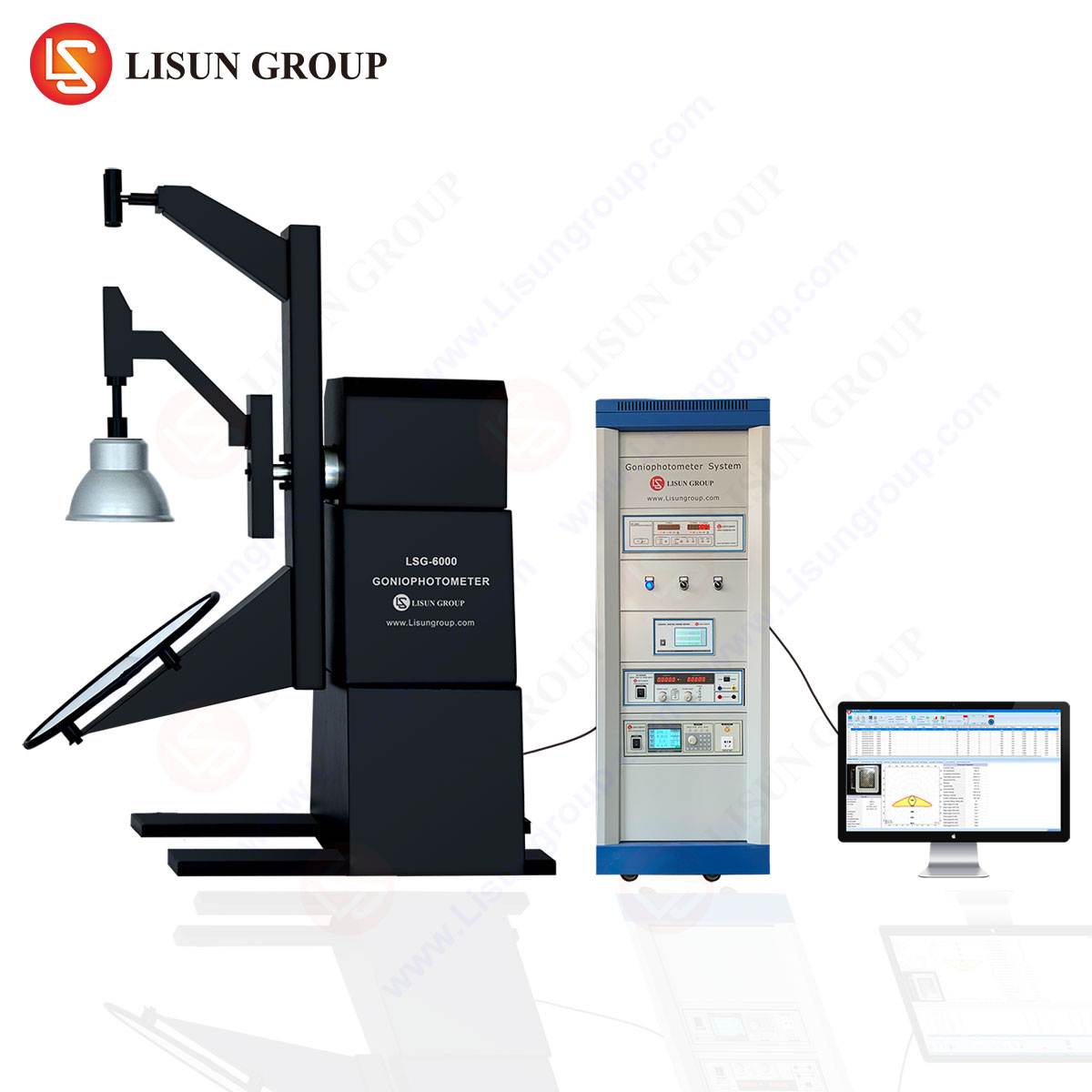
Yes. While the integrating sphere is ideal for total luminous flux and color measurement of the light source or module, testing complete headlamp assemblies for beam pattern, intensity (candelas), and regulatory compliance (e.g., for cut-off lines) requires a far-field goniophotometer. This is a separate, specialized instrument that rotates the luminaire in two axes to measure angular intensity distribution. The LPCE-3 sphere system would be used upstream for component-level validation and spectral analysis of the individual LEDs or light engines.