


Precision Photometric Measurement: Applications of PPFD Meters and the Role of Advanced Spectroradiometry
Introduction to Photosynthetic Photon Flux Density and its Metrological Significance
Photosynthetic Photon Flux Density (PPFD), quantified in micromoles per square meter per second (µmol/m²/s), represents the cornerstone metric for assessing the photosynthetically active radiation (PAR) incident upon a surface. Unlike broader illuminance measurements (lux), which are weighted by the human photopic vision curve, PPFD is strictly confined to the 400 to 700 nanometer wavelength band and quantifies the photon flux, the fundamental driver of photochemical reactions in photosynthesis. Accurate PPFD measurement is therefore not merely an exercise in radiometry but a critical requirement for industries and research fields where light functions as a reagent, a growth modulator, or an energy source. The fidelity of these measurements hinges on the precision and spectral accuracy of the instrumentation employed, transitioning from basic quantum sensors to sophisticated spectroradiometers for applications demanding uncompromising data integrity.
Fundamental Principles of PPFD Measurement and Instrumentation Evolution
The quantification of PPFD originates from the precise measurement of spectral irradiance across the PAR range. A spectroradiometer, the most advanced tool for this task, operates by dispersing incoming light via a diffraction grating or prism onto a detector array, enabling the capture of a complete spectral power distribution (SPD). The PPFD value is subsequently computed by integrating the spectral irradiance across 400-700 nm, weighted by the photon energy at each wavelength (a function of 1/λ). This method contrasts with simpler silicon photodiode-based quantum sensors, which utilize a broadband filter to approximate the PAR response. While suitable for basic agronomic assessments, such sensors are susceptible to errors due to spectral mismatch, especially under narrow-band light sources like monochromatic LEDs or mixed lighting environments common in research and high-tech industries. The evolution towards full-spectrum analysis via spectroradiometry represents the definitive solution for eliminating these inaccuracies, providing traceable data that aligns with international standards such as CIE S 017/E:2020 and ISO/CIE 19476:2014.
The LISUN LMS-6000 Series: Architectural Overview and Metrological Specifications
The LISUN LMS-6000 series of spectroradiometers embodies the high-fidelity approach to optical radiation measurement. Engineered for laboratory-grade accuracy and field-deployable robustness, this series serves as a primary reference instrument for PPFD and a comprehensive suite of photometric, radiometric, and colorimetric parameters. The core operational principle involves the collection of incident light through a cosine-corrected diffuser, guiding it via fiber optic cable to a high-resolution monochromator, and detecting the dispersed spectrum with a back-thinned CCD array cooled by a thermoelectric (TE) module to minimize dark noise.
Key specifications critical for PPFD applications include a wide spectral range (typically 200-1100nm, depending on the model, fully encompassing PAR and beyond), a high wavelength accuracy of ±0.2nm, and exceptional dynamic range. For instance, the LISUN LMS-6000S model, with its high sensitivity and signal-to-noise ratio, is particularly suited for low-light PPFD measurements in plant physiology research or deep-canopy studies. The LISUN LMS-6000F, featuring a fast sampling rate, is designed for dynamic light source testing, such as measuring pulsed LED systems used in horticulture or evaluating the temporal stability of growth lights. All models provide direct real-time calculation and display of PPFD, alongside yield photon flux (YPF) for advanced plant studies, circadian stimulus (CS) for human-centric lighting, and full CIE color coordinates.
Optimizing Horticultural Lighting Systems with Spectral Precision
In controlled environment agriculture (CEA) and horticultural lighting, PPFD is the primary design and validation parameter. However, the spectral composition within the PAR band profoundly influences plant morphology, secondary metabolite production, and growth efficiency. A basic quantum sensor may confirm a target PPFD of 300 µmol/m²/s at the canopy, but it cannot diagnose inefficiencies or spectral imbalances. The LMS-6000 series enables manufacturers and researchers to deconstruct the SPD of an LED grow light, verifying the exact proportions of blue (400-500nm), green (500-600nm), and red (600-700nm) radiation. This is crucial for tailoring recipes for specific crops—for example, optimizing far-red (700-750nm) content for shade avoidance responses using the extended range of the instrument. Furthermore, it allows for the precise calculation of the photon efficacy of radiation (PER, in µmol/J), a true measure of a lighting system’s energy efficiency in driving photosynthesis, which is indispensable for product development and sustainability claims.
Validating Photovoltaic Module Performance and Spectral Response
The photovoltaic industry relies on precise irradiance measurement to rate module performance under standard test conditions (STC). While pyranometers measure total solar irradiance, the spectral mismatch between sunlight and laboratory solar simulators can induce significant errors in efficiency calculations. The spectral responsivity of silicon and thin-film cells (e.g., CdTe, CIGS) varies across wavelengths. Using a spectroradiometer like the LMS-6000P, calibrated for high irradiance levels, engineers can measure the exact spectral irradiance of a solar simulator. By convolving this data with the known spectral response of the photovoltaic cell under test, they can apply precise spectral mismatch corrections per IEC 60904-7, ensuring accurate determination of peak power (Pmax), fill factor, and conversion efficiency. This application extends to outdoor spectral monitoring of natural sunlight, tracking variations in air mass that affect energy yield predictions.
Standardizing Automotive and Aerospace Lighting Compliance
Safety-critical lighting in automotive and aerospace sectors is governed by stringent international regulations (e.g., SAE, ECE, FAA). These standards specify not only luminous intensity distributions but also chromaticity coordinates and, increasingly, spectral requirements for LED-based signal lights and interior lighting. A spectroradiometer is essential for compliance testing. For example, the LMS-6000’s ability to measure the precise chromaticity of an aircraft navigation light or an automotive brake light ensures it falls within the legally mandated color boundaries on the CIE 1931 diagram. In cockpit and cabin lighting, where pilot circadian rhythm management is vital, the instrument can measure melanopic irradiance and circadian stimulus alongside traditional photometrics. Its high-resolution spectrum analysis also detects unwanted UV or IR leakage from LED assemblies, preventing material degradation or sensor interference.
Advancing Display and Medical Lighting Equipment Calibration
In display testing, uniformity of white point and color gamut coverage are paramount. The LMS-6000 series, when configured with a telescopic lens or imaging sphere, can measure the spectral radiance of individual pixels or full-screen patterns on OLED, micro-LED, and LCD displays. This allows for factory calibration to DCI-P3, Rec. 2020, or other color standards with extreme precision. Similarly, in medical lighting, such as surgical luminaires and dermatology treatment devices, spectral power is directly tied to efficacy and safety. A surgical light must provide high color rendering to distinguish tissue types, which requires a smooth, full-spectrum SPD—verifiable only with a spectroradiometer. Phototherapy devices for treating neonatal jaundice or skin conditions emit narrow-band radiation (e.g., blue light around 450nm, narrowband UVB at 311nm); the LMS-6000UV variant ensures the peak wavelength and bandwidth comply with medical device regulations, guaranteeing therapeutic dose accuracy and patient safety.
Supporting Fundamental Research in Photobiology and Material Science
Scientific research laboratories utilize PPFD meters and spectroradiometers as fundamental tools in photobiology, chemistry, and material science. Studies on coral symbiosis, for instance, require precise measurement of underwater PAR and spectral quality. The LMS-6000SF, with its robust design, can be deployed for such environmental monitoring. In material science, testing the photostability of polymers, pigments, or pharmaceuticals under specific wavelength ranges (often including UV-A and UV-B) necessitates detailed spectral irradiance data from weathering chambers. The instrument’s software can track spectral shifts and intensity decay over time, providing quantitative data for product lifetime predictions. This level of detail is unattainable with broadband sensors.
Enhancing Design Verification in Architectural and Specialized Lighting
Urban lighting designers and engineers for marine, stage, and studio applications benefit from spectral analysis beyond PPFD. The LMS-6000 facilitates the design of human-centric urban lighting by quantifying scotopic/photopic ratios and melanopic content, supporting well-being-oriented specifications. For marine navigation lights, verifying strict compliance with International Maritime Organization (IMO) spectral specifications ensures safe passage. In theatrical and film production, consistent color temperature and rendering across multiple luminaires are critical; a spectroradiometer allows for the precise matching of LED fixtures to traditional tungsten or daylight sources, creating seamless lighting environments.
Competitive Advantages of Integrated Spectroradiometric Analysis
The primary advantage of employing a system like the LISUN LMS-6000 series over discrete meters lies in data synthesis. A single measurement yields a full spectral dataset from which dozens of derived parameters—PPFD, YPF, Lux, CCT, CRI (R1-R15), chromaticity, peak wavelength, dominant wavelength, purity, and irradiance/radiance in any user-defined band—are calculated simultaneously with guaranteed spectral consistency. This eliminates the calibration drift and inter-instrument error inherent in using multiple dedicated meters. The integrated software typically includes GUM (Guide to the Uncertainty in Measurement) analysis, providing a metrologically sound uncertainty budget for each reported value, which is essential for ISO/IEC 17025 accredited testing laboratories and rigorous R&D.
Conclusion: The Indispensable Role of Spectral Fidelity
As lighting technology evolves from broad-spectrum sources to spectrally engineered, intelligent systems, the requirement for measurement precision escalates accordingly. PPFD remains a vital aggregate metric, but its true value and interpretation are unlocked only through an understanding of the underlying spectral composition. The LISUN LMS-6000 series of spectroradiometers provides the necessary toolset to achieve this depth of analysis across a diverse spectrum of industries, from ensuring global food security through optimized horticulture to guaranteeing passenger safety via compliant automotive lighting. By delivering laboratory-grade spectral data in both controlled and field environments, it establishes a universal standard for optical radiation measurement, underpinning innovation, compliance, and scientific discovery.
FAQ Section
Q1: What is the critical difference between using a dedicated PPFD quantum sensor and a spectroradiometer like the LMS-6000 for measuring grow light output?
A dedicated quantum sensor provides a single, filtered broadband reading of PPFD. It is susceptible to spectral mismatch error, meaning its calibration is optimal for a specific light source (often daylight) and may report inaccurate PPFD under narrow-band LED spectra. A spectroradiometer measures the complete spectral power distribution. It computes PPFD by integrating the photon flux across the PAR spectrum, providing an accurate, source-independent measurement. It also reveals the spectral composition, allowing for the calculation of photon efficacy (µmol/J) and spectral ratios (e.g., red:blue far-red) critical for advanced horticultural research.
Q2: For testing photovoltaic solar simulators per IEC 60904-7, which specific capability of the LMS-6000 series is most important?
The most critical capabilities are high irradiance measurement range (to directly measure simulator output without excessive attenuation), high wavelength accuracy (±0.2nm or better), and the software functionality to perform spectral mismatch calculations. The instrument must accurately capture the simulator’s spectral irradiance, which is then used with the reference cell’s spectral response and the reference solar spectrum to compute the precise spectral mismatch factor (M), correcting the measured short-circuit current of the test cell.
Q3: How does the LMS-6000 ensure accurate cosine response for irradiance measurements, such as PPFD or spectral irradiance, in real-world settings?
The instrument utilizes a precision-engineered cosine diffuser attachment, typically made from spectralon or similar Lambertian (perfectly diffuse) material, mounted at the entrance of the fiber optic cable. This diffuser is designed to follow the cosine correction law, where the effective collected irradiance is proportional to the cosine of the angle of incidence. The design and machining of this diffuser are calibrated to minimize angular response error, which is essential for measurements under directional light sources or in non-uniform fields.
Q4: In automotive lighting testing, can the LMS-6000 measure the luminous intensity (candelas) of a headlamp, or is it only for spectral data?
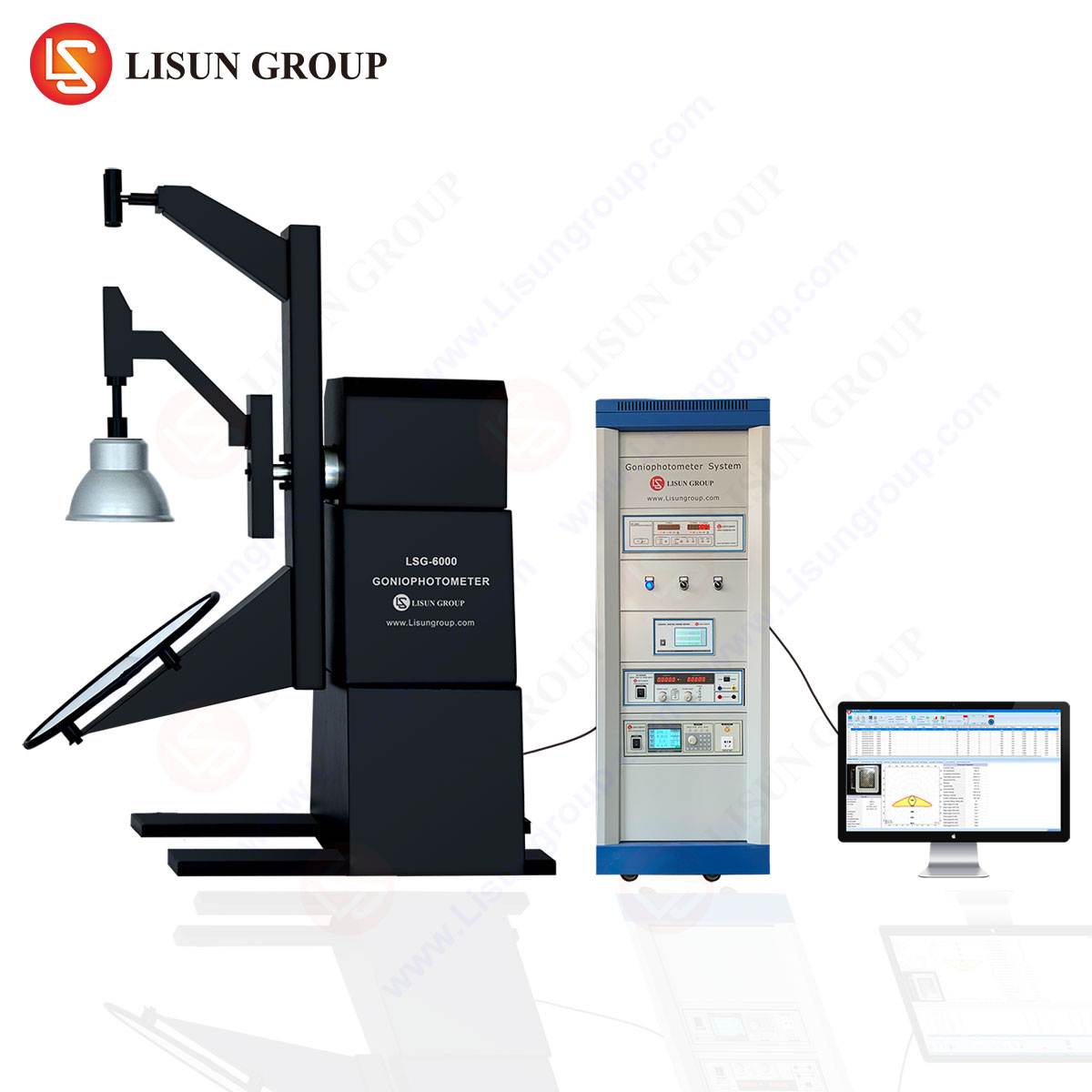
While the core function is spectral analysis, the LMS-6000 system can be configured for intensity measurements. By attaching a telescopic collimating lens to the fiber optic input, the instrument becomes a spectroradiometer for measuring spectral radiance. When the distance to the source is known and the source size is measured, spectral radiance can be converted to spectral intensity. Integrating across the visible spectrum yields total luminous intensity in candelas. However, for full photometric headlamp testing (beam pattern), a dedicated goniophotometer is typically used, often calibrated with a spectroradiometer like the LMS-6000 as its reference.
Q5: What is the significance of the TE-cooled CCD detector in the LMS-6000 for low-light applications, such as measuring moonlight for ecological studies or very low-irradiance LED indicators?
Thermoelectric cooling of the CCD detector significantly reduces its dark current—the electronic noise generated by thermal energy within the silicon. In low-light conditions, the signal from the photons is very small. Without cooling, the dark noise can overwhelm this signal, resulting in a poor signal-to-noise ratio (SNR) and inaccurate spectral data. Cooling the detector to temperatures often between -10°C to -30°C dramatically suppresses this noise, allowing the instrument to resolve extremely weak spectral signals with high fidelity, which is essential for precise environmental light monitoring and dim light source characterization.