


Advanced Goniophotometric Analysis for Precision Photometric Characterization
Abstract
The accurate quantification of a light source’s spatial radiation distribution is a cornerstone of optical metrology, impacting fields ranging from energy-efficient lighting design to the development of advanced photovoltaic systems. Goniophotometry, the technique of measuring luminous intensity as a function of angle, provides the most comprehensive data set for characterizing a luminaire’s fundamental photometric properties. This article delineates the principles, implementation, and critical applications of automated goniophotometer systems, with a detailed examination of the LSG-1890B as a paradigm for high-precision, large-scale luminaire testing. Adherence to international standards such as those from the International Electrotechnical Commission (IEC) and the Illuminating Engineering Society (IES) is emphasized as a prerequisite for generating reliable and universally comparable photometric data.
Fundamentals of Goniophotometric Measurement
Goniophotometry operates on the principle of measuring the luminous intensity distribution of a light source by rotating it through a series of spherical coordinates, typically defined by the C-plane (azimuth) and γ-plane (inclination) system. A fixed, spectrally calibrated photodetector captures the luminous flux at each discrete angular position, constructing a complete three-dimensional intensity surface. This data matrix, often referred to as the luminous intensity distribution (LID), is the primary output. From this foundational data set, a multitude of secondary photometric parameters are derived computationally. These include total luminous flux (lumens), efficacy (lumens per watt), zonal lumen distribution, luminance distribution, and coefficients of utilization. The spatial resolution and angular accuracy of the goniophotometer directly govern the fidelity of this derived data, making the mechanical and optical integrity of the system paramount.
Architectural Configuration of the LSG-1890B Goniophotometer System
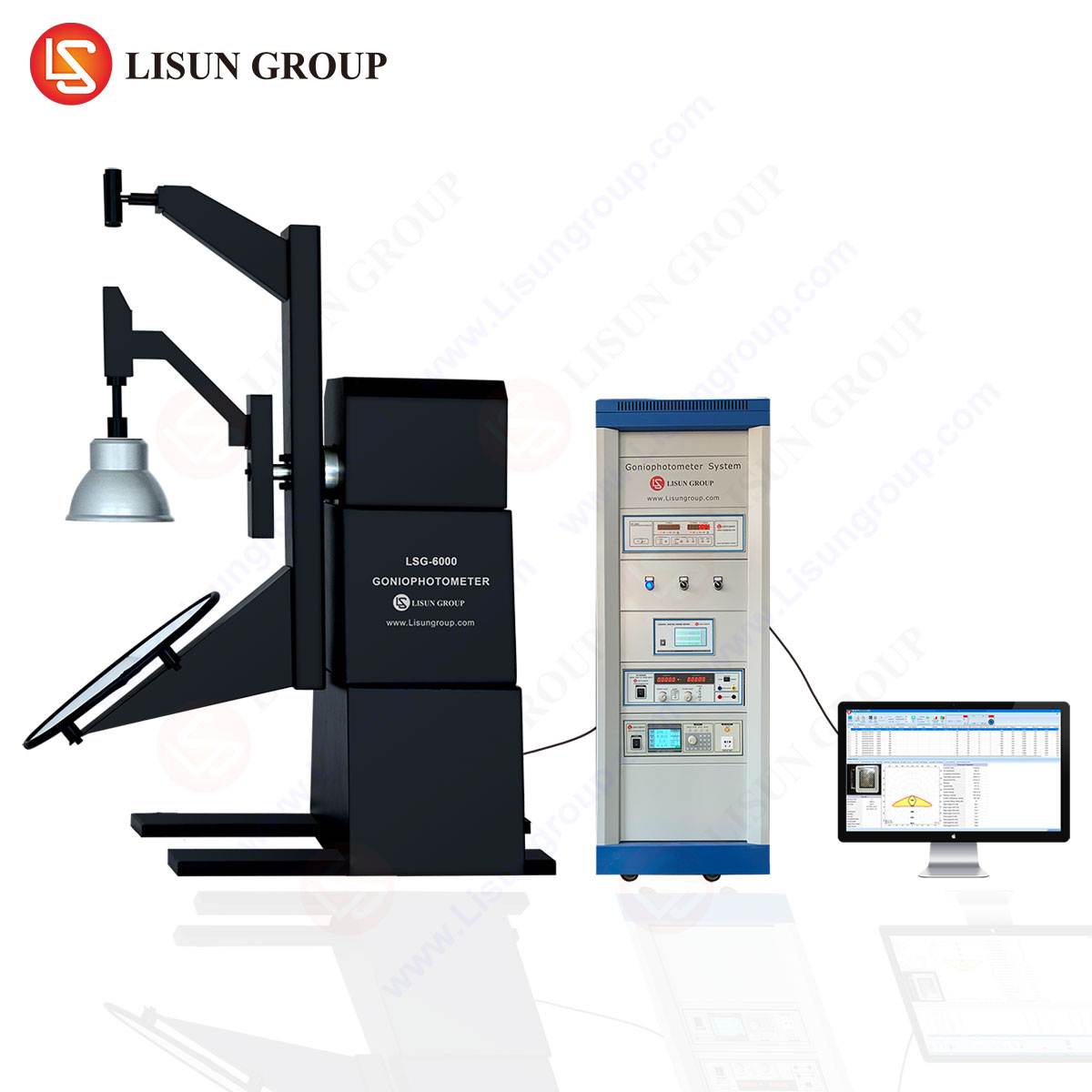
The LSG-1890B represents a Type C goniophotometer configuration, characterized by a moving photometer head and a fixed luminaire mounting position. This architecture is particularly advantageous for testing large, heavy, or complex luminaires, such as high-bay industrial lighting, streetlights, and sports field illumination, where rotating the device under test (DUT) would be impractical or would introduce mechanical stress. The system employs a robust dual-arm mechanism. One arm positions the spectroradiometer or photometer at a fixed distance from the DUT, while the second, vertical arm facilitates precise C-plane rotation. The entire assembly moves along a horizontal arc to cover the γ-plane, ensuring the detector maintains a constant distance and normal orientation to the DUT throughout the measurement sequence. This design eliminates the need for the inverse-square law correction that Type A systems require, streamlining data processing and enhancing accuracy.
Key specifications of the LSG-1890B include a maximum DUT weight capacity of 30 kg and a DUT size accommodation of up to 800mm x 800mm x 600mm. The measurement distance is user-configurable, typically set at 5m, 10m, or longer to meet the far-field condition as stipulated by standards like LM-79 and LM-63. Its angular positioning precision is better than 0.1°, enabling the generation of highly detailed LID curves. The system is fully automated, integrating a high-sensitivity CCD-array spectroradiometer or a V(λ)-corrected photodetector, and is controlled via dedicated software that manages motion control, data acquisition, and report generation.
Adherence to International Photometric Standards
Compliance with internationally recognized testing standards is non-negotiable for ensuring data validity and facilitating global market access. The LSG-1890B is engineered to meet or exceed the requirements of a comprehensive suite of standards. In the lighting industry, IESNA LM-79-19 (“Electrical and Photometric Measurements of Solid-State Lighting Products”) and its predecessor, CIE 121-1996 (“The Photometry and Goniophotometry of Luminaires”), define the methodologies for total flux, LID, and chromaticity measurements. For display equipment testing, standards such as IEC 62547-1 (“Guidelines for the measurement of high-power laser arrays”) provide frameworks for evaluating uniformity and angular color shift, which are critical for displays and backlight units.
In the photovoltaic industry, while goniophotometers are not used for cell testing, the principles are applied in the characterization of the angular response of photovoltaic reference cells and the spatial distribution of solar simulators, guided by standards like IEC 60904-9. The system’s design inherently supports the stringent requirements of DIN EN 13032-4, which specifies conditions for the photometric measurement of LED luminaires and modules, including considerations for thermal management during testing. This multi-standard compatibility makes the LSG-1890B an indispensable tool for independent testing laboratories, manufacturing quality assurance departments, and research institutions that serve international markets.
Industry-Specific Applications and Use Cases
Urban Lighting Design and Smart City Infrastructure: The spatial light distribution of a streetlamp directly influences road safety, visual comfort, and light pollution. The LSG-1890B provides the data necessary to calculate roadway illuminance (lux) and luminance (cd/m²) profiles using software like Dialux or Relux. This allows designers to optimize pole spacing and mounting height, ensuring compliance with standards such as ANSI/IES RP-8-14 for roadway lighting and minimizing obtrusive light into neighboring areas as per IDA/IES Model Lighting Ordinance.
LED and OLED Manufacturing: For LED package and module manufacturers, precise goniophotometry is critical for binning processes. The LSG-1890B can characterize the angular color uniformity (ACU) and correlated color temperature (CCT) shift over the emission hemisphere. This data is vital for high-quality OLED displays and lighting panels, where visual performance is highly dependent on viewing angle. Manufacturers can use this data to sort components into tight photometric and colorimetric bins, ensuring consistency in final products.
Stage and Studio Lighting: Theatrical and broadcast luminaires, such as ellipsoidal reflector spotlights and LED fresnels, are defined by their beam characteristics. The LSG-1890B measures key parameters like beam angle (to 50% peak intensity), field angle (to 10% peak intensity), and the shape of the beam profile. This information is used by lighting designers to select the correct fixtures for a scene and by manufacturers to validate optical designs against specifications for throw distance and field softness.
Medical Lighting Equipment: Surgical and diagnostic lighting demands extreme uniformity, high color rendering, and specific intensity distributions to avoid shadows and ensure accurate tissue color discrimination. The LSG-1890B verifies compliance with standards like IEC 60601-2-41, which specifies requirements for surgical luminaires, including the depth of illumination and the maximum permissible luminance to prevent glare.
Sensor and Optical Component Production: The angular response of photodiodes, ambient light sensors, and other optical components is a critical performance metric. By mounting a component as the DUT and using a stable, calibrated light source, the LSG-1890B can map its relative spectral responsivity versus angle of incidence. This data is essential for integrating these components into systems where the direction of incident light is variable, such as in automotive rain/light sensors or consumer electronics.
Comparative System Advantages in Precision Metrology
The LSG-1890B’s Type C configuration confers several distinct advantages over rotating DUT designs. Firstly, the fixed position of the luminaire ensures that its thermal and electrical characteristics remain stable throughout the test cycle, as there are no moving cables or connectors that could induce flicker or resistance changes. This is particularly crucial for LED testing, where performance is highly temperature-dependent. Secondly, the ability to test heavy and bulky luminaires without a complex and massive counterweight system simplifies facility requirements and operational logistics. The system’s software integrates advanced data processing algorithms that automatically generate standardized file formats, such as the IESNA LM-63 file (.ies), which is the universal format for importing photometric data into lighting design software. This end-to-end integration from raw angular measurement to industry-standard deliverable streamlines the workflow, reduces potential for human error, and accelerates time-to-market for new products.
Data Acquisition, Processing, and Output Formats
The measurement process begins with the system calibration using a standard lamp of known luminous intensity and spectral power distribution, traceable to a national metrology institute (NMI). The DUT is then mounted and allowed to reach thermal stability at its rated operating conditions. The LSG-1890B software automates the scanning trajectory, which can be a full 4π steradian sphere or a restricted section relevant to the luminaire’s application (e.g., downward-facing for indoor luminaires). At each angular step, the photodetector records illuminance, and the spectroradiometer, if equipped, captures the full spectral power distribution. The software then performs a coordinate transformation to convert the measured illuminance values (lux) into luminous intensity values (candelas). The resulting data set is used to generate polar candela diagrams, iso-candela plots, and tabular zonal lumen summaries. The final output is typically a comprehensive test report and an electronic IES file that encapsulates the entire LID for use in simulation software.
Table 1: Representative Data Output from an LSG-1890B Test on an LED Streetlight Luminaire
| Parameter | Measured Value | Standard Reference |
| :— | :— | :— |
| Total Luminous Flux | 12,580 lm | IES LM-79-19 |
| Luminous Efficacy | 125 lm/W | IES LM-79-19 |
| Beam Angle (to 50% intensity) | 120° | CIE 121-1996 |
| CCT (at 0° nadir) | 4021 K | IES LM-79-19 |
| Color Rendering Index (Ra) | 78 | IES LM-79-19 |
| Zonal Lumens (0-30°) | 3,520 lm | Calculated from LID |
Frequently Asked Questions (FAQ)
Q1: What is the primary distinction between a Type A and a Type C goniophotometer, and why is the Type C design of the LSG-1890B preferred for large luminaires?
A Type A goniophotometer rotates the luminaire around its photometric center while the detector remains fixed. A Type C system keeps the luminaire stationary and moves the detector around it. The Type C design is superior for large, heavy luminaires because it eliminates the mechanical complexity and potential safety hazard of rotating a massive object. It also prevents cable twisting and ensures more stable electrical and thermal connections during testing, leading to more accurate and repeatable results.
Q2: How does the system account for the spectral sensitivity of the human eye, and can it measure colorimetric properties?
The system utilizes a photopic filter that precisely corrects the detector’s spectral response to match the CIE standard observer V(λ) function. For comprehensive colorimetric analysis, an integrated spectroradiometer is used. This allows for the simultaneous measurement of illuminance and full spectral data at every angular position, enabling the calculation of Correlated Color Temperature (CCT), Color Rendering Index (CRI), and chromaticity coordinates (x,y or u’,v’) across the entire spatial distribution.
Q3: For a luminaire with a highly asymmetric light distribution, what measurement resolution is necessary to achieve an accurate IES file?
The required angular resolution depends on the complexity of the LID. For a luminaire with sharp cut-offs or complex reflector optics, a high-resolution scan with increments of 5° or less in both the C and γ planes is recommended. The LSG-1890B’s positioning precision of <0.1° allows for such detailed mapping. The system software can also implement adaptive scanning, using a finer resolution in regions of high intensity gradient and a coarser resolution in areas of uniform emission to optimize the balance between data accuracy and measurement time.
Q4: Can the LSG-1890B be used to test the temporal characteristics of a light source, such as flicker or dimming performance?
While its primary function is spatial photometry, the system can be configured for temporal analysis. By operating the detector in a high-speed acquisition mode at a fixed angular position, it is possible to capture the waveform of the light output. This allows for the measurement of flicker metrics, such as percent flicker and flicker index, as defined by IEEE PAR1789, and to characterize the photometric performance of a luminaire across its dimming range.