





Comprehensive Photometric Analysis: Principles, Methodologies, and Advanced Goniophotometric Systems
Introduction to Quantified Light Measurement
Photometric analysis constitutes the scientific discipline concerned with the measurement of visible light as perceived by the human eye. Unlike radiometry, which measures optical power across the entire electromagnetic spectrum, photometry applies the spectral sensitivity of the standard human photopic (and sometimes scotopic) observer, defined by the CIE (Commission Internationale de l’Éclairage). This quantification is fundamental for evaluating lighting products, ensuring compliance with performance and safety standards, and driving innovation across numerous industries. The core parameters derived from photometric analysis include luminous flux (lumens), luminous intensity distribution (candelas), illuminance (lux), luminance (candelas per square meter), and colorimetric coordinates. The precision and accuracy of these measurements are paramount, relying on sophisticated instrumentation, with the goniophotometer serving as the cornerstone apparatus for spatially resolved luminous intensity and total flux determination.
The Goniophotometer: Core Principles of Spatially Resolved Photometry
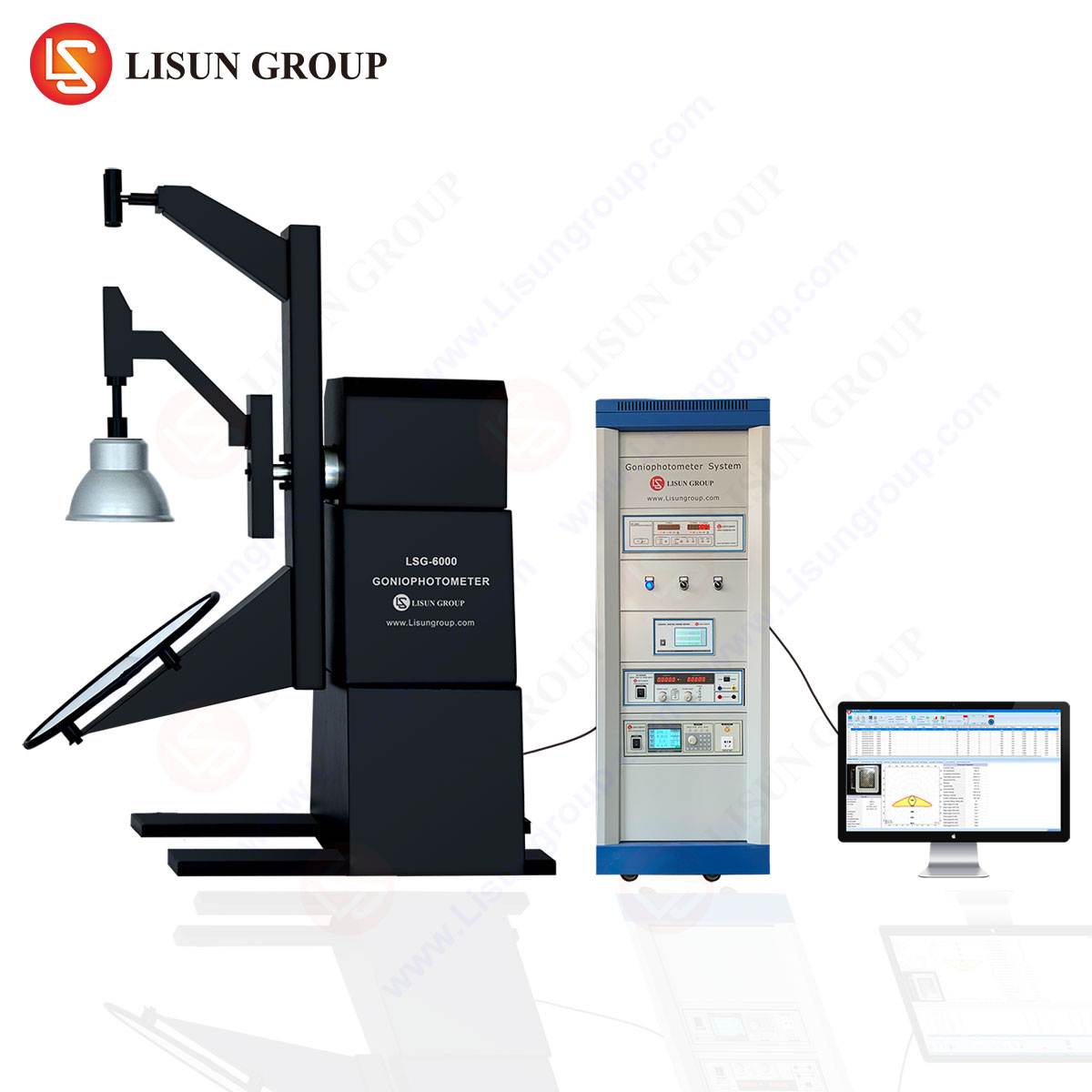
A goniophotometer is an electromechanical-optical system designed to measure the directional light distribution characteristics of a light source or luminaire. Its fundamental operating principle involves rotating either the light source under test (SUT) or a high-precision photodetector around one or more axes, capturing luminous intensity data across a spherical or hemispherical grid. This process generates a three-dimensional luminous intensity distribution, which is mathematically integrated to calculate total luminous flux. The two primary mechanical configurations are the Type C (moving detector) and Type B (moving luminaire) systems, as classified by CIE 70 and IEC 13032-1 standards. Type C systems, where the detector moves on a rotating arm about a fixed SUT, are often preferred for their ability to maintain constant measurement distance and minimize errors associated with source orientation changes.
The LSG-1890B Goniophotometer: System Architecture and Technical Specifications
The LSG-1890B represents a state-of-the-art, large-dimension Type C goniophotometer system engineered for high-accuracy photometric testing of luminaires up to 2.0 meters in length and 1.5 metric tons in weight. Its design addresses the critical need for testing large-scale commercial, industrial, and architectural lighting fixtures under precise, laboratory-controlled conditions.
Key technical specifications of the LSG-1890B include:
- Measurement Geometry: Type C, γ:C=0° to 180° (vertical), C:γ=0° to 360° (horizontal).
- Maximum SUT Dimensions: 2000 mm (L) x 2000 mm (W) x 2000 mm (H).
- Maximum SUT Weight: 1500 kg.
- Angular Resolution: ≤ 0.1°.
- Measurement Distance: Variable, typically 5m to 30m, ensuring far-field conditions per the inverse-square law requirement (5 times the maximum luminaire dimension).
- Detector System: Utilizes a high-precision, spectroradiometer-coupled or V(λ)-corrected photometer head with a dynamic range exceeding 1:10^8, traceable to national standards (e.g., NIST, PTB).
- Control Software: Fully automated data acquisition, processing, and report generation compliant with multiple international data formats (IESNA LM-63, EULUMDAT, CIE).
Testing Methodology and Compliance with International Standards
The operational methodology of the LSG-1890B is governed by a stringent adherence to international photometric standards. The system is designed to comply fully with:
- IEC 13032-1: “Methods of measurement of light distribution of luminaires.”
- IESNA LM-79: “Electrical and Photometric Measurements of Solid-State Lighting Products.”
- CIE 70: “The Measurement of Absolute Luminous Intensity Distributions.”
- EN 13032-1: (European harmonized standard).
- ANSI/IES RP-16: Nomenclature and Definitions for Illuminating Engineering.
The testing process involves mounting the SUT at the system’s center of photometry. The robotic detector arm, carrying the photometer head, traverses a pre-programmed spherical grid, capturing luminous intensity at defined angular increments (e.g., every 0.2° or 1.0°, depending on required detail). The system software corrects for background stray light, temperature fluctuations, and electrical supply variations. The resultant data set allows for the computation of total luminous flux, efficacy (lm/W), zonal lumen summary, and the generation of standardized photometric data files essential for lighting design software such as Dialux and Relux.
Industry-Specific Applications of Advanced Goniophotometry
The precision offered by systems like the LSG-1890B enables critical applications across diverse sectors:
- Lighting Industry & LED/OLED Manufacturing: For LED module and luminaire producers, verifying rated lumen output, efficacy claims, and spatial distribution is critical for product validation, quality control, and ENERGY STAR or DLC certification in North America. OLED panel manufacturers rely on goniophotometry to characterize the Lambertian emission profile and angular color uniformity.
- Display Equipment Testing: Evaluation of backlight units (BLUs) for monitors and televisions requires measurement of viewing angle, luminance uniformity, and contrast ratio. Goniophotometric data ensures displays meet performance specifications for consumer electronics and professional monitors.
- Photovoltaic Industry: While primarily for light emission, goniophotometers are adapted to measure the angular acceptance of light for solar panels and the spatial emission patterns of photovoltaic system indicator lights.
- Optical Instrument R&D and Scientific Research Laboratories: Researchers utilize these systems to characterize novel light sources, study material reflectance/transmittance properties when integrated with auxiliary optics, and validate theoretical optical models with empirical data.
- Urban Lighting Design and Medical Lighting Equipment: For streetlights and area luminaires, the intensity distribution (Isocandela plots) and glare control (UGR calculations) are paramount for public safety and compliance with standards like ANSI/IES RP-8 for roadways. Surgical and examination lights require precise beam shape, shadow reduction, and color rendering verification, all quantifiable via goniophotometry.
- Stage and Studio Lighting: Theatrical and film lighting fixtures demand specific beam angles, field angles, and fall-off characteristics. Goniophotometric analysis provides the photometric data files needed to pre-visualize lighting setups in software like Vectorworks Spotlight.
- Sensor and Optical Component Production: Manufacturers of ambient light sensors, IR receivers, and optical lenses use goniophotometers to map the angular sensitivity or transmission profiles of their components.
Competitive Advantages of Modern Goniophotometric Systems
Modern systems like the LSG-1890B offer distinct advantages over legacy or less sophisticated equipment. The Type C configuration eliminates gravitational effects on the SUT’s thermal and electrical performance, a critical factor for LED luminaires where junction temperature directly impacts output. The large chamber capacity and high weight tolerance future-proof the investment, accommodating the growing size and integration of modern luminaires. Integration with spectroradiometers enables simultaneous photometric and colorimetric measurements (CCT, CRI, Duv) across angles, essential for evaluating angular color shift—a common defect in LED-based products. Automated, standards-compliant software not only reduces human error but also streamlines the workflow from measurement to report, ensuring repeatability and auditability essential for accredited laboratory settings.
Data Integration and the Role of Standardized File Formats
The output of a goniophotometric analysis transcends simple tabular data. The generation of standardized electronic files is a critical function. The IESNA LM-63 (IES) file format is the industry lingua franca, containing the complete luminous intensity distribution in a compact, software-readable form. This file is directly imported into lighting design and simulation software, allowing designers to accurately model the performance of a luminaire within a virtual space before physical installation. The accuracy of the underlying goniophotometric data directly correlates to the reliability of these simulations, impacting energy use predictions, compliance with lighting codes (e.g., ASHRAE 90.1, IECC), and overall project success.
Conclusion
Photometric analysis, underpinned by advanced goniophotometer systems such as the LSG-1890B, is an indispensable engineering discipline. It provides the objective, quantitative foundation for product development, quality assurance, regulatory compliance, and innovative design across the entire spectrum of lighting and optical technology industries. By adhering to rigorous international standards and leveraging precise electromechanical control with sophisticated data processing, these systems transform the physical phenomenon of light into actionable, reliable data that drives progress, ensures safety, and optimizes performance in both commercial and scientific applications.
Frequently Asked Questions (FAQ)
Q1: What is the primary distinction between a Type B and a Type C goniophotometer, and why is it significant for LED testing?
A1: In a Type B system, the luminaire rotates while the detector remains fixed. In a Type C system, the detector moves around a stationary luminaire. For LED luminaires, thermal management is crucial; orientation can affect heat sink performance and thus junction temperature. Type C systems maintain a fixed luminaire orientation, ensuring consistent thermal conditions throughout the test, leading to more accurate and repeatable luminous flux and intensity measurements.
Q2: How does a goniophotometer account for the spectral sensitivity of the human eye?
A2: The system uses a photometer head equipped with a precision optical filter designed to match the CIE Standard Photopic Observer V(λ) function. This filter modifies the spectral response of the silicon photodiode detector so that it weighs incident optical radiation exactly as the human eye does, ensuring measurements are truly photometric (luminance, illuminance in lux) rather than purely radiometric.
Q3: Can the LSG-1890B system be used for measuring near-field luminous intensity or luminance distributions?
A3: The LSG-1890B is primarily designed for far-field measurements, which are required for classical photometric data used in lighting design software. For near-field goniophotometry, which captures detailed luminance maps of surfaces (e.g., displays, light guides), a different specialized instrument, often called a near-field goniophotometer or imaging sphere system, is typically employed.
Q4: What are the critical laboratory environmental controls required for accurate photometric testing per IEC standards?
A4: Standards such as IEC 13032-1 mandate strict environmental controls. These include a stable ambient temperature (typically 25°C ± 1°C), stable electrical supply to the SUT (within ±0.2% of rated voltage/current), a darkroom environment to eliminate stray light, and sufficient pre-burn-in time for the SUT to reach thermal and photometric stability before measurement commences.
Q5: Why is the measurement distance so large (e.g., 10-30 meters) for testing large luminaires?
A5: The fundamental requirement for far-field photometry is that the measurement distance must be at least five times the maximum dimension of the luminaire. This ensures that the detector is in the “photometric far-field,” where the luminous intensity distribution is essentially constant with distance and the inverse-square law holds true. For a 2-meter-long luminaire, this dictates a minimum distance of 10 meters, though greater distances further reduce measurement uncertainty.