




Optimizing Lighting Performance through Advanced Goniophotometric Analysis
Introduction
The precise quantification of a luminaire’s spatial light distribution is a fundamental requirement across numerous industries, from ensuring visual comfort in architectural spaces to guaranteeing the efficacy of medical devices. A luminaire’s photometric performance cannot be fully characterized by a single luminous flux (lumens) or intensity (candela) value; rather, it is defined by a complex three-dimensional radiation pattern. Goniophotometry, the science of measuring light as a function of angle, provides this critical data. The systematic acquisition and application of goniophotometer data form the cornerstone of optimizing lighting performance, enabling manufacturers, designers, and researchers to refine products, ensure regulatory compliance, and achieve precise optical engineering objectives. This article details the methodologies for leveraging this data, with a focus on the technical implementation facilitated by modern automated systems such as the LISUN LSG-1890B Goniophotometer Test System.
Fundamentals of Spatial Photometric Data Acquisition
A goniophotometer operates by rotating a luminaire about two perpendicular axes (typically horizontal C-γ or vertical B-β systems as defined by CIE 121:1996) while a fixed photodetector measures luminous intensity at each angular coordinate. This process generates a comprehensive set of data points that map the complete far-field intensity distribution. The primary output is the Intensity Distribution Curve (IDC), a polar plot representing luminous intensity versus angle. More fundamentally, the raw data set is used to construct a photometric data file, typically in the IESNA LM-63 (IES) or EULUMDAT (LDT) format. These files contain the C-plane or B-plane intensity arrays and are the universal language for lighting design software, allowing for accurate simulations of illuminance, luminance, and uniformity.
The accuracy and resolution of this data set are paramount. High angular resolution, often at 0.1° to 1.0° increments, is necessary to capture sharp cut-offs from louvers or precise beam patterns from spotlights. The LSG-1890B, for instance, utilizes a precision dual-axis robotic motion system with a minimum step angle of 0.001°, ensuring that even the most nuanced optical features are accurately recorded. This high-fidelity data acquisition is the essential first step in any performance optimization workflow.
From Raw Data to Actionable Performance Metrics
The raw goniophotometric data is processed to yield key performance indicators essential for optimization:
- Luminous Flux (Total, Zonal): Calculated by integrating intensity over the full 4π steradian sphere. Zonal flux analysis breaks this down into angular regions (e.g., 0-30°, 30-60°, 60-90°), crucial for evaluating uplight/downlight ratios in outdoor luminaires or task versus ambient light distribution.
- Efficacy (lm/W): Derived by dividing the total luminous flux by the electrical input power measured during the test. Optimization often targets maximizing this ratio.
- Beam Angle and Field Angle: Defined as the angles where intensity falls to 50% and 10% of the maximum, respectively. These are critical for classifying and refining beam types (flood, spot, wide flood).
- Coefficient of Utilization (CU) and Luminaire Efficiency: Calculated for indoor luminaires using zonal flux data and room cavity ratios, directly informing energy efficiency and lighting design calculations.
- Glare Metrics: Such as Unified Glare Rating (UGR) and Visual Comfort Probability (VCP), which are computed from intensity distributions and are vital for optimizing luminaires for office, educational, and healthcare settings to prevent visual discomfort.
System Implementation: The LISUN LSG-1890B Goniophotometer
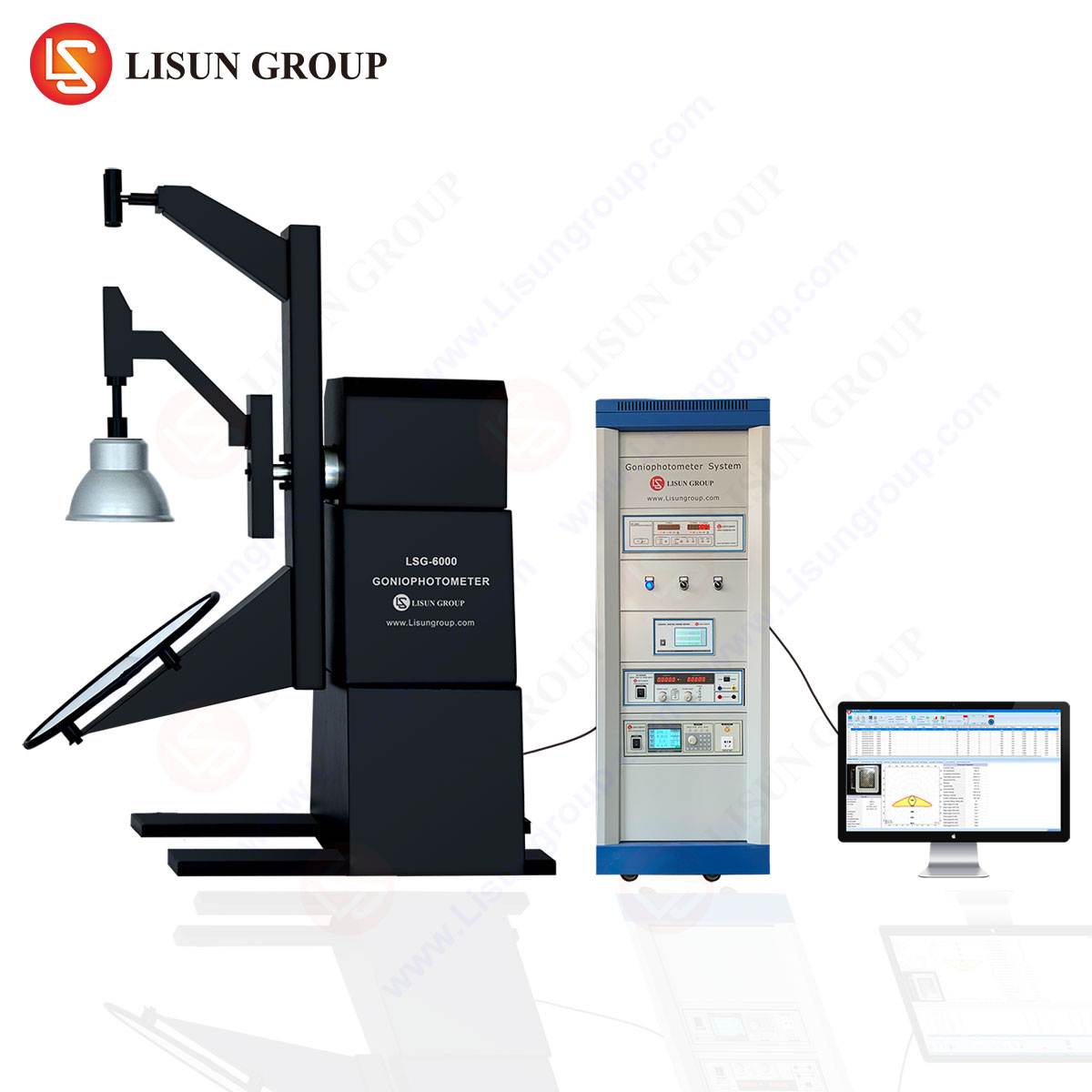
The LSG-1890B represents a Type C moving luminaire, fixed detector goniophotometer. Its design is engineered for high-precision, automated testing of a wide range of luminaires, from compact LED modules to large streetlights.
- Testing Principles & Specifications: The system employs a large-radius (variable, typically >2m) arm to rotate the luminaire around its photometric center. A high-sensitivity, spectrally corrected silicon photodetector is positioned at a fixed distance, ensuring measurements comply with the far-field condition (inverse square law validity). Key specifications include a wide dynamic measurement range (0.001 to 200,000 cd), an angular resolution of 0.001°, and the ability to handle luminaires up to 30kg in weight and 1.2m in length. It integrates a precision power supply and digital meter for simultaneous electrical measurements.
- Standards Compliance: The LSG-1890B is constructed to meet or exceed the requirements of major international and national standards, including:
- IEC: IEC 60598-1 (Luminaire safety), IEC 61341 (Method of measurement of center beam intensity and beam angle(s) of reflector lamps).
- IESNA: IESNA LM-79 (Electrical and Photometric Measurements of Solid-State Lighting Products), IESNA LM-75 (Goniophotometry of Luminaires).
- Other: EN 13032-1, CIE 121:1996, and national standards such as ANSI/IES RP-16 (Nomenclature and Definitions for Illuminating Engineering) and JIS C 8152.
- Competitive Advantages: The system’s advantages lie in its robust mechanical stability, which minimizes vibration-induced measurement error, and its advanced software suite. The software not only controls the hardware but also provides real-time 3D rendering of the intensity distribution, immediate calculation of all derived photometric parameters, and direct export to standard file formats (IES, LDT, CIE). Its automated sequence reduces operator error and significantly increases testing throughput.
Industry-Specific Applications for Performance Optimization
Lighting Industry & LED/OLED Manufacturing: Here, goniophotometer data is used for quality control, binning LEDs with similar spatial distributions, and refining secondary optics (lenses, reflectors). For OLED panels, it characterizes the Lambertian emission quality and viewing angle performance, critical for display and ambient lighting applications.
Display Equipment Testing: The angular color uniformity and luminance fall-off of displays are assessed using spectroradiometers integrated with goniometric stages. Data informs the design of optical films and diffusers to achieve wide, consistent viewing angles, a key parameter in consumer electronics and automotive displays.
Urban Lighting Design: For roadways and public spaces, data is used to calculate pavement luminance and illuminance uniformity ratios (as per EN 13201 and IESNA RP-8 standards), optimize pole spacing and mounting height, and minimize obtrusive light (skyglow, light trespass) by precisely controlling the light distribution.
Stage and Studio Lighting: Optimization focuses on beam shape, edge sharpness, and intensity gradients. Goniophotometer data allows designers of ellipsoidal reflector spotlights (ERS) and Fresnel fixtures to model gobo projection, field flatness, and the effects of barn doors, enabling creative control.
Medical Lighting Equipment: Surgical and examination lights require extreme uniformity, high color rendering, and specific shadow management. Spatial photometric data verifies that intensity and illuminance meet stringent standards (e.g., IEC 60601-2-41), ensuring clinician safety and procedural efficacy.
Sensor and Optical Component Production: The angular response of photodiodes, the gain profile of image intensifiers, and the transmission/reflection profiles of filters and diffusers are all characterized using goniophotometric principles, feeding directly into component specification and system integration.
Photovoltaic Industry & Scientific Research: While primarily for light emission, goniophotometer principles are applied in reverse to measure the angular dependence of light absorption in PV cells. In research labs, modified systems are used to study bi-directional scattering distribution functions (BSDF) of materials and novel light sources.
The Optimization Feedback Loop
Optimization is an iterative process. A prototype luminaire is measured, and its performance metrics are compared against design targets. For example, if a streetlight’s longitudinal uniformity ratio is below the 0.4 threshold of EN 13201 Class M, the reflector or lens geometry is adjusted. The modified prototype is re-measured. The high-resolution spatial data pinpoints exactly which angular zones require more or less intensity. This loop continues until all performance, efficacy, and glare criteria are satisfied. The final, optimized IES file then becomes the authoritative digital twin of the product, used by all lighting designers specifying the luminaire.
Integrating Spectral and Electrical Data
Modern advanced systems often couple the goniophotometer with a spectroradiometer. This allows for the measurement of chromaticity coordinates (CIE x,y, u’v’) and Color Rendering Index (CRI) as a function of angle. Angular color shift—a common issue in white LEDs due to phosphor geometry—can be quantified and minimized. Simultaneous electrical measurement (input power, power factor, current harmonics) links the optical performance directly to energy consumption and power quality, enabling holistic product optimization for both photometric and electrical standards.
Conclusion
Goniophotometer data transcends simple quality assurance; it is the foundational dataset for a systematic, engineering-driven approach to lighting performance optimization. From initial R&D through to compliance testing and end-use application simulation, the insights derived from precise spatial photometry enable innovations in efficiency, visual comfort, and optical control. The implementation of robust, automated, and standards-compliant test systems, such as the LISUN LSG-1890B, provides the reliable and high-resolution data necessary to execute this optimization across the diverse and technologically advanced landscape of modern lighting and optical industries.
FAQ
Q1: What is the primary difference between a Type A, Type B, and Type C goniophotometer, and why is the LSG-1890B classified as Type C?
A1: The classification (per CIE 121) refers to the axis rotation sequence. Type A rotates first about a vertical axis, Type B first about a horizontal axis, and Type C uses two independent rotations about vertical and horizontal axes where the luminaire’s photometric center remains fixed. The LSG-1890B is a Type C system, which is generally preferred for its mechanical stability with heavy luminaires and its alignment with common photometric reporting conventions (C-γ planes).
Q2: For very large luminaires, how is the far-field measurement condition maintained?
A2: The far-field condition requires the measurement distance to be at least five times the maximum dimension of the light source. For large-area luminaires, this can necessitate impractically large test distances. The solution is to use a near-field goniophotometer or an imaging photometer, which captures the luminous intensity distribution at a closer range and uses specialized software (ray file conversion) to mathematically compute the far-field distribution, as defined in standards like IESNA LM-79.
Q3: How does the system account for the self-heating of LED luminaires during measurement, which can affect photometric output?
A3: Accurate testing requires thermal stabilization. The LSG-1890B procedure involves a pre-conditioning period where the luminaire is powered at rated input until its light output reaches a steady state, as monitored by a reference detector. The actual goniophotometric scan is then performed while the luminaire remains in this thermally stable condition, and electrical parameters are monitored continuously to ensure consistency throughout the measurement cycle.
Q4: Can the LSG-1890B generate the photometric files required for specific regional lighting design software?
A4: Yes. The system’s software is capable of exporting the complete spatial intensity data in all major industry-standard formats, including IES (standard for North America), LDT (common in Europe), and CIE. These files are directly importable into virtually all professional lighting design and simulation software packages (e.g., Dialux, Relux, AGi32), ensuring global applicability.
Q5: What measures are in place to ensure the long-term accuracy and traceability of the measurements?
A5: The system’s photometric calibration is traceable to national metrology institutes (NMI) via calibrated reference standard lamps. Regular verification using these standards is required to maintain accuracy. Furthermore, the precision mechanical components, such as the robotic arms and encoders, are designed for minimal maintenance and long-term repeatability. The integrated software also includes routines for routine system self-check and alignment verification.