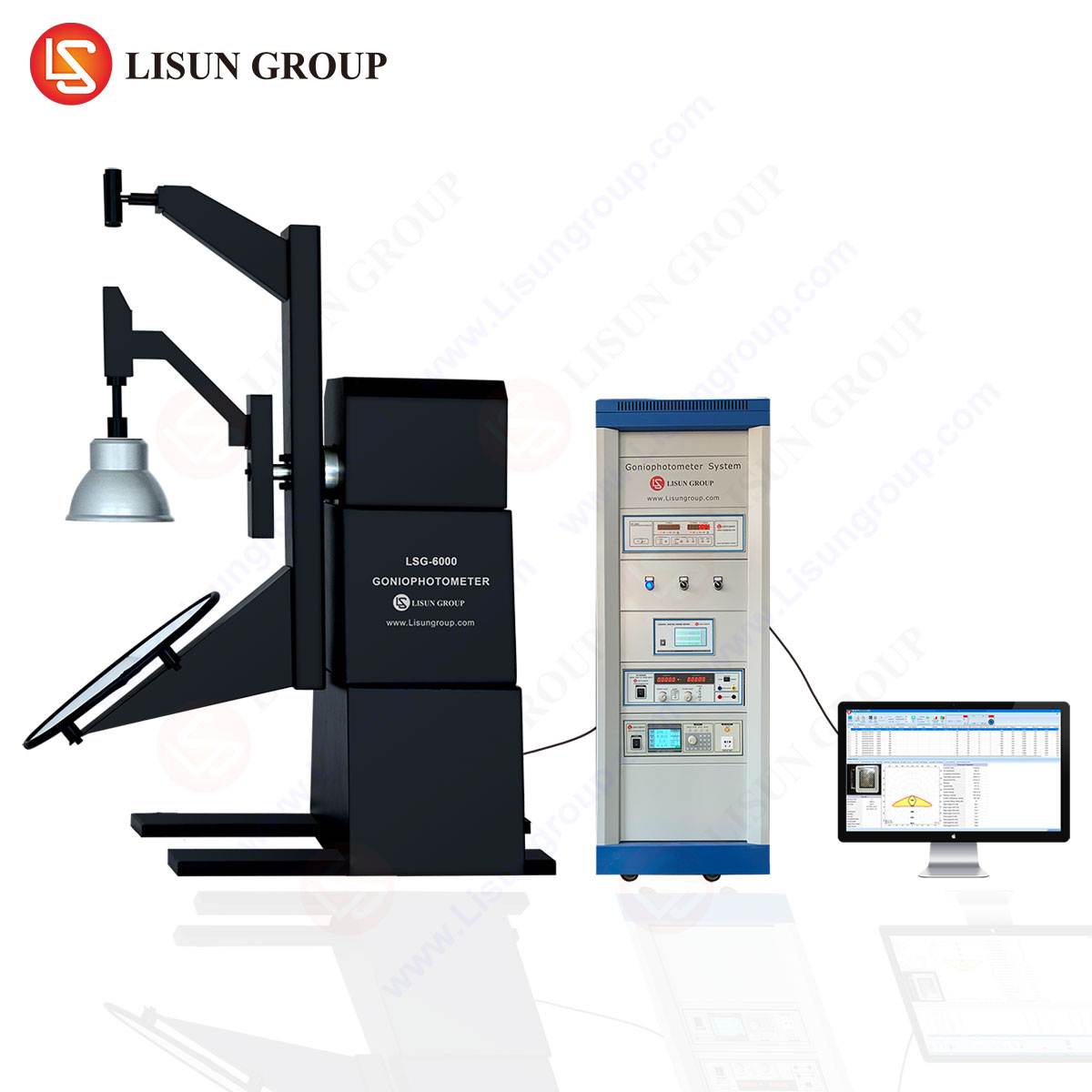



Advancements in Goniophotometric Systems for High-Precision Optical Characterization
Abstract
The quantitative assessment of spatial light distribution is a critical requirement across numerous scientific and industrial domains. Goniophotometry, the measurement of light intensity as a function of angle, provides the foundational methodology for this characterization. This article delineates the operational principles, technological implementations, and diverse applications of modern automated goniophotometric systems, with a specific focus on the LSG-6000 Goniophotometer Test System. The discussion encompasses its adherence to international standards, detailed technical specifications, and its pivotal role in research, development, and quality assurance processes within industries ranging from solid-state lighting to photovoltaic energy conversion.
Fundamentals of Goniophotometric Measurement
Goniophotometry operates on the principle of measuring the photometric or radiometric quantities of a light source from multiple angular perspectives. A goniophotometer system fundamentally consists of a rotating arm or a moving detector that orbits a stationary luminaire under test (LUT), or conversely, a mechanism that rotates the LUT in front of a fixed detector. The primary objective is to construct a comprehensive spatial intensity distribution, typically represented as a luminous intensity distribution curve (LIDC) or a full 3D model. Key photometric parameters derived from this data include total luminous flux (in lumens), luminous intensity (in candela), beam angle, and efficacy (lumens per watt). The accuracy of these measurements is contingent upon the system’s mechanical precision, the calibration of its photodetector, and its ability to minimize or account for ambient and stray light.
The measurement process is governed by the inverse square law, which states that the illuminance from a point source is inversely proportional to the square of the distance from the source. By maintaining a constant distance between the LUT and the detector, the goniophotometer ensures that variations in the detector signal are directly attributable to changes in the LUT’s luminous intensity. For near-field measurements of large-area sources like LED panels or displays, more complex near-field goniophotometry (NGF) techniques are employed, which capture detailed intensity data at close range and use specialized software to transform it into far-field distributions.
Architectural Design of the LSG-6000 Goniophotometer System
The LSG-6000 represents a Type C goniophotometer configuration, where the detector moves along a vertical arc while the LUT rotates around its own vertical and horizontal axes. This dual-axis rotation is critical for capturing a full 3D spatial distribution. The system’s architecture is engineered for high-precision measurements of luminaires with significant physical dimensions and weight, making it suitable for industrial R&D and certification laboratories.
The mechanical structure is constructed from rigid, anodized aluminum profiles to ensure long-term dimensional stability and resistance to environmental degradation. The central column, upon which the LUT is mounted, provides rotation around the vertical (gamma, γ) axis with a high angular resolution. The detector is mounted on a motorized arm that traverses the vertical (theta, θ) arc. The system’s design minimizes mechanical vibration and deflection, which are potential sources of measurement uncertainty. The LSG-6000 is typically housed within a dedicated darkroom, with walls coated in non-reflective, matte black paint to suppress stray light reflections that could contaminate the detector signal.
The photometric detector is a high-sensitivity, spectrally corrected silicon photodiode coupled with a precision current-to-voltage amplifier. For applications requiring spectral data, the system can be integrated with an array spectrometer, enabling the measurement of correlated color temperature (CCT), color rendering index (CRI), and chromaticity coordinates (x, y) as a function of angle. This is particularly vital for assessing color uniformity in LED modules and display backlighting units.
Technical Specifications and Performance Metrics of the LSG-6000
The performance of the LSG-6000 is defined by a set of rigorous technical specifications that dictate its measurement capabilities and accuracy. The following table enumerates its core parameters:
Table 1: Key Specifications of the LSG-6000 Goniophotometer
| Parameter | Specification |
|---|---|
| Measurement Distance | 5m to 30m (customizable) |
| Luminaire Maximum Weight | 100 kg |
| Luminaire Maximum Dimensions | 2000mm x 2000mm (L x W) |
| Gamma Axis (Vertical) | Rotation: 0° to 360°, Accuracy: ±0.05° |
| Theta Axis (Horizontal) | Rotation: -90° to +90° (or -180° to +180°), Accuracy: ±0.05° |
| Angular Step Size | Programmable, minimum step ≤ 0.1° |
| Photometric Detector | Class L (or Class A) photopic V(λ)-corrected sensor |
| Luminous Flux Range | 0.001 lm to 2,000,000 lm |
| Luminous Intensity Range | 0.001 cd to 1,000,000 cd |
| Data Acquisition System | 24-bit high-resolution ADC |
| Compliance Standards | IEC 60598-1, IEC 60630, IESNA LM-79, CIE 70, CIE 121, CIE S025, EN 13032-1 |
The system’s software provides automated control over the motion system and data acquisition. It allows for the definition of complex measurement sequences, including variable angular step sizes to optimize the trade-off between measurement resolution and duration. Post-processing algorithms generate industry-standard reports, including LIDC plots, isocandela diagrams, and 3D surface plots of luminous intensity. The software also calculates derived metrics such as zonal lumen summary, utilization factor, and beam angle classifications.
Adherence to International Standards and Certification Protocols
Compliance with internationally recognized standards is a non-negotiable prerequisite for instrumentation used in product development and certification. The LSG-6000 is designed to meet or exceed the requirements stipulated by several key standards bodies.
The International Electrotechnical Commission (IEC) standards, such as IEC 60598-1 (general requirements for luminaires) and IEC 60630 (performance specifications for incandescent lamps), provide foundational test methods. More specifically, the IESNA LM-79 standard, approved by the Illuminating Engineering Society of North America, prescribes the electrical and photometric measurements of solid-state lighting products. The LSG-6000 directly facilitates the photometric testing required by LM-79, Clause 9.0.
The International Commission on Illumination (CIE) provides the scientific underpinning for many of these standards. CIE 70 (Measurement of Absolute Luminous Intensity Distributions) and CIE 121 (The Photometry and Goniophotometry of Luminaires) are seminal documents that define the principles and practices for accurate goniophotometry. Furthermore, the CIE S025/E:2015 standard, which specifies test requirements for LED lamps, modules, and luminaires, is fully supported. In the European context, the EN 13032-1 standard (Light and lighting – Measurement and presentation of photometric data of lamps and luminaires) is a critical directive for lighting products entering the EU market. The LSG-6000’s design ensures that data output is formatted correctly for submission under these and other national standards, such as those from the American National Standards Institute (ANSI).
Application Spectrum in Research and Industrial Development
The versatility of a high-performance goniophotometer like the LSG-6000 enables its deployment across a wide array of R&D and quality control applications.
Lighting Industry and LED/OLED Manufacturing: Here, the system is indispensable for validating the optical performance of LED luminaires, modules, and OLED panels. Engineers use it to optimize secondary optics (lenses and reflectors) to achieve desired beam patterns, verify lumen output claims for Energy Star or DLC qualification, and analyze spatial color consistency, a common challenge in multi-LED arrays.
Display Equipment Testing: For manufacturers of LCD, OLED, and micro-LED displays, angular color shift and luminance uniformity are critical quality metrics. The LSG-6000 can map the viewing angle dependence of luminance and chromaticity, identifying issues like color washout or gamma shift that affect the user experience.
Photovoltaic Industry: While primarily a light-measurement tool, the principles of goniophotometry are inversely applied in photovoltaic R&D. By characterizing the angular response of solar cells or the spatial distribution of solar simulators, researchers can optimize the energy capture efficiency of PV systems under varying incident light angles.
Optical Instrument R&D and Scientific Research Laboratories: The system is used to characterize the output of lasers, collimators, and other optical assemblies. In scientific studies, it can be employed to measure the bi-directional reflectance distribution function (BRDF) of materials or the scattering profiles of particulates.
Urban Lighting Design: For public lighting projects, precise photometric data is required for simulation software to predict illuminance levels, uniformity, and potential light trespass or obtrusive light. The LSG-6000 provides the real-world data from prototype luminaires needed to validate these simulations.
Stage, Studio, and Medical Lighting Equipment: In these specialized fields, the beam’s shape, edge sharpness, and homogeneity are functionally critical. The goniophotometer allows designers to precisely quantify these attributes, ensuring that a theatrical spotlight provides a crisp, even field or that a surgical light offers shadow-free illumination.
Sensor and Optical Component Production: Manufacturers of ambient light sensors, imaging lenses, and optical filters utilize goniophotometric data to verify the angular acceptance profile and spectral sensitivity of their components, ensuring they perform as specified in the final application.
Comparative Analysis of System Capabilities and Limitations
The primary competitive advantage of a system like the LSG-6000 lies in its robust construction, high payload capacity, and measurement flexibility. Its ability to accommodate large and heavy luminaires, such as high-bay industrial lights or streetlights, positions it as an industrial-grade solution, distinguishing it from benchtop systems designed for smaller light sources. The high angular accuracy of ±0.05° ensures that even narrow-beam distributions are mapped with high fidelity, which is essential for applications like automotive headlight testing or high-precision optical systems.
A key consideration in goniophotometry is the trade-off between measurement speed and data density. A full 3D scan with fine angular resolution can be time-consuming. The LSG-6000’s software mitigates this by allowing adaptive scanning patterns, where critical angular regions (e.g., the center of a beam) are measured with higher resolution than peripheral areas. The requirement for a large, dedicated darkroom space and the associated infrastructure cost represents a significant investment, making such systems most suitable for central R&D laboratories, third-party testing houses, and high-volume manufacturers where comprehensive optical characterization is a core business function.
Frequently Asked Questions (FAQ)
Q1: What is the primary distinction between a Type A, Type B, and Type C goniophotometer, and why is the LSG-6000 classified as Type C?
Type A systems rotate the luminaire around its vertical and horizontal axes with a fixed detector. Type B systems rotate the luminaire around its vertical axis and the detector moves in the vertical plane. Type C systems, like the LSG-6000, rotate the luminaire around its vertical axis while the detector moves along a vertical arc. The Type C configuration is often preferred for large, asymmetrical luminaires as it maintains a constant distance to the photometric center, simplifying data analysis and improving accuracy for complex distributions.
Q2: How does the system account for the self-heating of LED luminaires during extended measurement cycles?
LED performance is highly dependent on junction temperature. The LSG-6000 procedure requires that the LUT be thermally stabilized at its rated operating temperature prior to the commencement of the goniophotometric scan. The measurement itself is then performed as rapidly as possible to minimize any further thermal drift. For highly accurate work, the drive current can be monitored and adjusted in real-time to maintain constant optical power, or the scan can be paused to re-stabilize the LUT.
Q3: Can the LSG-6000 measure the flicker percentage of a light source?
While a standard photometric detector is not fast enough to capture flicker, the LSG-6000 can be integrated with a high-speed photodetector and data acquisition card. This allows for the measurement of temporal light artifacts (TLA), including percent flicker and flicker index, as defined by standards like IEEE 1789, at various points in the spatial distribution. This is an essential capability for assessing lighting used in sensitive environments like studios or for high-speed camera applications.
Q4: What is the significance of the V(λ) correction in the photometric detector?
The human eye has a specific spectral sensitivity, known as the photopic luminosity function, V(λ). A photometric detector must be equipped with a filter that modifies its native spectral response to match this V(λ) curve. This correction is mandatory for all photometric measurements (luminous flux, luminous intensity) to ensure that the measured values accurately represent the light’s perceived brightness by a standard human observer, rather than its raw radiant power.
Q5: For near-field measurements of large-area sources like displays, what supplementary equipment is required?
For near-field goniophotometry (NGF), the standard far-field detector is replaced with a high-resolution imaging luminance measurement device (ILMD), such as a CCD or CMOS camera coupled with a scientific-grade lens and a filter wheel. The LSG-6000’s motion system would then position this camera at various angles relative to the display surface. Specialized NGF software is used to capture the luminance images and mathematically transform the near-field data into a far-field intensity distribution.