








The Role of Mirror Goniophotometry in Advanced Photometric Characterization
The accurate measurement of light is a cornerstone of modern photometric science, underpinning advancements across industries from solid-state lighting to medical device manufacturing. As light-emitting diode (LED) technology continues to evolve, offering unprecedented efficiency and design flexibility, the tools for its characterization must similarly advance. Traditional integrating spheres, while effective for total luminous flux measurement, fall short in providing the spatial distribution data essential for understanding a luminaire’s true performance. This necessitates the use of goniophotometry, the definitive method for measuring the spatial radiation pattern of light sources. Among the various goniophotometer designs, the mirror goniophotometer represents a pinnacle of precision, efficiency, and versatility for high-accuracy laboratory testing.
Fundamental Principles of Mirror-Based Goniophotometry
A goniophotometer functions by rotating a light source relative to a fixed photodetector, or vice versa, to measure luminous intensity at numerous points within a spherical coordinate system. The mirror goniophotometer optimizes this principle by employing a single, highly precise photodetector that remains stationary. The rotation of the light source is augmented by a moving mirror system that directs light from the source at any given angle to the fixed detector. This configuration offers significant advantages over moving-detector designs. By eliminating the need to move the sensitive detector assembly, the system enhances mechanical stability, reduces measurement uncertainty introduced by vibration or cable movement, and accelerates the testing process. The light path is carefully calibrated, and the mirror’s movement is synchronized with the rotation of the device under test (DUT) to ensure that the angle of incidence on the detector is constant, preserving measurement integrity.
The core measurement output is a comprehensive set of luminous intensity values across the C-γ (or C-Plane) and γ-α coordinate systems. This data set is processed to generate the Intensity Distribution Curve (IDC), which is a polar plot of luminous intensity. From this foundational data, a multitude of photometric parameters can be derived, including total luminous flux, beam angles, luminance distribution, efficacy (lm/W), and the generation of standardized file formats such as IES (Illuminating Engineering Society) and EULUMDAT (European Lumen Data format), which are critical for lighting design software.
Architectural Design and Operational Mechanics of the LSG-6000
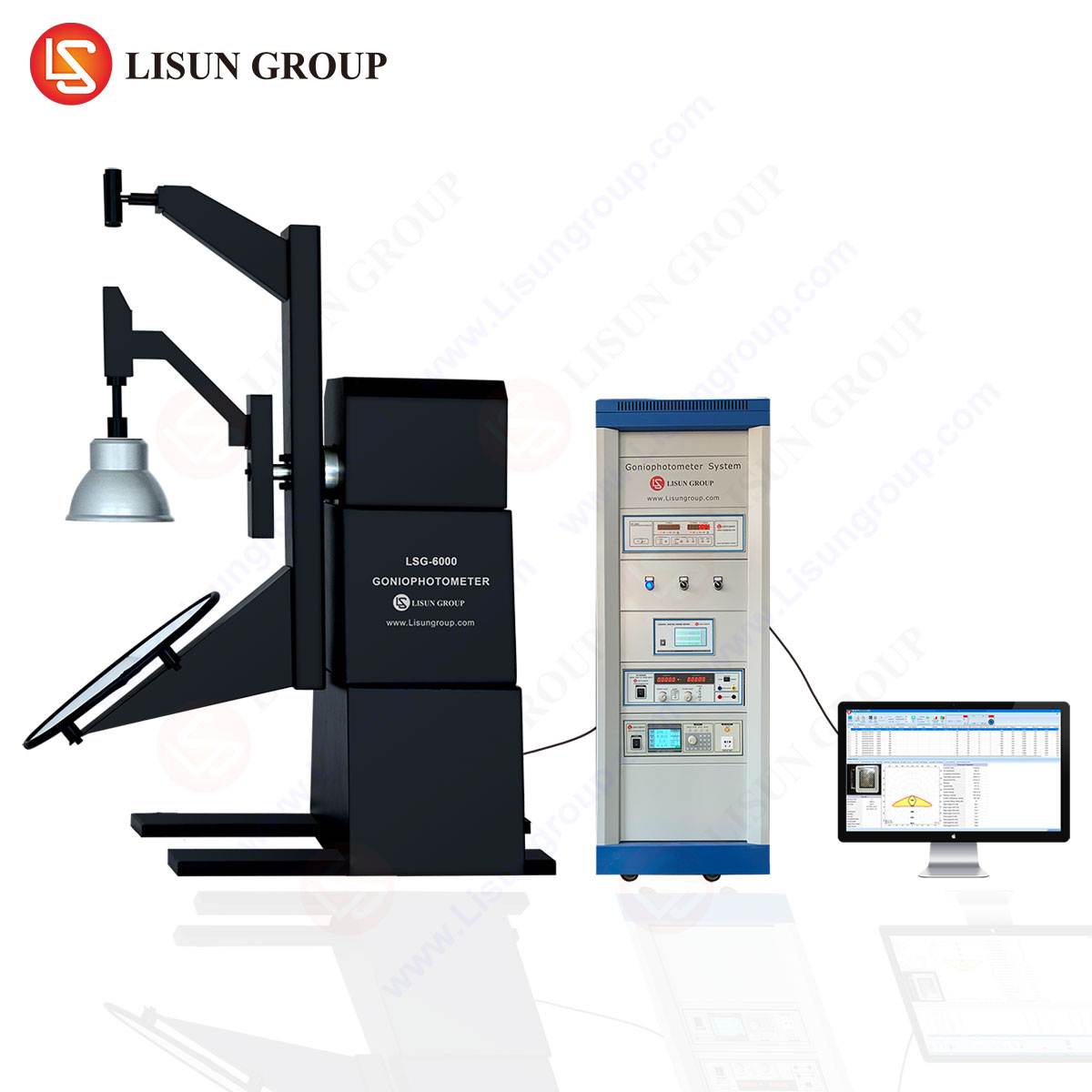
The LISUN LSG-6000 Mirror Goniophotometer exemplifies the application of these principles in a robust, industrial-grade testing system. Designed for large luminaires, the system features a significant test distance, ensuring measurements are conducted in the far-field, a prerequisite for accurate photometry as per international standards like CIE 70 and IESNA LM-79.
The system’s architecture is based on a dual-axis rotational mechanism. The DUT is mounted on a rotating arm that controls the vertical (γ) angle, while a large, high-reflectance, first-surface mirror rotates to capture and direct light to the detector for the horizontal (C) angle measurement. This mirror is engineered to have a spectrally neutral reflectance curve to prevent any alteration of the source’s spectral power distribution before it reaches the detector. The photodetector is a high-accuracy, V(λ)-corrected silicon photodiode, ensuring its spectral sensitivity matches the standardized CIE photopic luminosity function. The entire system is managed by sophisticated software that controls the stepper motors, collects data from the detector, and performs the complex calculations to transform raw photocurrent readings into actionable photometric data.
Key specifications of the LSG-6000 include a maximum luminaire size capacity of 1500mm in length and 150kg in weight, a testing distance configurable up to 30 meters, and angular resolution as precise as 0.001°. This combination of capacity, precision, and flexibility makes it suitable for testing a vast array of products, from high-bay industrial lighting and street luminaires to large sports lighting fixtures.
Compliance with International Photometric Standards
The design and operation of the LSG-6000 are rigorously aligned with a comprehensive suite of international testing standards. This compliance is not merely a feature but a fundamental requirement for laboratories seeking accreditation and for manufacturers aiming to sell products in global markets.
The primary standard governing electrical and photometric measurements of solid-state lighting products is IES LM-79-19, which explicitly approves the use of goniophotometers for measuring total luminous flux and spatial intensity distribution. The LSG-6000’s far-field design directly satisfies the requirements stipulated in this standard. Furthermore, the system adheres to CIE 70-1987 (The Measurement of Absolute Luminous Intensity Distributions) and CIE 121-1996 (The Photometry of Goniophotometers), which provide the foundational methodologies for goniophotometric measurement.
For specific applications, compliance extends to other critical standards. In automotive lighting, SAE J575 and ECE Regulations define photometric performance requirements for signal lamps and headlights; the LSG-6000 provides the spatial resolution necessary for such certification. For outdoor and road lighting, standards like EN 13201 and ANSI/IESNA RP-8 rely on precise intensity distribution data, which this instrument is designed to provide. This multi-standard capability ensures that data generated by the LSG-6000 is recognized and respected by testing bodies and regulatory agencies worldwide.
Industrial Applications Spanning Multiple Sectors
The precision of a mirror goniophotometer finds critical application in a diverse range of industries where control over light distribution is paramount.
Lighting Industry and LED Manufacturing: This is the primary application, where the system is used for quality control, R&D, and product certification. Manufacturers use the data to validate design prototypes, ensure batch-to-batch consistency, and generate the IES files required by architects and lighting designers.
Display Equipment Testing: The performance of backlight units (BLUs) for LCDs and the uniformity of large video walls require precise angular luminance measurements. A goniophotometer can characterize viewing angles, contrast ratios, and color shifts over angle, which are key metrics for display quality.
Urban Lighting Design: Designing effective and compliant public lighting requires precise knowledge of a luminaire’s intensity distribution to minimize light pollution (as guided by standards like IDA-IES Model Lighting Ordinance), ensure adequate roadway illumination, and prevent glare for drivers and pedestrians.
Stage and Studio Lighting: Theatrical and broadcast lighting fixtures are defined by their beam shape, field angle, and fall-off. Goniophotometry allows designers to precisely map these characteristics, enabling the creation of complex lighting scenes and ensuring consistent performance across a fleet of fixtures.
Medical Lighting Equipment: Surgical lights and medical examination lamps have stringent requirements for homogeneity, shadow reduction, and illuminance levels. Regulatory frameworks like ISO 9680 for dental lights and IEC 60601-2-41 for surgical luminaires require detailed photometric verification that only a goniophotometer can provide.
Optical Instrument R&D and Sensor Production: The development of lenses, diffusers, reflectors, and optical sensors often requires characterizing how these components interact with light from different angles. The LSG-6000 serves as an essential tool for validating optical simulations and prototyping new components.
Comparative Advantages in a Competitive Landscape
The LSG-6000’s mirror-type design confers several distinct advantages over alternative goniophotometer architectures, such as moving detector types or robotic-arm systems.
Enhanced Measurement Speed and Throughput: The movement of a lightweight mirror is inherently faster and requires less energy than moving a massive detector array or a robotic arm. This allows the LSG-6000 to complete full spatial scans in a fraction of the time, significantly increasing laboratory throughput for high-volume testing environments.
Superior Stability and Reduced Uncertainty: With the detector fixed in place, the system is immune to errors induced by flexing cables, shifting calibration, or mechanical vibration associated with moving the detector. This enhances measurement reproducibility and lowers the overall uncertainty budget, a critical factor for accredited calibration laboratories.
Operational Safety and Durability: By containing the high-speed movement within the mirror mechanism and keeping the detector static, the system reduces wear and tear on the most sensitive and expensive component—the photometer. This leads to lower long-term maintenance costs and higher system availability.
Flexibility for Complex Measurements: The software controlling the LSG-6000 can be programmed to perform specialized scans, such as high-resolution measurements within a specific angular region of interest (e.g., the peak beam of a spotlight). This flexibility is invaluable for R&D applications where detailed analysis of optical components is required.
Frequently Asked Questions
What is the primary difference between an integrating sphere and a goniophotometer?
An integrating sphere is designed to capture and average all light emitted from a source to measure total luminous flux. A goniophotometer measures the intensity of light emitted in each direction to map the spatial distribution of light, from which total flux can also be calculated. The goniophotometer provides a complete photometric profile, while the sphere provides only a sum.
Why is a far-field test distance necessary, and how is it determined?
Far-field measurements are required to ensure the photodetector sees the luminaire as a point source, which is a fundamental assumption behind the inverse-square law used in photometry. The test distance is typically determined as five times the largest dimension of the light-emitting surface of the DUT, as per standards like IES LM-79.
Can the LSG-6000 measure the color properties of a light source, such as CCT or CRI, over angle?
While the standard system uses a photopic (V(λ)) detector for intensity, it can be equipped with a high-speed spectroradiometer as the detector. This allows for the measurement of complete spectral data at every angle, enabling the calculation of angular color uniformity, Correlated Color Temperature (CCT), Color Rendering Index (CRI), and other colorimetric parameters.
How does the system handle temperature sensitivity of LEDs during testing?
LED performance is highly dependent on junction temperature. The LSG-6000 software can integrate with external power supplies and thermal monitoring systems. For precise characterization, tests are often run after the DUT has reached thermal steady-state, and the software can log electrical parameters (voltage, current) throughout the measurement to ensure data consistency.
What file formats can the system generate for lighting design applications?
The system software is capable of exporting photometric data in all industry-standard formats, including IES (.ies), EULUMDAT (.ldt), and CIBSE TM14 (.cibse). These files contain the intensity distribution matrix and metadata, which can be imported into lighting simulation software like Dialux, Relux, and AGi32 for design and analysis.