





Foundations of Luminance Quantification and the Role of Spectroradiometry
Luminance, the photometric measure of luminous intensity per unit area of light travelling in a given direction, serves as a fundamental parameter in quantifying the perceptual brightness of a source or surface. Its accurate measurement is critical across a diverse spectrum of industries, from ensuring the safety and performance of automotive lighting to guaranteeing the color fidelity of consumer displays. The transition from broad-band, filter-based luminance meters to high-precision spectroradiometric systems represents a significant technological evolution, enabling a comprehensive characterization of light that encompasses both its photometric and radiometric properties. Modern luminance measurement solutions, therefore, are not merely instruments for reading a value in candelas per square meter (cd/m²), but sophisticated analytical tools that decode the complete spectral story of a light source. This article delineates the principles, applications, and technological specifications of advanced spectroradiometric systems, with a specific focus on the capabilities of the LISUN LMS-6000 series as a paradigm of contemporary measurement engineering.
Spectral Radiance as the Primary Photometric Quantity
The cornerstone of precise luminance measurement lies in the principle of spectral radiance, measured in watts per steradian per square meter per nanometer (W·sr⁻¹·m⁻²·nm⁻¹). A spectroradiometer configured for luminance quantifies the spectral radiance of a source within a precisely defined field of view. The instrument’s optical system, typically comprising a telescopic lens assembly, collects light from a targeted area and directs it onto a diffraction grating or other dispersive element. This element spatially separates the incident light into its constituent wavelengths, which are then projected onto a high-sensitivity detector array, such as a Charge-Coupled Device (CCD). The resulting spectral power distribution (SPD) is the fundamental dataset from which all photometric and colorimetric quantities are derived.
Luminance (Lv) is calculated by integrating the spectral radiance data, weighted by the CIE standard photopic luminosity function, V(λ), which models the spectral sensitivity of the human eye under typical lighting conditions. The governing equation is:
Lv = Km ∫ Lλ(λ) V(λ) dλ
where:
- Lv is the luminance in cd/m².
- Km is the photopic luminous efficacy constant (683 lm/W).
- Lλ(λ) is the spectral radiance.
- V(λ) is the CIE photopic luminosity function.
This methodology provides a significant advantage over direct-reading luminance meters. By capturing the full SPD, a spectroradiometer can calculate not only luminance but also a complete suite of photopic and scotopic quantities, correlated color temperature (CCT), color rendering index (CRI), chromaticity coordinates (x, y; u’, v’), and dominant wavelength. This multi-parameter output from a single measurement is indispensable for comprehensive light source characterization.
Architectural Design of the LISUN LMS-6000 Spectroradiometer Series
The LISUN LMS-6000 series embodies a modular approach to high-fidelity spectroradiometry, designed to meet the stringent requirements of various industrial and research applications. The core architecture of these instruments is built upon a high-resolution optical system and a thermally stabilized detector to ensure long-term measurement stability and repeatability. A key feature is the use of an imaging spectrograph coupled with a high-performance CCD, allowing for the simultaneous capture of a wide spectral range with minimal stray light.
The series comprises several specialized models, each optimized for specific measurement regimes:
- LMS-6000: The foundational model, offering a standard wavelength range and high sensitivity for general-purpose applications.
- LMS-6000F: Engineered with an enhanced dynamic range and signal-to-noise ratio for measuring low-light-level sources, such as emergency signage or display blacks.
- LMS-6000S: Incorporates a high-sensitivity, deep-cooled CCD detector, significantly reducing dark noise for applications requiring extreme precision, such as in scientific research laboratories measuring bioluminescence or faint astrophysical light sources.
- LMS-6000P: Features a high-power, pulsed light source input capability, designed for characterizing high-intensity pulsed LEDs and lasers used in medical equipment and automotive LIDAR systems.
- LMS-6000UV: Extends the spectral range into the ultraviolet region, critical for applications involving UV curing in industrial processes, sterilization efficacy of medical lighting, and material degradation studies.
- LMS-6000SF: A specialized fast-trigger model that synchronizes measurements with pulsed or rapidly modulating light sources, essential for testing automotive brake lights and communication systems using visible light (Li-Fi).
Table 1: Representative Technical Specifications of the LISUN LMS-6000 Series
| Parameter | Specification | Note |
| :— | :— | :— |
| Wavelength Range | 350nm – 800nm (Standard); 200nm – 800nm (UV Model) | Covers photopic and scotopic vision ranges. |
| Wavelength Accuracy | ±0.3nm | Ensures precise chromaticity calculation. |
| Luminance Measurement Range | 0.001 to 500,000 cd/m² | Suitable from starlight to direct sunlight. |
| Field of View | 1°, 0.5°, 0.2° (Selectable) | Enables measurement of small or distant sources. |
| Photometric Accuracy | ±3% (for standard illuminant A) | Traceable to NIST standards. |
| Dynamic Range | > 10^6:1 (LMS-6000F/SF) | Critical for high-contrast display testing. |
Validation and Calibration Protocols for Measurement Integrity
The metrological credibility of any luminance measurement system is contingent upon a rigorous and traceable calibration process. The LMS-6000 series is calibrated against a primary standard lamp, whose spectral radiance is certified by a national metrology institute (NMI) such as NIST or PTB. This process establishes a direct traceability chain, ensuring that all measurements are accurate and reproducible. The calibration involves characterizing the instrument’s absolute spectral responsivity, wavelength scale, and linearity across its entire dynamic range.
Regular verification using secondary standard sources is a critical practice in maintaining measurement integrity. For luminance applications, this often involves a stable, uniform luminance source with a known and stable spectral output. The system’s linearity is paramount, especially when measuring sources with high dynamic ranges, such as OLED displays with local dimming. Non-linearity can lead to significant errors in both photometric and colorimetric data. The LMS-6000 series employs advanced electronic and algorithmic compensation to maintain linearity across its operational range, a feature verified through calibrated neutral density filters or an integrating sphere with an adjustable output.
Application in Automotive Lighting and Signaling Systems
The automotive industry presents one of the most demanding environments for luminance measurement, governed by stringent international regulations such as ECE and SAE standards. The performance of headlamps, daytime running lights (DRLs), tail lights, and interior displays must be meticulously validated. The LMS-6000SF, with its fast-trigger capability, is uniquely suited for this sector. It can synchronize with a vehicle’s electronic control unit (ECU) to capture the instantaneous luminance of a pulsed LED brake light, ensuring it meets the mandated rise-time and peak intensity requirements.
Furthermore, the instrument’s small field of view (e.g., 0.2°) allows engineers to measure specific zones within a complex headlamp lens pattern, verifying that the high-beam and low-beam distributions conform to regulatory cut-off lines and hot-spot specifications. The ability to measure CCT and chromaticity ensures that white headlamps do not exhibit undesirable blue tints, which can cause discomfort glare for oncoming drivers, and that signal lights fall within the legally defined color gamuts.
Precision Metrology in Display and Panel Manufacturing
In the competitive display industry, encompassing LCD, LED, OLED, and micro-LED technologies, luminance uniformity, color consistency, and contrast ratio are key differentiators. The high dynamic range of the LMS-6000F model is essential for accurately measuring the true contrast ratio of a display, which requires quantifying both the peak white luminance and the deepest black level within the same measurement session. Stray light within the instrument’s optical path can artificially inflate black-level readings; the LMS-6000’s low-stray-light design mitigates this, providing a true representation of display performance.
For OLED and micro-LED panel manufacturers, the instrument’s small field of view enables pixel-level and sub-pixel-level measurements. This is critical for identifying mura defects (non-uniformity) and verifying the color gamut coverage against standards like DCI-P3 and Rec. 2020. The spectroradiometric data allows for the calculation of color deviation (Δu’v’) across the entire panel surface, providing quantitative data for process control and quality assurance.
Aerospace, Marine, and Urban Lighting Compliance
Beyond consumer electronics, luminance measurement is a matter of safety and regulation in aerospace, marine, and urban contexts. Aircraft cockpit displays and control panels must maintain legibility under extreme ambient lighting conditions, from direct sunlight to pitch darkness. The LMS-6000S, with its high sensitivity and cooled detector, can reliably measure the dimmest settings of these displays to ensure they remain readable without causing pilot dark adaptation issues.
In marine and navigation lighting, the precise chromaticity and intensity of port (red) and starboard (green) lights are legally defined by the International Maritime Organization (IMO). A spectroradiometer is the only tool capable of verifying compliance with these narrow color boundaries. Similarly, in urban lighting design, the LMS-6000 is used to assess the obtrusive light and glare from streetlights and architectural facades, ensuring they adhere to dark-sky ordinances and contribute to a safe, comfortable public visual environment.
Advanced Applications in Photovoltaic and Medical Equipment Testing
The utility of spectroradiometric luminance measurement extends into highly specialized fields. In the photovoltaic industry, the LMS-6000 is used to characterize the spectral irradiance of solar simulators. The accuracy of solar cell efficiency testing is directly dependent on the simulator’s spectrum matching the AM1.5G standard spectrum. The high wavelength accuracy of the LMS-6000 allows for precise spectral mismatch calculations, leading to more accurate corrections and reliable performance data for solar panels.
In the medical field, the LMS-6000UV finds application in validating surgical and diagnostic lighting. The color rendering properties of surgical lights are critical for accurate tissue differentiation, requiring high CRI values. Furthermore, for phototherapy equipment used in treating neonatal jaundice or skin conditions, the absolute spectral radiance in the blue or UV-A/UV-B regions must be precisely controlled to deliver the correct therapeutic dose while minimizing harmful overexposure.
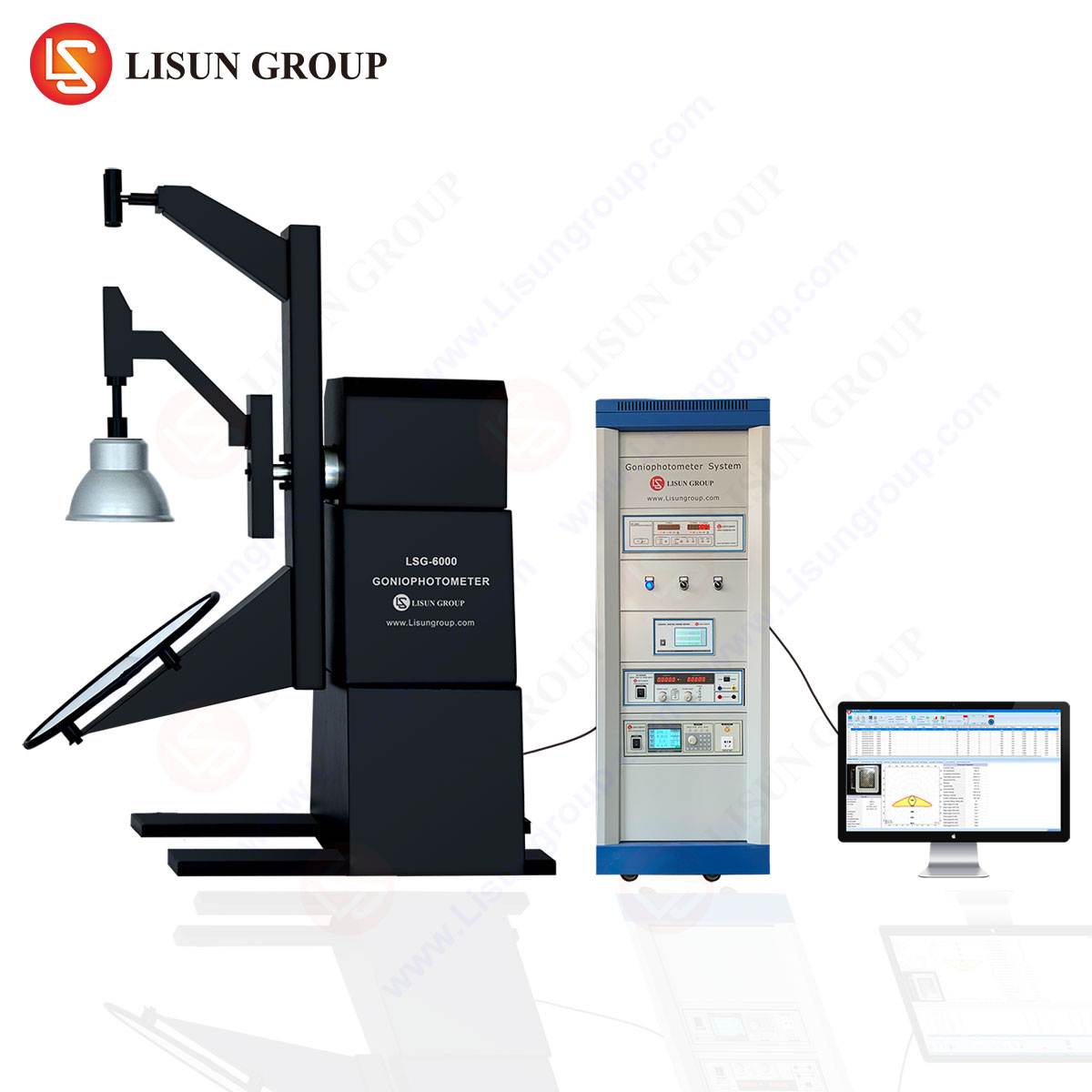
Integration with Goniophotometric Systems for Spatial Luminous Intensity Distribution
A standalone spectroradiometer provides a point measurement. For a complete characterization of a luminaire’s performance, it must be integrated into a goniophotometer. In this configuration, the LMS-6000 is mounted on a moving arm that rotates around the light source under test, measuring the spectral radiance (and thus luminance) from hundreds or thousands of different angles. This data set is used to generate a complete 3D model of the source’s luminous intensity distribution, total luminous flux (in lumens), and spatial color uniformity. This integrated system is the gold standard for lighting manufacturers in the LED & OLED manufacturing sector for certifying product performance datasheets.
FAQ Section
Q1: What is the critical difference between a spectroradiometer like the LMS-6000 and a traditional luminance meter?
A traditional luminance meter uses filtered photodiodes to approximate the V(λ) function and provides only a luminance value. A spectroradiometer captures the full spectral power distribution, enabling the calculation of luminance, chromaticity, CCT, CRI, and many other photometric and colorimetric parameters from a single, fundamental measurement, offering far greater analytical depth and accuracy.
Q2: How does the field of view selection impact a luminance measurement?
The field of view defines the area on the target from which light is collected. A smaller FOV (e.g., 0.2°) allows for the measurement of very small features, such as an individual LED chip or a single pixel on a display. A larger FOV (e.g., 1°) provides an average measurement over a broader area, which is suitable for evaluating the uniformity of a larger light panel or a backlit surface.
Q3: Why is dynamic range particularly important for testing modern display technologies?
Modern high-dynamic-range (HDR) displays are designed to simultaneously render very bright highlights and very deep blacks. To accurately measure the contrast ratio, the instrument must be capable of quantifying both extremes without saturating at the high end or losing the signal in noise at the low end. A high dynamic range, as found in the LMS-6000F, is therefore essential for valid HDR performance verification.
Q4: Can the LMS-6000 be used to measure flicker or temporal light modulation?
While the standard models capture a steady-state spectrum, the LMS-6000SF (Fast-Trigger) variant is designed for this purpose. It can be synchronized with a source’s modulation to capture the luminance at specific phases of the waveform, enabling the analysis of flicker percentage, frequency, and other temporal characteristics critical for automotive signaling and display performance.
Q5: What is the significance of NIST-traceable calibration for a luminance measurement system?
NIST-traceable calibration provides an unbroken chain of comparisons linking the instrument’s readings back to the primary standards maintained by the National Institute of Standards and Technology (USA). This ensures that the measurements are accurate, reliable, and internationally recognized, which is a fundamental requirement for regulatory compliance, quality control, and credible research and development data.