


Technical Analysis of the LMS-6000 High-Precision Array Spectroradiometer
Abstract
The evolution of photometric and radiometric measurement demands instrumentation capable of delivering high fidelity across a broad spectral range with exceptional efficiency. The LMS-6000 array spectroradiometer represents a significant advancement in optical measurement technology, integrating a high-performance CCD detector with a stabilized optical bench to address rigorous application requirements. This article provides a detailed examination of the LMS-6000’s operational principles, technical specifications, and its pivotal role in ensuring compliance and driving innovation across multiple scientific and industrial sectors.
Optical Architecture and Signal Acquisition Methodology
The foundational principle of the LMS-6000 is based on dispersive spectrometry utilizing a fixed-grating polychromator. Incoming light is collected via an integrating sphere, cosine corrector, or direct-fiber optic input and transmitted through a single-mode optical fiber to ensure spatial uniformity. This light is collimated and directed onto a planar diffraction grating with high groove density. The grating disperses the polychromatic beam into its constituent wavelengths, which are then focused onto a 2048-element linear silicon CCD array.
Each pixel on the CCD corresponds to a specific wavelength channel, enabling simultaneous capture of the entire spectral range from 350nm to 800nm (extendable to 250nm-1050nm with grating options). This parallel detection scheme eliminates the mechanical scanning mechanisms found in traditional monochromators, resulting in a typical measurement duration of 10-100 milliseconds per scan. This speed is critical for capturing transient phenomena or for high-throughput testing environments. The system employs a 16-bit analog-to-digital converter (ADC) to digitize the CCD signal, providing a dynamic range sufficient to measure both very low and high irradiance levels without detector saturation or excessive noise.
Calibration Traceability and Measurement Accuracy
Metrological traceability is paramount for any measurement instrument. The LMS-6000 is factory-calibrated using NIST-traceable standard lamps for absolute spectral irradiance and radiance. The calibration process characterizes the system’s spectral responsivity (in counts per watt per square meter per nanometer) and wavelength accuracy. A key feature is the integrated wavelength calibration source, typically a mercury-argon or deuterium lamp, which allows for periodic verification and correction of wavelength alignment, ensuring long-term stability against thermal drift or mechanical stress.
The system’s software incorporates algorithms for dark current subtraction, electrical offset correction, and nonlinearity compensation. The baseline noise, expressed as the root-mean-square (RMS) of a dark measurement, is typically less than 0.0001 W/m²/sr/nm, enabling the detection of subtle spectral features. The wavelength reproducibility is within ±0.2nm, and the photometric linearity exceeds 99.8% across the full dynamic range. These parameters are not merely specifications but are rigorously validated against international standards such as CIE 063-1984, CIE 013.3-1995, and IESNA LM-79.
Spectral Resolution and Stray Light Suppression
Effective spectral resolution, defined as the Full Width at Half Maximum (FWHM) of the instrument’s slit function, is approximately 2.5nm for the standard LMS-6000 configuration. This is achieved through a combination of the entrance slit width, grating dispersion, and pixel pitch of the CCD. This resolution is sufficient to resolve the characteristic emission lines of phosphor-converted LEDs, the fine structure of narrow-band emitters, and the absorption features in material testing.
A more critical performance metric for array spectrometers is stray light rejection—the instrument’s ability to prevent light at one wavelength from being measured at another. The LMS-6000 utilizes a double-monochromator inspired optical layout with multiple baffles and order-sorting filters. This design yields an out-of-band rejection ratio better than 10⁻⁵, which is essential for accurate measurement of LEDs with dominant blue pumps, where stray blue light can artificially inflate measurements in the red and far-red regions. This performance is validated using sharp-cut filters and laser line sources per IES TM-27-20.
Application-Specific Configurations and Industry Deployment
The core LMS-6000 platform is adapted through specific configurations to meet domain-specific requirements.
-
Lighting Industry and LED/OLED Manufacturing: Here, the instrument measures luminous flux (in lumens), chromaticity coordinates (CIE 1931 x,y and CIE 1976 u’,v’), correlated color temperature (CCT), color rendering index (CRI, Ra), and newer metrics like TM-30 (Rf, Rg). In production lines, the LMS-6000’s speed enables 100% binning of LEDs for color consistency. For OLED panels, it assesses spatial uniformity and angular color shift.
-
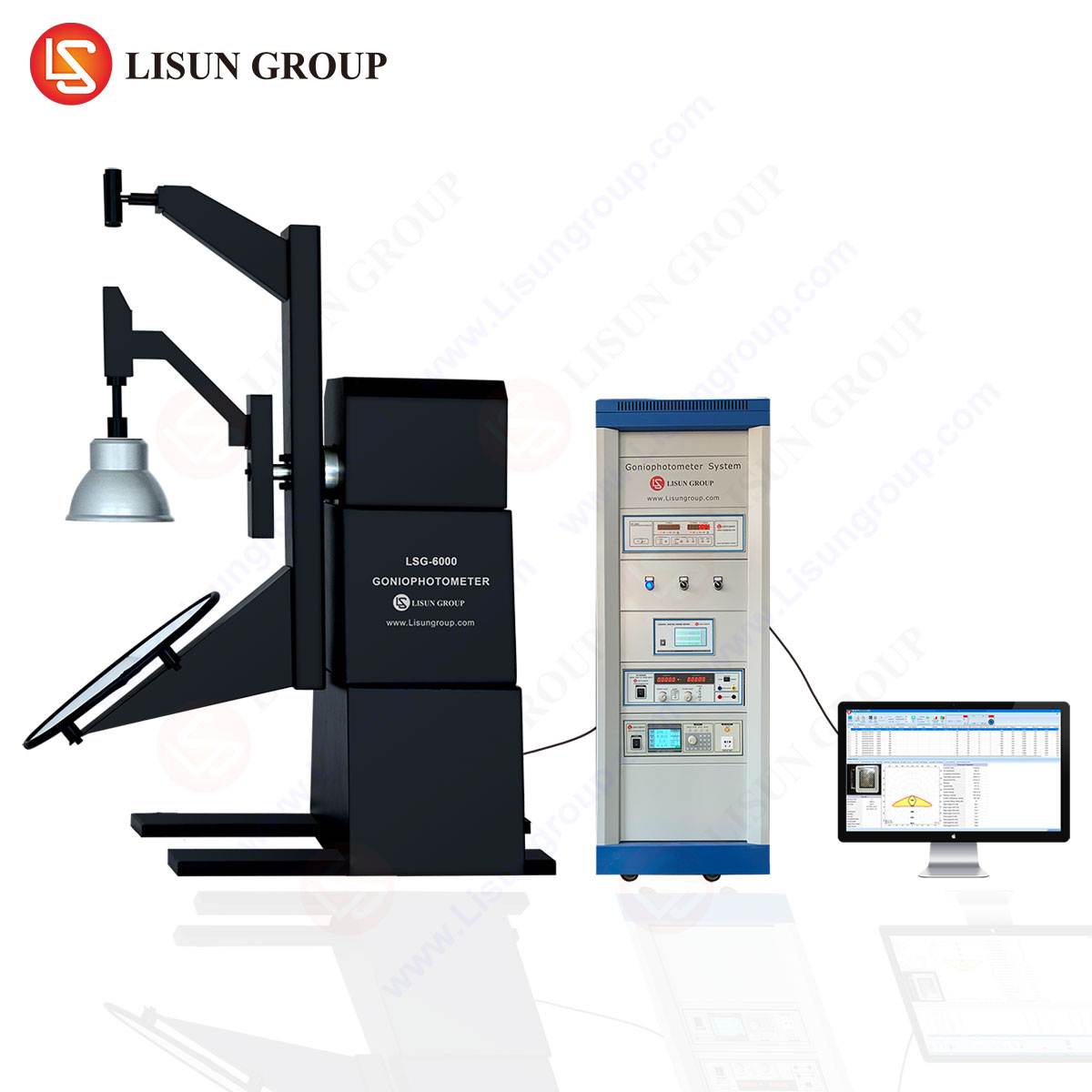
Automotive Lighting Testing: Compliance with regulations such as ECE, SAE, and FMVSS 108 requires precise measurements of luminous intensity (candelas), beam pattern, and color of signal lights (stop, turn, daytime running lights). The LMS-6000, when coupled with a goniophotometer, captures the full spectral data at each angular point, enabling calculation of photopic and scotopic luminance, and ensuring amber and red lights fall within the legally defined chromaticity boundaries.
-
Display Equipment Testing: For LCD, OLED, and micro-LED displays, the spectrometer measures screen luminance (cd/m²), contrast ratio, white point, and color gamut coverage (e.g., sRGB, DCI-P3, Rec. 2020). Its fast response is used to characterize flicker percentage and temporal stability, critical for user eye comfort and compliance with standards like IEC 62471.
-
Photovoltaic Industry: In this domain, the LMS-6000 is configured as a spectroradiometer to measure the spectral irradiance (W/m²/nm) of solar simulators. Accurate classification of a simulator (Class A, B, or C per IEC 60904-9) requires calculating the spectral mismatch factor, which is derived from the detailed spectral power distribution (SPD) measured by the instrument. This ensures reliable testing of solar cell efficiency.
-
Aerospace, Aviation, and Marine Lighting: Testing navigation lights, cockpit displays, and airport runway lights demands reliability under extreme conditions. The LMS-6000’s robust design and ability to measure very specific chromaticity regions ensures compliance with ICAO Annex 14 and FAA specifications for marine signal lights (COLREGs) and aviation red/green position lights.
-
Scientific Research and Optical Instrument R&D: Applications include measuring the spectral output of lasers and LEDs for photobiological safety (IEC 62471), characterizing fluorescent and phosphorescent materials, and calibrating light sources for horticultural research where specific photon flux densities (PPFD) in the 400-700nm PAR range are critical.
Data Integrity and Software Ecosystem
The instrument is operated via dedicated software that controls integration time, averaging, and data processing. The software suite includes modules for:
- Real-time Display: Live spectral graph, photometric, and colorimetric values.
- Spatial Scanning: Control of motorized stages for luminance uniformity mapping.
- Temporal Monitoring: Long-term logging of light source stability.
- Standard Compliance: Automated calculation and reporting against dozens of international standards.
Data is exported in standard formats (CSV, XML) for further analysis in third-party software. The system supports remote operation and automation via DLL or SDK, facilitating integration into custom test stands and production line systems.
Comparative Advantages in a Demanding Metrology Landscape
The LMS-6000’s position is defined by a synthesis of key attributes not always found concurrently in competing systems.
- Speed and Throughput: The array design enables measurements orders of magnitude faster than scanning systems, a decisive advantage in manufacturing quality control.
- Stability and Reproducibility: The absence of moving parts in the optical path minimizes wear and long-term calibration drift, enhancing measurement reliability.
- Comprehensive Spectral Data: Every acquisition captures the complete SPD, allowing for the retrospective calculation of any photometric or colorimetric quantity as standards evolve, unlike filter-based photometers which are metric-specific.
- High Dynamic Range and Low Noise: The 16-bit ADC and cooled CCD detector allow for accurate measurement of very dim sources (e.g., emergency exit signs) and very bright sources (e.g., automotive headlamps) with a single calibration.
- Application Versatility: From UV (250nm) in material degradation studies to near-infrared (1050nm) in photovoltaic testing, the configurable platform serves a wider range of industries than dedicated instruments.
Conclusion
The LMS-6000 spectroradiometer embodies a convergence of optical engineering, electronic design, and software intelligence to meet the exacting demands of modern light measurement. Its architecture provides a robust, accurate, and efficient solution for applications ranging from fundamental scientific research to high-volume industrial production. By delivering complete spectral data with high speed and fidelity, it serves as an indispensable tool for ensuring product quality, regulatory compliance, and fostering innovation in the science and technology of light.
Frequently Asked Questions (FAQ)
Q1: How does the measurement speed of an array spectrometer like the LMS-6000 compare to a traditional scanning monochromator, and what are the practical implications?
A1: A scanning monochromator mechanically moves a grating or mirror to sequentially measure each wavelength, typically requiring several seconds to minutes per full spectrum. The LMS-6000’s array detector captures all wavelengths simultaneously, completing a scan in milliseconds. This translates to vastly higher throughput in production testing, the ability to characterize unstable or pulsed light sources, and the feasibility of performing real-time spectral monitoring over extended periods.
Q2: For LED testing, why is stray light rejection particularly important, and how does the LMS-6000 address this?
A2: Many white LEDs use a blue pump die with a yellow phosphor. Intense blue light can scatter inside an imperfect spectrometer and be detected at longer wavelengths, artificially increasing the measured red component and distorting chromaticity and CRI calculations. The LMS-6000 employs a multi-stage optical design with strategic baffling and filters to suppress this stray light to a level below 0.001%, ensuring accurate colorimetry, especially for high-color-temperature LEDs.
Q3: Can the LMS-6000 be used to measure the absolute intensity of UV light sources for medical or disinfection equipment validation?
A3: Yes, with the appropriate configuration (LMS-6000UV). This variant uses a UV-optimized grating and detector coating to extend the spectral range down to 250nm. When calibrated with a NIST-traceable standard source in the UV region, it can accurately measure spectral irradiance (µW/cm²/nm), which is critical for validating the efficacy and safety of UV-C germicidal lamps or phototherapy equipment according to standards like ISO 15858.
Q4: In photovoltaic testing, what is a “spectral mismatch factor,” and how does the LMS-6000 enable its calculation?
A4: The spectral mismatch factor (MMF) corrects for errors when testing a solar cell under a laboratory solar simulator whose spectrum differs from the reference sunlight spectrum (AM1.5G). It is calculated by integrating the product of the simulator’s SPD, the cell’s spectral responsivity, and the reference spectrum. The LMS-6000 directly measures the simulator’s SPD with high accuracy, which is the essential first input for computing the MMF, thereby ensuring the reported cell efficiency is reliable and comparable.
Q5: How is the instrument’s long-term wavelength accuracy maintained outside of a controlled laboratory environment?
A5: The LMS-6000 incorporates an internal wavelength calibration source (e.g., a mercury-argon lamp). The user can initiate an automated calibration sequence where the instrument records the known emission lines of this lamp. The software then constructs a pixel-to-wavelength mapping polynomial, correcting for any minor shifts caused by temperature changes or physical perturbations. This process, taking only a few minutes, ensures wavelength accuracy is maintained within specification over time without requiring factory return.