


LISUN Luminance Meters: A Comprehensive Guide to Precision Light Measurement
Foundations of Luminance Quantification
Luminance, the photometric equivalent of radiance, quantifies the luminous intensity a surface emits, reflects, or transmits per unit area in a given direction. Its unit, candela per square meter (cd/m²), is a fundamental parameter in characterizing perceived brightness. Accurate luminance measurement is not merely a matter of instrument sensitivity; it is a complex interplay of optics, detector physics, and standardized human photopic response. The precision of these measurements directly impacts product quality, safety compliance, and research validity across a multitude of industries. Instruments designed for this purpose, such as those manufactured by LISUN, must adhere to stringent metrological principles to ensure data integrity, traceability to international standards, and repeatability across diverse application environments. The core challenge lies in designing a system that accurately mimics the spectral sensitivity of the human eye, defined by the CIE 1931 Standard Observer, while maintaining high spatial resolution, a wide dynamic range, and minimal angular uncertainty.
Optical and Electronic Architecture of Imaging Luminance Measurement Devices
The most advanced class of instruments for this task is the Imaging Luminance Measurement Device (ILMD). Unlike spot meters that capture a single point, an ILMD utilizes a calibrated scientific-grade CCD or CMOS sensor coupled with precision optics to capture a spatially resolved luminance map of an entire scene. The optical path typically includes a telecentric lens system to minimize angular measurement errors, ensuring that the luminance value for each pixel is largely independent of minor alignment variations. A critical component is the V(λ) correction filter, a multi-layer optical filter engineered to precisely match the spectral responsivity of the detector to the CIE photopic luminosity function. Any deviation from this curve, known as the f1′ error, is a primary source of spectral mismatch and measurement inaccuracy, particularly when measuring narrow-band light sources like LEDs.
The electronic architecture involves 16-bit or higher analog-to-digital conversion to provide a wide dynamic range, often exceeding 1,000,000:1, which is essential for scenes containing both very dark and extremely bright elements, such as an automotive display in direct sunlight. The sensor is temperature-stabilized using a Peltier cooler to minimize dark current drift, a key factor in long-exposure stability and low-light measurement accuracy. The resulting raw image data is processed through proprietary algorithms that apply calibration coefficients, correcting for lens vignetting, sensor non-uniformity, and non-linearity, transforming pixel values into an absolute luminance matrix traceable to national metrology institutes.
The LMS-6000 Series: Integrating Sphere-Based Spectroradiometric Calibration
While ILMDs provide spatial data, the highest accuracy for colorimetric and absolute radiometric calibration is achieved through spectroradiometry. The LISUN LMS-6000 series of high-precision spectroradiometers represents the pinnacle of this approach. This series, including models like the LMS-6000C, LMS-6000S, and LMS-6000F, is engineered for applications demanding the utmost precision in spectral power distribution (SPD) measurement, from which all photometric and colorimetric quantities, including luminance, can be derived with exceptional accuracy.
The core testing principle of the LMS-6000 series involves the use of an integrating sphere as a front-end optical component. The sphere acts as a spatial homogenizer, collecting light from the source under test and producing a uniform Lambertian radiance field at its output port. The spectroradiometer, fiber-optically coupled to this port, then measures the SPD of this uniform field. This method eliminates errors associated with the spatial non-uniformity of the source, a critical factor when testing complex luminaires like automotive headlamps or OLED panels. The spectrometer itself is typically a crossed Czerny-Turner monochromator with a high-linearity silicon photodiode array detector, providing fast scan speeds and high signal-to-noise ratio.
Key Specifications of the LMS-6000 Series:
- Wavelength Range: Typically 380nm to 780nm (visible), with extended options (LMS-6000UV) covering 200nm-800nm.
- Wavelength Accuracy: ≤ 0.3nm
- Wavelength Half-Width: 2nm (e.g., LMS-6000S), 5nm (e.g., LMS-6000F for faster measurement), configurable based on model.
- Luminance Measurement Range: 0.001 to 1,000,000 cd/m² (dependent on sphere and fiber configuration).
- Dynamic Range: Greater than 1:1,000,000.
- f1′ (Spectral Mismatch): <1.5%, a figure significantly superior to most filter-based photometers.
- Communication Interface: USB, Ethernet, and RS-232 for integration into automated test systems.
Metrological Traceability and Compliance with International Standards
The validity of any photometric measurement is contingent upon its traceability to the International System of Units (SI). The calibration of the LMS-6000 series is performed using standard lamps of known spectral irradiance or luminance, which are themselves calibrated against primary standards maintained by national metrology laboratories such as NIST (USA) or PTB (Germany). This unbroken chain of calibration ensures that every measurement is directly comparable to the global measurement benchmark.
The instruments are designed to facilitate compliance with a vast array of international and industry-specific standards. This includes:
- CIE S 023/E:2013 – Characterisation of the Performance of Illuminance and Luminance Meters
- IES LM-79 – Electrical and Photometric Measurements of Solid-State Lighting Products
- IES LM-80 – Measuring Luminous Flux and Color Maintenance of LED Packages, Arrays, and Modules
- ISO 3623 – Measurement of light emitted by vehicle lighting devices
- SAE J578 – Color Specification for automotive lighting
- IEC 60601-2-57 – Particular requirements for the basic safety and essential performance of non-laser light source equipment used in medical applications
The low f1′ error of the LMS-6000 series is particularly critical for compliance with standards like CIE S 023, which sets strict limits on spectral mismatch for high-quality measurements.
Application in LED and OLED Manufacturing and Quality Control
In the manufacturing of LEDs and OLEDs, the LMS-6000 series is indispensable for binning and quality assurance. LED dies from a single wafer can exhibit variations in chromaticity coordinates (x,y or u’v’) and correlated color temperature (CCT). Precise spectroradiometric measurement allows manufacturers to sort components into tight bins, ensuring consistency in the final product. For OLED displays, measuring the angular dependence of color and luminance is critical. The integrating sphere configuration of the LMS-6000 enables accurate measurement of the total spectral flux of an OLED panel, from which key parameters like efficacy (lm/W), CCT, and Color Rendering Index (CRI) are calculated. The high-speed scanning capability of models like the LMS-6000F allows for 100% inline testing in high-throughput production environments, identifying substandard units before they are assembled into costly modules.
Automotive Lighting Testing for Safety and Regulation
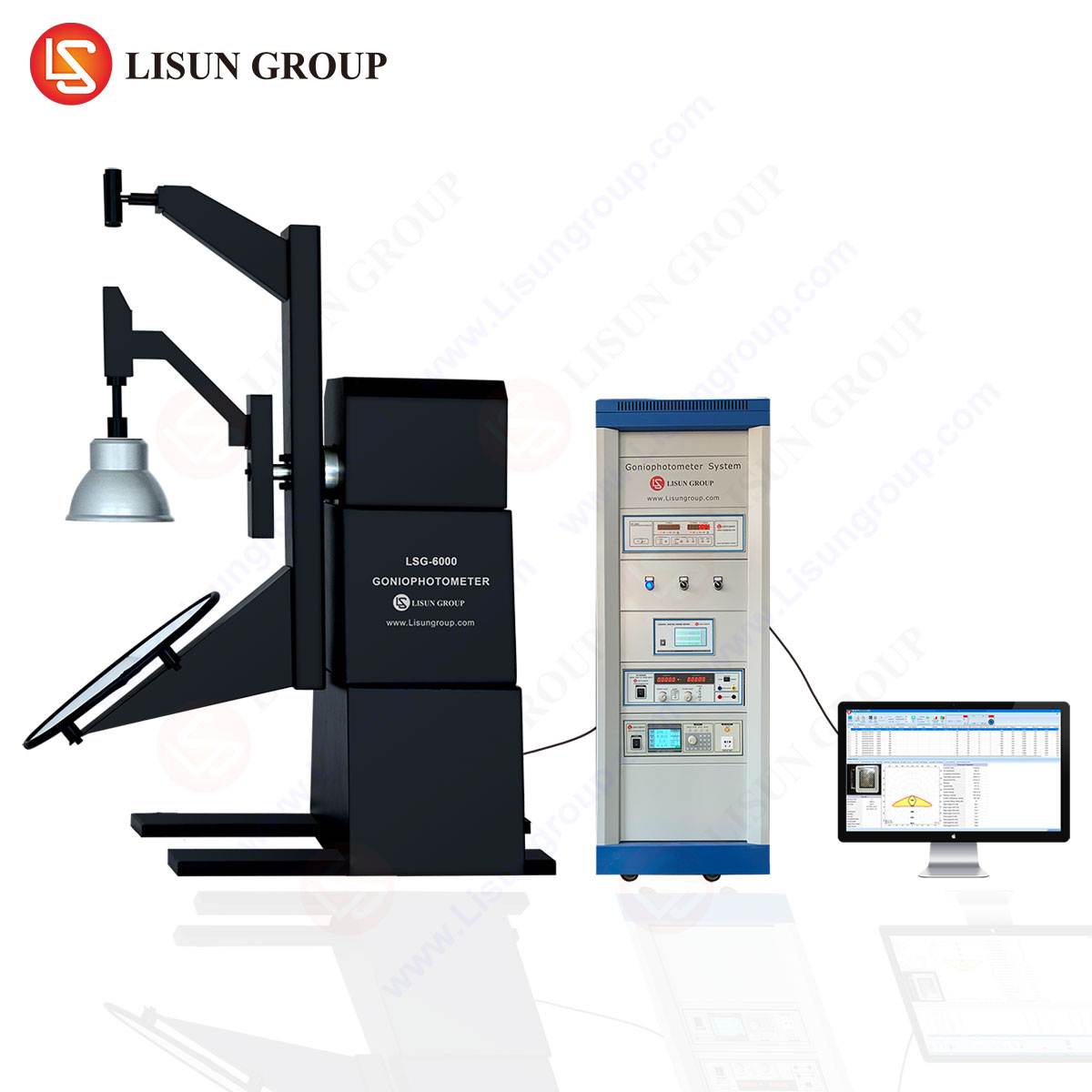
Automotive lighting represents one of the most demanding applications for luminance and color measurement. A single headlamp contains multiple LEDs for low beam, high beam, daytime running lights (DRLs), and turn signals, each with specific photometric and color requirements governed by regulations such as ECE and FMVSS108. The LMS-6000 series, when configured with a goniophotometer, can measure the complete luminous intensity distribution of a headlamp. Furthermore, its high dynamic range is essential for measuring the luminance of individual LED pixels in Adaptive Driving Beam (ADB) systems, where precise control of bright and dark zones is required to avoid dazzling oncoming drivers while maintaining high-beam illumination. The instrument’s accuracy in measuring the specific yellow and red chromaticities of turn signals and brake lights is vital for ensuring they are unambiguous and meet legal color boundaries.
Validation of Display Performance in Consumer Electronics and Aviation
From smartphone OLEDs to aircraft cockpit displays, performance validation is critical. In consumer electronics, manufacturers use the LMS-6000 to measure key display metrics such as peak luminance, contrast ratio, color gamut coverage (e.g., DCI-P3, Rec. 2020), and grayscale uniformity. The instrument’s ability to measure very low luminance levels is crucial for assessing contrast ratio in dark environments. In aviation, displays must remain readable under extreme ambient lighting conditions, including direct sunlight. The LMS-6000 is used to verify that a head-down display maintains a minimum luminance of 685 cd/m² and that all chromaticities remain within the defined “safe operating envelope” under various viewing angles, as per standards like DO-160.
Scientific Research and Photovoltaic Characterization
Beyond photometry, the extended-range models like the LMS-6000UV and LMS-6000P serve critical roles in scientific research. In the photovoltaic industry, the spectral responsivity of solar cells must be characterized. The LMS-6000P, configured as a spectroradiometer, can measure the precise SPD of solar simulators, ensuring that the light used for testing solar cells matches the reference AM1.5G solar spectrum. In materials science, researchers use these instruments to measure the absolute quantum yield of phosphors or the spectral emission of novel light-emitting materials. In medical lighting research, the precise SPD measurement is used to validate the efficacy of phototherapy equipment for treating conditions like neonatal jaundice or seasonal affective disorder, where specific wavelength bands are medically critical.
Comparative Advantages of Spectroradiometric Luminance Measurement
The primary advantage of using a spectroradiometer like the LMS-6000 over a traditional filter-based luminance meter is the elimination of spectral mismatch error. A filter-based meter’s V(λ) correction is an approximation and can lead to significant errors when measuring non-continuous spectra. Since the LMS-6000 measures the full SPD, it calculates luminance by mathematically convolving the SPD with the CIE V(λ) function, resulting in a fundamentally more accurate photopic value. Furthermore, a single measurement provides a complete dataset from which all photometric (luminous flux, illuminance, luminance) and colorimetric (chromaticity, CCT, CRI) parameters can be derived simultaneously, enhancing testing efficiency and data coherence.
Operational Considerations for High-Fidelity Data Acquisition
Achieving laboratory-grade results requires meticulous attention to operational parameters. The instrument must be allowed to thermally stabilize in its operating environment prior to calibration and use. Proper alignment is paramount; the target must completely fill the input port of the integrating sphere to avoid stray light errors. For low-light measurements, integration times must be optimized to maximize signal without saturating the detector or introducing significant noise. Regular recalibration, typically on an annual basis, is mandatory to maintain traceability and account for any potential drift in the system’s responsivity. The software provided with the LMS-6000 series typically includes features for automating these procedures, managing calibration certificates, and generating compliant test reports.
Frequently Asked Questions
Q1: What is the fundamental difference between a spot luminance meter and the LMS-6000 spectroradiometer system?
A spot luminance meter uses a filtered detector to measure the average luminance within a specific field of view. The LMS-6000 is a spectroradiometer that measures the complete spectral power distribution of the light. From this SPD, luminance and all other photometric and colorimetric values are calculated with superior accuracy, as it is not subject to the spectral mismatch errors inherent in physical V(λ) filters.
Q2: Why is the f1′ value so critical, and how does the LMS-6000 achieve a value of less than 1.5%?
The f1′ value quantifies the instrument’s deviation from the ideal CIE V(λ) curve. A high f1′ error leads to inaccurate luminance readings, especially for narrow-band sources like LEDs. The LMS-6000 achieves a low f1′ by not relying on a physical filter. Instead, it uses the fundamental method of measuring the full spectrum and mathematically applying the V(λ) function, making its photopic response virtually perfect.
Q3: Can the LMS-6000 measure the luminance of a single pixel on a high-resolution display?
Not directly in its standard integrating sphere configuration. The sphere measures the total spectral flux of a source. To measure a single pixel, the system would be reconfigured with a focusing lens instead of an integrating sphere, turning it into a telescopic spectroradiometer. This allows it to target and measure the SPD of a very small area, from which the luminance of that specific pixel can be calculated.
Q4: How is the instrument calibrated for absolute luminance measurement?
Calibration is performed using a standard luminance source traceable to a national metrology institute. The known spectral radiance of this standard is used to generate a calibration file within the instrument’s software. This file contains wavelength-dependent correction factors that convert the raw detector signal into an absolute spectral radiance (W/sr/m²/nm), which is then integrated with the V(λ) function to yield luminance (cd/m²).
Q5: In an automotive context, can the LMS-6000 measure the flicker percentage of PWM-controlled LEDs?
Yes, provided the model is equipped with a high-speed detector and corresponding software. By operating in a fast, time-resolved measurement mode, the LMS-6000 can capture the rapid modulation of the LED’s intensity over time. The software can then analyze this waveform to calculate flicker percentage, frequency, and modulation index, which are important for assessing perceptual flicker and compliance with emerging automotive flicker standards.