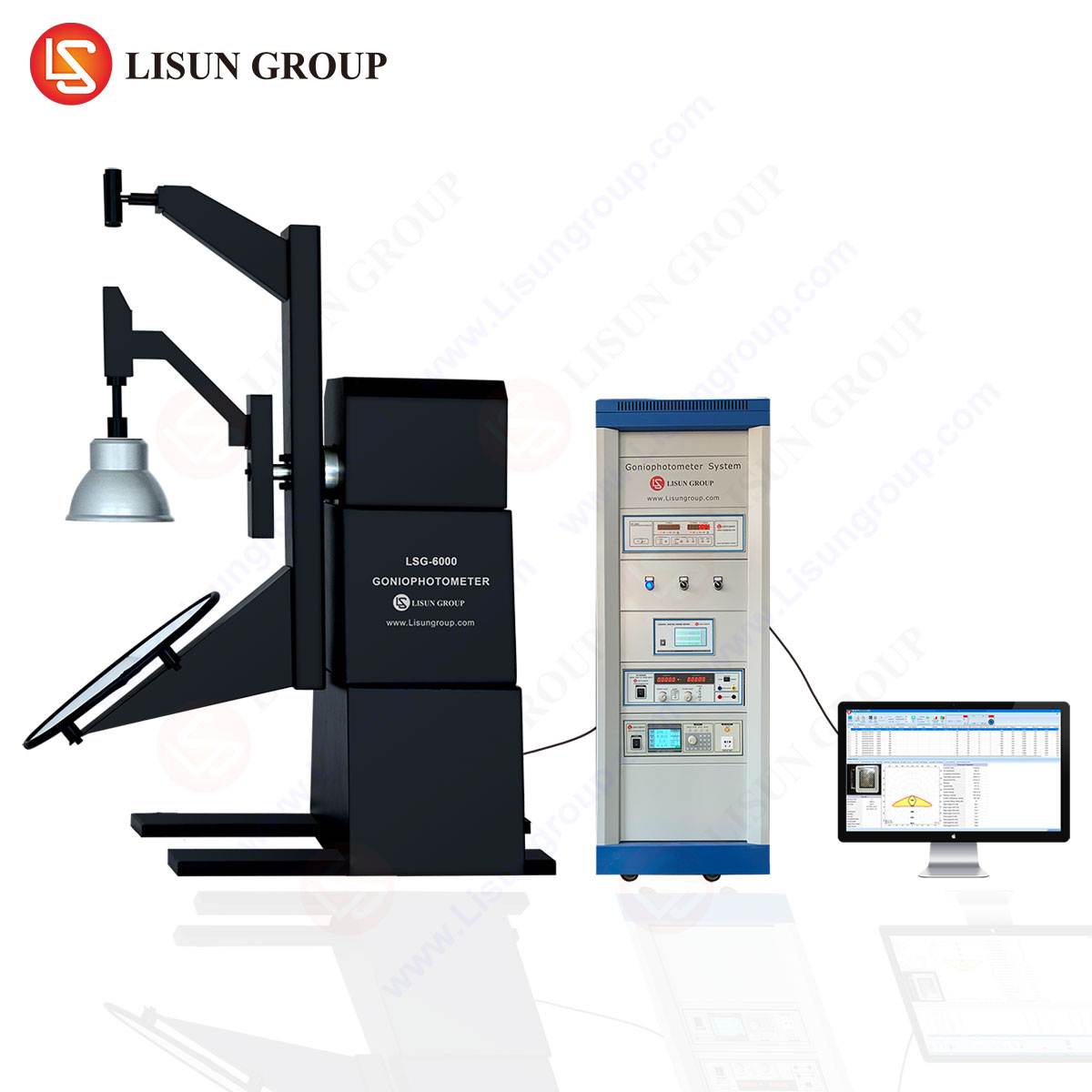





The Role of the Goniophotometer in Comprehensive Photometric and Colorimetric Characterization of Light Sources
Introduction to Spatial Photometric Measurement
The accurate characterization of a light source extends far beyond a simple measurement of total luminous flux. The spatial distribution of light—its intensity, color, and spectral power across three-dimensional space—is a critical performance parameter influencing efficacy, application suitability, and regulatory compliance. The goniophotometer serves as the definitive instrument for this spatial analysis. By precisely rotating a light source relative to a fixed photodetector, or vice versa, it maps the complete luminous intensity distribution (LID) and enables the derivation of total flux, zonal lumen fractions, and beam patterns. This article examines the technical principles, methodologies, and advanced integrations of modern goniophotometer systems, with a specific focus on hybrid solutions that combine mechanical goniometry with spectroradiometric analysis via integrating spheres.
Fundamental Principles of Goniophotometric Data Acquisition
A goniophotometer operates on the coordinate system defined by the CIE (Commission Internationale de l’Éclairage). The source is positioned at the center of a hypothetical sphere. The instrument measures luminous intensity, I(θ, φ), at numerous discrete angular positions, where θ (theta) is the vertical angle (nadir to zenith) and φ (phi) is the horizontal azimuthal angle. The most common configuration is the moving detector, fixed lamp (Type C) goniophotometer, where the detector, mounted on a rotating arm, traverses a spherical surface around the stationary luminaire. The measured intensity data set, the Intensity Distribution Curve (IDC), is the primary output. Total luminous flux (Φ) is calculated by integrating the intensity over the entire solid angle of 4π steradians: Φ = ∫ I(θ, φ) dΩ. This method, known as the absolute goniophotometric method, is recognized by standards bodies such as IESNA LM-79 and CIE S025 as a direct and accurate means for total flux measurement, free from the spectral mismatch errors that can affect integrating sphere measurements.
Integration of Spectroradiometry with Goniophotometric Systems
While traditional goniophotometers utilize a photopic-filtered detector (V(λ)-corrected) to measure photometric quantities, modern applications demand spectral and colorimetric data as a function of angle. This is crucial for sources like LEDs and OLEDs, where chromaticity consistency (spatial color uniformity) is a key quality metric. The integration of a spectroradiometer into the goniophotometer system facilitates this. A fiber-optic cable, mounted on the moving arm alongside the photometer, collects light at each angular position. The spectroradiometer disperses this light, measuring the full spectral power distribution (SPD). From the SPD, a suite of data is derived: chromaticity coordinates (CIE 1931 x,y; CIE 1976 u’,v’), correlated color temperature (CCT), color rendering index (CRI, Ra), and the newer TM-30 metrics (Rf, Rg). This hybrid system provides a complete spatio-spectral characterization.
The LPCE-3 Integrated System: Goniophotometer with Spectroradiometer and Sphere
A representative example of this advanced integration is the LISUN LPCE-3 system. It combines a high-precision Type C goniophotometer with a CCD array spectroradiometer and a separate integrating sphere, creating a versatile platform for comprehensive lighting testing. The system is designed to comply with multiple international standards including IES LM-79-19, IES LM-80-20, ENERGY STAR, and CIE 177.
The system’s core specifications include a goniophotometer with a typical measurement distance of 5 to 30 meters (adjustable based on luminaire size and required far-field condition), dual-axis rotation with minimal angular increments (e.g., 0.1°), and a high-stability robotic arm. The integrated spectroradiometer, such as the LMS-9000, covers a wavelength range of 380nm to 780nm with a typical wavelength accuracy of ±0.3nm. The companion integrating sphere, available in diameters from 1m to 3m, is coated with highly stable, diffuse reflectance material (e.g., Spectraflect®) and includes an auxiliary lamp for sphere correction via the substitution method.
Testing Methodology and Data Synthesis
The LPCE-3 system operates through a coordinated workflow. For spatial distribution analysis, the luminaire is secured at the goniometer center. The arm, equipped with both a photometer head and a spectroradiometer fiber, moves through a pre-programmed grid. At each point, photometric intensity and a full spectrum are captured. Software constructs 3D models, polar curves (C0-C180, C90-C270 planes), and false-color maps of intensity and chromaticity. Concurrently, for absolute total luminous flux verification, the same luminaire can be measured within the integrating sphere. The spectroradiometer measures the sphere’s output, and software applies necessary corrections (self-absorption, spatial non-uniformity) to calculate flux. This dual-method approach provides validation and caters to different standard requirements.
Industry-Specific Applications and Use Cases
- LED & OLED Manufacturing: For LED packages and modules, angular color uniformity is critical. The system maps CCT and Duv (deviation from the Planckian locus) shifts across viewing angles, identifying binning inconsistencies and phosphor coating irregularities. In OLED panel testing, it assesses the Lambertian emission profile and verifies color consistency essential for display and lighting applications.
- Automotive Lighting Testing: Compliance with ECE, SAE, and FMVSS regulations requires precise beam pattern verification for headlamps, signal lights, and interior lighting. The goniophotometer measures cut-off lines, hotspot intensities, and glare metrics. The spectroradiometer ensures the chromaticity of rear lamps (stop, turn) falls within the legally defined color boundaries.
- Aerospace and Aviation Lighting: Navigation lights, anti-collision beacons, and cabin lighting must meet stringent RTCA/DO-160 or MIL-STD environmental and photometric standards. The system tests for intensity distribution under various voltage and temperature conditions simulated in environmental chambers.
- Display Equipment Testing: For HDR displays, projectors, and backlight units, the system measures viewing angle characteristics including luminance fall-off (viewing cone) and color shift, which are key parameters for ISO 9241-307 (display color gamut) and VESA DisplayHDR standards.
- Urban Lighting Design: For streetlights and area luminaires, metrics like Upward Light Ratio (ULR), light trespass, and roadway illuminance uniformity are derived from the LID data. This informs designs that meet Dark Sky initiatives and IES RP-8 roadway lighting standards.
- Stage and Studio Lighting: Ellipsoidal reflector spotlights (ERS), Fresnels, and LED wash lights are characterized for their field angle, beam angle, and throw distance. Spectroradiometric data ensures consistent white point and color filter/gel reproduction across the entire fixture output.
- Medical Lighting Equipment: Surgical and examination lights require homogeneous fields with high color rendering to accurately distinguish tissue states. The system quantifies the illuminance uniformity across the target plane and measures CRI (Ra) and TM-30 Rf values to ensure diagnostic accuracy.
Competitive Advantages of an Integrated Measurement Platform
The primary advantage of a system like the LPCE-3 is data congruence and workflow efficiency. Having photometric, colorimetric, and spectral data from a single test object on a unified software platform eliminates device correlation errors and saves significant time. The absolute goniophotometric method provides high accuracy for total flux, especially for directional sources or those with unusual LIDs that challenge integrating sphere accuracy. The system’s modularity—allowing use of the goniophotometer, spectroradiometer, and sphere independently or in tandem—offers laboratories exceptional flexibility to configure tests for specific standards. Automated, software-controlled operation minimizes human error and ensures repeatable measurement sequences, which is vital for quality control and R&D benchmarking.
Standards Compliance and Metrological Traceability
Robust goniophotometer systems are designed for metrological traceability. Calibration is performed using standard reference lamps (e.g., from NIST or PTB) for both the photometer and spectroradiometer. The system software incorporates necessary correction algorithms: background subtraction, distance correction (inverse square law), and for sphere measurements, self-absorption correction using the auxiliary lamp method. This ensures measurements are directly traceable to national standards, a requirement for laboratories seeking ISO/IEC 17025 accreditation.
Conclusion
The evolution of the goniophotometer from a photometric mapping tool to a integrated spatio-spectral analysis platform reflects the increasing complexity of modern light sources. Systems that synergize precision mechanical goniometry with high-resolution spectroradiometry, such as the LPCE-3, provide the comprehensive dataset necessary for innovation and quality assurance across diverse industries. By delivering absolute photometric quantities, detailed spatial distributions, and full spectral and colorimetric data at every angle, these instruments form the cornerstone of advanced lighting testing, enabling manufacturers, designers, and researchers to fully characterize, optimize, and validate their products against the highest technical and regulatory benchmarks.
FAQ Section
Q1: What is the key difference between measuring total luminous flux with a goniophotometer versus an integrating sphere?
A1: An integrating sphere uses the spatial integration of light through multiple internal reflections, requiring correction factors for the test sample’s self-absorption and spatial distribution. The goniophotometer uses the absolute method, mathematically integrating the directly measured luminous intensity distribution over 4π steradians. It is often considered more accurate for highly directional or unusually shaped luminaires that significantly alter the sphere’s spatial response.
Q2: Why is angular color uniformity measurement critical for white LED modules?
A2: Due to the construction of white LEDs (a blue chip with a phosphor coating), variations in phosphor thickness or concentration can cause the correlated color temperature (CCT) to shift with viewing angle—a phenomenon known as spatial color non-uniformity or “yellow ring.” This is undesirable in many applications, especially in retail lighting and displays. A goniophotometer with a spectroradiometer quantifies this shift, allowing for process control and binning.
Q3: For automotive headlamp testing, can the system generate isocandela diagrams and perform regulatory compliance checks?
A3: Yes. Advanced goniophotometer software can process the measured intensity matrix to generate standard isocandela plots, identify the hotspot (maximum intensity), and plot the beam pattern on a virtual screen. It can then overlay the regulatory boundaries (as defined by ECE R112, SAE J1383, etc.) and automatically flag any intensities that fall outside the allowed zones (e.g., excessive glare in zone III) or fail to meet minimum intensity requirements in critical zones.
Q4: How does the system handle the measurement of very large or heavy luminaires, such as high-bay industrial lights?
A4: Type C goniophotometers with a fixed lamp position are well-suited for large luminaires. The test sample remains stationary on a sturdy mounting platform at the center of the system. The detector, which is relatively lightweight, rotates around it. The system’s structural design specifies a maximum load capacity for the center mount (often several hundred kilograms), accommodating most commercial and industrial luminaires. The measurement distance is adjusted to ensure far-field conditions are met.
Q5: In an integrated system, is the spectroradiometer used during the sphere-based flux measurement the same as the one on the goniometer arm?
A5: Typically, yes. A key advantage of a platform like the LPCE-3 is the use of a single, high-performance spectroradiometer (e.g., the LMS-9000) for both measurement modalities. The fiber-optic input is connected either to the sphere’s sampling port or to the collimating lens on the goniometer arm via a switchable fiber port or manual reconnection. This ensures consistency in spectral calibration across all measurements and simplifies the instrument setup.