


Precision Radiometric Measurement: Applications and Methodologies in Modern Industry
Introduction to Spectroradiometric Measurement
The quantitative assessment of optical radiation forms a critical foundation across a diverse array of scientific and industrial disciplines. A light meter, in its most fundamental form, measures photometric quantities perceived by the human eye, such as illuminance (lux) and luminance (cd/m²). However, the limitations of photometry become apparent when characterizing sources with discontinuous spectra, such as Light Emitting Diodes (LEDs), or when evaluating non-visual biological effects and material interactions. This necessitates the use of spectroradiometry, a more sophisticated methodology that measures the spectral power distribution (SPD) of a source across a defined wavelength range. From this fundamental SPD data, a comprehensive suite of photometric, colorimetric, and radiometric parameters can be derived with high accuracy. This article examines the advanced applications of spectroradiometric systems, with a specific focus on the technical implementation and advantages of the LISUN LMS-6000 series of high-precision spectroradiometers.
Core Operational Principles of Array Spectroradiometers
Modern spectroradiometers like the LISUN LMS-6000 series employ a diffraction grating and a charge-coupled device (CCD) or complementary metal-oxide-semiconductor (CMOS) detector array to simultaneously capture light intensity across a broad spectrum. Incident light is collimated and directed onto the grating, which disperses it into its constituent wavelengths. This dispersed spectrum is then projected onto the linear detector array, where each pixel corresponds to a specific nanometer (or sub-nanometer) wavelength interval. The electrical signal from each pixel is digitized and processed to construct the SPD. This design eliminates moving parts, enhancing measurement speed and long-term mechanical reliability compared to traditional scanning monochromator systems. The critical components defining performance include optical resolution (Full Width at Half Maximum, or FWHM), wavelength accuracy, stray light rejection, and dynamic range. High-fidelity systems incorporate double-grating monochromators or advanced order-sorting filters to minimize stray light, a paramount concern when measuring narrow-band LEDs or sources with high UV/IR content.
The LISUN LMS-6000SF: A Benchmark for Comprehensive Spectral Analysis
The LISUN LMS-6000SF represents a pinnacle of this array-based technology, engineered for laboratories and production environments requiring uncompromising accuracy and versatility. Its specifications establish it as a reference-grade instrument for demanding applications.
- Spectral Range: The instrument covers an extensive wavelength span from 200 nm to 1100 nm, seamlessly encompassing ultraviolet (UV), visible (VIS), and near-infrared (NIR) regions. This broad range is essential for applications from UV curing validation to photovoltaic cell response testing.
- Optical Resolution: It achieves a typical optical resolution of ≤1.5 nm FWHM, ensuring precise characterization of narrow spectral peaks common in laser diodes, OLED materials, and phosphor-converted LEDs.
- Wavelength Accuracy: Calibrated to within ±0.2 nm, this level of accuracy is critical for consistent colorimetric calculations (CIE 1931/1976) and for compliance testing against stringent spectral standards.
- Stray Light Level: Maintained at ≤0.05%, this low level is a definitive competitive advantage, preventing spectral leakage from high-intensity wavelengths (e.g., blue pump LEDs) from artificially inflating measurements in adjacent spectral bands, a common failure point in inferior systems.
- Dynamic Range and Integration Time: With a wide dynamic range and programmable integration times from 1 millisecond to 10 seconds, the LMS-6000SF can accurately measure everything from faint luminances in dark-room displays to the intense irradiance of solar simulators.
The system operates on the principle of absolute radiometric calibration traceable to national metrology institutes (e.g., NIST, PTB). A calibrated integrating sphere or cosine corrector is typically used as a front optic to collect light, ensuring angular response conformity (e.g., CIE Type A or B for illuminance measurements) for field measurements.
Validation and Quality Assurance in LED and OLED Manufacturing
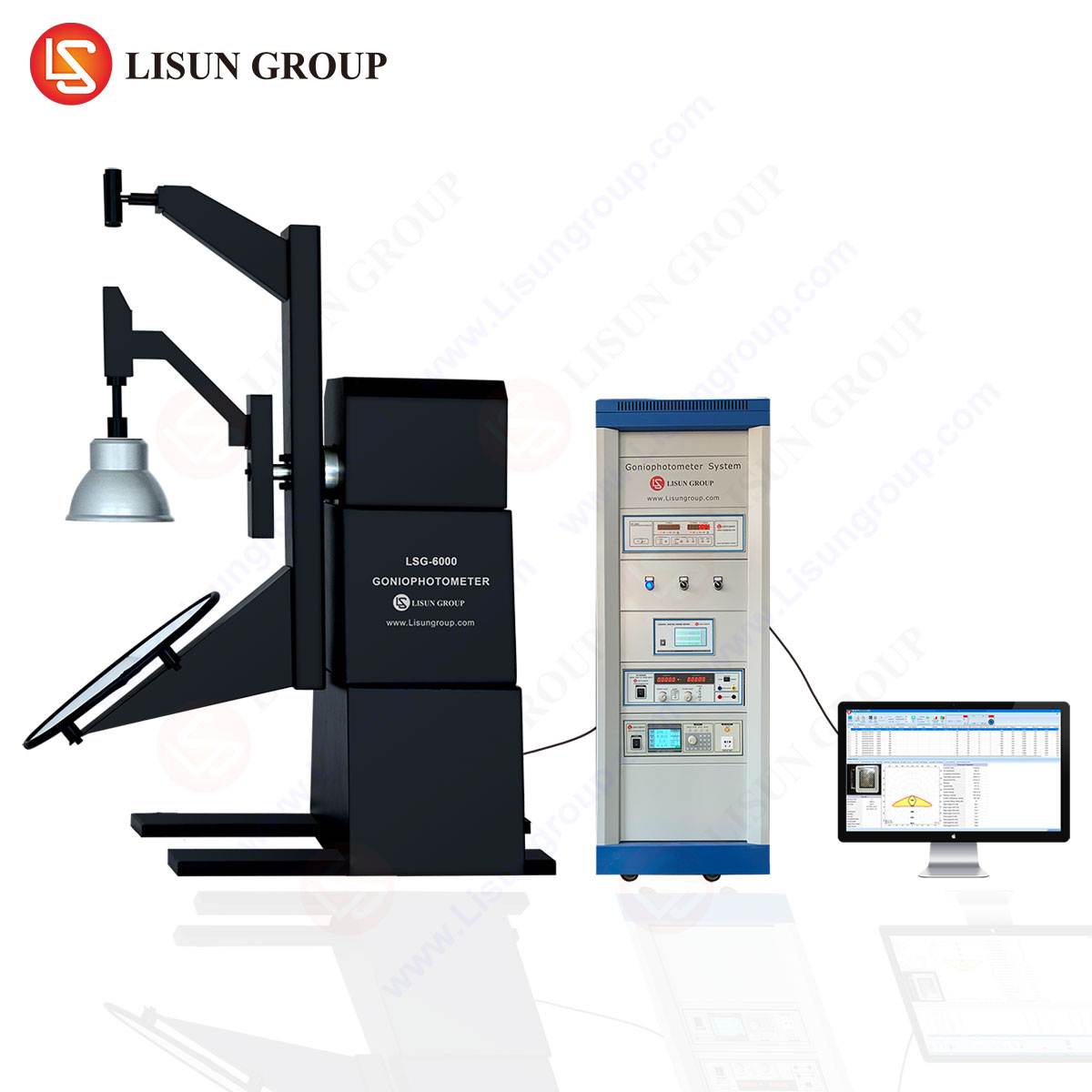
In the production of solid-state lighting, spectroradiometry is indispensable for binning, quality control, and performance validation. The LMS-6000SF is deployed to measure key parameters directly from the SPD: correlated color temperature (CCT), color rendering index (CRI, including the extended R9 value for saturated reds), chromaticity coordinates (x, y; u’, v’), and luminous flux (lumens). For OLED panels, spatial uniformity of color and luminance is a critical quality metric. The instrument can be integrated with motorized goniophotometers or imaging colorimeters to map these parameters across the entire emitting surface, identifying micro-defects and color shifts. Compliance with standards such as IES LM-79 and LM-80 for LED lumen maintenance and chromaticity stability requires the long-term precision offered by the LMS-6000SF’s stable optical bench and temperature-regulated detector.
Automotive and Aerospace Lighting: Safety and Regulatory Compliance
Automotive lighting systems, encompassing headlamps (low beam, high beam), daytime running lights (DRLs), signal lights, and interior displays, are subject to rigorous international regulations (ECE, SAE, FMVSS). These standards specify precise photometric minima/maxima and chromaticity boundaries within specific angular zones. The LMS-6000SF, when coupled with a narrow-angle lens or a goniometric system, performs absolute intensity (candela) distribution measurements. Its high wavelength accuracy ensures that the color of signal lights (e.g., red stop lamps, amber turn signals) falls within the legally mandated CIE chromaticity boxes. In aerospace, similar testing applies to cockpit displays, warning lights, and external navigation/anti-collision lights, which must remain legible under extreme ambient light conditions and adhere to standards like RTCA DO-160.
Advanced Display Metrology for Consumer Electronics
The evaluation of displays (LCD, OLED, microLED) extends beyond simple luminance. The LMS-6000SF is utilized to measure contrast ratio, color gamut coverage (e.g., sRGB, DCI-P3, Rec. 2020), white point accuracy, and viewing-angle performance. For High Dynamic Range (HDR) displays, accurate measurement of peak brightness and black level is essential. The instrument’s low stray light characteristic is particularly valuable when measuring the extremely low luminance of “true black” states in OLEDs, preventing false readings. Furthermore, it can assess the temporal characteristics of pulse-width modulated (PWM) dimming, which can affect perceived flicker.
Photovoltaic and Solar Simulation Characterization
In the photovoltaic industry, the spectral match of a solar simulator to a reference spectrum (e.g., AM1.5G) is a Class A requirement per standards such as IEC 60904-9. The LMS-6000SF’s broad 200-1100 nm range allows for the complete characterization of the simulator’s spectral irradiance. It is also used to measure the spectral responsivity of photovoltaic cells and modules, determining their efficiency under different spectral conditions—a critical factor for predicting real-world energy yield.
Scientific Research and Photobiological Safety
Research laboratories employ the LMS-6000SF for fundamental studies in material science, horticulture, and human-centric lighting. In horticultural lighting, the precise quantification of photosynthetic photon flux density (PPFD, 400-700 nm) and its spectral composition (e.g., far-red ratios) directly influences plant morphology and yield. For human-centric lighting, research into circadian stimulus and melanopic equivalent daylight illuminance requires accurate SPD measurement in the cyan-to-blue spectral region (≈480 nm) where the intrinsically photosensitive retinal ganglion cells (ipRGCs) are most sensitive. Furthermore, the instrument is used to evaluate photobiological safety per IEC 62471, classifying lamps and lamp systems into risk groups based on UV, blue-light, and thermal retinal hazards.
Specialized Applications in Niche Lighting Sectors
- Medical Lighting: Surgical and diagnostic lighting requires exceptional color rendering and shadow reduction. Spectroradiometers verify that surgical lights meet ISO 9680 requirements for color temperature, color rendering index, and homogeneous illuminance.
- Marine and Navigation: The LMS-6000SF tests the intensity and chromaticity of navigation lights, deck lights, and searchlights against International Maritime Organization (IMO) and other naval standards, ensuring safety at sea.
- Stage and Studio Lighting: For broadcast and film production, consistent color temperature and high CRI are non-negotiable. The instrument is used to calibrate LED fresnels, spotlights, and large-format LED walls to ensure color matching across all fixtures.
- Urban Lighting Design: Beyond illuminance levels, modern urban lighting design considers spectral impact on skyglow, wildlife, and human perception. The tool enables designers to quantify the spectral emission of proposed luminaires, aiding in the selection of sources that minimize disruptive blue light at night.
Competitive Advantages of High-Fidelity Spectroradiometry
The primary advantage of an instrument like the LISUN LMS-6000SF lies in its ability to derive a multitude of accurate parameters from a single, fundamental measurement of the SPD. This eliminates the need for and potential calibration drift between multiple single-purpose meters (lux meters, color meters, UV meters). Its low stray light performance ensures data integrity, especially for modern light sources with spiky spectra. The combination of speed (array detection), accuracy, and a broad spectral range creates a versatile platform capable of serving R&D, quality assurance, and compliance roles across disparate industries, thereby streamlining instrumentation investment and standardizing measurement protocols.
Conclusion
As optical technologies continue to advance, the role of precise spectroradiometric measurement becomes increasingly central. From ensuring the safety and performance of automotive lighting to optimizing the growth of plants in controlled environments, the data derived from instruments like the LISUN LMS-6000SF inform critical decisions in design, manufacturing, and regulation. Its technical specifications, particularly its wide spectral range, high resolution, and exceptionally low stray light, establish it as a foundational tool for any enterprise where the accurate characterization of light is not merely beneficial but essential.
FAQ Section
Q1: Why is low stray light specification particularly important when measuring LEDs?
A1: LEDs, especially narrow-band blue pump LEDs used in white phosphor-converted devices, emit intense radiation within a very narrow wavelength band. High stray light in a spectroradiometer causes this intense signal to “bleed” into adjacent wavelength pixels. This artificially inflates measured values in spectral regions where the LED actually emits very little light, leading to significant errors in calculated parameters like color rendering index (CRI), chromaticity coordinates, and radiometric efficiency. A stray light level of ≤0.05% is critical for data fidelity.
Q2: Can the LMS-6000SF be used for both laboratory benchtop and field measurements?
A2: Yes, the core spectroradiometer unit is designed for flexibility. In a laboratory setting, it is typically integrated with calibrated integrating spheres for total luminous flux measurement or mounted on goniophotometers for spatial distribution analysis. For field use, it can be connected to a cosine-corrected irradiance probe or a telescopic luminance lens, powered by a portable computer and battery pack, enabling on-site measurements of architectural lighting, streetlights, or ambient light conditions.
Q3: How does the instrument maintain wavelength accuracy over time and temperature variations?
A3: The LMS-6000SF incorporates a stable optical bench design with minimal sensitivity to thermal drift. Furthermore, it utilizes built-in wavelength calibration features, often employing known spectral line sources (e.g., mercury-argon lamps) for periodic user verification. For highest accuracy, professional recalibration at recommended intervals (typically annually) against NIST-traceable standards is advised to account for any long-term detector or optical component shifts.
Q4: What is the significance of the 200-1100 nm spectral range for applications beyond visible light?
A4: This extended range is vital for numerous applications. The ultraviolet (200-400 nm) segment is crucial for testing UV curing lamps, photobiological safety (IEC 62471), and material degradation studies. The near-infrared (700-1100 nm) range is essential for characterizing the output of solar simulators, measuring the efficiency of silicon-based photovoltaic cells, and assessing the radiant heat component from light sources or the performance of IR LEDs and sensors.
Q5: In display testing, why is dynamic range a critical specification?
A5: Modern displays, particularly HDR-capable ones, have an extreme ratio between their peak white luminance (often exceeding 1000 cd/m²) and their minimum black level (which can be below 0.0005 cd/m² for OLEDs). A spectroradiometer must have sufficient dynamic range to accurately measure both extremes within a single measurement sequence without saturating the detector on bright areas or losing the signal in noise for dark areas. This allows for accurate calculation of contrast ratio and tonal representation.