





Fundamentals of Luminous Flux and Its Spatial Distribution
The accurate characterization of a light source’s performance extends beyond a single scalar luminous flux value. The spatial distribution of light, or how luminous intensity is radiated in different directions, is a critical parameter defining the efficacy, application suitability, and optical quality of luminaires. This distribution is mathematically described by the luminous intensity distribution curve, a three-dimensional surface that is often projected onto two-dimensional planes for practical analysis. The total luminous flux, measured in lumens (lm), is the integral of this intensity distribution over the entire solid angle of a sphere. Consequently, the most fundamental method for determining the total luminous flux of a luminaire is through a goniophotometric measurement, which captures this complete spatial light distribution. This process is indispensable for validating photometric performance against design specifications and international standards.
Principles of Goniophotometric Measurement Systems
A goniophotometer is an electro-optical system designed to measure the directional light intensity of a source. The core principle involves moving a photodetector, or the light source itself, through a series of spherical coordinates (typically azimuth (C) and elevation (γ) angles) while a precision photometer records the illuminance at a fixed distance. According to the inverse-square law, the luminous intensity I(γ, C) in candelas (cd) is calculated from the measured illuminance E(γ, C) in lux (lx) and the measurement distance d in meters (m): I(γ, C) = E(γ, C) * d². By systematically sampling the entire sphere surrounding the luminaire, the system constructs a comprehensive intensity distribution. From this data set, a multitude of photometric parameters can be derived, including total luminous flux, luminaire efficacy, zonal lumen distribution, beam angles, and utilization factors. Modern systems automate this process with high angular resolution, ensuring data integrity and repeatability.
The LSG-6000: A Benchmark for Type C Goniophotometry
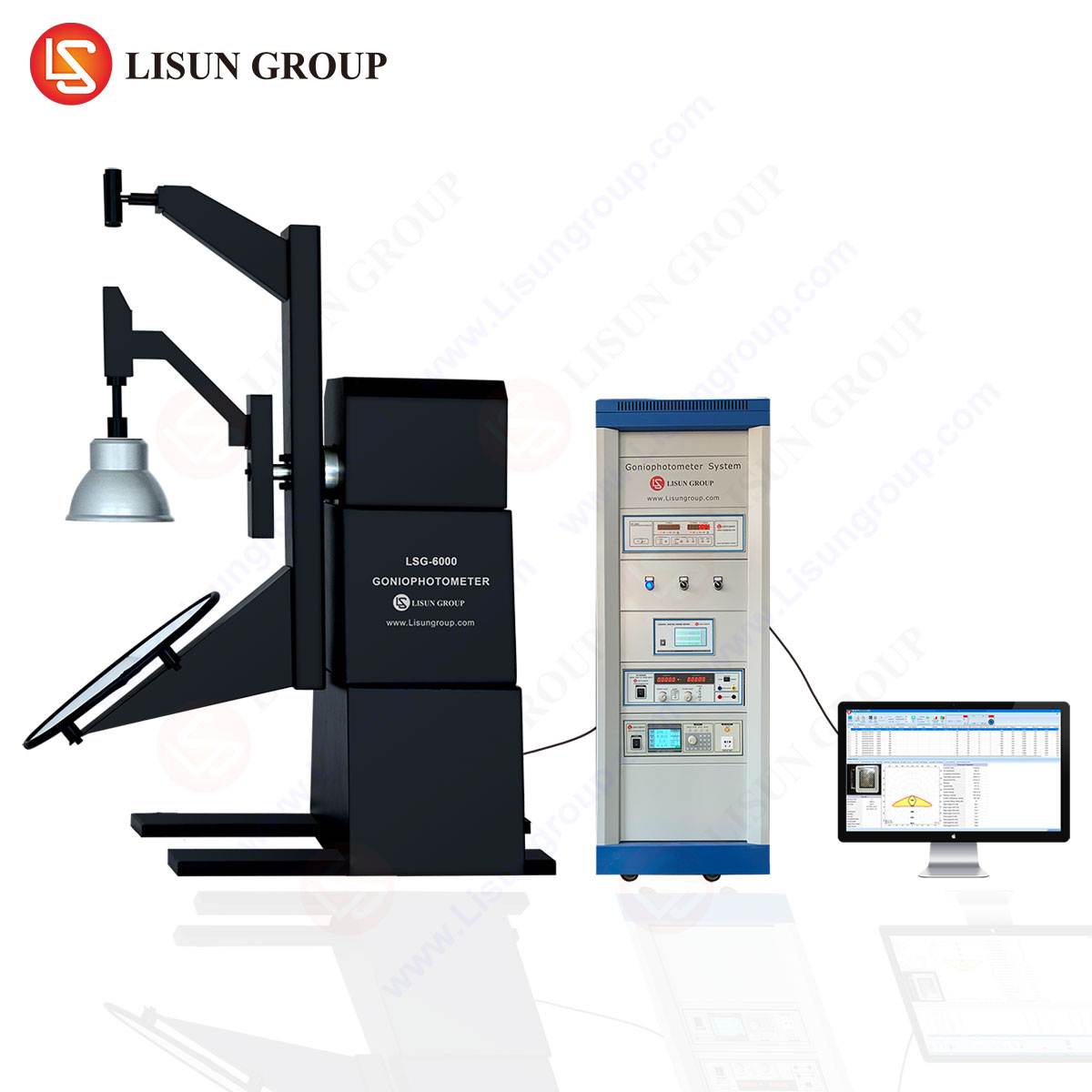
The LISUN LSG-6000 represents a state-of-the-art implementation of a Type C goniophotometer, where the luminaire under test rotates around its photometric center in two perpendicular axes while the photodetector remains stationary. This configuration is particularly advantageous for testing heavy or large luminaires, such as street lights, high-bay industrial lighting, and sports field lighting, where moving the fixture is more practical than moving a complex detector assembly over a large radius. The system’s robust mechanical design ensures minimal vibration and high positional accuracy, which are prerequisites for reliable and consistent measurements. The LSG-6000 is engineered to comply with a comprehensive suite of international standards, including LM-79-19, LM-80-20, IESNA LM-75-01, EN 13032-1, CIE 70, CIE 121, and CIE S025, making it a versatile tool for global markets.
Key Specifications of the LSG-6000:
- Measurement Distance: Configurable from 5m to 30+ meters.
- Luminous Intensity Range: 0.001 cd to 2,000,000 cd.
- Total Luminous Flux Range: 0.1 lm to 2,000,000 lm.
- Angular Accuracy: Superior to ±0.2°.
- Spectral Mismatch Correction: Fully automated, compliant with CIE photopic observer functions.
- Mirror System: Utilizes a high-reflectance, front-surface mirror to direct light to the stationary detector, minimizing errors associated with detector movement.
Data Acquisition and Photometric Parameter Derivation
Upon completion of the spherical scan, the LSG-6000’s software processes the raw illuminance data into a standardized IES or LDT file format. This file contains the complete photometric data of the luminaire and serves as the input for lighting design software. The derivation of key parameters is a computational process: total luminous flux is the spherical integral of intensity; luminaire efficacy is the ratio of total luminous flux to input power; beam angles (e.g., 50% and 10% of maximum intensity) define the light spread; and zonal lumen fractions quantify flux within specific angular zones. For the LED and OLED manufacturing industries, this data is critical for binning products based on flux and spatial output, ensuring consistency. In scientific research laboratories, the high-resolution data enables the study of novel optical materials and light source architectures.
Application in Urban Lighting Design and Standardization
In urban lighting design, the performance of roadway and area luminaires is strictly governed by standards such as ANSI/IES RP-8-21 (Roadway Lighting) and EN 13201. The LSG-6000 provides the essential data to verify compliance with these regulations. Designers utilize the goniophotometrically-generated IES files to simulate lighting levels, uniformity, and glare (as measured by Threshold Increment – TI) on virtual roadways before installation. This predictive capability prevents under-lit or over-lit conditions, enhances public safety, and optimizes energy usage. The system’s ability to accurately measure intensity at high angular resolutions is paramount for modeling light trespass and uplight, which are regulated to mitigate obtrusive light and sky glow, aligning with Dark-Sky Association guidelines.
Calibration Protocols and Measurement Traceability
The metrological integrity of any goniophotometric system hinges on a rigorous calibration chain. The LSG-6000’s photometric detector must be calibrated against a standard lamp, which itself is traceable to a national metrology institute (NMI) such as NIST (USA) or PTB (Germany). This traceability ensures that measurements are accurate and internationally recognized. Regular calibration checks are mandated by standards like ISO/IEC 17025 for accredited testing laboratories. Furthermore, the system’s mechanical alignment, including the verification of the distance between the photometric center of the luminaire and the detector, is a critical part of the calibration process. Any misalignment introduces a cosine error that disproportionately affects measurements at high angles of incidence.
Advanced Testing for Display Equipment and Medical Lighting
The requirements for display equipment testing and medical lighting equipment demand extreme precision. For LCD and OLED displays, the uniformity of backlight units (BLUs) is a key quality metric. The LSG-6000 can be configured with high-speed array spectroradiometers to measure not just intensity, but also the chromaticity uniformity across the display’s surface from various viewing angles, a parameter defined in standards like ICDM (Information Display Measurements Standard). In the medical field, surgical and diagnostic lighting must comply with stringent standards such as IEC 60601-2-41. This standard specifies requirements for field luminance, depth of illumination, and color rendering. The LSG-6000’s capability to provide high-angular-resolution luminance and color data ensures that medical luminaires deliver the shadow-free, high-contrast illumination required for safe and effective procedures.
Goniophotometry in the Photovoltaic and Sensor Industries
While goniophotometry is traditionally associated with visible light, its principles are directly applicable to the photovoltaic (PV) industry and sensor production. For PV module development, a specialized goniophotometer can be used to measure the angular response of a solar cell. The efficiency of a cell is highly dependent on the angle of incidence of sunlight; characterizing this response is vital for predicting real-world energy yield. Similarly, for sensor and optical component production, such as the manufacturing of photodiodes, ambient light sensors, and complex lenses, verifying the angular sensitivity or transmittance is a critical quality control step. The LSG-6000 platform, with its precise angular control, can be adapted for these non-traditional measurements, showcasing its versatility beyond general lighting.
Competitive Advantages of the LSG-6000 System
The LSG-6000 system distinguishes itself through several key engineering features. Its dual-axis rotating structure is built with high-torque, servo-driven motors that provide exceptional stability and positioning repeatability, even under significant load. The system incorporates a real-time temperature monitoring and compensation circuit for the detector, mitigating drift caused by ambient temperature fluctuations. The software architecture is designed for seamless integration with spectroradiometers, enabling simultaneous photometric and colorimetric (chromaticity, CCT, CRI) testing in a single automated sequence. This integrated approach eliminates the need for separate test setups, reducing total characterization time and potential errors from fixture repositioning. The system’s modular design also allows for future upgrades, such as the addition of flicker measurement capabilities per IEEE 1789-2015, protecting the investment against evolving industry requirements.
Conclusion
The science of light intensity measurement via goniophotometry is a cornerstone of modern photometry, providing the foundational data that drives innovation, ensures quality, and enforces compliance across a diverse range of industries. The LISUN LSG-6000 Goniophotometer Test System embodies the technical rigor required for these applications, offering a robust, accurate, and standards-compliant platform. From optimizing the energy efficiency of urban lighting to ensuring the color fidelity of a high-end display or the critical performance of a surgical lamp, the data generated by such systems is indispensable. As lighting technology continues to evolve, particularly with the increased complexity of solid-state lighting and smart, adaptive systems, the role of precise spatial photometry will only grow in importance.
Frequently Asked Questions (FAQ)
Q1: What is the primary difference between a Type A, Type B, and Type C goniophotometer, and why is the LSG-6000 a Type C system?
Type A systems rotate the luminaire vertically and the detector horizontally. Type B systems rotate the luminaire horizontally and the detector vertically. Type C systems, like the LSG-6000, rotate the luminaire in both horizontal and vertical axes while the detector remains fixed. The Type C configuration is ideal for large, heavy luminaires because it eliminates the need to move a massive detector arm, ensuring greater mechanical stability and measurement accuracy for such form factors.
Q2: How does the system account for the spectral power distribution of different light sources, such as warm white LEDs versus cool white LEDs?
The system’s photopic detector is equipped with a V(λ) filter that mimics the spectral sensitivity of the human eye. However, no filter is perfect. The LSG-6000 software performs automatic spectral mismatch correction. This requires inputting the spectral power distribution (SPD) of the light source under test, which can be measured by an integrated spectroradiometer. The software then calculates and applies a correction factor to ensure the photometric readings are accurate regardless of the source’s spectrum.
Q3: Can the LSG-6000 measure the flicker percentage of a luminaire?
While the primary function is spatial photometry, the LSG-6000 platform can be optionally equipped with a high-speed photometer or synchronized with an external oscilloscope. This allows for the capture of rapid light output variations. When combined with specialized software algorithms, it can derive flicker metrics such as percent flicker and flicker index, as defined in standards like ASSIST and IEEE 1789, providing a comprehensive test solution.
Q4: What is the typical measurement time for a full 4π steradian (sphere) scan of a standard LED luminaire?
The measurement time is dependent on the required angular resolution. A standard scan with a 5° x 5° resolution for a general lighting product typically takes between 30 to 60 minutes. Higher resolutions (e.g., 1° x 1°) or the inclusion of synchronous spectroradiometric measurements will increase the total scan time proportionally. The system’s software allows for user-defined resolution to balance speed and data detail.
Q5: For testing street lights, is it necessary to measure the entire sphere, or is a partial scan sufficient?
Most roadway luminaires are designed to project light downward. Therefore, a full 4π scan is often unnecessary. Standards like EN 13032-1 allow for a partial scan, typically covering the lower hemisphere (2π steradians). The LSG-6000 software can be configured for partial scans, significantly reducing measurement time while still capturing all photometric data relevant for the application.