








A Comprehensive Guide to LED Measurement Instrumentation: Principles, Standards, and Advanced Spectroradiometry
Introduction to Photometric and Radiometric Quantification
The accurate characterization of light-emitting diodes (LEDs) and solid-state lighting (SSL) products is a fundamental requirement across a diverse array of industries. Unlike traditional incandescent sources, LEDs are narrow-band emitters with spectral power distributions (SPDs) that can vary significantly in form and peak wavelength. This complexity necessitates instrumentation that moves beyond simple photodetectors to capture the complete optical profile of a device. Precise measurement is critical for quantifying performance, ensuring regulatory compliance, guaranteeing safety, and driving innovation. This guide delineates the core principles of LED measurement, relevant international standards, and the central role of advanced spectroradiometers, with a detailed examination of a representative high-performance instrument.
Fundamental Optical Quantities and Their Interdependence
The metrology of light is built upon two parallel systems: radiometry, the science of measuring electromagnetic radiation in absolute power terms, and photometry, which weights radiometric quantities by the spectral sensitivity of the standard human photopic vision, defined by the CIE 1931 V(λ) function. Key quantities include radiant flux (Watts), luminous flux (lumens), radiant intensity (W/sr), luminous intensity (candelas), irradiance (W/m²), illuminance (lux), radiance (W/m²·sr), and luminance (cd/m² or nits). For LEDs, chromaticity coordinates (x,y or u’,v’), correlated color temperature (CCT), color rendering index (CRI), and newer metrics like TM-30 (Rf, Rg) are equally vital. The accurate derivation of all photometric and colorimetric values from a single instrument requires the capture of the absolute SPD. This establishes the spectroradiometer as the primary reference instrument for comprehensive LED testing.
Critical Specifications in Spectroradiometer Selection
Selecting an appropriate spectroradiometer requires careful analysis of specifications that directly impact measurement accuracy and applicability. Wavelength range must encompass the emission of the device under test (DUT), from deep ultraviolet for sterilization LEDs to far-red for horticulture and biomedical applications. Wavelength accuracy, often within ±0.3 nm or better, is essential for precise chromaticity calculation. Optical bandwidth, typically the full width at half maximum (FWHM) of the instrument’s slit function, determines spectral resolution; a narrower bandwidth is required to resolve sharp emission peaks common in laser diodes or OLED displays. Dynamic range and linearity ensure that both very dim and very bright sources can be measured without saturation or signal-to-noise degradation. Stray light rejection, quantified as the ability to suppress out-of-band signal, is paramount for measuring narrow-band LEDs where light from a dominant peak can artificially inflate signal in other spectral regions. Finally, the absolute calibration traceability to national metrology institutes (e.g., NIST, PTB) underpins all measurement credibility.
The LISUN LMS-6000SF Spectroradiometer: Architecture and Operational Principles
The LISUN LMS-6000SF high-precision array spectroradiometer exemplifies the integration of advanced optical engineering to meet rigorous industrial and laboratory demands. Its design centers on a symmetrical Czerny-Turner optical system with a holographic diffraction grating and a high-sensitivity, scientific-grade CCD detector array. This configuration provides simultaneous capture of the entire spectrum from 200-1000nm, eliminating mechanical scanning for speed and repeatability. A key innovation is its integrated double-monochromator design for exceptional stray light rejection, achieving an optical density (OD) of better than 6 at 600 nm. This is critical for applications such as measuring the narrow-band blue peak of a white LED phosphor-converted package without contaminating the longer-wavelength phosphor emission data.
The instrument’s operation follows a traceable calibration chain. It is factory-calibrated for absolute spectral responsivity using standard lamps traceable to NIST. For relative spectral measurement (e.g., color), a deuterium and tungsten halogen combination lamp provides stable calibration. The system software then converts the raw digital counts from the CCD into an absolute spectral radiance (W/m²·sr·nm) or spectral irradiance (W/m²·nm) curve, from which all photometric, colorimetric, and radiometric parameters are computed algorithmically in compliance with CIE and ISO standards.
Industry-Specific Applications and Measurement Protocols
Lighting Industry & LED Manufacturing: In production lines, the LMS-6000SF performs binning based on flux, chromaticity, and forward voltage to ensure color consistency. It verifies compliance with ENERGY STAR, DLC, and IEC 62717 standards for luminous efficacy (lm/W), CCT, CRI, and R9.
Automotive Lighting Testing: Adhering to ECE/SAE regulations, the instrument measures the luminous intensity distribution of headlamps, signal lights, and interior lighting. It assesses chromaticity corners for red stop lamps and amber turn signals to ensure they fall within the legally defined color boxes in CIE chromaticity space.
Aerospace and Aviation Lighting: Measurement of navigation lights, cockpit displays, and emergency lighting requires extreme reliability. The spectroradiometer validates compliance with FAA TSO and EUROCAE standards, particularly for color purity and performance under extreme temperature and vibration conditions.
Display Equipment Testing: For LCD, OLED, and micro-LED displays, the LMS-6000SF measures panel uniformity, contrast ratio, white point, and color gamut coverage (e.g., sRGB, DCI-P3, Rec.2020). Its fast measurement speed enables flicker analysis and response time characterization.
Photovoltaic Industry: The instrument characterizes the spectral irradiance of solar simulators per IEC 60904-9 standards (Class A, B, or C spectral match). It is also used to measure the spectral responsivity of PV cells.
Scientific Research Laboratories: In photobiological safety testing (IEC 62471), it quantifies actinic UV hazard, blue light hazard, and retinal thermal hazard weighted irradiances. It is also employed in material fluorescence studies and quantum dot characterization.
Urban Lighting Design: It assists in measuring and specifying the spectral composition of outdoor lighting to evaluate factors like mesopic vision performance, sky glow implications, and environmental impact on wildlife.
Medical Lighting Equipment: For surgical lights and phototherapy devices (e.g., neonatal jaundice treatment, dermatological treatments), precise measurement of irradiance and spectral distribution is a safety-critical function, ensuring dosage accuracy and adherence to FDA and IEC 60601 standards.
Addressing Measurement Challenges: Goniophotometry, Integrating Spheres, and Environmental Control
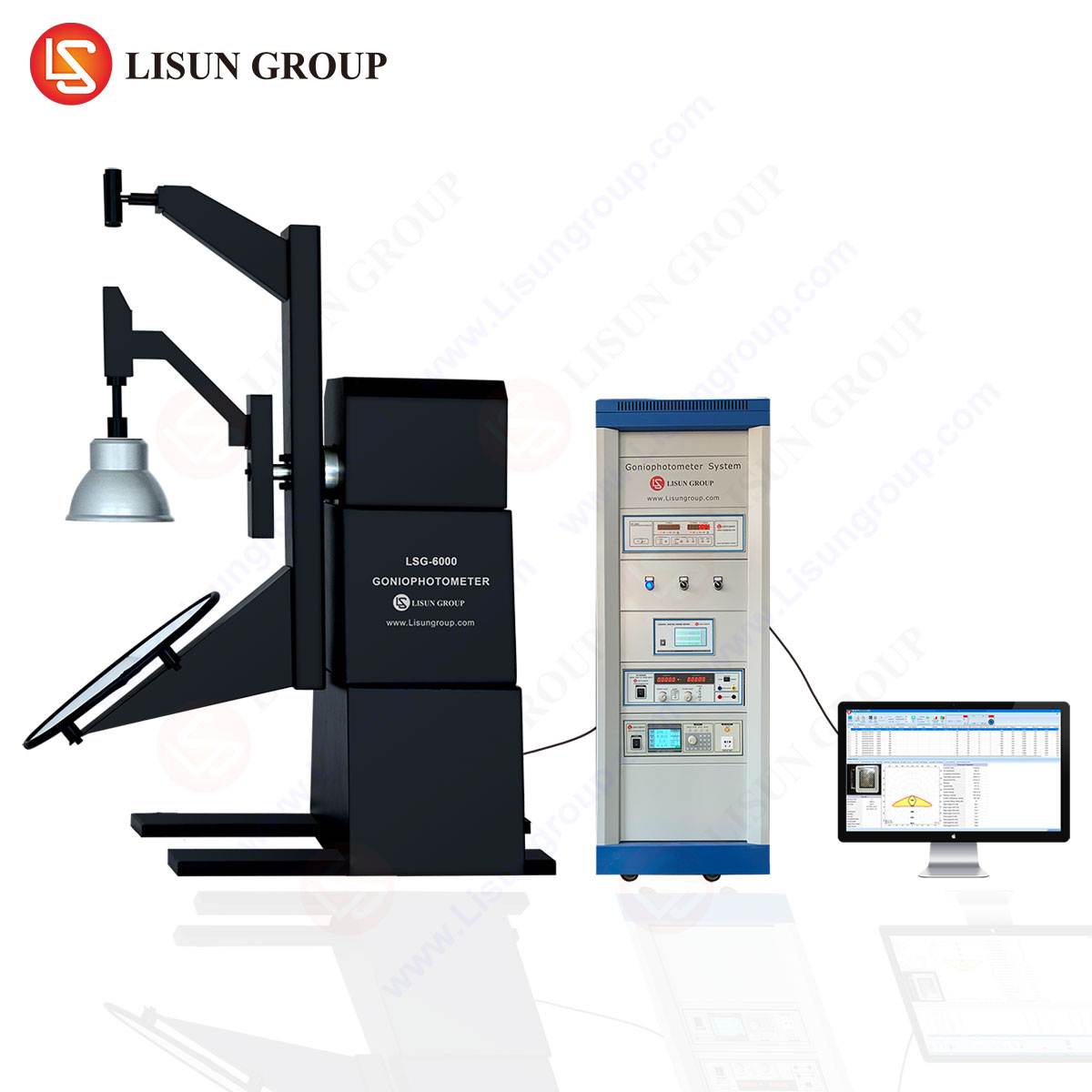
A spectroradiometer is often one component in a larger test system. For total luminous flux measurement, the instrument is coupled with an integrating sphere. The sphere’s size, coating (e.g., BaSO₄ or PTFE), and auxiliary lamp correction method (4π or 2π geometry) must be selected per IES LM-78 and LM-79 guidelines. For directional intensity measurements, a goniophotometer rotates the DUT or the detector around one or two axes, with the spectroradiometer capturing data at each angular position to build a full 3D intensity distribution. Environmental control chambers are integrated to perform temperature-dependent measurements (typically from -40°C to +100°C) as per IES LM-85, which defines the thermal characterization of LED packages and arrays.
Compliance with International Standards and Metrology Frameworks
Robust LED measurement is inextricably linked to formal standards. Key governing documents include:
- CIE S 023/E:2013: Defines the measurement of LEDs.
- IES LM-79: Approved method for electrical and photometric testing of SSL products.
- IES LM-80: Measuring lumen depreciation of LED light sources.
- IEC 62717: Performance requirements for LED modules for general lighting.
- IEC 62612: Self-ballasted LED lamps performance requirements.
- ISO/CIE 19476:2014: Characterisation of the performance of illuminance and luminance meters.
The LMS-6000SF is engineered to facilitate compliance with these and other standards, providing automated test sequences and report generation that directly incorporate the required calculations and tolerances.
Advanced Metrics: Beyond CRI to TM-30 and SSI
While CRI (Ra) has been a longstanding metric, its limitations for LED sources are well-documented. Modern spectroradiometers enable calculation of the IES TM-30-20 framework, which provides a Fidelity Index (Rf) and a Gamut Index (Rg), offering a more complete assessment of color rendition. The Spectral Similarity Index (SSI) is crucial for film, broadcast, and studio lighting, ensuring different light sources will render colors identically on camera. The ability of an instrument like the LMS-6000SF to capture high-resolution, low-noise SPDs is a prerequisite for computing these advanced indices reliably.
Data Integrity, Calibration Maintenance, and Uncertainty Analysis
Maintaining measurement integrity requires a rigorous calibration schedule, typically annual recertification against traceable standards. Regular performance validation using stable LED reference sources is recommended. A complete measurement report must include an estimation of measurement uncertainty, considering components from instrument calibration, noise, sphere geometry, distance alignment, and temperature stability, following the ISO/IEC Guide 98-3 (GUM).
Future Trends: IoT Integration and Smart Manufacturing
The evolution of LED measurement is towards greater integration with Industry 4.0 frameworks. Modern spectroradiometers offer Ethernet, GPIB, and RS-232 interfaces for seamless integration into automated test systems and factory networks. Data can be streamed to centralized quality management systems for real-time statistical process control (SPC), predictive maintenance, and automated binning, driving efficiency in high-volume manufacturing environments.
Frequently Asked Questions (FAQ)
Q1: What is the significance of stray light rejection in an array spectroradiometer, and when is it most critical?
A1: Stray light refers to spurious signal detected at wavelengths where no actual radiation from the source is present, caused by scattering and imperfections within the optical system. High stray light severely distorts measured SPDs, leading to large errors in derived photometric and colorimetric values. It is most critical when measuring sources with high dynamic range within their spectrum, such as a white LED with a intense blue pump peak and a broad, lower-intensity phosphor emission, or when measuring narrow-band monochromatic LEDs (e.g., red, blue) where stray light can artificially inflate apparent output in off-band regions.
Q2: For measuring the total luminous flux of an LED lamp in an integrating sphere, what is auxiliary lamp correction and why is it necessary?
A2: Auxiliary lamp correction (also known as self-absorption correction) is a procedure required because the physical presence of the LED lamp inside the sphere alters the sphere’s spatial reflectance properties compared to when the sphere is calibrated with the standard lamp alone. The lamp housing absorbs a different amount of light. The correction method involves using a stable auxiliary lamp mounted on the sphere wall. Measurements are taken with and without the DUT present but powered off. This ratio corrects for the absorption effect, ensuring an accurate measurement of the DUT’s flux as per IES LM-79 guidelines.
Q3: How does measurement distance impact the results when using a spectroradiometer for luminance or intensity measurements?
A3: For illuminance (lux) measurements, the inverse-square law applies precisely only for point sources at sufficient distances. For extended sources like LED panels, a minimum distance (often 5 times the largest source dimension) is recommended to minimize spatial non-uniformity errors. For luminance (cd/m²) measurements, the instrument’s field of view, defined by its lens and aperture, must be entirely filled by a uniform area of the source. Distance is less critical for luminance if the FOV condition is met, but alignment perpendicular to the source surface is paramount.
Q4: Can a single spectroradiometer like the LMS-6000SF be used for both extremely low-light (e.g., aviation panel lights) and very high-power (e.g., stadium lighting) applications?
A4: Yes, provided the instrument possesses a sufficiently high dynamic range and linear response. This is achieved through hardware design (e.g., a highly linear CCD with low dark noise) and software controls, including adjustable integration time. For very low light levels, long integration times accumulate signal. For very bright sources, neutral density (ND) filters of known attenuation can be placed in the optical path to bring the signal within the detector’s optimal range, with the software applying the appropriate correction factor. The instrument’s specified linearity across its dynamic range ensures accuracy in both regimes.