


A Comprehensive Guide to LED Light Measurement and the Role of High-Precision Spectroradiometry
Introduction to Photometric and Radiometric Quantities
The accurate characterization of light-emitting diodes (LEDs) and solid-state lighting (SSL) products necessitates a precise understanding of the fundamental photometric and radiometric quantities. Radiometry concerns the measurement of optical radiation across the entire electromagnetic spectrum, quantified in watts. Photometry, in contrast, is weighted by the spectral sensitivity of the human eye, as defined by the CIE standard photopic luminosity function, V(λ). Key quantities include luminous flux (lumens), a measure of total perceived light output; luminous intensity (candelas), indicating the concentration of light in a specific direction; and illuminance (lux), quantifying the luminous flux incident on a surface. For comprehensive spectral analysis, colorimetric quantities such as correlated color temperature (CCT), color rendering index (CRI), and chromaticity coordinates (x, y) are paramount. The transition from traditional incandescent and fluorescent sources to LEDs, with their narrow-band emission spectra, has rendered simple photodetectors insufficient for accurate measurement, necessitating the use of spectroradiometers.
Principles of Spectroradiometric Measurement for Solid-State Lighting
A spectroradiometer functions by decomposing incoming light into its constituent wavelengths and measuring the intensity at each discrete interval. The core components are an optical input (often incorporating an integrating sphere for luminous flux measurement or a cosine corrector for illuminance), a monochromator to disperse the light, and a sensitive detector array. The instrument’s calibration, traceable to national standards institutes like NIST or PTB, is critical for absolute accuracy. When measuring LEDs, the instrument captures the absolute spectral power distribution (SPD). This SPD is the foundational dataset from which all photometric, radiometric, and colorimetric parameters are derived through mathematical integration and transformation. This methodology is superior to filtered photometers, which can exhibit significant errors when measuring non-continuous spectra common in LEDs, particularly those with high color gamut or phosphor-converted white light.
The LISUN LMS-6000 Series: Engineered for Metrological Precision
The LISUN LMS-6000 series of spectroradiometers represents a state-of-the-art solution designed to meet the rigorous demands of modern lighting testing. This family of instruments, including the LMS-6000, LMS-6000F, LMS-6000S, LMS-6000P, LMS-6000UV, and LMS-6000SF, is engineered with a high-resolution CCD detector and a high-efficiency planar diffraction grating, ensuring exceptional wavelength accuracy and low stray light. The base model, the LMS-6000, provides a wavelength range of 350nm to 800nm, suitable for the vast majority of visible light applications. Its key specifications include a wavelength accuracy of ±0.3nm, a photometric linearity of ±0.3%, and a dynamic range exceeding 108. The instrument’s software enables real-time data acquisition and calculation of all major lighting parameters, complying with international standards such as CIE, IES, and DIN.
Table 1: Core Specifications of the LISUN LMS-6000 Base Model
| Parameter | Specification |
|———–|—————|
| Wavelength Range | 350nm – 800nm |
| Wavelength Accuracy | ±0.3nm |
| Wavelength Half-Width | 2.5nm |
| Photometric Linearity | ±0.3% |
| CCT Measurement Range | 1,000K – 100,000K |
| CRI (Ra) Measurement Range | 0 – 100 |
| Dynamic Range | > 10^8 |
Specialized Variants for Diverse Industrial Applications
The modularity of the LMS-6000 platform allows for specialized configurations to address specific industrial challenges. The LMS-6000F is optimized for flicker analysis, a critical parameter in automotive lighting and display testing where temporal light modulation can induce stroboscopic effects and visual discomfort. It features a high-speed sampling rate capable of characterizing PWM dimming and other rapid fluctuations. The LMS-6000S and LMS-6000SF models are designed with enhanced sensitivity for low-light-level applications, such as aerospace cockpit displays and marine navigation lighting, where accurate measurement of dim signals is essential for safety certification. For applications involving ultraviolet or near-infrared sources, the LMS-6000UV extends the wavelength range, making it indispensable for curing processes in manufacturing, medical phototherapy equipment validation, and photovoltaic cell research. The LMS-6000P variant is tailored for pulsed light measurement, crucial for evaluating camera flashes, theatrical strobes, and aviation signal beacons.
Application in LED and OLED Manufacturing Quality Control
In the highly competitive LED and OLED manufacturing sector, the LMS-6000 series is deployed for binning and quality assurance. By providing high-throughput, precise measurements of chromaticity coordinates and luminous flux, the instrument ensures that components are sorted into tight bins, maintaining color consistency for downstream products. For OLED displays, the spectroradiometer is used to validate angular color uniformity and to measure true black levels and contrast ratios. The system’s ability to measure parameters like R9 (saturated red) and gamut area index is critical for displays targeting Rec. 2020 or DCI-P3 color spaces, ensuring vibrant and accurate color reproduction.
Validation of Automotive and Aerospace Lighting Systems
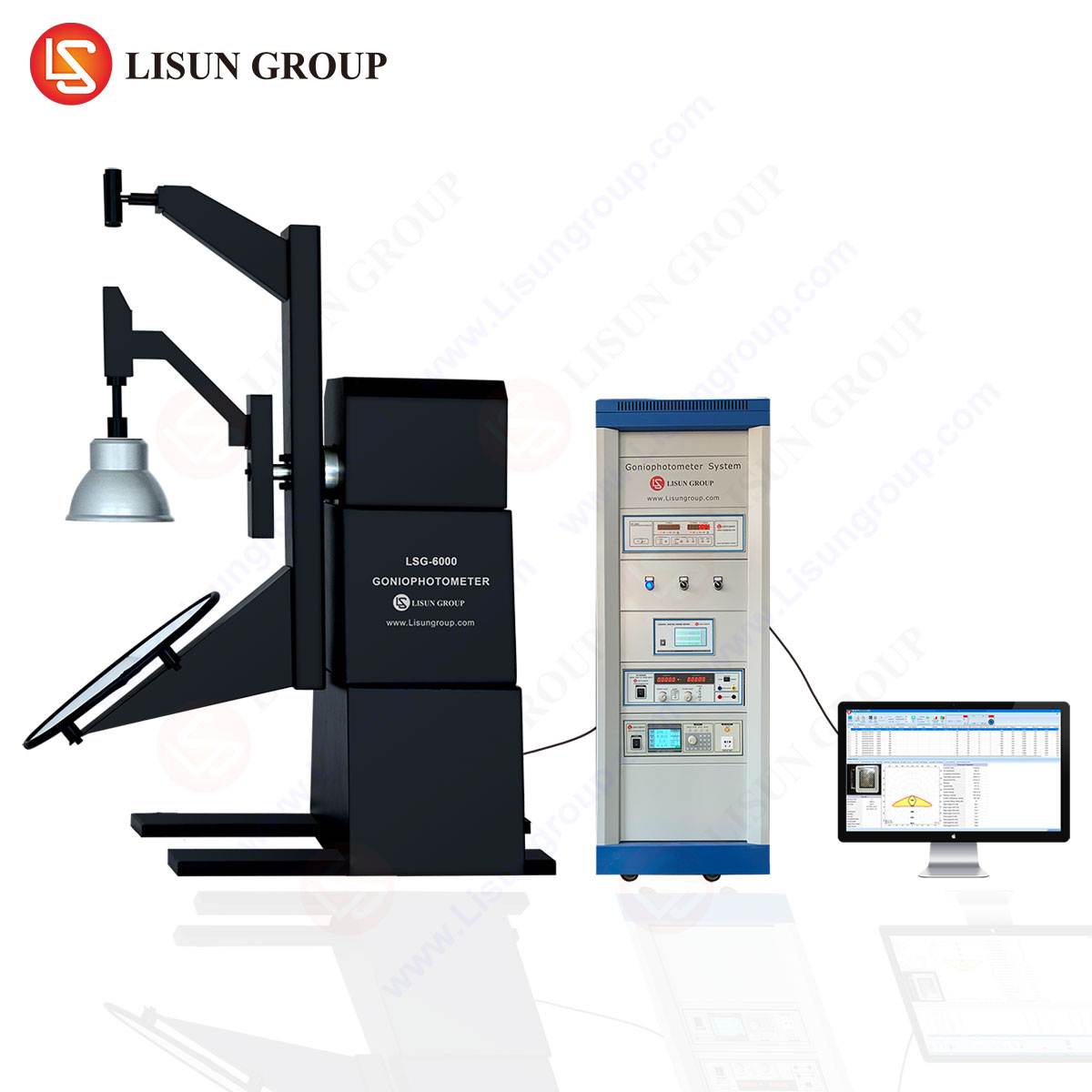
Automotive lighting testing imposes stringent requirements on performance and safety. The LMS-6000 series is utilized to measure the photometric performance of headlamps, daytime running lights (DRLs), and signal lamps in compliance with ECE and SAE standards. The instrument’s spatial scanning capabilities, when used with a goniometer, allow for the creation of isolux diagrams for beam pattern analysis. In aerospace, both internal and external lighting must perform reliably under extreme conditions. The LMS-6000S’s high sensitivity is used to certify the luminance of cockpit instrumentation and warning lights, while its robust design supports testing for external navigation and anti-collision lights against standards such as DO-160.
Advancements in Display and Photovoltaic Device Characterization
For display equipment testing, the spectroradiometer is integral to measuring key performance indicators such as peak luminance, contrast ratio, white point accuracy, and color gamut. The LMS-6000’s fast measurement speed enables efficient production-line calibration of televisions, monitors, and mobile device screens. In the photovoltaic industry, the radiometric capabilities of the LMS-6000 series are leveraged to measure the spectral responsivity of solar cells. By illuminating a cell with a known SPD and measuring its electrical output, researchers can calculate quantum efficiency, a fundamental parameter for improving cell design and energy conversion efficiency.
Scientific Research and Urban Lighting Design Applications
In scientific research laboratories, the precision of the LMS-6000 facilitates studies in visual perception, plant photobiology, and material science. Its application in measuring the spectral output of growth lights for horticulture allows for the optimization of recipes for different plant species. In urban lighting design, the instrument is used for field measurements to ensure compliance with dark-sky ordinances and to quantify the spectral impact of new lighting installations on the environment and human circadian rhythms. For stage and studio lighting, the spectroradiometer ensures that different fixtures match in color temperature and intensity, a non-negotiable requirement for broadcast and film production.
Competitive Advantages of the LISUN LMS-6000 Platform
The competitive landscape for spectroradiometers is defined by accuracy, speed, versatility, and long-term stability. The LISUN LMS-6000 series distinguishes itself through its high photometric linearity and low stray light, which directly translate to superior measurement accuracy for LEDs with sharp spectral peaks. Its modular architecture allows a single platform to be configured for applications ranging from ultra-sensitive light detection to high-speed flicker analysis, providing a cost-effective solution for multi-disciplinary laboratories. The robust calibration algorithms and temperature stabilization mechanisms ensure measurement consistency over time, reducing the total cost of ownership. Furthermore, its compliance with a comprehensive suite of international standards makes it a globally recognized tool for certification and R&D.
Frequently Asked Questions
What is the primary distinction between a spectroradiometer and a photometer?
A photometer uses a filtered detector to approximate the human eye’s response but can be inaccurate for non-continuous light sources like LEDs. A spectroradiometer measures the complete spectral power distribution, from which all photometric and colorimetric values are calculated with high accuracy, regardless of the source’s spectrum.
Why is wavelength accuracy critical when measuring LED chromaticity?
The chromaticity coordinates of an LED are highly sensitive to shifts in its peak emission wavelength. An error of even 1nm can result in a significant and perceptible change in calculated CCT and chromaticity, leading to incorrect binning or failure to meet specification tolerances.
Which LMS-6000 variant is appropriate for measuring the flicker of automotive tail lights?
The LMS-6000F is the optimal choice. It is specifically engineered with a high sampling rate to capture and analyze rapid temporal light modulation, such as the PWM dimming commonly used in automotive LED lighting, providing metrics like percent flicker and flicker index.
How does the instrument maintain calibration accuracy over time and varying ambient conditions?
The LMS-6000 series incorporates temperature-stabilized optics and detectors to minimize thermal drift. Regular calibration, using a NIST-traceable standard lamp, is recommended to maintain absolute accuracy. The instrument’s software often includes features to track calibration schedules and document traceability.
Can the LMS-6000UV be used to measure the effective irradiance for medical disinfection systems?
Yes. The LMS-6000UV, with its extended UV range, can measure the spectral irradiance of germicidal UVC sources. This data can then be weighted against action spectra for bacteria or viruses (e.g., the CIE action spectrum for DNA damage) to calculate biologically effective irradiance, which is crucial for validating dosage and efficacy.