


Precision Luminance Measurement: Principles, Instrumentation, and the LISUN LMS-6000 Series Spectroradiometer
Abstract: The quantitative assessment of luminance is a fundamental requirement across diverse scientific and industrial fields, from fundamental photometric research to the compliance testing of commercial lighting products. This technical article delineates the core principles of luminance measurement, examines the critical specifications of modern luminance meters, and presents a detailed analysis of the LISUN LMS-6000 series spectroradiometer as a paradigm of high-fidelity optical measurement technology. The discussion encompasses operational methodologies, adherence to international standards, and specific applications within key industries including automotive lighting, display technology, and aerospace.
Fundamental Photometric Quantities and Luminance Definition
Luminance, denoted as Lv, is the photometric equivalent of radiance, weighted by the standardized human photopic visual response function, V(λ). It is defined as the luminous intensity emitted, transmitted, or reflected per unit projected area in a given direction. The unit of luminance is the candela per square meter (cd/m²), also known as the nit. This quantity describes the perceptual brightness of a surface as seen by an observer and is the primary parameter for evaluating visual performance, glare, and uniformity of light sources and illuminated surfaces. Accurate luminance measurement, therefore, requires instrumentation that precisely replicates the spectral sensitivity of the CIE standard observer while providing robust spatial resolution to isolate specific areas of interest within a complex luminous field.
Architectural Paradigms in Modern Luminance Measurement Systems
Contemporary luminance measurement devices fall into two primary categories: imaging luminance meters and spot (or telescopic) luminance meters. Imaging luminance meters utilize a calibrated charge-coupled device (CCD) or complementary metal-oxide-semiconductor (CMOS) sensor coupled with precise optics to capture a two-dimensional luminance map of an entire scene. This allows for simultaneous analysis of uniformity, contrast, and glare over wide fields of view. Spot luminance meters, conversely, employ a telescopic optical system to measure luminance within a very narrow, defined field of view (FOV), often as small as 0.1° or 1°, providing high-precision point measurements critical for evaluating small light sources like LED chips or distant signals. The LISUN LMS-6000 series integrates the foundational principles of both approaches by utilizing a high-resolution imaging sensor for target acquisition and alignment, while its core measurement is derived from a sophisticated spectroradiometric engine, transcending the limitations of filter-based photometers.
The Spectroradiometric Advantage in Luminance Quantification
Traditional luminance meters utilize silicon photodiodes with color correction filters designed to approximate the V(λ) function. While effective for many applications, filter mismatches can lead to significant errors when measuring light sources with discontinuous or narrowband spectra, such as LEDs. A spectroradiometer-based luminance measurement system, exemplified by the LISUN LMS-6000 series, eliminates this source of error by measuring the full spectral radiance, L_e(λ), of the target. Luminance is then calculated through a direct integration of the spectral data with the V(λ) function, as per the fundamental equation:
[
L_v = Km int{380,nm}^{780,nm} L_e(lambda) V(lambda) , dlambda
]
where ( K_m ) is the maximum luminous efficacy (683 lm/W). This method ensures theoretically perfect photopic response, future-proofing measurements against any novel spectral power distribution and enabling the derivation of chromaticity coordinates (CIE x, y, u’, v’), correlated color temperature (CCT), and color rendering index (CRI) from a single acquisition.
Technical Exposition: The LISUN LMS-6000F Spectroradiometer
The LISUN LMS-6000F represents a focused implementation within the LMS-6000 series, optimized for high-speed, high-accuracy spectral luminance and chromaticity measurement. Its design prioritizes laboratory-grade precision for R&D and quality control environments.
Optical and Spectral Specifications:
- Spectral Range: 380 nm to 780 nm (standard configuration), covering the entire visible spectrum critical for photopic and colorimetric analysis.
- Spectral Bandwidth (FWHM): ≤ 2.5 nm, ensuring high spectral resolution capable of characterizing narrow emission peaks from phosphor-converted LEDs and laser diodes.
- Wavelength Accuracy: ± 0.3 nm, guaranteeing repeatable and traceable measurements across the spectrum.
- Luminance Measurement Range: A wide dynamic range from 0.01 cd/m² to 5,000,000 cd/m², facilitated by programmable integration times and neutral density filter options. This allows characterization of everything from dim cockpit indicators to high-brightness automotive headlamps.
- Field of View: Configurable via precision apertures and telescopic optics. A typical 1° FOV aperture enables the measurement of small, discrete light sources or specific regions on a display panel.
- Measurement Geometry: The instrument is designed for conformance with CIE-defined geometries (e.g., 0°/45° for reflective surfaces, or direct emission measurement) and can be integrated into goniophotometer systems for angular-dependent characterization.
Calibration and Traceability: The LMS-6000F is calibrated against NIST-traceable standard sources, including tungsten halogen lamps for spectral radiance and standard luminance sources. This establishes a direct metrological chain to international standards, a non-negotiable requirement for certification testing and scientific publication.
Data Acquisition and Software: The proprietary software suite enables real-time visualization of spectral curves, luminance, and colorimetric data. Features include pass/fail analysis against user-defined tolerances, temporal stability monitoring, and comprehensive data export formats for further analysis. Automated measurement sequences support production line integration.
Industry-Specific Applications and Compliance Testing
The precision and versatility of the LMS-6000F spectroradiometer address stringent requirements across multiple sectors.
Automotive Lighting Testing: The device is instrumental in verifying compliance with UN ECE, SAE, and FMVSS standards for signal lamps, headlamps, and interior lighting. It measures the luminous intensity and chromaticity coordinates of tail lights, brake lights, and turn signals to ensure they fall within the legally mandated colorimetric boxes. Its ability to measure high-brightness sources directly qualifies it for hotspot luminance measurement in LED-based headlamp modules.
Display Equipment Testing: For OLED and LCD manufacturers, the LMS-6000F measures key parameters such as screen uniformity, contrast ratio, viewing angle color shift, and absolute luminance. It validates compliance with standards like ISO 9241-307 for visual display requirements and characterizes the performance of HDR (High Dynamic Range) displays, where precise luminance and color fidelity are paramount.
Aerospace and Aviation Lighting: In this safety-critical domain, the instrument tests the luminance and color of cockpit displays, panel-mounted indicators, and external navigation lights against rigorous RTCA/DO-160 and MIL-STD-3009 specifications. Its low-light measurement capability is essential for night-vision imaging system (NVIS) compatible lighting.
Lighting Industry and LED Manufacturing: Beyond simple luminance, the LMS-6000F provides full spectral analysis for LED binning, verifying CCT, CRI (R1-R15), and peak wavelength consistency. It is used in the development and quality assurance of solid-state lighting products for general illumination, ensuring they meet design targets and industry standards such as ANSI/IES LM-79 and IEC 62612.
Scientific Research Laboratories: In optical R&D, the instrument serves as a primary tool for characterizing novel light-emitting materials, including perovskites and quantum dots, measuring the spectral radiance of integrating spheres, and calibrating other optical test equipment.
Comparative Advantages of Spectroradiometric Luminance Measurement
The primary advantage of the LMS-6000F over filter-based luminance meters is its inherent immunity to spectral mismatch error. This translates to superior accuracy when measuring sources with non-continuous spectra. Furthermore, a single measurement yields a complete photometric and colorimetric dataset, increasing efficiency and ensuring internal consistency between luminance and chromaticity values. The spectral data also allows for post-hoc re-analysis with different weighting functions (e.g., scotopic, melanopic) as scientific understanding evolves, protecting the long-term value of the measurement investment.
Integration with Ancillary Testing Apparatus
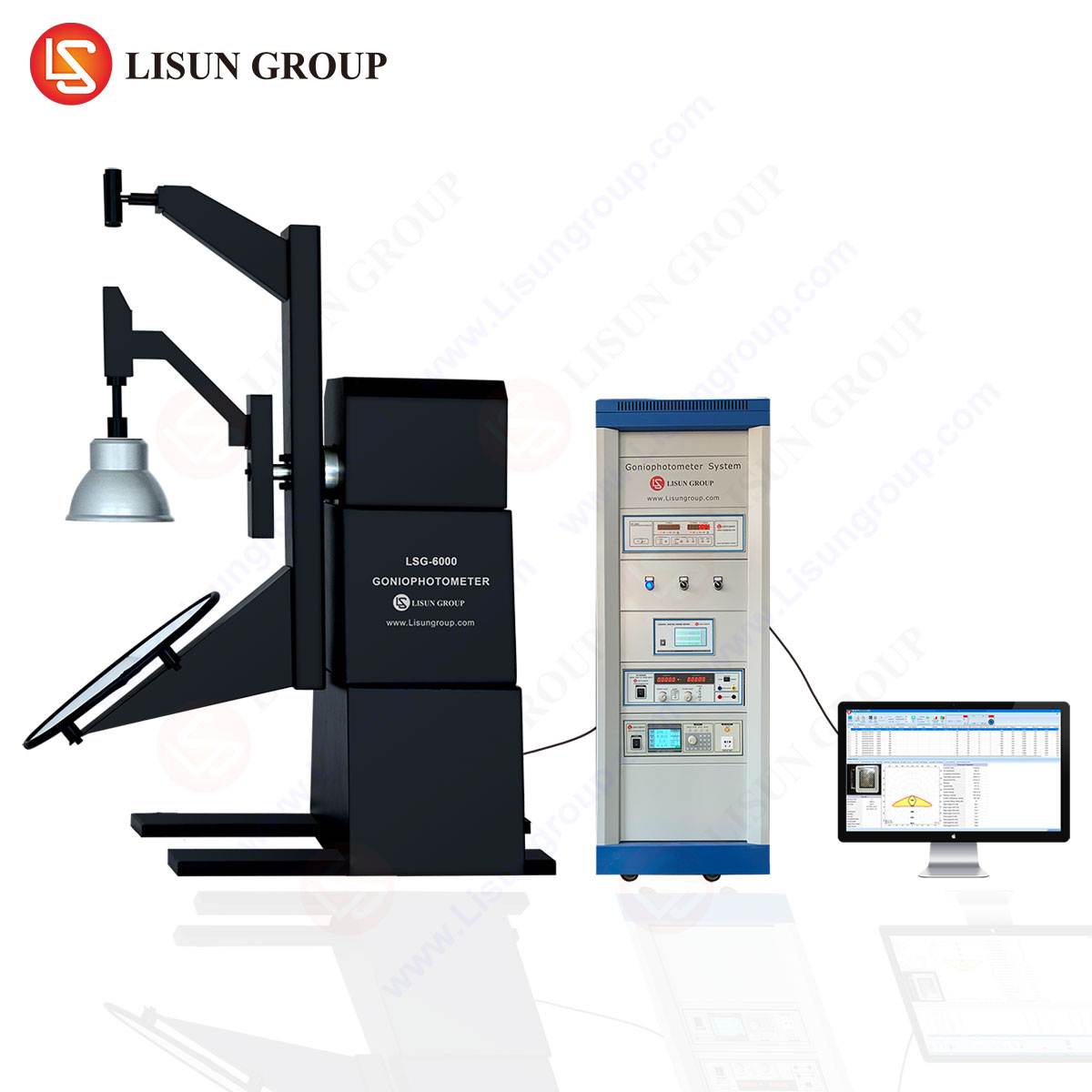
For comprehensive light source characterization, the LMS-6000F is designed to interface with auxiliary systems. It functions as the detector in a Type C goniophotometer for measuring spatial luminous intensity distributions. It can be mounted on robotic arms for automated display testing or paired with environmental chambers to study the effects of temperature and humidity on luminous output. This interoperability makes it a central component in advanced optical test laboratories.
Adherence to International Metrological Standards
Measurements performed with the LMS-6000F are structured to comply with a framework of international standards, ensuring global recognition of test results. Key referenced standards include:
- CIE S 023/E:2013: Characterisation of the Performance of Illuminance and Luminance Meters.
- ISO/CIE 19476:2014: Characterization of the Performance of Illuminance and Luminance Meters.
- IEC 62612: Self-ballasted LED-lamps for general lighting services – Performance requirements.
- ANSI/IES LM-79: Approved Method for the Electrical and Photometric Testing of Solid-State Lighting Products.
Frequently Asked Questions (FAQ)
Q1: What is the primary functional distinction between the LMS-6000F and a conventional imaging luminance meter?
While both can provide luminance values, the LMS-6000F is fundamentally a spectroradiometer with a narrow field-of-view attachment. It provides the complete spectral radiance curve of a specific point, enabling perfect V(λ) weighting and full colorimetric analysis. A conventional imaging luminance meter uses a filtered sensor array to capture a 2D luminance map directly but typically offers limited or derived spectral information, making it more susceptible to errors with non-standard light sources.
Q2: For automotive forward lighting testing, how does the LMS-6000F handle the extreme brightness of LED or laser headlamp hot spots?
The LMS-6000F is equipped with a wide dynamic range achieved through software-controlled integration times and optional, calibrated neutral density (ND) filter wheels that can be automatically inserted into the optical path. This allows it to accurately measure very high luminance levels (up to 5,000,000 cd/m²) without saturating the detector, ensuring precise measurement of the peak intensity zones critical for regulatory compliance and optical design validation.
Q3: In display testing, can the LMS-6000F measure the luminance uniformity of an entire screen?
The LMS-6000F is a spot meter, designed for high-accuracy point measurements. For full-screen uniformity mapping, it would be integrated with a motorized X-Y translation stage or a robotic arm to automate point-by-point measurement across a predefined grid. For rapid uniformity assessment, LISUN offers dedicated imaging luminance meters; however, the LMS-6000F would be used to provide the absolute luminance calibration for those systems or to perform deep-dive spectral analysis on specific non-uniform regions identified by the imager.
Q4: How is the instrument calibrated for low-luminance measurements required in aerospace (e.g., NVIS compatibility) or darkroom environments?
Calibration traceability extends to the lower end of the measurement range. Using NIST-traceable low-luminance standard sources, the instrument’s response is characterized for high signal-to-noise ratio performance at low light levels. The calibration process accounts for dark signal noise and linearity across the entire dynamic range, ensuring reliable and accurate data even at sub-candela levels critical for night-vision and specialty lighting applications.
Q5: What is the significance of the ≤ 2.5 nm spectral bandwidth for LED testing?
A narrow spectral bandwidth is crucial for accurately resolving the sharp emission peaks characteristic of monochromatic LEDs (e.g., royal blue, red) and the finer spectral features of phosphor-converted white LEDs. A wider bandwidth would convolve the true spectral shape, leading to inaccuracies in calculated chromaticity coordinates, dominant wavelength, and purity. The ≤ 2.5 nm resolution of the LMS-6000F ensures high fidelity in capturing these features, enabling precise binning and quality control.