








A Comprehensive Guide to the Principles and Applications of Integrating Sphere Systems for Photometric and Radiometric Measurement
Introduction
The accurate quantification of light—encompassing its total luminous flux, spectral power distribution, colorimetric properties, and radiant power—is a fundamental requirement across a diverse array of scientific and industrial disciplines. The integrating sphere, a simple yet profoundly effective optical device, serves as the cornerstone for these precise measurements. By creating a spatially uniform radiance field through multiple diffuse reflections, it enables the measurement of total light output from a source, irrespective of its spatial emission characteristics. This article delineates the rigorous methodology for employing integrating sphere systems, with a specific examination of the LISUN LPCE-2 Integrating Sphere Spectroradiometer System as a paradigmatic implementation. The discourse will encompass operational principles, calibration protocols, measurement procedures, and nuanced applications across advanced technological sectors.
Fundamental Operating Principles of an Integrating Sphere
An integrating sphere is a hollow spherical cavity, whose interior surface is coated with a highly reflective, spectrally neutral, and perfectly diffuse material, typically barium sulfate (BaSO₄) or polytetrafluoroethylene (PTFE). When a light source is placed within the sphere, its radiation undergoes multiple diffuse reflections. The principle of spatial integration states that after several reflections, the irradiance on any patch of the sphere wall becomes directly proportional to the total flux entering the cavity, and is independent of the original spatial distribution of the source. This homogenized radiance is sampled through a small port, where a baffle strategically blocks first-reflection light from the source from directly reaching the detector, ensuring measurement accuracy.
The governing equation for the sphere’s performance is derived from the theory of radiative exchange within an enclosure. The spectral flux, Φ(λ), incident on the detector can be expressed as:
Φ_det(λ) = Φ_source(λ) [ρ(λ) / (1 – ρ(λ) (1 – f))] * (A_det / A_sphere)
where ρ(λ) is the wall reflectance, f is the port fraction (total area of all ports relative to the sphere’s internal surface area), A_det is the area of the detector port, and A_sphere is the internal surface area of the sphere. A high wall reflectance (ρ > 0.95) and a minimal port fraction (f < 0.05) are critical for maximizing sphere efficiency and measurement linearity.
System Configuration and Critical Components: The LPCE-2 Paradigm
The LISUN LPCE-2 system exemplifies a fully integrated solution for comprehensive light measurement. Its architecture comprises several synchronized components, each fulfilling a specific function within the measurement chain.
- The Integrating Sphere: Available in standardized diameters (e.g., 0.5m, 1m, 1.5m, 2m), the sphere size is selected based on the physical dimensions and total flux of the device under test (DUT). Larger spheres minimize self-absorption errors for larger sources. The interior is coated with a stable, high-reflectance diffuse material.
- The Spectroradiometer: This is the core analytical instrument. It consists of a diffraction grating monochromator and a high-sensitivity CCD or photomultiplier tube detector. It measures the spectral power distribution (SPD) of the light sampled from the sphere across a defined wavelength range (e.g., 380-780nm for visible light, extended for UV or IR applications).
- The Photometric Calibration System: This includes a reference standard lamp, typically a quartz halogen lamp calibrated for spectral irradiance or total luminous flux by a national metrology institute (NMI). The standard lamp is used to establish the absolute responsivity of the entire sphere-spectrometer system.
- Auxiliary Lamp (for Spectralon-type spheres): For measurements of light sources that are not self-luminous (e.g., displays, reflective samples), a stable auxiliary lamp is mounted on the sphere to provide controlled illumination.
- Power Supply & Control Electronics: Stable, programmable power sources for both the DUT and the standard lamp are essential for repeatable measurements.
- Software Suite: Dedicated software controls the spectrometer, data acquisition, and performs calculations per CIE, IES, and other international standards. It computes photometric quantities (luminous flux in lumens, efficacy in lm/W), colorimetric data (CIE 1931/1976 chromaticity coordinates, correlated color temperature CCT, color rendering index CRI, R9), and spectral parameters.
Pre-Measurement Calibration and System Characterization
Prior to any measurement, a meticulous calibration sequence is mandatory to define the system’s absolute responsivity and correct for inherent systematic errors.
- System Responsivity Calibration: The NMI-traceable standard lamp is operated at its specified current and allowed to reach thermal equilibrium. It is placed at the center of the sphere (or at a designated holder). The spectroradiometer measures the SPD from the sphere. The software computes a calibration coefficient, K(λ), for each wavelength, which relates the raw detector signal to absolute spectral flux. This step accounts for the sphere’s wall reflectance, port losses, and detector sensitivity.
- Self-Absorption Correction (Error Type F1): A significant error arises because the DUT and the standard lamp have different physical shapes and spectral reflectance, causing different amounts of light to be absorbed when placed inside the sphere. The correction factor is determined by a substitution method using a stable auxiliary lamp mounted on the sphere wall. The procedure involves measuring the sphere signal with: a) only the auxiliary lamp, b) auxiliary lamp with the standard lamp holder (or a dummy of equivalent size/shape) present, and c) auxiliary lamp with the DUT present. The correction factor is calculated from the ratio of these signals.
- Spatial Non-Uniformity Assessment: While the sphere idealizes uniform radiance, minor non-uniformities exist. Mapping the sphere’s response using a movable point source can characterize this, though for many industrial applications following strict port/baffle geometry, this error is minimized and often accounted for in the calibration uncertainty budget.
Measurement Procedure for a Typical Light Source
Following calibration, the measurement of a DUT proceeds with strict protocol adherence.
- DUT Stabilization: The light source (e.g., an LED module, automotive headlamp, or horticultural luminaire) is powered using the stabilized supply and operated until its photometric and thermal output stabilizes, as per relevant standards (e.g., IES LM-79, LM-80).
- Dark Signal Measurement: The spectrometer measures the signal with all lights off to account for electronic offset and ambient light leakage.
- DUT Measurement: The stabilized DUT is placed in the sphere, typically at the center. The spectroradiometer acquires the SPD. The software subtracts the dark signal and applies the calibration coefficient K(λ) and the self-absorption correction factor to compute the absolute spectral flux of the DUT.
- Data Computation: From the corrected absolute SPD, the software derives all required parameters:
- Total Luminous Flux (Φ_v): ∫ Φ_e(λ) * V(λ) dλ, where V(λ) is the CIE photopic luminosity function.
- Chromaticity Coordinates: (x,y) or (u’,v’) in CIE color spaces.
- Correlated Color Temperature (CCT) and Duv distance from the Planckian locus.
- Color Rendering Index (CRI, Ra): Calculated per CIE 13.3-1995, including the special index R9 for saturated red.
- Spectral Efficacy: Luminous flux per electrical watt input (lm/W).
- Peak Wavelength and Dominant Wavelength.
Industry-Specific Applications and Use Cases
The versatility of integrating sphere systems like the LPCE-2 is demonstrated by their critical role in diverse sectors.
- LED & OLED Manufacturing: For binning LEDs by flux and chromaticity, verifying datasheet claims, and testing OLED panels for uniform emissive properties. The LPCE-2’s high-resolution spectrometer is crucial for accurately measuring narrow-band LED spectra and calculating CRI/R9.
- Automotive Lighting Testing: Measuring the total luminous flux of signal lamps (tail lights, turn indicators), interior lighting, and increasingly, the complex spectra of LED-based adaptive driving beam (ADB) headlamps. Compliance with regulations such as ECE, SAE, and FMVSS108 is facilitated.
- Aerospace and Aviation Lighting: Certification of navigation lights, cabin lighting, and emergency lighting for aircraft requires precise photometry under stringent environmental conditions, often referenced to standards like RTCA DO-160.
- Display Equipment Testing: When configured with an auxiliary lamp, the sphere becomes a tool for measuring the reflectance of display surfaces or the luminance uniformity of emissive displays by measuring light from a defined sample port.
- Photovoltaic Industry: Characterizing the spectral irradiance of solar simulators used for testing PV cells is essential, as the cell’s responsivity is wavelength-dependent. The sphere measures the simulator’s output to ensure it meets Class A, B, or C specifications per IEC 60904-9.
- Optical Instrument R&D: Calibrating the throughput of lenses, diffusers, and optical systems by measuring total transmitted or reflected flux.
- Urban Lighting Design: Validating the performance of street luminaires and architectural lighting fixtures for photometric output and spectral quality, impacting both efficacy and light pollution (e.g., evaluating melatonin suppression potential via melanopic ratios).
- Marine and Navigation Lighting: Testing maritime signal lights to ensure they meet intensity and color requirements as per International Maritime Organization (IMO) COLREGs conventions.
- Stage and Studio Lighting: Quantifying the output and color characteristics of LED-based theatrical luminaires for lighting design and fixture specification.
- Medical Lighting Equipment: Validating the spectral output of surgical lights, phototherapy devices (e.g., for neonatal jaundice or dermatological treatments), and diagnostic illumination systems against stringent medical device regulations.
Advantages of an Integrated Spectroradiometer System
The LPCE-2’s design as a combined sphere and spectroradiometer offers distinct advantages over traditional systems using filter-based photometers.
- Spectral Versatility: A single measurement yields the complete SPD, from which all photometric and colorimetric quantities are derived simultaneously, ensuring internal consistency.
- High Accuracy for Modern Sources: Filter photometers rely on a perfect match between their spectral responsivity and the V(λ) function. Any mismatch leads to large errors with narrow-band sources like LEDs. A spectroradiometric system is inherently immune to this spectral mismatch error.
- Future-Proofing: As new metrics emerge (e.g., TM-30-18 for color fidelity and gamut, melanopic lux), they are computed from the underlying SPD. A spectroradiometer system can implement these via software updates, whereas a filter system may require hardware changes.
- Diagnostic Capability: Analysis of the raw SPD can reveal manufacturing defects, such as phosphor inconsistencies in white LEDs or unexpected emission peaks.
Considerations for Measurement Accuracy and Uncertainty
Achieving metrologically sound results requires attention to several factors.
- Sphere Size and Port Fraction: The DUT should not exceed recommended size limits (typically <1/10 of sphere diameter) to minimize spatial integration errors and increased port fraction.
- Thermal Management: Many light sources, especially high-power LEDs, are sensitive to junction temperature. The sphere’s enclosed environment can lead to heating, necessitating adequate ventilation or pulsed measurement techniques as defined in standards.
- Stray Light and Spectrometer Performance: The spectrometer’s stray light rejection and wavelength accuracy must be suitable for the DUT’s spectrum. Regular wavelength calibration using mercury or argon lamps is required.
- Uncertainty Budget: A comprehensive measurement uncertainty budget, following the GUM (Guide to the Expression of Uncertainty in Measurement), must include contributions from: standard lamp calibration uncertainty, sphere self-absorption correction, spectrometer nonlinearity and noise, DUT instability, and positioning repeatability. For a system like the LPCE-2, total expanded uncertainties (k=2) for luminous flux below 1% are achievable with careful operation.
Conclusion
The integrating sphere, particularly when integrated with a high-performance spectroradiometer as in the LISUN LPCE-2 system, represents an indispensable tool for the science of light measurement. Its operation, grounded in fundamental radiative transfer principles, demands a disciplined approach to calibration and procedure. Mastery of its use enables industries ranging from solid-state lighting manufacturing to aerospace and biomedical engineering to quantify, qualify, and innovate with confidence, ensuring product performance, regulatory compliance, and the advancement of lighting science.
Frequently Asked Questions (FAQ)
Q1: What is the primary difference between using an integrating sphere with a spectroradiometer versus a photometer?
A spectroradiometer measures the complete spectral power distribution (SPD) of the light, from which all photometric (luminous flux, intensity) and colorimetric (CCT, CRI, chromaticity) parameters are calculated mathematically. A photometer uses a filtered detector to measure luminous flux directly but is susceptible to significant spectral mismatch errors, especially with narrow-band sources like LEDs. The spectroradiometric method is more accurate, versatile, and future-proof.
Q2: How often should the integrating sphere system be recalibrated?
The calibration interval depends on usage intensity, environmental conditions, and required measurement uncertainty. For critical quality control applications, a full system responsivity calibration using the traceable standard lamp is recommended monthly or quarterly. Wavelength calibration of the spectrometer should be performed weekly or before high-precision measurement campaigns. The sphere’s internal coating degradation is slow; its performance is monitored through regular calibration checks.
Q3: Can the LPCE-2 system measure the luminous intensity (candelas) of a light source?
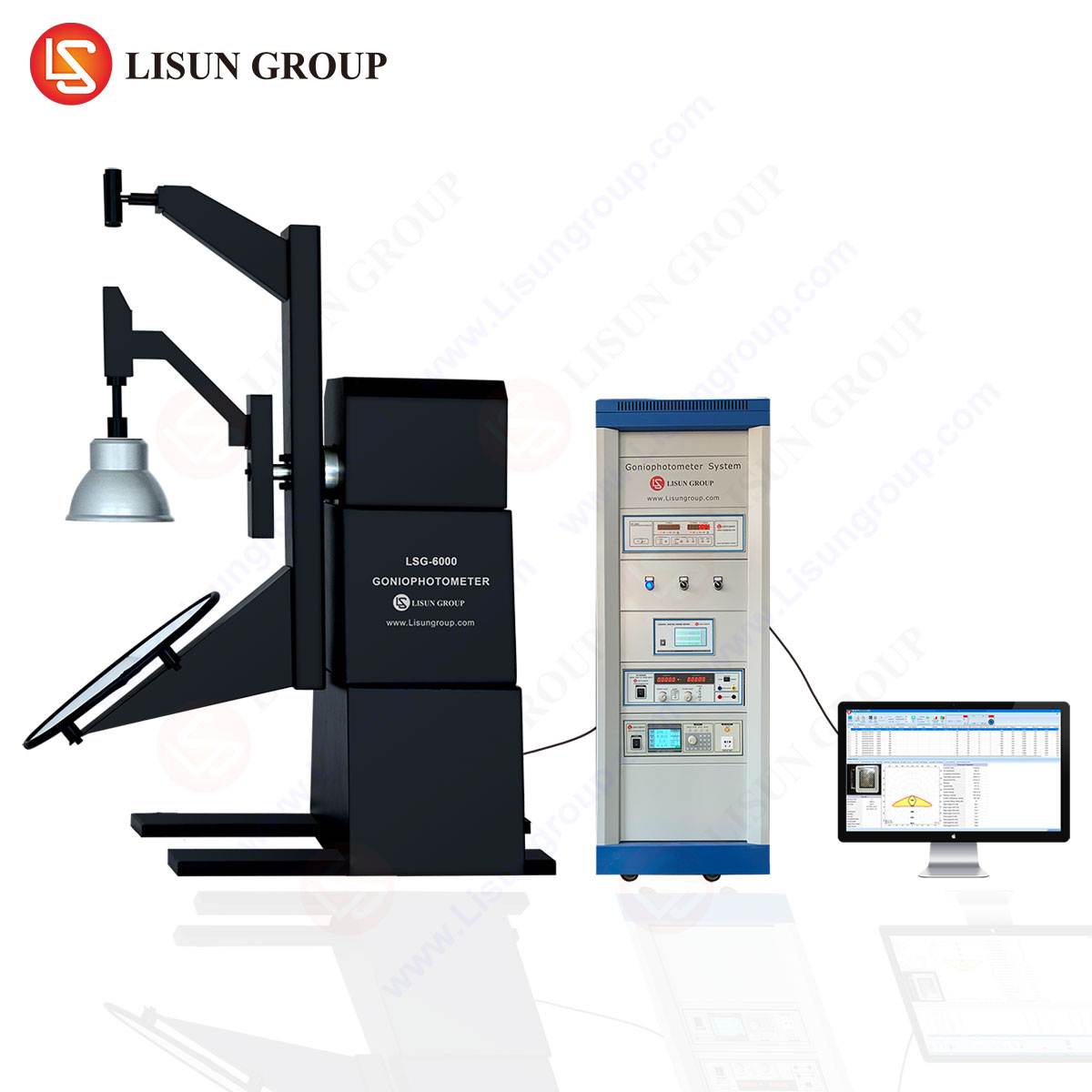
Not directly. An integrating sphere measures total luminous flux (lumens). To obtain the luminous intensity distribution (candelas as a function of angle), a goniophotometer is required. However, for some applications, the average intensity over a defined solid angle can be estimated from the total flux if the spatial distribution is known or assumed to be Lambertian, but this is not a substitute for goniophotometry.
Q4: How is self-absorption error corrected for sources with very different geometries, like a long linear fluorescent tube versus a compact standard lamp?
The auxiliary lamp method described is the standard correction technique. It accurately accounts for the difference in the amount of light blocked/absorbed by the physical presence of the DUT versus the standard lamp (or its holder/dummy) inside the sphere. For extremely disparate geometries, using a larger sphere or a sphere with a dedicated holder system designed to minimize shadowing is also beneficial.
Q5: What standards govern testing with integrating sphere systems for general lighting?
Key standards include IES LM-79 (Electrical and Photometric Measurements of Solid-State Lighting Products), which prescribes methods for total flux, electrical power, and efficacy. IES LM-78 covers measurement of traditional light sources. CIE 84 and CIE S 025 provide foundational guidance on photometry and spectroradiometry of LEDs. For color rendering, CIE 13.3 and IES TM-30-18 are relevant. Compliance with these standards is built into the software and operational protocols of systems like the LPCE-2.