


Foundations of Photometric Quantification and Measurement Methodologies
Introduction to Radiometric and Photometric Principles
The quantification of light, perceived as brightness by the human visual system, is a cornerstone of optical science and engineering. Accurate measurement is not a singular concept but a family of related quantities, each defined by specific scientific principles. The foundation rests upon the distinction between radiometry and photometry. Radiometry is the science of measuring electromagnetic radiation in terms of absolute power, encompassing all wavelengths. Photometry, however, is a filtered subset of radiometry that weights radiometric quantities by the spectral sensitivity of the human eye, as defined by the CIE standard photopic luminosity function, V(λ). This function, which peaks at 555 nanometers under typical daylight (photopic) conditions, reflects the eye’s varying sensitivity to different wavelengths. Consequently, the fundamental photometric unit, the candela (cd), is a base unit in the International System of Units (SI), defined from a monochromatic radiometric source using V(λ). Key derived units include the lumen (lm) for luminous flux (total perceived light output) and the lux (lx) for illuminance (luminous flux incident on a surface). Luminance (cd/m²), or the photometric brightness of a surface, is often the most critical parameter for displays and lighting applications. The accurate conversion from radiometric data to photometric values necessitates precise spectral measurement, which is the domain of spectroradiometry.
The Critical Role of Spectroradiometry in Accurate Brightness Assessment
While filtered photometers provide a direct and rapid measurement of photometric quantities, they are inherently limited by the accuracy with which their built-in filter matches the V(λ) curve. Any deviation leads to significant errors, especially when measuring non-standard light sources like light-emitting diodes (LEDs) or lasers, whose spectral power distributions (SPDs) can have narrow peaks far from the peak of the V(λ) function. Spectroradiometry overcomes this limitation by measuring the absolute spectral power distribution of a source across the visible spectrum (typically 380-780 nm) with high wavelength accuracy. The spectral data is then computationally integrated with the V(λ) function to derive all relevant photometric values with the highest possible accuracy. This method is indispensable for characterizing modern light sources, validating color rendering properties, and ensuring compliance with stringent industry standards. It provides a complete optical fingerprint of the source, enabling not just brightness measurement but also a full chromaticity analysis.
Essential Calibration Protocols for Measurement Integrity
The integrity of any photometric or spectroradiometric measurement is entirely dependent on a rigorous calibration chain. The process begins with national metrology institutes (e.g., NIST, PTB) that maintain primary standard lamps, whose luminous intensity is known with extreme uncertainty. These are used to calibrate reference standard lamps, which in turn are used to calibrate working standard lamps in accredited calibration laboratories. For spectroradiometers, a two-step calibration is critical. First, wavelength accuracy is verified using spectral line sources, such as mercury-argon lamps, which emit light at known, discrete wavelengths. Second, absolute radiometric responsivity is calibrated using a standard lamp of known spectral irradiance. This calibration assigns a precise conversion factor at each wavelength, transforming the instrument’s raw signal (e.g., counts) into absolute spectral radiance or irradiance units. Regular recalibration, typically on an annual basis, is mandatory to account for sensor degradation and ensure long-term measurement traceability to SI units.
Advanced Instrumentation for Precision Photometry
Architecture and Operational Principles of the LISUN LMS-6000 Spectroradiometer Series
The LISUN LMS-6000 series represents a class of high-precision spectroradiometers engineered for laboratory-grade optical measurement. The core of its operation is based on a diffraction grating and a CCD array detector. Incident light enters the instrument through a cosine-corrected diffuser or a fiber optic cable, ensuring accurate angular response for illuminance or radiance measurements, respectively. The light is then collimated and directed onto a planar diffraction grating, which disperses the light into its constituent wavelengths. This spectrum is projected onto a linear CCD array, where each pixel corresponds to a specific wavelength. The electrical charge accumulated at each pixel, proportional to the light intensity at that wavelength, is read out to construct the complete spectral power distribution of the source. The LMS-6000 series encompasses several models tailored for specific applications:
- LMS-6000/LMS-6000F: Standard and fast-scanning models for general lighting and display testing.
- LMS-6000S: Configured with a high-sensitivity CCD for measuring low-light-level sources.
- LMS-6000P: Integrated with a pulsed light source measurement function, critical for characterizing camera flashes, automotive turn signals, and other transient light events.
- LMS-6000UV: Extended spectral range into the ultraviolet region (200-400 nm), essential for UV curing, sterilization equipment, and material aging tests.
- LMS-6000SF: A combination model offering both high sensitivity and pulsed light measurement capabilities.
Technical Specifications and Performance Metrics of the LMS-6000 Series
The performance of the LMS-6000 series is defined by a set of critical specifications that determine its suitability for various industrial and scientific tasks.
Table 1: Key Specifications of the LISUN LMS-6000 Series
| Parameter | Specification | Significance |
| :— | :— | :— |
| Wavelength Range | 380-780nm (Standard); 200-780nm (UV Model) | Covers the visible spectrum and beyond for specialized applications. |
| Wavelength Accuracy | ±0.2 nm | Ensures precise identification of spectral peaks, crucial for laser and narrow-band LED measurement. |
| Photometric Accuracy | ±2% (against NIM standard) | Guarantees traceable and reliable measurement of luminance, illuminance, and luminous flux. |
| Dynamic Range | > 3.0×10⁶ :1 | Allows measurement from very dim to very bright sources without changing hardware. |
| Stray Light | < 0.05% | Minimizes spurious signals, improving accuracy for LEDs with sharp spectral peaks. |
| Pixel Resolution | 2048 pixels | Provides high-resolution spectral data for detailed analysis. |
These specifications enable the instrument to achieve a low luminance measurement capability down to 0.0001 cd/m² and a high-end capability exceeding 3,000,000 cd/m², making it versatile for applications from nocturnal aviation lighting to high-brightness automotive headlamps.
Comparative Advantages of High-Dynamic-Range Spectroradiometry
A key competitive advantage of instruments like the LMS-6000 series is their exceptionally high dynamic range. Traditional measurement setups often require the use of neutral density filters or aperture adjustments to avoid detector saturation when measuring bright sources, a process that introduces potential for error and inefficiency. High-dynamic-range (HDR) spectroradiometry allows for the seamless measurement of a scene containing both very dark and very bright areas within a single capture. This is achieved through advanced CCD readout architectures and signal processing algorithms. In the Automotive Lighting Testing industry, this capability is vital for measuring the precise luminous intensity of a headlamp’s hot spot while simultaneously evaluating the cutoff line and glare, all in one integrated measurement, ensuring compliance with UNECE and SAE standards.
Industry-Specific Applications and Measurement Protocols
Validation of Luminous Efficacy in LED and OLED Manufacturing
In the competitive LED & OLED Manufacturing sector, luminous efficacy (lumens per watt, lm/W) is a primary metric of energy efficiency. Accurate measurement is critical for product grading and marketing. Using an integrating sphere coupled with a spectroradiometer like the LMS-6000, the total luminous flux of an LED package or module is measured. The spectroradiometer’s high wavelength accuracy ensures that the calculation of lumens from the measured SPD is correct, even for phosphor-converted LEDs with complex spectra that challenge simple photometers. Furthermore, the same data set is used to derive chromaticity coordinates (CIE x,y or u’v’) and correlated color temperature (CCT), providing a complete photometric and colorimetric characterization from a single measurement.
Compliance Testing for Automotive Forward Lighting Systems
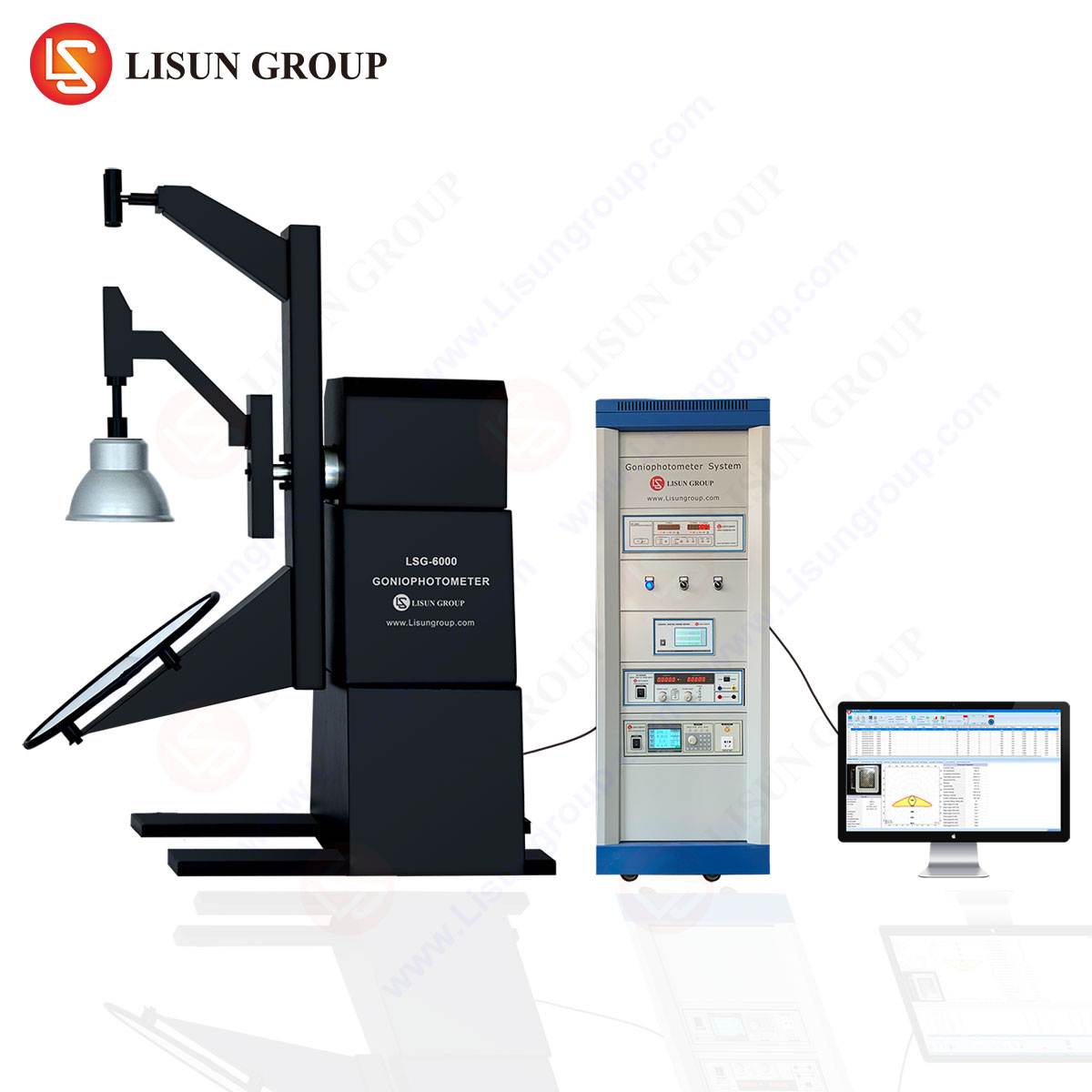
Automotive Lighting Testing is governed by rigorous international regulations (e.g., ECE R148, FMVSS 108) that specify minimum and maximum luminous intensities within precisely defined angular zones. A goniophotometer, which rotates the light source or the detector, is used to map the entire light distribution pattern. At each measurement point, a spectroradiometer like the LMS-6000P is used to capture the intensity and color. The pulsed measurement function of the LMS-6000P is essential for accurately characterizing the brightness of LED turn signals and brake lights, which are typically driven by pulsed-width modulation (PWM). A standard instrument would yield an average value, while the pulsed function captures the peak intensity, which is the regulated parameter.
Quantifying Display Performance Metrics for Consumer Electronics
In Display Equipment Testing, luminance is a fundamental parameter. However, modern displays require more nuanced measurements. Contrast ratio, for example, is the ratio of the luminance of a full-white screen to that of a full-black screen. The high dynamic range of the LMS-6000SF allows for the accurate measurement of both extremes without instrument recalibration. Furthermore, the evaluation of High Dynamic Range (HDR) displays, which can produce extremely bright highlights, demands an instrument capable of measuring up to several thousand nits (cd/m²) with precision. The spectral data also allows for the calculation of the display’s color gamut, verifying its compliance with standards like DCI-P3 or Rec. 2020.
Ensuring Spectral Purity in Medical and Scientific Illumination
For Medical Lighting Equipment (e.g., surgical lights, phototherapy units) and Scientific Research Laboratories, spectral content is often as important as brightness. Surgical lights require high color rendering to allow clinicians to distinguish tissue types accurately, which is calculated from the SPD. Phototherapy units for treating neonatal jaundice must emit light within a very specific blue wavelength band (approximately 450-470 nm). The high wavelength accuracy of the LMS-6000 ensures that the spectral output is within the therapeutic window and that potentially harmful UV or IR radiation is absent. In research, whether studying plant growth (Photovoltaic Industry research) or material fluorescence (Optical Instrument R&D), knowing the exact spectral power of the illumination source is non-negotiable for reproducible results.
Navigational Lighting Certification for Aerospace and Marine Environments
Lighting in Aerospace and Aviation and Marine and Navigation Lighting must adhere to strict specifications for intensity, color, and angular distribution to ensure safety. An aircraft’s anti-collision beacon, for example, must be bright enough to be seen from miles away and must be a specific shade of red. A spectroradiometer configured for luminance measurement is used to certify that the installed lighting meets the standards set by organizations like the FAA and ICAO for aviation, and the IMO for maritime applications. The ability to measure reliably in often harsh environmental conditions is a key requirement for the instrumentation used in these fields.
Frequently Asked Questions (FAQ)
Q1: What is the primary advantage of using a spectroradiometer like the LMS-6000 over a traditional photometer for measuring brightness?
The primary advantage is spectral accuracy. A photometer uses a physical filter to approximate the human eye’s response (V(λ) curve), which can lead to significant errors when measuring non-incandescent sources like LEDs or lasers. A spectroradiometer measures the full spectral power distribution and calculates photometric values mathematically using the exact V(λ) function, resulting in superior accuracy, especially for sources with atypical spectra.
Q2: When would the pulsed light measurement function (LMS-6000P) be necessary?
The pulsed measurement function is essential for accurately characterizing the peak intensity of light sources that are driven by pulsed currents, such as camera flashes, automotive signal lamps (turn indicators, brake lights), and certain types of Stage and Studio Lighting (e.g., strobes). A standard measurement mode would only provide an average intensity over the pulse period, which underestimates the perceived peak brightness.
Q3: How does the high dynamic range of the LMS-6000 series benefit display testing?
High dynamic range allows for the measurement of a display’s full contrast ratio in a single, uninterrupted session. It can accurately measure the very low luminance of a black state and the very high luminance of a white or HDR highlight without requiring manual adjustment of the instrument’s integration time or the use of attenuation filters. This increases measurement speed, repeatability, and accuracy.
Q4: For Urban Lighting Design, is measuring illuminance (lux) or luminance (cd/m²) more important?
Both are critical but serve different purposes. Illuminance (lux) measures the amount of light falling on a surface (e.g., a road or pedestrian walkway) and is used to ensure minimum light levels for safety and functionality are met. Luminance (cd/m²) measures the light reflected from a surface (e.g., the road surface itself) and is a more direct correlate of human perception of brightness. Modern standards increasingly emphasize luminance-based design to optimize for visual performance and minimize glare and light pollution. A spectroradiometer can be configured to measure either quantity.
Q5: What is the significance of stray light specification in a spectroradiometer?
Stray light refers to spurious signals detected at a given wavelength that originate from light at other wavelengths. It is caused by imperfections in the optical system. A low stray light specification (<0.05% in the LMS-6000) is crucial for accurately measuring sources with sharp spectral peaks, such as lasers or narrow-band LEDs. High stray light can artificially inflate the measured signal in the spectral valleys, leading to errors in colorimetric calculations and an overestimation of the broad-spectrum components of a source.