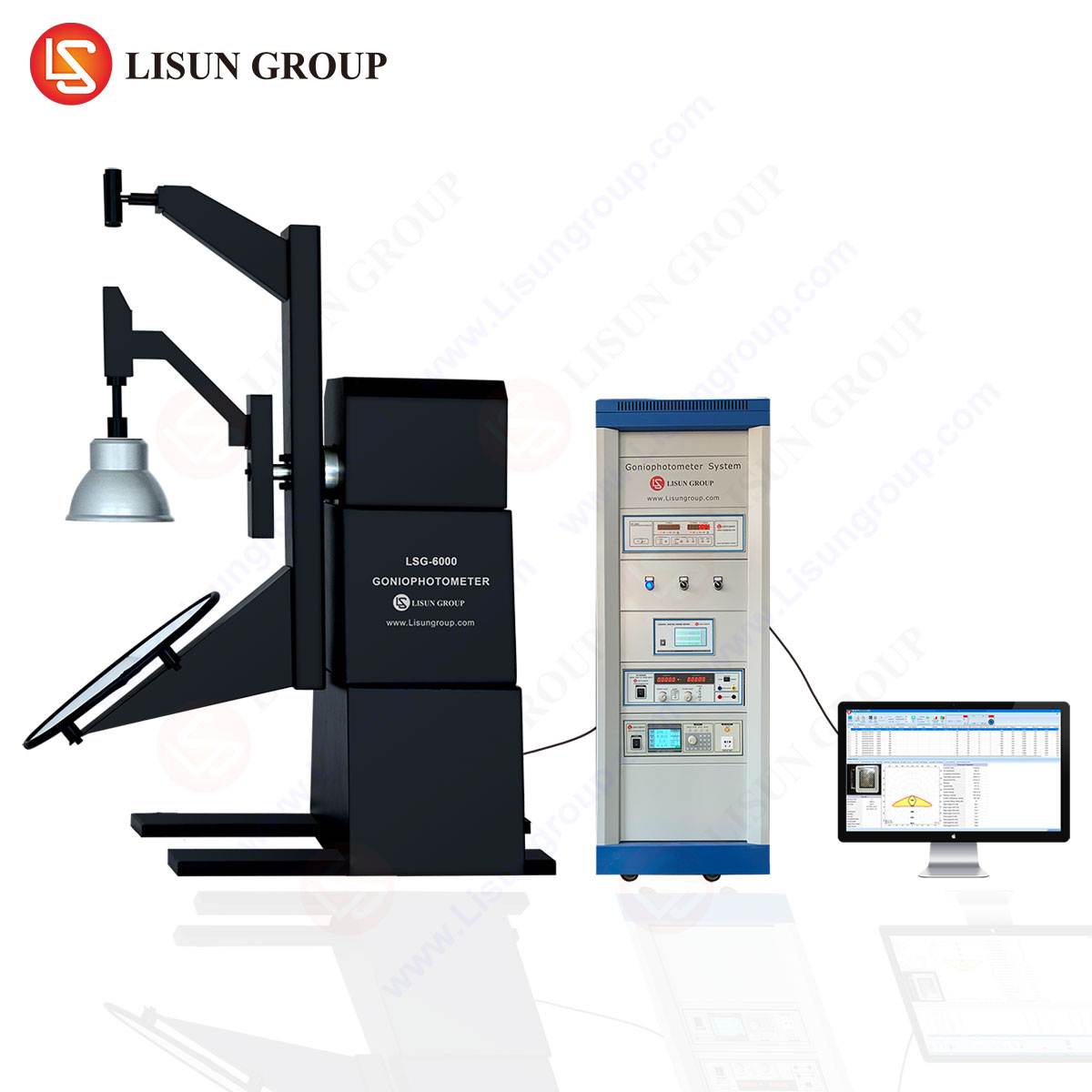



Fundamental Principles of Luminous Intensity Distribution Measurement
The accurate characterization of a light source’s spatial emission is a cornerstone of photometric science. Unlike a simple lux meter that measures illuminance at a single point, a goniophotometer quantifies how luminous intensity varies in three-dimensional space around the source. This spatial distribution, known as the luminous intensity distribution (LID), is critical for predicting real-world performance, ensuring regulatory compliance, and guiding optical design. The Type C goniophotometer represents a specific mechanical configuration optimized for measuring luminaires—complete lighting units that include the light source, housing, and optical components such as reflectors and lenses. Its operational principle is based on moving a photodetector along a path that maintains a fixed orientation relative to the luminaire, typically pointing directly at it throughout the measurement sweep. This configuration treats the luminaire as the apex of a virtual sphere, with the detector traversing lines of longitude while the luminaire itself may rotate along the latitudinal axis.
Mechanical Configuration and Kinematics of the Type C System
The defining characteristic of a Type C goniophotometer is its two-axis rotational scheme, as defined by the Commission Internationale de l’Eclairage (CIE). In this system, the luminaire is mounted on a rotating arm or platform that provides the C-axis (gamma) rotation, which corresponds to the tilting of the luminaire. The photodetector is mounted on a separate, larger arm that rotates around the luminaire on the A-axis (alpha), maintaining a constant distance. This arrangement ensures that the detector’s sensitive surface remains normal to the line connecting it to the luminaire’s photometric center. The kinematic sequence is crucial: for each incremental step of the A-axis (the detector’s longitudinal movement), the C-axis (the luminaire’s latitudinal tilt) is rotated through a full 180 or 360 degrees. This motion traces out a spherical coordinate system, allowing for the comprehensive sampling of the luminaire’s light output in all directions. The mechanical stability and precision of these axes are paramount, as any wobble or misalignment introduces significant measurement error, particularly for narrow-beam luminaires.
The Role of Spectroradiometric and Photometric Detectors
At the heart of the measurement system is the detector. While a simple photopic-filtered photodetector, calibrated to the CIE V(λ) function, is sufficient for basic photometric quantities (luminous flux, intensity), modern applications often require spectroradiometric capability. A spectroradiometer integrated into the system enables the measurement of the complete spectral power distribution (SPD) at each angular position. This allows for the derivation of colorimetric quantities such as chromaticity coordinates (CIE x, y), correlated color temperature (CCT), and Color Rendering Index (CRI), all as a function of direction. This is especially critical for industries like LED & OLED Manufacturing and Display Equipment Testing, where color consistency across viewing angles is a key performance indicator. The data acquisition system must synchronize the angular position of the goniometer arms with the instantaneous reading from the detector, building a multi-dimensional dataset of optical properties versus spatial coordinates.
Introduction to the LSG-6000 Goniophotometer System
The LISUN LSG-6000 represents a contemporary implementation of the Type C goniophotometer, designed to meet the rigorous demands of international standard testing for a wide array of luminaires. Its large dimensions accommodate luminaires up to 6000mm in length and 2000kg in weight, making it suitable for industrial-scale lighting products, including high-bay fixtures, streetlights, and large-area architectural luminaires. The system is engineered for high-precision angular positioning, with a minimal step size of 0.001° on the A-axis and C-axis, ensuring high resolution for both wide-flood and very narrow-spot distributions. The LSG-6000 utilizes a feedback-controlled DC power supply to provide stable input to the device under test, a critical factor for obtaining repeatable photometric data. Its design prioritizes the minimization of stray light and the exclusion of ambient light, which are essential for achieving the low uncertainty levels required for certified laboratory testing.
LSG-6000 Key Specifications:
- Luminaire Size Capacity: Up to Ø2000mm x 6000mm (L)
- Maximum Luminaire Weight: 2000 kg
- Photometric Distance: 5m to 30m (adjustable)
- Angular Resolution: 0.001°
- Positioning Accuracy: ± 0.2°
- Luminous Flux Measurement Range: 0.001 lm to 2,000,000 lm
Adherence to International Photometric Standards
The operation and calibration of Type C goniophotometers like the LSG-6000 are governed by a suite of international standards to ensure global consistency and accuracy of photometric data. The primary standard is IEC 60598-1, “Luminaires – Part 1: General requirements and tests,” which references the need for goniophotometric verification of photometric performance and safety. More specifically, the methodology for luminous flux measurement is detailed in standards such as IES LM-79-19, “Electrical and Photometric Measurements of Solid-State Lighting Products,” and CIE 121-1996, “The Photometry of Goniophotometers.” Compliance with these standards is non-negotiable for manufacturers seeking certification marks like UL, CE, or DLC (DesignLights Consortium) in North America and other regions. For the Photovoltaic Industry, the testing of luminaires for solar simulators requires adherence to ASTM E927 standards, where the angular uniformity of irradiance is critical. The LSG-6000’s design and software are structured to automate testing sequences that fulfill the angular scan requirements stipulated by these documents.
Data Acquisition and the Construction of the IES/LDT File
The raw data collected from the goniophotometer—a matrix of luminous intensity values over a grid of A and C angles—is processed into industry-standard file formats. The most common of these is the IES (Illuminating Engineering Society) file format, a standardized digital container for the LID data. This file is an essential output, as it serves as the input for lighting design and simulation software such as Dialux, Relux, and AGi32. The process involves several steps: the raw intensity data is corrected for background noise and the distance from the photometric center; it is then formatted according to the IES LM-63 standard. For luminaires with symmetric distributions, data may be compressed, but for asymmetric luminaires common in Urban Lighting Design and Stage and Studio Lighting, a full spherical dataset is stored. The software accompanying the LSG-6000 automates this entire process, from measurement to the generation of a verified IES or EULUMDAT (LDT) file, which includes additional product metadata and summary photometric data (total luminous flux, efficiency, zonal lumen summary).
Application in LED and OLED Manufacturing Quality Control
In the highly competitive field of LED & OLED Manufacturing, the Type C goniophotometer is an indispensable tool for quality assurance and R&D. For LED modules and integrated luminaires, it is used to verify beam angle, peak intensity, and the spatial uniformity of color. A common metric derived is the Beam Angle, defined as the angular extent over which intensity is at least 50% of the maximum. For OLED panels, which are inherently area sources, the goniophotometer precisely measures the angular dependence of luminance and color shift, a critical factor for display and specialty lighting applications. Manufacturers use this data to bin products based on photometric performance and to validate design iterations against simulation models. The LSG-6000’s ability to handle large, planar light sources makes it particularly suited for testing flat OLED panels and large-format LED fixtures.
Advanced Use Cases in Specialized Industries
The utility of the Type C goniophotometer extends far beyond general lighting. In the field of Medical Lighting Equipment, for example, surgical lights have stringent requirements for shadow reduction and field uniformity, which are quantified by goniophotometric analysis according to standards like IEC 60601-2-41. The system measures the depth of illumination and the field diameter at specific illuminance levels. In Sensor and Optical Component Production, the device can characterize the angular response of photodetectors or the gain profile of retro-reflectors. For Scientific Research Laboratories, it is used to study novel materials, such as phosphors or quantum dots, by analyzing how their emission properties change with viewing angle. In the Display Equipment Testing industry, it is employed to measure the viewing angle characteristics of monitors and televisions, quantifying contrast ratio and color shift as a function of the observer’s position.
Comparative Analysis of Goniophotometer Types
While the Type C configuration is ideal for luminaires, it is instructive to contrast it with the Type A and Type B systems to understand its specific advantages. A Type A goniophotometer rotates the luminaire around its vertical axis (A-axis) and its horizontal axis (B-axis). This is best suited for light sources whose photometric characteristics are independent of burning position, such as incandescent bulbs. A Type B system rotates the luminaire around its vertical axis (B-axis) and a horizontal axis nominally parallel to its photometric axis (C-axis). The Type C’s primary advantage lies in its fixed detector orientation, which simplifies the optical path and, for large and heavy luminaires, is mechanically more stable than rotating the entire fixture in all directions. This stability is a key competitive advantage of the LSG-6000, as it minimizes inertial effects during the rapid acceleration and deceleration of the heavy luminaire on only one axis (C-axis), leading to faster test cycles and higher repeatability.
Mitigating Stray Light and Environmental Interference
A significant challenge in high-accuracy goniophotometry is the control of measurement artifacts. Stray light—any light that reaches the detector from paths other than the direct line from the luminaire—must be meticulously eliminated. The LSG-6000 addresses this through a combination of a long photometric distance, blackened and baffled surfaces on all mechanical components, and often, a darkroom environment. Furthermore, the system must be isolated from ambient vibrations that could cause relative movement between the detector and the luminaire. Temperature stabilization is also critical, as the output of LED-based products is highly temperature-dependent. The LSG-6000’s integrated environmental monitoring and DC power supply with temperature compensation help maintain consistent operating conditions throughout the duration of a test, which can last several hours for a high-resolution, full-spherical scan.
Software Integration and Automated Test Sequences
The hardware of a goniophotometer is only one component of the system; the software is the orchestrator that defines its capability and ease of use. The software for a system like the LSG-6000 provides a full suite of tools for test planning, execution, data management, and report generation. Users can define custom measurement grids, setting different angular resolutions for different zones (e.g., a finer resolution within the main beam and a coarser one outside it) to optimize measurement time. Automated sequences can run unattended, performing a full photometric and colorimetric characterization. The software also includes routines for system calibration, including the calibration of the spectroradiometer using NIST-traceable standard lamps and the geometric calibration of the goniometer arms to ensure the photometric distance is exact. This level of automation is vital for laboratories performing high-volume testing for compliance and R&D purposes across the diverse industries previously mentioned.
Frequently Asked Questions
What is the typical duration for a full spatial scan of a streetlight luminaire on the LSG-6000?
The test duration is a function of the selected angular resolution and the speed of the positioning system. For a standard test of a streetlight according to IES LM-79, with a resolution of 2.5° in the C-plane and 5° in the A-plane, a complete scan can be completed in approximately 30 to 45 minutes. Higher resolutions or the addition of full spectral measurements at each point will proportionally increase the measurement time.
How does the system accommodate luminaires with highly asymmetric light distributions?
The LSG-6000’s software allows for the definition of a fully customizable, non-uniform measurement grid. For an asymmetric luminaire, such as a wall-washer or a roadway luminaire with a sharp cut-off, the user can program a much finer angular step within the region of high gradient in the LID and a coarser step in areas of minimal change. This ensures accurate characterization of the complex distribution without unnecessarily prolonging the test duration.
Can the LSG-6000 measure the absolute intensity of a luminaire, or is it only for relative distribution?
The system is calibrated to provide absolute photometric measurements. By using a reference photometer or spectroradiometer that has been calibrated with an NIST-traceable standard lamp, the system measures absolute luminous intensity in candelas (cd) at each point. The integration of this absolute intensity distribution over the full sphere then yields the total luminous flux in lumens (lm).
What are the requirements for the laboratory environment housing a large goniophotometer like the LSG-6000?
The primary requirements are a dedicated darkroom of sufficient size to accommodate the maximum photometric distance (e.g., over 30 meters), stable thermal conditions (typically 25 ± 2°C), and a stable, low-vibration foundation. The facility must also provide clean, stable power. Airflow should be minimized to prevent cooling of the luminaire that is not representative of its end-use environment, unless specifically testing thermal performance.