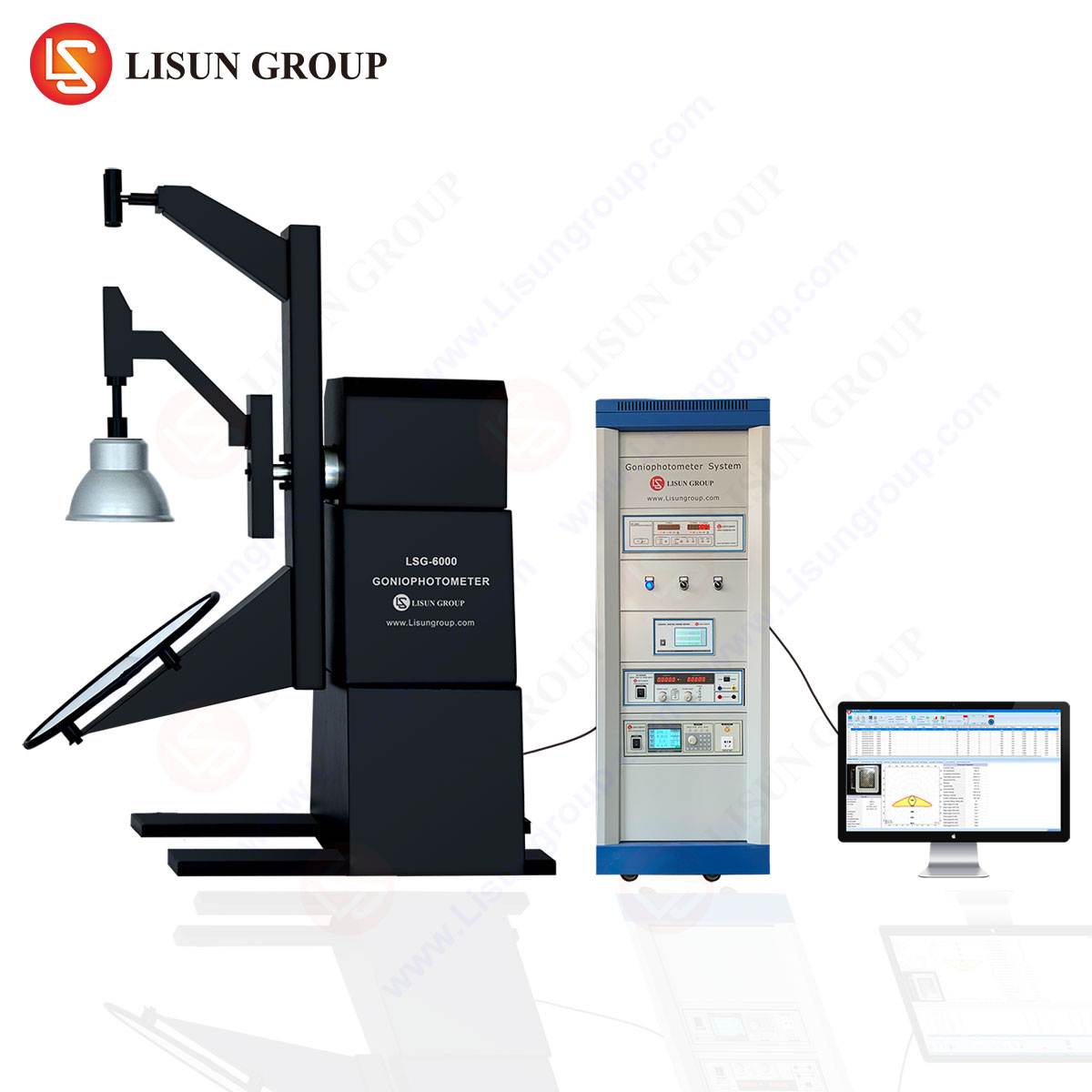



Fundamentals of Goniophotometric Light Measurement
The accurate characterization of a light source’s spatial radiation pattern is a cornerstone of photometric science. Unlike simple luminous flux or intensity measurements, which provide aggregate values, understanding how light is distributed in space is critical for evaluating performance, ensuring regulatory compliance, and guiding application-specific design. The primary instrument for this sophisticated analysis is the goniophotometer, a device engineered to measure luminous intensity distribution with high precision. The operational principle is based on the coordinated movement of a photodetector relative to a light source under test (LUT), sampling luminous intensity at numerous points across a spherical or partial-spherical coordinate system. The resulting data set enables the computation of total luminous flux, candela distribution curves, efficacy, and other key photometric parameters, forming an indispensable dataset for industries ranging from architectural lighting to advanced optical component manufacturing.
Architectural Principles of a Goniophotometer System
A goniophotometer’s design is fundamentally an electromechanical positioning system integrated with a high-accuracy photometric sensor. The core components include a rigid mechanical frame, a rotation stage for azimuthal (C-axis) movement, a second stage for vertical or polar (γ-axis) movement, a spectroradiometer or photometer head, and a master control computer running specialized analysis software. The system operates by positioning the photodetector at a fixed distance from the LUT and systematically varying the angular coordinates (C, γ) to map the entire light distribution. Two primary optical configurations are employed: Type C, where the photodetector moves on a path around the stationary LUT, and Type B, where the LUT is rotated while the detector remains fixed. The Type C configuration is often preferred for its consistent measurement distance, which simplifies the inverse-square law calculations for intensity. The entire apparatus is typically housed within a darkroom or a shielded enclosure to eliminate the influence of ambient light, ensuring data integrity.
The LSG-6000 Goniophotometer: A System for Comprehensive Photometric Analysis
The LISUN LSG-6000 represents a state-of-the-art implementation of a moving detector (Type C) goniophotometer, designed to meet the rigorous demands of international standard IEC 60598-1 and its referenced photometric testing method, CIE 121. This system is engineered for high-precision measurement of the total luminous flux and spatial light distribution of various luminaires, including LED fixtures, high-bay lights, street lights, and indoor lighting products.
Key Specifications of the LSG-6000:
- Measurement Distance: Configurable from 5m to 30 meters, accommodating a wide range of luminaire sizes and ensuring far-field conditions.
- Angular Resolution: High-precision encoders provide a resolution of 0.001° for both the C and γ axes, enabling highly detailed distribution mapping.
- Detector System: Utilizes a high-accuracy, fast-response photometer or a spectroradiometer (as an option) with f1′<3%, compliant with the standards of DIN 5032-6 and CIE 69.
- Maximum Luminare Weight: Capable of supporting LUTs weighing up to 50 kg.
- Software Compliance: The integrated software automatically generates test reports in accordance with IESNA LM-63 and CIE 102 formats, which are the de facto standards for lighting design software like Dialux and Relux.
The testing principle of the LSG-6000 involves mounting the LUT at the center of the goniometer’s rotational axes. The photometer head traverses a virtual sphere around the LUT, capturing intensity data at predefined angular intervals. The software constructs a three-dimensional intensity distribution from this data, from which it calculates total luminous flux by integrating the intensity over the entire solid angle. This system’s long measurement distance is a significant competitive advantage, as it minimizes near-field effects and provides data that accurately represents the luminaire’s performance in real-world installations, a critical factor for urban lighting design and large-area industrial lighting.
Data Acquisition and the Construction of Photometric Solids
The raw data collected during a goniophotometric scan consists of a matrix of luminous intensity values, each tagged with its corresponding (C, γ) coordinate. This discrete point cloud is processed by the system’s software to generate a continuous photometric solid—a three-dimensional representation of the light distribution. Advanced algorithms interpolate between measured points to create a smooth surface. This model is then used to extract two-dimensional planar slices, known as candela distribution curves, which are pivotal for lighting design. For instance, a street light’s performance is assessed by its vertical (C0-C180) and horizontal (C90-C270) planes. The software further calculates zonal lumen summaries, dividing the distribution into segments (e.g., 0-30°, 30-60°, 60-90°, 90-120°, 120-180°) to quantify the flux emitted in different angular regions, a metric directly relevant to glare analysis and visual comfort in applications such as office lighting and medical examination lighting.
Adherence to International Standards and Protocols
Compliance with international standards is not merely a formality but a prerequisite for market access and product reliability. The LSG-6000 is designed to test luminaires against a comprehensive suite of global standards. Beyond the core IEC 60598-1 and IESNA LM-79, it supports testing per EN 13032-1 (European standard for light and lighting), ANSI/IES RP-16 (Nomenclature and Definitions for Illuminating Engineering), and AS/NZS 2299 (Australian/New Zealand standard for emergency lighting). In the photovoltaic industry, the principles of goniophotometry are adapted for testing the angular dependence of photovoltaic modules and solar simulators, referencing standards like IEC 60904. For display equipment testing, the measurement of viewing angle characteristics and uniformity of backlight units (BLUs) aligns with methodologies in IDMS and VESA standards. This multi-standard capability ensures that manufacturers in LED & OLED manufacturing, as well as optical instrument R&D, can validate their products for a global marketplace.
Industry-Specific Applications of Goniophotometric Data
The utility of goniophotometric analysis extends across a diverse spectrum of high-technology industries, each with unique requirements.
- Lighting Industry and LED Manufacturing: This is the primary application, where data is used for quality control, performance benchmarking, and generating IES files for lighting simulation software. Manufacturers rely on it to verify claims of luminous efficacy (lm/W) and to optimize the optical design of reflectors and lenses.
- Urban Lighting Design: For street and area lighting, goniophotometry quantifies light trespass, upward waste light (UWR), and illuminance uniformity on roadways. This data is crucial for meeting the stringent requirements of the Dark-Sky Association and municipal lighting ordinances.
- Stage and Studio Lighting: Theatrical and broadcast luminaires require precise beam control. Goniophotometers measure field angles (the angle where intensity falls to 10% of the maximum), beam angles (50% of maximum), and throw distances, enabling lighting designers to select the perfect fixture for a given application.
- Medical Lighting Equipment: Surgical and diagnostic lights demand exceptional uniformity and shadow reduction. Goniophotometric analysis verifies that these luminaires provide a consistent, high-intensity field free from striations or hotspots, as mandated by standards such as IEC 60601-2-41.
- Sensor and Optical Component Production: Manufacturers of photodiodes, ambient light sensors, and optical filters use goniophotometers to characterize the angular response of their components, ensuring they perform as specified when integrated into end-user devices.
Comparative Analysis with Integrating Sphere Systems
While integrating spheres are excellent for measuring total luminous flux, they possess inherent limitations that goniophotometers overcome. An integrating sphere provides a single, aggregate flux value but yields no information on how that light is distributed in space. It is also susceptible to errors related to spatial non-uniformity of the sphere’s coating and the spectral mismatch between the standard lamp and the LUT. In contrast, a goniophotometer provides a complete spatial distribution, enabling the derivation of total flux alongside all directional characteristics. For directional light sources like spotlights or street lights, the goniophotometer is the definitive tool, as the spatial distribution is the primary performance metric. The LSG-6000’s competitive advantage lies in its ability to provide this complete photometric picture with high distance-based accuracy, making it the instrument of choice for certification and advanced R&D, complementing rather than replacing the simpler integrating sphere.
Advanced Capabilities: Spectroradiometric Integration
The integration of a spectroradiometer instead of a simple photometer head elevates the goniophotometer from a photometric to a radiometric and colorimetric instrument. This advanced configuration, available as an option with systems like the LSG-6000, allows for the measurement of spatially resolved spectral power distribution (SPD). From the SPD, a multitude of additional parameters can be calculated, including:
- Correlated Color Temperature (CCT)
- Color Rendering Index (CRI) and the newer TM-30 metrics (Rf, Rg)
- Chromaticity coordinates (x, y; u’, v’)
- Peak wavelength and dominant wavelength
This capability is indispensable for scientific research laboratories and display equipment testing, where the angular color shift of OLED displays or the color consistency of a multi-LED luminaire are critical quality parameters. It allows for a full 3D characterization of a light source’s color performance, a level of detail required in high-end applications from museum lighting to automotive forward lighting.
FAQ
What is the required stabilization time for an LED luminaire before testing on the LSG-6000?
LED performance is temperature-dependent. Per standards like IES LM-80 and LM-82, the LUT must be operated at its rated power until it reaches thermal and photometric stability, typically defined as less than a 0.5% change in photometric output over a 30-minute interval. This process can take from 30 minutes to several hours, depending on the thermal design of the luminaire.
How does the LSG-6000 handle the measurement of asymmetrical luminaires, such as street lights?
The system’s software is designed to manage asymmetrical distributions. The scan is programmed to cover the full 360 degrees in the C-plane and 180 degrees in the γ-plane. The resulting 3D model accurately captures the asymmetry, and the reporting functions can generate specific planar cuts (e.g., parallel and perpendicular to the road) as required by standards like EN 13201 for street lighting.
Can the LSG-6000 measure the flicker percentage of a light source?
While a standard goniophotometer measures time-averaged intensity, when equipped with a high-speed photometer or a spectroradiometer capable of high-frequency sampling, the system can be used to characterize temporal light artifacts (TLAs), including flicker percent and flicker index, as defined by IEEE PAR1789 and CIE TN 006:2016. This requires specific software modules and detector capabilities.
What is the significance of the f1′ value for the photodetector?
The f1′ value quantifies the spectral mismatch of the photometer relative to the CIE standard photopic observer V(λ) function. An f1′ value of <3%, as offered with the LSG-6000, indicates high fidelity to the human eye's spectral sensitivity, minimizing one of the most significant sources of systematic error in photometric measurements, especially for narrow-band sources like colored LEDs.