


The Principles and Applications of Goniophotometric Measurement in Photometric Analysis
Abstract
Goniophotometry stands as a cornerstone of precise photometric and colorimetric science, enabling the comprehensive characterization of a light source’s spatial distribution of luminous intensity and color. This technical article delineates the operational principles of a goniophotometer, detailing its mechanical, optical, and electronic subsystems. A specific examination of the LISUN LSG-6000 Goniophotometer Test System is provided to illustrate the practical implementation of these principles, including its specifications, adherence to international standards such as IEC, and its diverse applications across industries ranging from LED manufacturing to urban lighting design.
Fundamental Principles of Goniophotometric Measurement
The core objective of goniophotometry is to measure the luminous intensity distribution (LID) of a light source. Luminous intensity, measured in candelas (cd), is not an intrinsic property of the source alone but is a function of the direction from which it is observed. A goniophotometer achieves this by systematically moving a photodetector or the light source itself through a series of spherical coordinates—azimuth (C-plane, γ-angle) and elevation (γ-plane, C-angle)—around a fixed point, which is the photometric center of the source under test (SUT). At each angular position, the illuminance (lux) incident upon the detector is measured. By applying the inverse square law, where illuminance (E) is proportional to luminous intensity (I) divided by the square of the distance (d) (E = I/d²), the luminous intensity in that specific direction is calculated. Since the distance remains constant throughout the measurement, the illuminance readings are directly convertible to relative or absolute luminous intensity values, thereby constructing a complete three-dimensional intensity surface.
This methodology is critical because it moves beyond aggregate metrics like total luminous flux (lumens) to provide a vectorial map of light emission. This data is indispensable for predicting real-world performance, such as how a streetlamp will illuminate a roadway or how an automotive headlight will project its beam.
Architectural Configuration of a Modern Goniophotometer System
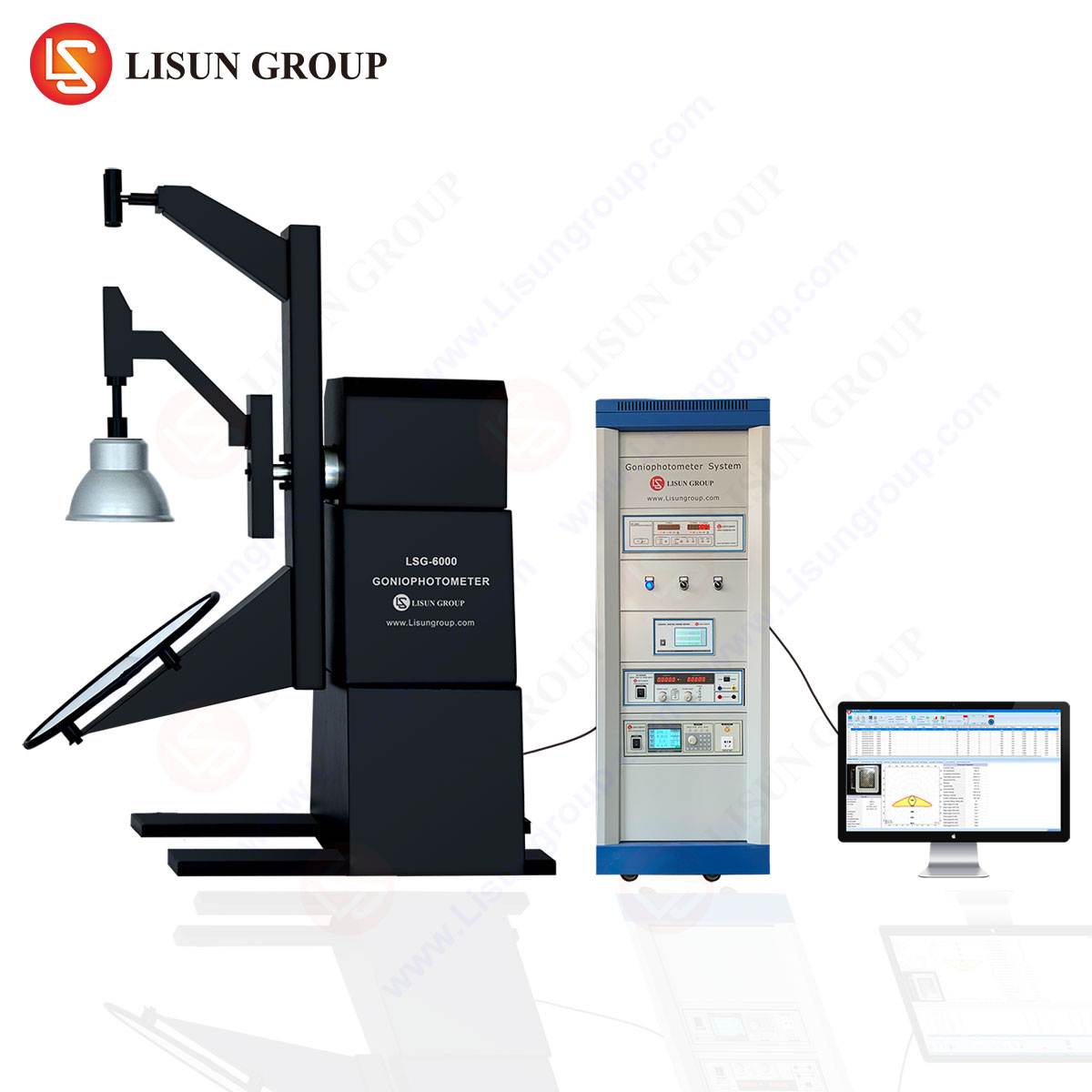
A contemporary goniophotometer, such as the LISUN LSG-6000, is an integrated system comprising several key subsystems that work in concert to achieve high-precision measurements.
Mechanical Positioning System: The foundation of the instrument is its robust and precise mechanical structure. It typically consists of two orthogonal rotation axes. The primary axis controls the horizontal rotation (azimuth, 0-360°), while the secondary axis controls the vertical tilt (elevation, typically -90° to +90° or a full 180°). High-torque, low-vibration stepper or servo motors drive these axes, with positioning feedback provided by high-resolution optical encoders to ensure angular accuracy often within ±0.2°. The system must be engineered to minimize sag and deflection, especially when testing large and heavy luminaires, to maintain the fixed distance between the SUT’s photometric center and the detector.
Optical and Photometric Detection System: The photodetector is the sensory core of the system. It is housed in a assembly that includes precision apertures to define the measurement field of view and a spectral correction filter (V(λ) filter) that adjusts the detector’s responsivity to match the standardized human eye sensitivity curve. For colorimetric measurements, a spectroradiometer is often integrated, allowing for the measurement of chromaticity coordinates (CIE x, y), correlated color temperature (CCT), and color rendering index (CRI). The detector is positioned at a sufficiently large distance to satisfy the far-field condition, where the SUT can be treated as a point source, a requirement for the inverse square law to hold true.
Data Acquisition and Control Software: Sophisticated software orchestrates the entire measurement process. It controls the motion of the axes, triggers data acquisition from the detector at precise angular intervals, and records the vast dataset of illuminance versus angle. Post-measurement, the software processes this raw data to generate a wide array of photometric deliverables, including LID curves (polar and Cartesian plots), isocandela diagrams, lumen summation for total flux, efficacy calculations, and 3D models of the light distribution. Compliance with international standards is embedded within the software’s algorithms for data reduction and reporting.
The LISUN LSG-6000 Goniophotometer Test System: A Technical Overview
The LISUN LSG-6000 exemplifies a Type C goniophotometer, where the luminaire rotates around both its horizontal and vertical axes while the detector remains stationary. This configuration is particularly advantageous for testing large and heavy luminaires, as it avoids the need to move the massive detector assembly.
Key Specifications:
- Measurement Distance: 5m, 10m, 15m, 20m, or 30m (customizable), ensuring far-field conditions for a wide range of SUT sizes.
- Angular Range: Azimuth: 0° to 360°; Elevation: -90° to +90° (or 0° to 180°).
- Angular Resolution: ≤ 0.1°.
- Luminous Intensity Measurement Range: 0.001 cd to 2,000,000 cd.
- Detector System: High-precision photometer with V(λ) mismatch < 3% (f1'), often coupled with an optional CCD spectroradiometer for full spectral analysis.
- Standards Compliance: Designed to meet the requirements of IESNA LM-79, LM-80, ENERGY STAR, IEC 60598-1, IEC 60630, CIE 70, CIE 121, CIE S025, and ANSI C78.377.
Testing Principles in Practice: In the LSG-6000, the luminaire is mounted on the dual-axis rotating arm. The software is programmed with the desired angular step size (e.g., 5° for a coarse scan or 1° for high-resolution data). The arm moves the SUT to a specific (C,γ) coordinate. The detector, positioned at the fixed distance, measures the illuminance. This value is instantly converted to luminous intensity. The arm then increments to the next position, and the process repeats until the entire spherical surface is mapped. The system’s high-speed data acquisition allows for comprehensive testing to be completed in a fraction of the time required by traditional methods.
Adherence to International Standards and Testing Protocols
Goniophotometric data is only valuable if it is generated in a consistent, reproducible, and standardized manner. The LSG-6000 is engineered to comply with a suite of international standards that govern photometric testing.
- IEC 60598-1: This standard for luminaire safety includes clauses requiring photometric testing to verify performance claims. The LSG-6000 provides the data necessary for compliance.
- IESNA LM-79: This is the essential standard for the electrical and photometric testing of solid-state lighting products. It explicitly prescribes the use of goniophotometers for measuring total luminous flux and spatial intensity distribution of LED luminaires.
- CIE 70, CIE 121: These publications from the International Commission on Illumination (CIE) provide the fundamental methodology for the measurement of luminous flux and the photometry of luminaires, forming the scientific basis for commercial standards.
- ANSI C78.377: This standard defines the chromaticity specifications for white LED light sources. The LSG-6000, when equipped with a spectroradiometer, can verify that a luminaire’s CCT falls within the appropriate ANSI quadrangles.
Industry-Specific Applications of Goniophotometric Data
The data produced by a goniophotometer like the LSG-6000 is critical across a multitude of industries.
Lighting Industry and LED Manufacturing: For LED luminaire manufacturers, goniophotometry is a non-negotiable step in R&D and quality control. It validates optical design efficiency, ensures beam patterns meet marketing specifications (e.g., narrow spot, wide flood), and calculates total luminous flux for efficacy (lm/W) reporting. It is used to optimize secondary optics like lenses and reflectors.
Display Equipment Testing: The uniformity and angular color stability of backlight units (BLUs) for LCD displays and the viewing angle characteristics of OLED panels are paramount. A goniophotometer can measure luminance and chromaticity shifts as a function of viewing angle, providing critical data for display quality assessment.
Urban Lighting Design: In architectural and street lighting, precise LID data is used in lighting simulation software (e.g., Dialux) to predict illumination levels on streets and facades before installation. This ensures compliance with regulations, minimizes light pollution (uplight and obtrusive light), and optimizes energy usage.
Stage and Studio Lighting: The performance of ellipsoidal reflector spotlights (ERS), fresnels, and moving head lights is defined by their beam shape, field angle, and intensity. Goniophotometry allows designers to select the correct fixture for an application and create accurate photometric data files for pre-visualization software.
Medical Lighting Equipment: Surgical lights require extremely uniform and shadow-free illumination with specific color rendering properties to accurately distinguish tissue. Goniophotometric testing verifies that the light field meets stringent medical standards (e.g., ISO 9680) for diameter, depth, and homogeneity.
Sensor and Optical Component Production: Beyond light sources, goniophotometers can characterize the bidirectional transmittance distribution function (BTDF) of diffusers, the reflectance distribution (BRDF) of materials, and the angular response of light sensors.
Comparative Advantages of the Type C Goniophotometer Design
The LSG-6000’s Type C design offers distinct operational benefits. By rotating the luminaire, the detector and its sensitive, often bulky, spectral equipment remain stationary. This eliminates the potential for vibration-induced noise in the optical measurements and simplifies the integration of a fixed, temperature-stabilized spectroradiometer. Furthermore, the cable management for the SUT is more straightforward, as the rotations are concentric, reducing the risk of cable torque affecting the luminaire’s position or damaging connections. This design is inherently more stable for testing high-mass objects, as the center of mass remains near the pivot point of the goniometer arm.
Data Outputs and Analytical Deliverables
The final value of a goniophotometer lies in the quality and clarity of its output data. The LSG-6000 software generates a comprehensive suite of reports:
- Isocandela Diagrams: Contour plots that represent lines of equal luminous intensity on a spherical surface, providing an intuitive visualization of the beam pattern.
- Polar and Cartesian LID Curves: Standard plots showing intensity as a function of angle in specific planes (e.g., 0°, 45°, 90°).
- Luminous Flux Summary: Calculation of total luminous flux (lumens), zonal lumen distribution, and luminaire efficacy.
- Colorimetric Data: Chromaticity diagrams, CCT, Duv, and CRI (Ra) values, often presented as a function of angle to assess color uniformity.
- IES/LDT Files: Industry-standard electronic files that contain the complete photometric data set, which can be imported into lighting design software.
Frequently Asked Questions (FAQ)
Q1: What is the minimum required measurement distance for accurate goniophotometry?
The distance must be sufficient to meet the far-field condition, typically five times the maximum dimension of the luminaire’s luminous area. Standards like LM-79 provide specific guidelines. The LSG-6000’s configurable distances (5m to 30m) ensure compliance for a vast range of product sizes.
Q2: How does a goniophotometer handle the measurement of asymmetrical light distributions, such as those from streetlights or wall-washers?
The instrument measures the entire spherical distribution without assumption of symmetry. The software captures data at fine angular increments across both axes (e.g., 1° x 1°), building a complete 3D model. The resulting isocandela diagrams and LID curves will accurately reflect the asymmetrical nature of the beam.
Q3: Can the LSG-6000 measure the spectral power distribution (SPD) at different angles?
Yes, when equipped with an integrated spectroradiometer option, the LSG-6000 can capture the full SPD at each measurement point. This is essential for applications requiring angular color consistency, such as display testing or high-end architectural lighting.
Q4: What are the critical environmental controls for a goniophotometer laboratory?
Stable ambient temperature (e.g., 25°C ±1°C) is crucial, as LED performance is temperature-sensitive. The laboratory must be a darkroom to eliminate stray light, and air currents should be minimized to prevent temperature fluctuations in the SUT, which is often powered on during testing.
Q5: What is the difference between Type A, Type B, and Type C goniophotometers, and why is Type C often preferred for large luminaires?
Type A rotates the luminaire around its vertical axis (for measuring horizontal LID), Type B around its horizontal axis (for vertical LID), and Type C around both axes simultaneously. Type C is preferred for large, heavy luminaires because it rotates the SUT in a way that minimizes mechanical stress and keeps the detector stationary, simplifying the integration of sensitive optical equipment.