








Title: The Architecture of Precision: Principles and Applications of High-Accuracy Spectroradiometry Systems
Abstract
High-accuracy spectroradiometry constitutes a critical metrological discipline, enabling the quantitative characterization of optical radiation across scientific research and industrial quality assurance. This article delineates the core architectural principles of modern spectroradiometer systems, emphasizing the engineering required for traceable radiometric, photometric, and colorimetric data acquisition. A detailed examination of a representative high-performance instrument, the LISUN LMS-6000 series, provides a concrete framework for discussing implementation, calibration, and application across diverse fields including solid-state lighting, display technology, photovoltaics, and aerospace.
Foundational Metrology of Optical Radiation Measurement
Spectroradiometry transcends simple spectral analysis by demanding absolute radiometric calibration traceable to national standards institutes (NSIs), such as NIST, PTB, or NIM. The fundamental measurand is spectral radiance (W·sr⁻¹·m⁻²·nm⁻¹) or spectral irradiance (W·m⁻²·nm⁻¹), from which a suite of derived quantities is computed. These include photometric quantities (luminous flux in lumens, illuminance in lux) via convolution with the CIE photopic luminosity function V(λ), colorimetric coordinates (CIE 1931 xy, CIE 1976 u’v’, CRI, TM-30 metrics), and radiometric parameters for non-visual applications. The accuracy of these derived values is intrinsically dependent on the fidelity of the underlying spectral data, making system linearity, stray light rejection, wavelength accuracy, and calibration stability paramount.
Opto-Mechanical and Electronic Architecture of a High-Performance System
The performance of a spectroradiometer is dictated by its constituent subsystems. A high-resolution Czerny-Turner or crossed-beam monochromator with a holographic grating provides superior stray light suppression, essential for measuring narrow-band emitters like LEDs or lasers. The selection of the diffraction grating and entrance slit dimensions creates a critical trade-off between optical throughput (f-number) and spectral bandwidth. A thermoelectrically cooled (TE-cooled) CCD or back-thinned CCD detector is non-negotiable for high-accuracy work, reducing dark noise by several orders of magnitude and enabling integration times sufficient for low-light measurements without signal degradation. Precision motorized drives for grating rotation and order-sorting filters, coupled with a 16-bit or higher analog-to-digital converter, ensure repeatable wavelength selection and high dynamic range. The entire optical bench must be housed in a light-tight, thermally stabilized enclosure to mitigate drift induced by ambient temperature fluctuations.
The Imperative of Calibration Traceability and Uncertainty Analysis
Metrological traceability, established through calibration against standard lamps or detectors characterized by an NSI, is the cornerstone of high-accuracy spectroradiometry. A comprehensive calibration encompasses wavelength calibration using atomic emission lines (e.g., mercury-argon), irradiance/radiance response calibration using a FEL-type quartz-halogen standard lamp, and linearity verification via an attenuated double-aperture method. The resulting calibration factors are applied within the instrument’s firmware with rigorous uncertainty propagation. A complete measurement uncertainty budget, compliant with ISO/IEC Guide 98-3 (GUM), must account for Type A (statistical) and Type B (systematic) uncertainties from the standard lamp, calibration geometry, detector non-linearity, stray light, and wavelength misalignment. For applications in regulated industries, documentation of this traceability chain is as critical as the measurement data itself.
Implementation of the LISUN LMS-6000F Spectroradiometer System
The LISUN LMS-6000F represents an integrated spectroradiometry solution engineered for laboratory-grade accuracy in production and R&D environments. Its system architecture embodies the principles outlined above, configured specifically for luminous flux measurement of lamps and luminaries using an integrating sphere.
Testing Principle: The device under test (DUT) is placed within a coated integrating sphere, which creates a Lambertian radiance field by multiple diffuse reflections. The LMS-6000F spectroradiometer, coupled to the sphere via a fiber optic cable and cosine-corrected input optics, measures the spectral radiance at a defined port. Using the sphere’s spatially averaged responsivity (calibrated with a standard lamp of known luminous flux), the system software computes the total spectral power distribution (SPD) and all photometric and colorimetric quantities.
Key Specifications:
- Wavelength Range: 380 nm – 780 nm (standard for photometry), extendable configurations available.
- Wavelength Accuracy: ±0.2 nm.
- Wavelength Half-Width: 2.5 nm.
- Dynamic Range: > 1:1,000,000.
- Photometric Linearity: < 0.3%.
- Stray Light: < 0.05%.
- Detector: TE-cooled CCD, -5°C stabilization.
- Calibration: NIST-traceable for irradiance and luminous flux.
Industry-Specific Applications and Use Cases
The utility of a system like the LMS-6000F is demonstrated through its deployment across stringent industrial and scientific verticals.
LED & OLED Manufacturing: For LED binning, the system measures chromaticity coordinates (x, y) and dominant wavelength with precision ensuring consistency within ANSI C78.377 quadrangles. For white LEDs, it calculates Color Rendering Index (CRI), extended CRI (R96a), and IES TM-30 (Rf, Rg) metrics to validate color quality. In OLED production, it assesses spatial color uniformity and angular color shift.
Automotive Lighting Testing: Compliance with regulations such as ECE, SAE, and FMVSS 108 requires precise measurements of luminous intensity (candelas), cut-off line sharpness, and color of signal lamps. The system’s high linearity ensures accurate measurement of high-intensity brake lights alongside low-intensity position lamps.
Aerospace and Aviation Lighting: Navigation lights, cockpit displays, and emergency lighting must adhere to RTCA/DO-160 standards and specific color chromaticity boundaries defined by ICAO. High-accuracy spectroradiometry validates that colors remain within mandated regions under all operational temperature and voltage conditions.
Display Equipment Testing: For LCD, OLED, and micro-LED displays, the system, often with a conoscopic or goniometric attachment, measures white point, color gamut (e.g., % of Rec. 709, DCI-P3), gamma curve, and luminance uniformity across the screen surface per ISO 9241-307 and display-specific standards.
Photovoltaic Industry: While the LMS-6000F is photopically optimized, spectroradiometers with extended range (e.g., LMS-6000UV) are used to measure the spectral irradiance of solar simulators. This ensures alignment with reference spectra (AM1.5G) per IEC 60904-9, classifying simulators as Class A, B, or C based on spectral match, non-uniformity, and temporal instability.
Optical Instrument R&D & Scientific Laboratories: In the development of sensors, cameras, and optical materials, the system provides the absolute spectral power distribution needed to characterize responsivity, quantum efficiency, and filter transmission profiles.
Advanced Considerations in System Integration and Measurement
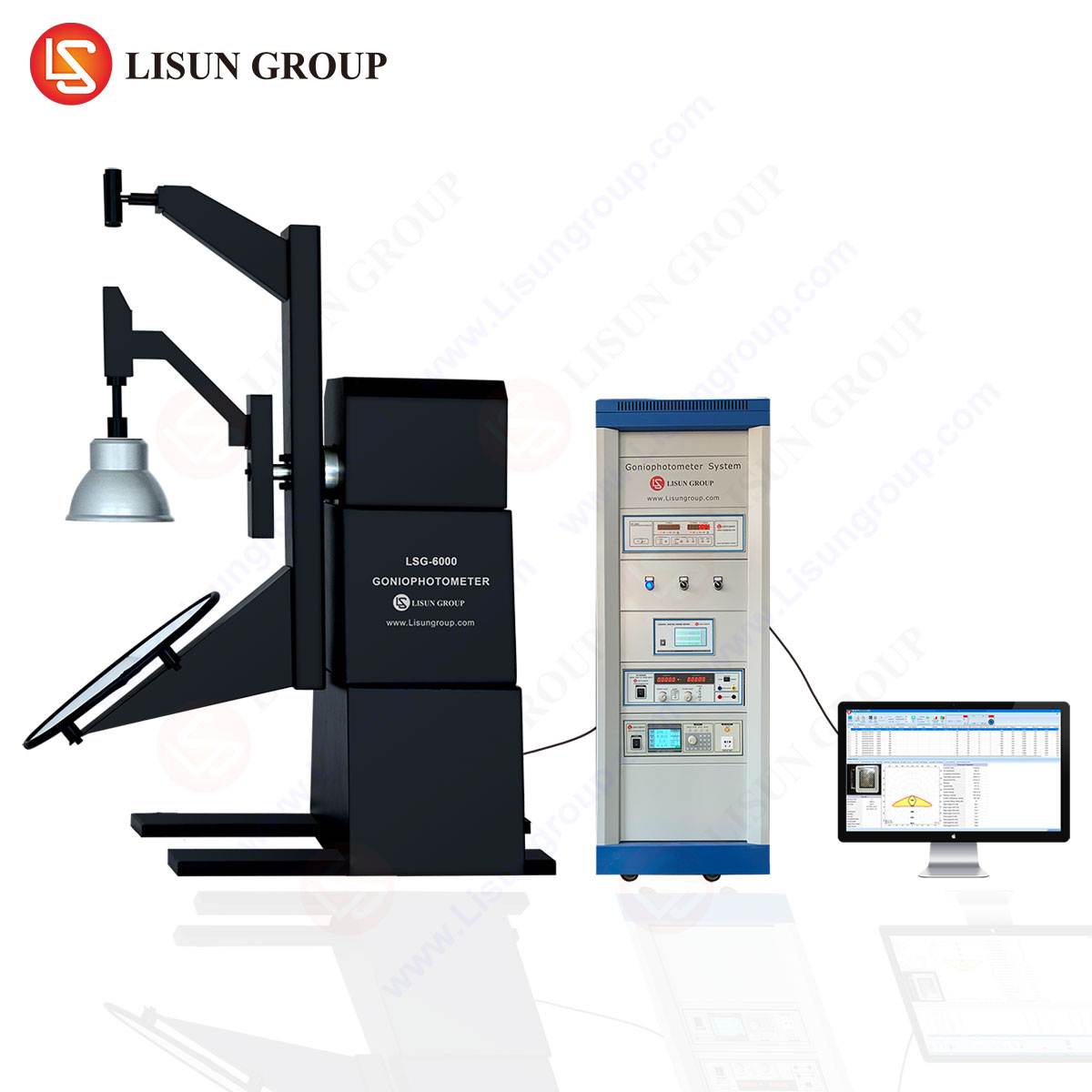
Beyond the core spectrometer, auxiliary components define system capability. For goniophotometric applications, the spectroradiometer is mounted on a robotic arm or a moving mirror system within a darkroom to capture the spatial distribution of luminous intensity and color. In urban lighting design, such data informs models predicting light pollution (skyglow) and verifying compliance with Dark-Sky Association guidelines by quantifying correlated color temperature (CCT) and spectral content of outdoor luminaires. For marine and navigation lighting, measurement of luminous range requires precise intensity data under controlled atmospheric conditions simulated in the lab. In stage and studio lighting, consistency of color temperature and rendering across multiple fixtures is critical, necessitating high-accuracy spectral calibration of each unit. Medical lighting equipment, particularly surgical and diagnostic lights, must meet stringent standards for color rendering and shadow reduction (IEC 60601-2-41), verified through spectroradiometric analysis of the SPD and field uniformity.
Competitive Advantages of an Integrated High-Accuracy Platform
The LISUN LMS-6000F system exemplifies advantages critical for industrial metrology. Its TE-cooled CCD detector enables stable, low-noise operation essential for measuring low-light signals or achieving high signal-to-noise ratios at short integration times. The integrated software suite automates compliance testing against multiple global standards, generating formatted reports for regulatory submission. The system’s modularity—compatible with various sphere sizes, goniometers, and optical accessories—allows a single spectroradiometer core to serve multiple test stations, from R&D to final quality inspection. Crucially, the design prioritizes long-term stability, minimizing recalibration frequency and reducing lifecycle cost of ownership while maintaining measurement integrity.
Conclusion
High-accuracy spectroradiometry is an enabling technology for innovation and quality control in optics-intensive industries. The implementation of a system like the LISUN LMS-6000F, grounded in rigorous metrological principles and designed for operational robustness, provides the data fidelity required to drive product development, ensure regulatory compliance, and advance scientific understanding of light and its interactions.
FAQ Section
Q1: What is the significance of a thermoelectrically cooled (TE-cooled) detector in a spectroradiometer like the LMS-6000F?
A TE-cooled detector stabilizes the sensor chip at a temperature below ambient (e.g., -5°C). This dramatically reduces thermally generated dark current noise, which is the primary source of error in low-light measurements or during long integration times. This allows for accurate measurement of very dim sources (e.g., low-level emergency lighting) or the precise characterization of weak spectral features without signal degradation, ensuring high signal-to-noise ratio across the entire dynamic range.
Q2: How does the system maintain accuracy when measuring light sources with very spiky or discontinuous spectra, such as narrow-band LEDs?
This challenge is addressed through two key design features. First, the high-resolution monochromator with a holographic grating minimizes stray light, preventing energy from one wavelength from “leaking” and contaminating the signal at adjacent wavelengths. Second, the system’s calibration includes a rigorous linearity verification across its entire dynamic range. This ensures that the intense peaks from a narrow-band emitter are measured with the same proportionality as the valleys, preserving the true shape of the spectral power distribution.
Q3: For automotive forward lighting (headlamps), is an integrating sphere system sufficient, or is additional equipment required?
An integrating sphere like that used with the LMS-6000F is ideal for measuring total luminous flux (lumens) of a headlamp. However, regulatory standards for headlamps primarily specify luminous intensity distribution (the beam pattern) on the road. This requires a goniophotometric measurement. The LMS-6000 spectroradiometer core can be integrated with a computer-controlled goniometer in a darkroom to measure intensity (in candelas) and color at thousands of angular positions, creating a full 3D intensity distribution map for compliance testing against ECE or SAE beam pattern templates.
Q4: In photovoltaic testing, why is the spectral match of a solar simulator so critical, and how is it measured?
The electrical output of a photovoltaic cell is directly dependent on the wavelength of the incident light. A solar simulator must closely replicate the standard solar spectrum (e.g., AM1.5G) to yield valid efficiency measurements (IEC 60904-9). A spectroradiometer with a suitable wavelength range (typically 300-1200 nm or broader) measures the simulator’s spectral irradiance at the test plane. Software then divides this measured spectrum by the reference spectrum at multiple wavelength intervals, calculating the spectral match. A Class A simulator requires a match within ±25% across each interval.
Q5: What is the recommended recalibration interval for a high-accuracy system in a production environment, and what factors influence it?
While annual recalibration traceable to an NSI is a common industry practice for maintaining certification, the required interval is influenced by usage severity and environmental controls. Factors include the number of measurement cycles, exposure to high-intensity sources that could degrade the detector, and laboratory temperature stability. A best practice is to perform periodic performance verifications using a stable, internal reference source. A statistically significant shift in the verification data indicates a need for recalibration before the annual date.