





The Metrological Foundation of High-Accuracy Goniophotometry
Goniophotometry represents a cornerstone of photometric science, providing the definitive methodology for characterizing the spatial distribution of light emitted from a source. A goniophotometer functions by measuring the luminous intensity of a light source from a comprehensive set of spherical coordinates, thereby constructing a complete three-dimensional intensity distribution. This data is fundamental for quantifying performance parameters such as total luminous flux, efficacy, beam angles, and candela distribution curves. The transition from traditional, broad-spectrum light sources to sophisticated solid-state lighting (SSL), including LEDs and OLEDs, has exponentially increased the demand for measurement precision. These modern sources often exhibit intense spatial and spectral non-uniformity, rendering simplified integrating sphere measurements insufficient for comprehensive analysis. Consequently, high-accuracy goniophotometry has become an indispensable tool across a multitude of industries reliant on precise optical performance.
Architectural Principles of a Type C Goniophotometer
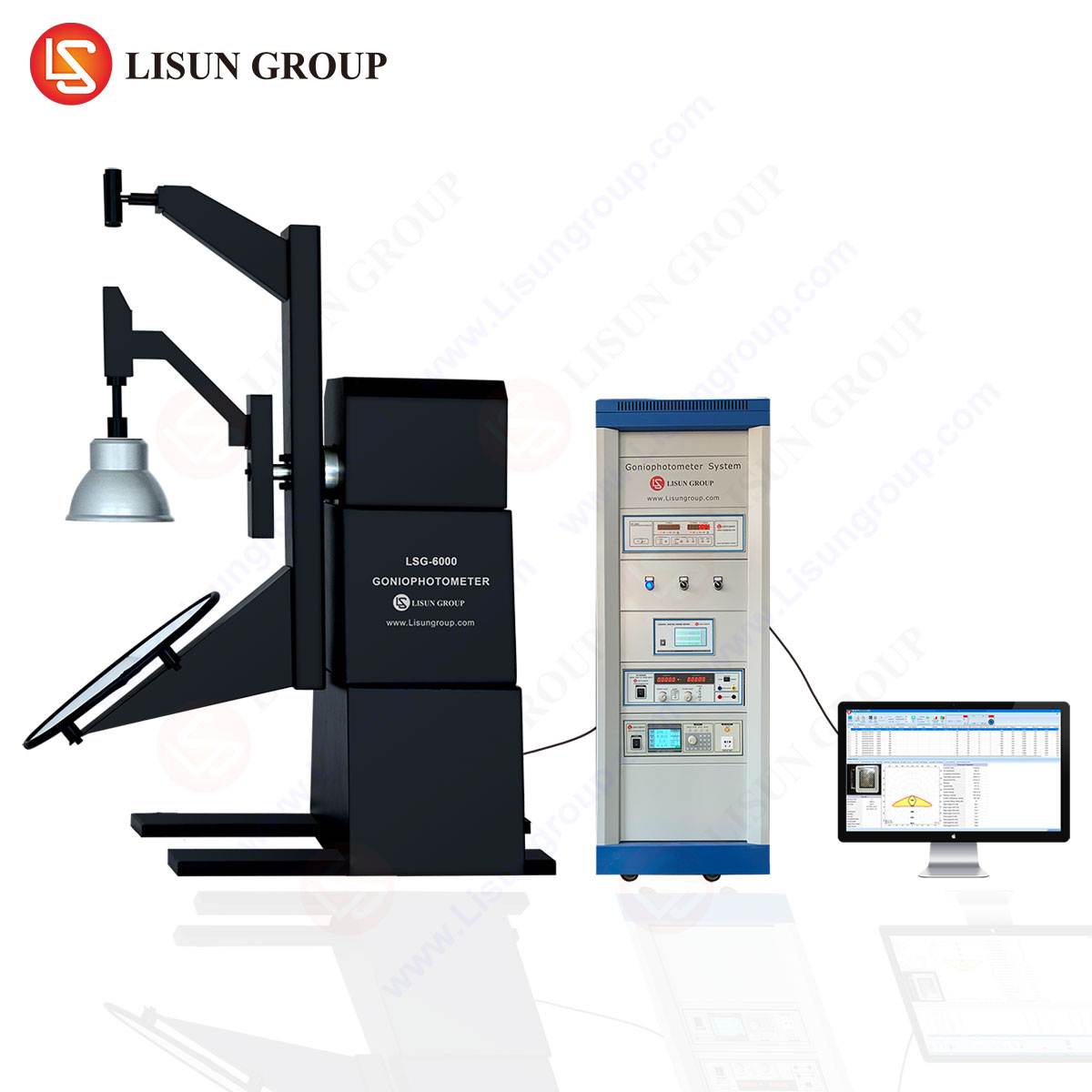
The LSG-6000 Goniophotometer Test System exemplifies the Type C goniophotometer architecture, a design optimized for high-precision and operational efficiency. In this configuration, the photometer or spectrometer detector remains stationary at a fixed distance from the light source under test (LSUT). The LSUT itself is rotated around two perpendicular axes—typically the horizontal (gamma, γ) and vertical (theta, θ) axes—by a sophisticated dual-axis robotic positioning system. This design offers significant metrological advantages. By maintaining a constant detector alignment and distance, it eliminates errors associated with moving large, sensitive optical components. The fixed detector position ensures consistent alignment with the optical bench and reference standards, thereby enhancing measurement reproducibility and absolute accuracy.
The mechanical construction of such a system is paramount. The LSG-6000 employs a rigid, vibration-damped structural frame to mitigate any mechanical oscillations that could introduce angular errors. The rotation stages are driven by high-resolution servo motors coupled with precision encoders, achieving an angular positioning accuracy often better than ±0.1°. This level of precision is critical when characterizing sources with sharp cut-offs or complex beam patterns, such as those found in automotive headlamps, medical surgical lights, or professional studio spotlights. The system’s large working distance is designed to comply with the far-field condition, a prerequisite for accurate photometry where the detector must be sufficiently distant from the LSUT to approximate a point source, as stipulated in standards like CIE 70 and IEC 60598.
Spectroradiometric Integration in Spatial Light Measurement
While photometric detectors provide valuable luminance and illuminance data, the integration of a spectroradiometer into the goniophotometer system, as seen in advanced configurations of the LSG-6000, unlocks a deeper layer of analysis. This combination facilitates the measurement of spatially resolved spectral power distribution (SPD). For each angular position (γ, θ), the system captures the full spectrum of the emitted light. This capability is transformative for applications requiring colorimetric fidelity.
In the display equipment testing industry, this allows for the validation of uniformity in color temperature and gamut across different viewing angles for backlight units (BLUs) and OLED displays. For LED and OLED manufacturing, it enables the precise binning of components based on correlated color temperature (CCT) and Duv stability over the entire spatial emission profile. In scientific research laboratories, studying the angular color shift of phosphor-converted LEDs or the directional emission of micro-LED arrays is a routine application. The data acquired allows for the calculation of angular-dependent color coordinates (CIE x, y; u’, v’), CCT, Color Rendering Index (CRI), and newer metrics like TM-30 (Rf, Rg), providing a complete photometric and colorimetric portrait of the source.
Adherence to International Photometric Standards
The validation and certification of any high-accuracy goniophotometer are contingent upon its compliance with international standards. The LSG-6000 system is engineered to meet the rigorous requirements outlined in a suite of global standards, ensuring that data generated is reliable, repeatable, and recognized across international markets. Key standards governing its operation include:
- IESNA LM-79-19: This standard, published by the Illuminating Engineering Society of North America, prescribes the approved methods for the electrical and photometric testing of solid-state lighting products. It explicitly endorses goniophotometry as a method for total luminous flux measurement.
- IEC 60598-1: This foundational standard for luminaires specifies safety and performance requirements, including photometric testing protocols that necessitate goniophotometric data for verifying glare, beam shape, and light output.
- CIE 70: The International Commission on Illumination’s (CIE) publication “Measurement of Absolute Luminous Intensity Distributions” provides the fundamental scientific framework and best practices for goniophotometric measurements.
- ANSI C78.377 & IEC 62663: These standards relate to the specifications for chromaticity and light output of various lamp types, requiring precise angular color measurement capabilities.
- DIN 5032-6: The German Institute for Standardization’s standard for photometric measurements also details procedures for goniophotometry.
Compliance with these standards is not merely a feature but a systemic requirement, influencing the system’s mechanical design, software algorithms for data processing, and calibration procedures.
Technical Specifications of the LSG-6000 Goniophotometer System
The following table delineates the core technical specifications of the LSG-6000, underscoring its capability for high-accuracy analysis.
| Parameter | Specification | Significance |
|---|---|---|
| Measurement Type | Luminous Intensity, Luminous Flux, Chromaticity Coordinates, CCT, CRI, etc. | Provides a comprehensive suite of photometric and colorimetric data. |
| Goniometer Type | Type C (Moving Light Source, Fixed Detector) | Ensures detector stability, enhancing accuracy and simplifying calibration. |
| Angular Resolution | ≤ 0.1° | Enables detailed mapping of complex beam patterns with sharp gradients. |
| Positioning Accuracy | ≤ ±0.1° | Critical for measurement repeatability and compliance with standards. |
| Max. Luminaire Weight | 30 kg | Accommodates a wide range of commercial and industrial lighting products. |
| Max. Luminaire Dimensions | 2000 x 1500 mm (L x H) | Suitable for large luminaires, including street lights and high-bay fixtures. |
| Spectral Range | 380 nm – 780 nm (with spectroradiometer) | Covers the entire visible spectrum for full colorimetric analysis. |
| Photometric Range | 0.001 cd to 2,000,000 cd | Allows measurement from very dim indicator lights to high-intensity searchlights. |
| Compliant Standards | IES LM-79, CIE 70, IEC 60598, DIN 5032-6 | Ensures global regulatory and industry acceptance of test results. |
Industry-Specific Applications and Use Cases
The high-accuracy data generated by the LSG-6000 finds critical application in a diverse array of industries beyond conventional lighting.
- Urban Lighting Design and Smart Cities: For roadway and area lighting, the system precisely maps the iso-candela diagrams and calculates light trespass, glare ratings, and utilization factors. This data is vital for designing efficient public lighting that meets Dark-Sky Initiative recommendations and specific municipal standards like ANSI/IES RP-8 for roadways.
- Stage and Studio Lighting: Theatrical and broadcast luminaires demand precise beam control, including field angles, beam angles, and evenness. The LSG-6000 characterizes these parameters alongside color consistency across the beam, which is crucial for ensuring uniform illumination on set without hot-spots or color shifts.
- Medical Lighting Equipment: Surgical and diagnostic lights require extremely uniform illuminance with minimal shadowing and strict adherence to color rendering metrics to ensure accurate tissue differentiation. Goniophotometric analysis validates compliance with stringent standards such as IEC 60601-2-41.
- Sensor and Optical Component Production: The angular response of photodiodes, light-dependent resistors (LDRs), and optical filters can be characterized by using a stable reference source on the goniophotometer and measuring the output of the component-under-test as a function of incident angle.
- Photovoltaic Industry: While not for light emission, the principle is adapted to measure the angular dependence of light incidence on solar panels. A reference cell can be mounted on the goniometer to study how a panel’s efficiency varies with the angle of incoming light, simulating different times of day and seasons.
- Optical Instrument R&D: The system is used to characterize the output of integrating spheres, the collimation of laser diodes, and the performance of complex optical assemblies where directional light output is a key performance indicator.
Advanced Software for Data Acquisition and Luminaire Modeling
The hardware capabilities of a goniophotometer are fully realized through its dedicated software suite. The system software controls all aspects of the measurement sequence, from defining the angular scan grid to processing the raw data into industry-standard formats. A critical output is the generation of an IES (Illuminating Engineering Society) or EULUMDAT (LDT) file. These file formats contain the complete luminous intensity distribution data of the luminaire and serve as the digital photometric profile. Lighting design software, such as DIALux, Relux, and AGi32, imports these files to perform accurate simulations of lighting installations, predicting illuminance levels, uniformity, and visual comfort before physical implementation.
The software also provides advanced analysis tools, including 3D candela distribution plots, polar diagrams (C-planes and Gamma-planes), and false-color renderings of the light output. Automated reporting functions compile all measured parameters—total flux, efficacy, beam angles, CCT, CRI—into standardized test reports, streamlining the quality assurance and certification processes for manufacturers.
Mitigation of Stray Light and Thermal Management
Achieving high accuracy, particularly when measuring low-intensity light or sources with high dynamic range, necessitates rigorous control of stray light. The internal surfaces of the LSG-6000 measurement chamber are coated with a highly absorptive, matte black material with a reflectance of less than 2% to minimize inter-reflections. Baffles are strategically placed to block the direct line of sight between the LSUT and the detector for all but the intended measurement angle.
Furthermore, the thermal stability of the LSUT, especially for LED products, is a critical factor. LED performance is highly sensitive to junction temperature. The LSG-6000 system can be integrated with temperature monitoring probes and a constant-current power supply to ensure the LSUT is measured under stable, known thermal conditions, as required by standards like LM-80 and TM-21, which govern LED lumen maintenance testing.
Frequently Asked Questions (FAQ)
Q1: What is the primary advantage of a Type C goniophotometer over other designs?
The primary advantage of a Type C design, where the light source moves and the detector remains fixed, is the enhanced metrological stability. It eliminates potential errors from moving the sensitive and potentially heavy detector assembly, ensuring consistent alignment and distance calibration throughout the measurement cycle. This leads to superior repeatability and absolute accuracy for luminous intensity measurements.
Q2: Can the LSG-6000 accurately measure the luminous flux of a light source with an asymmetric distribution?
Yes, this is a fundamental strength of goniophotometry. Unlike an integrating sphere, which can have errors due to spatial non-uniformity of the source, a goniophotometer measures the intensity at a near-infinite number of points over the full 4π steradian solid angle. By numerically integrating this spatial data, it calculates the total luminous flux with high accuracy, regardless of how asymmetric or complex the light distribution may be.
Q3: How does the system account for the self-absorption error that can occur when a large luminaire is rotated inside the chamber?
Self-absorption, where parts of the luminaire block its own light, is a recognized phenomenon. The system’s software can apply correction algorithms based on the known geometry of the luminaire. Furthermore, the large chamber size and optimized measurement distance help to minimize the magnitude of this effect. For the most accurate results, the measurement is always a characterization of the luminaire as a complete system, which inherently includes its self-absorption characteristics.
Q4: What is the typical measurement time for a full spatial scan of a luminaire?
The measurement time is highly variable and depends on the required angular resolution, the number of spectral scans (if using a spectroradiometer), and the stabilization time required at each point. A high-resolution photometric scan may take 30-60 minutes, while a full spectroradiometric scan with high colorimetric accuracy could take several hours. The system software allows for optimization of the scan grid to balance speed and detail based on the symmetry of the LSUT.
Q5: Is the system suitable for measuring the output of laser-based lighting sources?
Yes, but with specific considerations. Laser diodes have extremely high luminance and can pose a safety risk. The system must be equipped with appropriate neutral density filters to attenuate the beam to a safe level for the detector. Furthermore, the coherence of laser light can cause speckle patterns, which may require specialized measurement techniques or integrating components to average the signal for accurate photometry. The system’s high dynamic range and programmatic filter control make it adaptable for such challenging sources.