


Fundamental Principles of Photometric and Radiometric Measurement
The accurate quantification of light is a cornerstone of modern photonics, underpinning advancements across numerous scientific and industrial domains. Two primary methodologies dominate this field: goniophotometry and integrating sphere-based measurement. While both serve the ultimate goal of characterizing light sources, their underlying principles, operational mechanisms, and resultant data sets are fundamentally distinct. A comprehensive understanding of their respective capabilities and limitations is paramount for selecting the optimal measurement strategy for a given application.
Goniophotometry is a spatially resolved measurement technique. It involves rotating a light source around one or two axes (typically vertical C-γ and horizontal B-β) while a fixed, high-accuracy photodetector, positioned at a sufficient distance to satisfy the far-field condition, records luminous intensity data across a spherical grid of points. This process generates a comprehensive three-dimensional intensity distribution, known as the luminous intensity distribution (LID) curve. From this rich dataset, a multitude of photometric parameters can be derived, including total luminous flux (via numerical integration), zonal lumen distribution, beam angles, efficacy, and luminance distribution.
Conversely, the integrating sphere operates on the principle of spatial integration. It is a hollow spherical cavity whose interior is coated with a highly diffuse and highly reflective material, such as barium sulfate or polytetrafluoroethylene (PTFE). When a light source is placed inside the sphere, the light undergoes multiple diffuse reflections, creating a uniform radiance across the entire inner wall. A detector, shielded by a baffle to prevent direct illumination from the source, then measures this uniform illuminance. Since the measured signal is proportional to the total flux emitted by the source, the sphere enables direct measurement of total luminous or radiant flux after calibration with a standard lamp of known flux output.
Operational Mechanisms and System Architectures
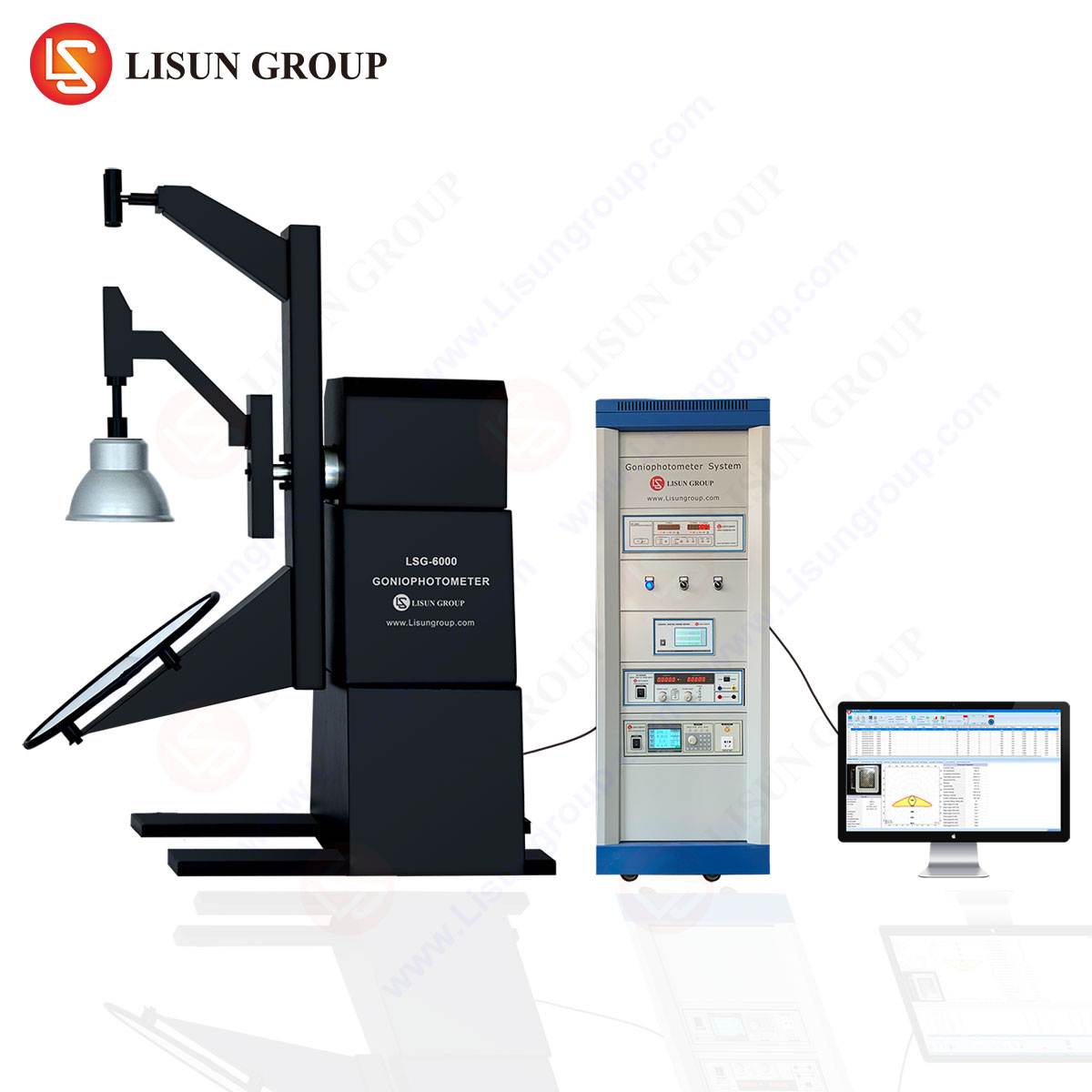
The architectural differences between these systems dictate their operational workflows and physical requirements. A goniophotometer, such as the LISUN LSG-6000, is a large-scale robotic system. The LSG-6000 features a dual-axis rotating mechanism where the photometer or spectrometer remains stationary while the luminaire itself is precisely manipulated through the C-γ and B-β axes. This design is critical for measuring large, heavy, or complex luminaires that cannot be easily moved. The system requires a long, dark tunnel to minimize stray light and ensure accurate far-field measurements. Data acquisition is a sequential process, capturing intensity point-by-point to build a complete photometric web, which can be time-consuming but yields an exceptionally high-resolution spatial model.
An integrating sphere system is comparatively compact. It consists of the sphere itself, a calibrated detector assembly, and often auxiliary lamps for self-absorption correction (the substitution method). The measurement process is rapid; the source is placed inside, and a single reading provides the total flux. However, the accuracy of an integrating sphere is heavily dependent on the quality of its coating, the precision of its calibration, and the application of correction factors for the source’s self-absorption properties—where the test source alters the sphere’s effective reflectance due to its physical presence and spectral characteristics.
Comparative Analysis of Key Photometric Parameters
The choice between these instruments is primarily dictated by the specific parameters required.
Total Luminous Flux: The integrating sphere is the traditional and standardized instrument for this measurement (as per LM-79, IEC 60598, IES LM-66), offering speed and high repeatability. A goniophotometer derives total flux through mathematical integration of its intensity distribution. While potentially more accurate in an absolute sense, as it measures in the far-field and is less susceptible to spatial errors and self-absorption effects, the process is significantly slower. For high-throughput production testing of lamps and small luminaires, the sphere is preferred. For absolute reference-grade measurements or for luminaires with significant self-absorption, the goniometric method is superior.
Luminous Intensity Distribution: This is the exclusive domain of the goniophotometer. The LID curve, often represented in formats like IES (.ies) or EULUMDAT (.ldt), is indispensable for lighting design software. It describes how light is emitted in all directions, enabling the calculation of illuminance at any point in a space. An integrating sphere provides no spatial information whatsoever.
Colorimetric and Spectral Spatial Non-Uniformity: Advanced goniophotometers like the LSG-6000 can be equipped with array spectroradiometers or imaging colorimeters. This allows for the measurement of spatial color variation—a critical parameter for LED modules, display panels, and architectural lighting where consistent chromaticity across the emitting surface is required. This capability is absent in a standard integrating sphere.
Efficacy (lm/W): Both systems can calculate efficacy by measuring total flux and input power. The goniophotometer’s derived flux may offer a more accurate value for certain source types, influencing the efficacy calculation.
Table 1: Instrument Capability Matrix
| Photometric Parameter | Integrating Sphere | Goniophotometer |
| :— | :— | :— |
| Total Luminous Flux | Direct, Fast Measurement | Derived via Integration |
| Luminous Intensity Distribution | Not Capable | Primary Function |
| Beam Angle, Field Angle | Not Capable | Directly Measured |
| Colorimetric Spatial Uniformity | Not Capable | Measured (with spectrometer) |
| Luminance Distribution | Not Capable | Measured (with imaging photometer) |
| Measurement Speed | Very Fast (Seconds) | Slow (Minutes to Hours) |
| Absolute Accuracy Potential | High (with corrections) | Very High (Far-field) |
The LISUN LSG-6000 Goniophotometer: A Technical Exemplar
The LISUN LSG-6000 represents a state-of-the-art implementation of a moving luminaire, fixed detector goniophotometer. It is engineered to comply with a comprehensive suite of international standards, including IES LM-79, LM-80, IESNA LM-75, EN 13032-1, CIE 70, CIE 121, and IEC 60598-1, making it a globally recognized tool for certification and research.
Its testing principle relies on the precise robotic manipulation of the luminaire through a full 4π steradian solid angle. The stationary detector ensures unwavering calibration and measurement stability throughout the often lengthy testing cycle. The system’s software constructs the 3D photometric body and extracts all necessary data, exporting it in all standard formats required by optical design programs like Dialux, Relux, and AGi32.
Industry Use Cases for the LSG-6000:
- Lighting Industry & LED Manufacturing: Generating precise IES files for commercial, industrial, and roadway luminaires to predict performance in virtual environments before physical installation.
- Display Equipment Testing: Characterizing the angular luminance and color uniformity of backlight units (BLUs) and direct-lit displays for consumer electronics and professional monitors.
- Urban Lighting Design: Validating the performance of streetlights and area lights to ensure compliance with dark-sky ordinances and specific road lighting standards (e.g., ANSI/IES RP-8) by analyzing light trespass and upward waste light.
- Stage and Studio Lighting: Profiling the complex beam shapes, gobo projections, and field angles of entertainment lighting fixtures for pre-visualization and setup in concert and film production software.
- Medical Lighting Equipment: Verifying the intense, focused beam characteristics and homogeneity of surgical and dental lights to meet stringent regulatory requirements (e.g., IEC 60601-2-41).
Its competitive advantages lie in its robust construction capable of handling luminaires up to 30kg, its high angular positioning accuracy (superior to 0.1°), and its seamless integration with spectral and imaging sensors for comprehensive photometric and colorimetric analysis.
Application-Specific Selection Criteria
The optimal instrument is a function of the application’s primary requirement.
Integrating Sphere Applications: Ideal for high-volume quality control of light engines, LED packages, and finished lamps where the sole metric is total flux and efficacy. It is also the preferred tool for measuring reflectance and transmittance of materials. Its use is ubiquitous in photovoltaic industry research for quantifying the total radiant flux of solar simulators.
Goniophotometer Applications: Essential for any application where the directionality of light matters. This includes the design and testing of virtually all luminaires—from automotive headlights and signal lamps to indoor downlights and floodlights. In optical instrument R&D and sensor production, it is used to characterize the angular response of detectors and the emission profiles of lasers and IR sources. Scientific research laboratories employ it for fundamental studies of novel emitting materials and structures, such as advanced OLEDs or micro-LED arrays.
Synergistic Use in a Comprehensive Laboratory
Rather than being viewed as mutually exclusive, these instruments are highly complementary within a full-featured photometric laboratory. A common workflow involves using an integrating sphere for rapid, routine total flux checks during the R&D and production phases. Once a design is finalized, a goniophotometer like the LSG-6000 is employed for full characterization to generate the official photometric data file for lighting designers and regulators. This two-tiered approach maximizes efficiency while guaranteeing the highest data integrity and completeness.
Frequently Asked Questions
Q1: For a new LED street light design, why is a goniophotometer necessary if the integrating sphere already gives total lumens?
A: Total lumens only indicate the quantity of light, not its distribution. A street light must direct light precisely onto the roadway with minimal glare and light trespass into adjacent areas. The goniophotometer provides the intensity distribution data required to model the light’s placement on the street, ensuring compliance with lighting standards and maximizing application efficacy.
Q2: What is the self-absorption error in an integrating sphere, and how is it corrected?
A: Self-absorption occurs because the physical presence of the test source and its housing absorbs a portion of the reflected light within the sphere, altering the sphere’s multiplicative constant. This error is corrected using the substitution method: a standard lamp of known flux is used to calibrate the sphere. The standard lamp is then replaced with the test source without changing the sphere’s configuration, and a measurement is taken. For the highest accuracy, an auxiliary lamp is used to quantify the absorption effect of the test source itself.
Q3: Can a goniophotometer measure the precise color properties of a light source at different angles?
A: Yes, but only when equipped with a spectroradiometer as the detector. This configuration, often called a goniospectrophotometer, captures the full spectral power distribution at each angular position. This is critical for assessing angular color shift (ACoS) in high-quality LED lighting and for characterizing the viewing angle performance of displays and signage.
Q4: The LSG-6000 is a significant investment. What justifies its cost over a sphere system for a luminaire manufacturer?
A: The justification lies in the value of the data. For a manufacturer, selling a luminaire without a certified IES file is increasingly impossible. Lighting designers rely on this data for their projects. The goniophotometer is not merely a measurement device; it is an essential product development and sales tool that validates optical design performance, ensures regulatory compliance, and provides the necessary technical documentation to win bids in professional lighting markets.