


A Comprehensive Analysis of Goniophotometer Systems for Photometric and Radiometric Characterization
Abstract
The precise measurement of spatial light distribution is a critical requirement across numerous scientific and industrial fields. Goniophotometers, as the primary instruments for this task, enable the comprehensive characterization of luminous intensity distribution, total luminous flux, and other key photometric parameters. This technical article provides a detailed examination of goniophotometer typologies, their underlying operational principles, and their diverse applications. A specific focus is placed on the LSG-6000 rotating detector, single mirror goniophotometer, highlighting its technical specifications, adherence to international standards such as IEC, and its pivotal role in ensuring product quality and performance in sectors ranging from LED manufacturing to urban lighting design.
Fundamental Principles of Goniophotometric Measurement
A goniophotometer functions by measuring the light output of a source from a series of spherical or hemispherical positions relative to the device under test (DUT). The core principle involves moving either the photometer (detector) or the light source through a series of angles (azimuth and elevation) to map the intensity as a function of direction. This spherical coordinate system allows for the reconstruction of the complete three-dimensional light distribution. The primary data collected is the luminous intensity distribution curve, which can be integrated to calculate total luminous flux, a fundamental quantity in lighting engineering. The accuracy of these measurements is governed by the geometric precision of the goniophotometer’s movement, the calibration of its detector, and the control of ambient conditions to eliminate stray light. The mathematical foundation is based on the inverse square law and the principles of spherical integration, as defined by standards such as CIE 121 and IESNA LM-79.
Classification of Goniophotometer System Architectures
Goniophotometers are categorized based on their mechanical configuration, which directly influences their measurement capabilities, accuracy, and suitability for specific applications. The two primary classifications are defined by which component is mobile: the detector or the light source.
Type C: Rotating Detector, Fixed Luminaire Systems
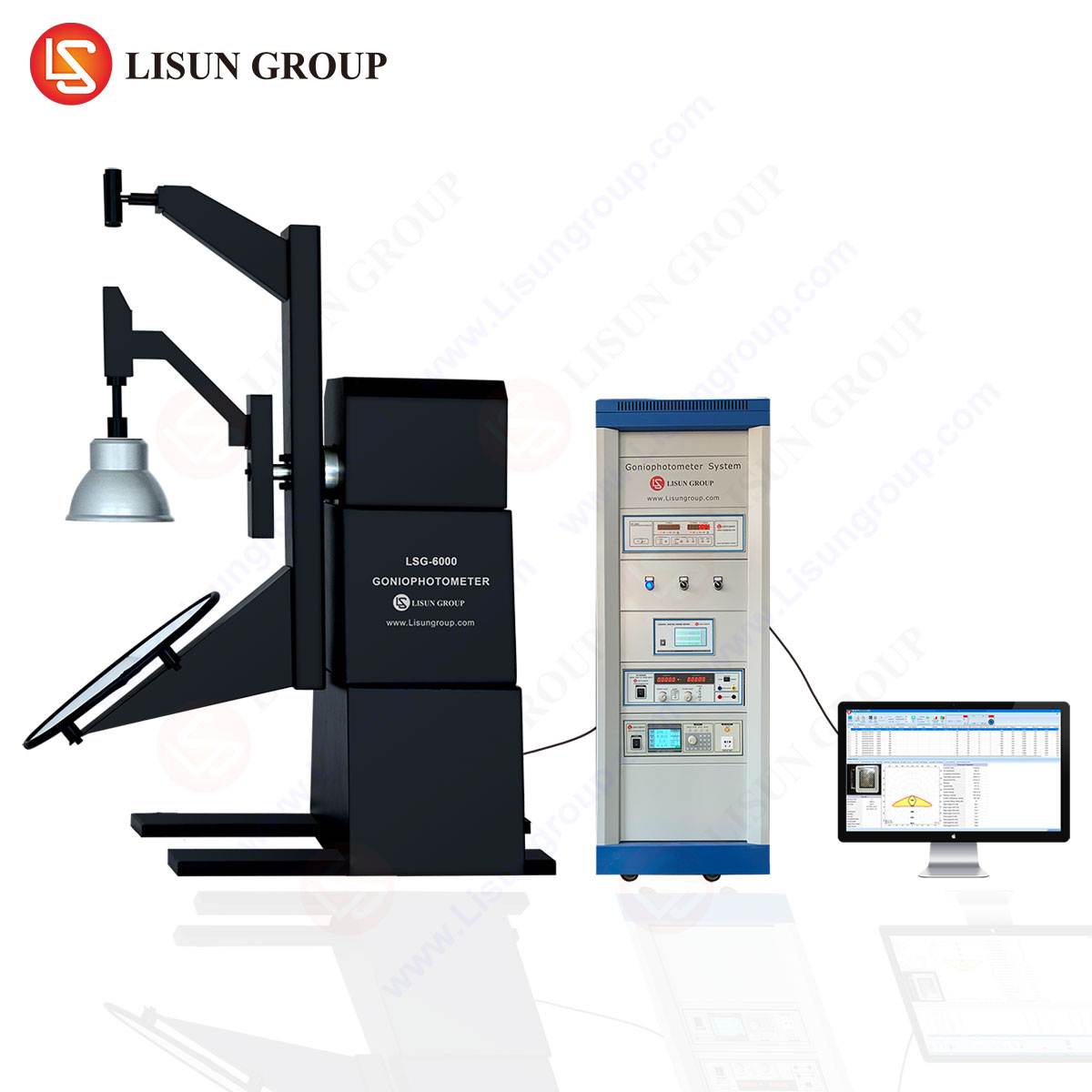
In a Type C system, the DUT remains stationary at the center of the instrument, while the detector assembly moves along a path on a sphere or hemisphere around it. This configuration is further divided into two subtypes. The Type C-y system rotates the detector in both the vertical (gamma, γ) and horizontal (C, azimuth) planes, tracing a path over the surface of a sphere. This design is mechanically complex but offers high accuracy for near-field measurements. The more common Type C-gamma system fixes the detector’s horizontal position and moves it only along a vertical arc (gamma movement), while the DUT is rotated around its vertical axis (C-plane movement). This simpler, more robust design is highly effective for measuring luminaires with rotational symmetry and is the basis for many modern systems, including the LISUN LSG-6000.
Type A and Type B: Rotating Luminaire Systems
Conversely, Type A and Type B systems rotate the DUT itself. In a Type A system, the luminaire rotates around its horizontal axis (A-plane), while the detector is fixed at a distance. The DUT may also be rotated around its vertical axis for a full spherical measurement. Type B systems rotate the DUT around its vertical axis (B-plane). These rotating luminaire designs are often used for far-field measurements where maintaining a large fixed distance is practical. However, they can introduce errors if the DUT’s light output or thermal characteristics are sensitive to orientation, as the gravitational and thermal convection vectors change during measurement.
Mirror-Based Goniophotometers
To address the challenges of moving heavy or sensitive detectors, mirror-based systems utilize a highly precise, rotating mirror to redirect light from the DUT to a stationary detector. The LSG-1890B is an example of a moving mirror goniophotometer. The mirror’s movement simulates the changing angular position of a detector, offering significant advantages in speed and mechanical stability, as the sensitive detector and its electronics remain fixed. The optical quality and precise alignment of the mirror are paramount to the system’s accuracy.
The LSG-6000 Goniophotometer: A Technical Overview
The LISUN LSG-6000 is a Type C-gamma goniophotometer designed for high-accuracy testing of luminaires and lamps. Its architecture features a stationary DUT position and a detector that moves along a large vertical arc, ensuring consistent measurement conditions for the light source throughout the testing process.
Key Specifications and Design Features:
- Measurement Geometry: Type C-gamma (rotating detector on vertical arm, rotating DUT on horizontal plane).
- Angular Range: Gamma axis: -90° to +90° or -180° to +180° (customizable); C-axis: 0° to 360°.
- Measurement Distance: Adjustable, typically configured to meet the far-field condition (≥ 5 times the maximum dimension of the DUT) as per IEC 60598-1 and other standards.
- Detector System: Utilizes a high-precision, spectrally corrected silicon photodiode detector with a V(λ) filter to match the CIE standard photopic observer function. The system can be equipped with imaging luminance measurement devices (ILMDs) for spatially resolved luminance distribution analysis.
- Software Integration: The system is controlled by sophisticated software that automates the measurement sequence, data acquisition, and report generation. It directly calculates parameters such as total luminous flux, luminous efficacy, luminous intensity distribution, beam angle, zone flux, and colorimetric data (if a spectrometer is integrated).
- Standards Compliance: The LSG-6000 is engineered to comply with a multitude of international standards, including:
- IEC Standards: IEC 60598-1, IEC 60630, IEC 62321, IEC 61341, IEC 62031
- CIE Standards: CIE 70, CIE 121
- IESNA Standards: IESNA LM-79, LM-80
- Regional Standards: EN 13032-1, ENERGY STAR, DLC (DesignLights Consortium) requirements.
Industry-Specific Applications of Advanced Goniophotometry
Precision in LED and OLED Manufacturing
In LED and OLED manufacturing, the LSG-6000 is indispensable for quality control and performance validation. It provides absolute photometric data required for datasheets and compliance with standards like IES LM-80 for measuring lumen depreciation and LED lifetime. For OLED panels, which are diffuse area sources, the goniophotometer accurately measures the angular dependence of luminance and chromaticity, critical for display and lighting applications where viewing angle performance is a key differentiator.
Validation of Display Equipment and Optical Components
For the display industry, goniophotometers characterize the viewing angle performance of backlight units (BLUs), LCD modules, and signage. Measurements of contrast ratio, color shift, and luminance uniformity as a function of angle are essential. In optical component production, such as for lenses, diffusers, and reflectors, the system quantifies scattering profiles, transmission efficiency, and beam-shaping effectiveness, providing vital data for R&D and production batch consistency.
Optimization for Urban and Architectural Lighting Design
Urban lighting designers rely on goniophotometric data to predict the performance of luminaires in real-world applications. The LSG-6000 generates files in standardized formats (e.g., IES or EULUMDAT) that can be imported into lighting simulation software (e.g., DIALux, Relux). This allows designers to model illuminance levels, uniformity, and glare for streetlights, facade lighting, and interior luminaires before installation, ensuring compliance with standards like EN 13201 for road lighting and promoting energy-efficient designs.
Specialized Testing for Stage, Studio, and Medical Lighting
The demanding requirements of stage, studio, and medical lighting necessitate rigorous testing. The LSG-6000 can characterize the complex beam patterns of spotlights, followspots, and theatrical luminaires, measuring parameters like field angle, beam angle, and intensity reach. For medical lighting, such as surgical lights, it is critical to measure parameters defined by standards like IEC 60601-2-41, including field diameter, depth of illumination, and the absence of striations and shadows, all of which are dependent on precise goniophotometric analysis.
Supporting Research in Photovoltaics and Sensor Development
In the photovoltaic industry, goniophotometers are used inversely to measure the angular response of solar cells and modules. Understanding how a cell responds to light incident from different angles is crucial for predicting energy yield under varying sun positions. Similarly, for sensor production (e.g., ambient light sensors, photodiodes), characterizing the angular sensitivity profile is a fundamental step in the design and calibration process.
Comparative Advantages of the LSG-6000 System
The LSG-6000’s Type C-gamma design offers several distinct competitive advantages. By keeping the DUT stationary, it eliminates measurement artifacts caused by changes in convective cooling or orientation-sensitive components (e.g., filaments, drivers), ensuring thermal stability and electrical consistency during testing. This is a significant benefit over Type A/B systems for modern LED luminaires whose junction temperature and light output are intrinsically linked. The robust mechanical construction minimizes vibration, leading to higher signal-to-noise ratios and more repeatable measurements. Furthermore, its compliance with a comprehensive set of international standards makes it a singular, versatile solution for manufacturers and laboratories serving global markets, streamlining the product certification process for organizations like UL, TÜV, and Intertek.
Conclusion
Goniophotometers are foundational instruments for the advancement of lighting and optical technology. The selection of an appropriate system—whether Type A, B, C, or mirror-based—depends on the specific application, required accuracy, and the physical characteristics of the devices under test. The LISUN LSG-6000, with its Type C-gamma rotating detector architecture, represents a robust and highly accurate solution tailored to the needs of modern industries. Its ability to provide standardized, reliable data for product development, quality assurance, and regulatory compliance makes it an essential tool for driving innovation and ensuring quality across the lighting, display, and optical sectors.
Frequently Asked Questions (FAQ)
Q1: What is the primary difference between the LSG-6000 (Type C-gamma) and a mirror-based goniophotometer like the LSG-1890B?
The primary difference lies in the mechanical principle. The LSG-6000 moves the physical detector on a mechanical arm, while the LSG-1890B keeps the detector stationary and uses a rotating mirror to reflect light from the DUT. Mirror-based systems can offer faster measurement speeds and greater mechanical stability for the detector, whereas Type C systems like the LSG-6000 are often praised for their direct measurement path and high accuracy for a wide range of luminaire sizes and types.
Q2: Why is maintaining a constant DUT temperature during goniophotometric measurement critical for LED luminaires?
The light output (luminous flux) and color characteristics of LED packages are highly dependent on their junction temperature. If the luminaire is rotated (as in Type A/B systems), convective cooling patterns change, causing the junction temperature to fluctuate. This introduces significant error in the measurement. The LSG-6000’s fixed DUT position ensures consistent thermal conditions, leading to more accurate and repeatable results.
Q3: Which international standards must a goniophotometer comply with to perform LM-79 testing?
IESNA LM-79 is the standard approved method for electrical and photometric measurements of solid-state lighting products. To perform LM-79 testing, a goniophotometer must comply with the requirements outlined in LM-79 itself, as well as referenced standards such as CIE 70, CIE 121, and IESNA LM-78 (which describes goniophotometer types). The LSG-6000 is designed to meet these specific requirements.
Q4: Can the LSG-6000 measure the color properties of a light source, or is it only for intensity?
While the core system measures photometric intensity, the LSG-6000 can be integrated with a high-precision spectrometer. This enables the simultaneous measurement of photometric and colorimetric data (e.g., CCT – Correlated Color Temperature, CRI – Color Rendering Index, and chromaticity coordinates) as a function of angle, which is essential for characterizing sources like RGB LEDs or OLEDs where color shift is a concern.
Q5: What is the importance of generating an IES file from goniophotometer data?
An IES (Illuminating Engineering Society) file is a standardized digital format that contains the complete luminous intensity distribution data of a luminaire. Lighting designers use these files in simulation software to accurately model how a light fixture will perform in a virtual space. The ability of the LSG-6000 software to automatically generate compliant IES files is crucial for connecting manufacturing data with real-world application engineering.