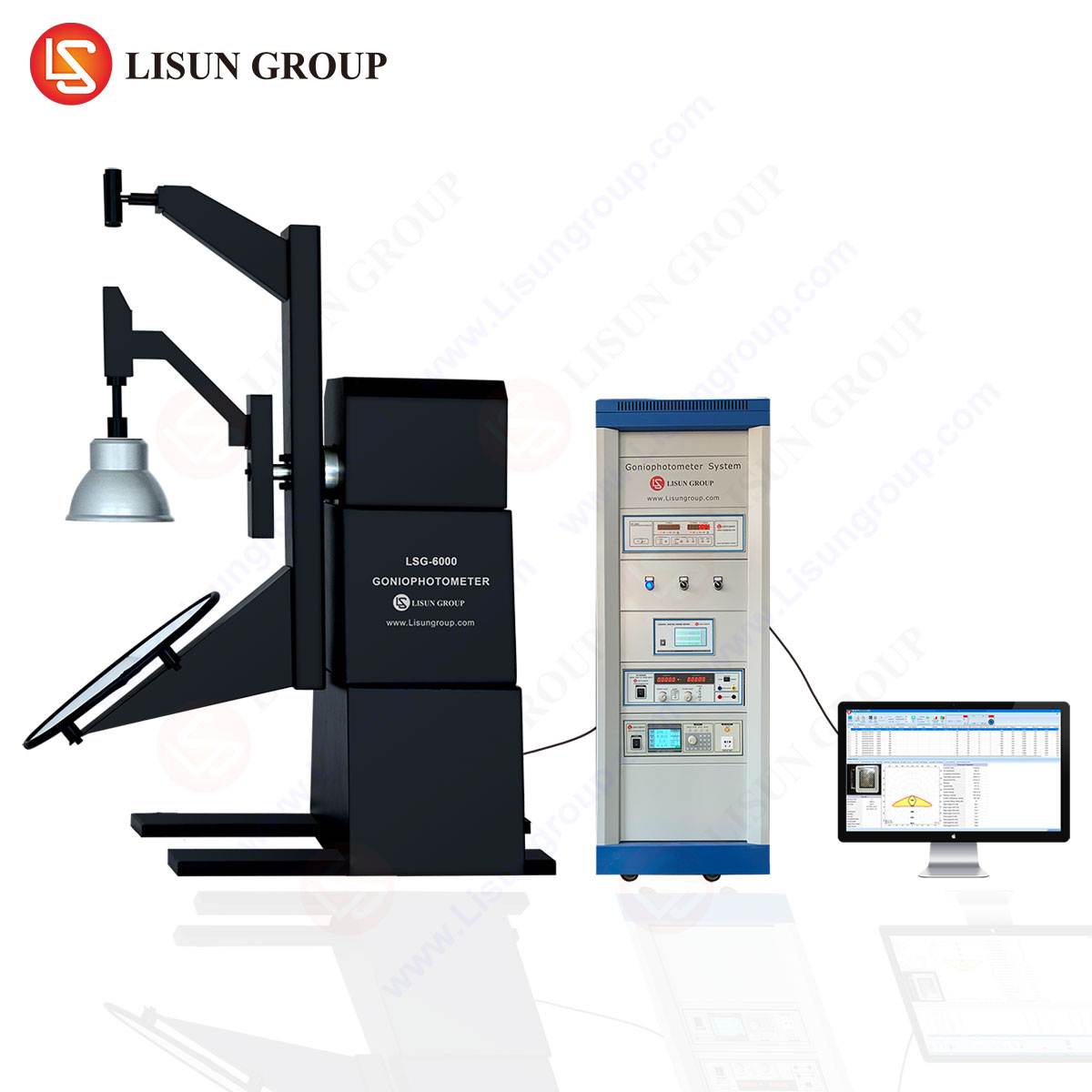



A Comprehensive Analysis of Goniophotometer Type C for Advanced Luminous Flux Measurement
Abstract
The precise characterization of the spatial distribution of luminous flux is a fundamental requirement across numerous photometric disciplines. The Goniophotometer, Type C, distinguished by its moving mirror optical path, represents a sophisticated solution for obtaining highly accurate far-field luminous intensity data. This technical treatise examines the operational principles, industry-specific applications, and compliance with international standards of Type C systems, with a specific focus on the implementation and capabilities of the LSG-6000 goniophotometer. The analysis underscores the instrument’s critical role in ensuring optical product integrity, facilitating research and development, and upholding regulatory compliance in a global market.
Optical Path Configuration of the Moving Mirror Goniophotometer
The defining characteristic of a Type C, or moving mirror, goniophotometer is its stationary light source and detector, with a system of one or more mirrors that traverse the spherical coordinate space around the luminaire under test. This configuration presents significant advantages for testing heavy, large, or thermally sensitive light sources. In a typical LSG-6000 arrangement, the luminaire is mounted in a fixed position at the center of the goniometer’s rotational axes. A highly reflective, spectrally neutral mirror is moved through a series of zenith (γ) and azimuth (C) angles by a precision robotic armature. This mirror captures light emitted from the source at each specific angular coordinate and directs it to a fixed, high-sensitivity photodetector or spectroradiometer.
This architecture eliminates the mechanical stress and potential cable management issues associated with rotating the test sample itself. Consequently, it is the preferred methodology for evaluating large-area LED panels, OLED luminaires, and fixtures with complex thermal management systems whose performance would be compromised by movement. The stability of the light source during testing ensures that thermal and electrical operating conditions remain constant, leading to data that accurately reflects the luminaire’s performance in a static, installed state.
Metrological Principles of Far-Field Photometric Data Acquisition
The primary metrological objective of a Type C goniophotometer is to measure the luminous intensity distribution (LID) of a light source in the far-field condition. The fundamental principle is based on the inverse square law, which states that the illuminance (E) at a point on a surface is proportional to the luminous intensity (I) of the source in the direction of that point and inversely proportional to the square of the distance (d) between the source and the point: E = I / d². By maintaining a constant and sufficiently large distance between the effective source (via the mirror) and the detector, the system ensures far-field measurements, where the source can be treated as a point source.
The LSG-6000 system automates this process, systematically positioning the mirror to collect illuminance data across the entire 4π steradian sphere surrounding the luminaire. The luminous intensity for each angle is then calculated from the measured illuminance and the known, fixed distance. This raw data set is processed to generate the complete luminous intensity distribution, which can be used to derive total luminous flux (by integrating intensity over the spherical surface), coefficient of utilization (CU), luminaire efficiency, and various graphical representations such as polar candela diagrams and iso-candela plots.
Technical Specifications of the LSG-6000 Goniophotometer System
The LSG-6000 embodies the practical application of Type C goniophotometry, engineered for high-precision testing of modern light sources. Its specifications are tailored to meet the rigorous demands of international standardization and industrial quality control.
- Measurement Geometry: Full 4π steradian sphere; C-axis rotation 0° to 360° (azimuth), γ-axis rotation 0° to 180° or 180° to 360° (zenith).
- Angular Resolution: ≤ 0.1° (programmable), enabling the capture of highly detailed LID patterns from narrow-beam spotlights to wide-flood luminaires.
- Measurement Distance: Variable, configurable to meet the far-field requirements specified in standards such as IEC 60598-1 and IES LM-79.
- Detector System: Typically integrates a high-precision photopic filter-equipped photometer head (V(λ) matched to CIE 1931 standard observer) or a fast-scanning spectroradiometer for full spectral and colorimetric analysis (e.g., CCT, CRI, Duv).
- Luminous Flux Measurement Range: Capable of measuring from a few lumens to several million lumens, accommodating everything from miniature indicator LEDs to high-bay industrial lighting.
- Software Capabilities: Automated control, data acquisition, and comprehensive reporting. Outputs include IES (.ies) and EULUMDAT (.ldt) files for lighting design software, along with compliance verification against standards like ENER STAR and DLC.
- Standard Compliance: Designed to comply with LM-79-19, LM-80-20, IEC 60598-1, CIE 70, CIE 121, CIE S025, and EN 13032-1.
Application in Solid-State Lighting Manufacturing and Compliance
The advent of LED and OLED technology has fundamentally altered the landscape of the lighting industry, placing a premium on accurate spatial photometry. The LSG-6000 is extensively employed in LED & OLED manufacturing for performance validation and quality assurance. Manufacturers utilize the system to verify total luminous flux output, a key metric for product binning and warranty claims. More critically, it characterizes the beam pattern, identifying optical imperfections, glare characteristics, and the efficacy (lumens per watt) of the complete system.
Compliance with international standards is a non-negotiable aspect of global market access. The LSG-6000 facilitates testing in accordance with IEC 60598-1 for luminaire safety and performance, and IES LM-79-19, which stipulates the electrical and photometric measurement of solid-state lighting products. For OLED panels, which are inherently large-area and directionally sensitive sources, the moving mirror design of the Type C goniophotometer is indispensable. It allows for accurate measurement without subjecting the fragile and flexible OLED substrate to mechanical rotation, ensuring data integrity and preventing damage to the sample.
Precision Evaluation of Display and Projection Equipment
In the domain of Display Equipment Testing, uniformity of luminance and color across the viewing angle is a critical quality parameter. The LSG-6000, when configured with a spectroradiometer, can perform conoscopic measurements (fixed point on screen, varying viewing angle) to generate detailed viewing angle profiles. This data is essential for characterizing the performance of LCD, OLED, and microLED displays for consumer electronics, medical imaging monitors, and automotive dashboards.
For projection systems, the goniophotometer measures the total flux and angular distribution of the projected light. This is vital for quantifying the performance of digital cinema projectors, head-up displays (HUDs), and augmented reality (AR) projection units. The ability to produce standardized IES files allows optical designers to simulate the performance of a projector in a virtual environment long before physical prototypes are integrated into a final product.
Validation of Photovoltaic Module Angular Response
A non-lighting application where Type C goniophotometry proves invaluable is in the Photovoltaic Industry. The energy yield of a solar cell is not only dependent on the intensity of incident light but also on its angle of incidence. The angular response, or the effective responsivity as a function of the incident light angle, is a key parameter for predicting real-world performance.
The LSG-6000 can be adapted to function as an angular response measurement system. A calibrated reference solar cell or the module under test is mounted at the center, and a stable, collimated light source simulates solar irradiation. The mirror and detector system is replaced by the fixed light source, and the photovoltaic device is rotated to measure the generated current at each angle of incidence. This data is crucial for optimizing anti-reflective coatings and cell geometry, and for modeling the annual energy production of PV installations at specific geographic latitudes.
Supporting Innovation in Optical Instrumentation and Sensor Technology
The development of novel optical components, from complex lens assemblies to miniaturized sensors, requires empirical validation of their light-gathering and distribution properties. In Optical Instrument R&D and Sensor and Optical Component Production, the LSG-6000 provides the quantitative data needed to correlate optical simulations with physical performance.
For instance, the spatial sensitivity of an image sensor or the angular acceptance profile of a photoelectric sensor can be precisely mapped. Researchers developing novel light guides for medical devices or automotive lighting can verify the efficiency and distribution uniformity achieved by their designs. The high angular resolution of the system allows for the detection of subtle artifacts and scattering effects that would be invisible to simpler integrating sphere-based measurements, thereby driving innovation and refinement in optical engineering.
Optimizing Luminous Environments in Architectural and Urban Contexts
Urban Lighting Design and the specification of Stage and Studio Lighting rely heavily on predictive modeling. The accuracy of these models is entirely dependent on the quality of the photometric data files used for the virtual light sources. The LSG-6000 is the primary tool for generating the IES files that define how a luminaire will perform in a simulated environment.
Urban planners use this data to design roadways that meet strict illuminance and uniformity standards (e.g., ANSI/IES RP-8) while minimizing light pollution and glare for residents. Architects and lighting designers can accurately visualize interior lighting scenes, ensuring that the selected fixtures provide the desired aesthetic and functional outcome. In theatrical and studio settings, the precise beam characteristics of a spotlight—its field angle, beam angle, and falloff—are artistic tools. The goniophotometer provides the manufacturer’s data that allows lighting directors to select the perfect instrument for a specific application, from a sharp gobo projection to a soft wash of light.
Ensuring Efficacy and Safety in Medical Illumination
Medical Lighting Equipment, such as surgical lights, dental operatory lights, and diagnostic illumination devices, is subject to the most stringent performance and safety standards. Regulations like IEC 60601-2-41 specify critical requirements for surgical luminaires, including the size and shape of the illuminated field, depth of illumination, and maximum levels of irradiance to prevent tissue damage.
The LSG-6000 is instrumental in the design verification and production quality control of these devices. It provides the quantitative data to prove that a surgical light delivers the required illuminance (e.g., > 40,000 lux at 1 meter) within a defined field diameter, with a steep falloff to minimize glare for the surgeon. The color rendering index (CRI), measured spectroradiometrically, is also vital for accurate tissue differentiation. The moving mirror design is particularly suited for these often bulky and complex luminaires, allowing for stable and repeatable measurements.
Advantages of the Moving Mirror Architecture in Comparative Analysis
The competitive advantage of the LSG-6000 and similar Type C systems becomes evident when compared to Type A (moving detector) or Type B (moving lamp) architectures. For large, heavy, or air-flow dependent luminaires, the Type C design is logistically superior and mitigates measurement error. By keeping the luminaire stationary, its thermal state—a critical factor for LED performance—remains consistent with its operational state. There is no risk of twisting power or data cables, which can affect electrical input or onboard control systems. Furthermore, the fixed detector ensures constant calibration conditions and allows for the integration of large, sensitive, or cryogenically-cooled spectroradiometers that would be impractical to mount on a moving arm. This makes the Type C goniophotometer the most versatile and error-resistant configuration for a vast majority of modern lighting applications.
Frequently Asked Questions (FAQ)
Q1: What is the maximum physical size and weight of a luminaire that the LSG-6000 can test?
The LSG-6000 is designed to accommodate large and heavy luminaires. The specific capacity is model-dependent, but typical systems can handle samples weighing several hundred kilograms with dimensions exceeding two meters in length or diameter. The stationary mounting principle of the Type C design is the key enabler for this high capacity, as the fixture does not need to be rotated.
Q2: How does the system account for the spectral reflectance of the moving mirror?
The system is calibrated using a standard reference lamp with a known spatial and spectral flux distribution. This calibration process inherently accounts for the spectral reflectance of the mirror, as well as the spectral sensitivity of the detector. The calibration factor determined for each angular position normalizes the system’s response, ensuring accurate photometric and colorimetric data. For the highest accuracy, the mirror is coated with a material that provides high, spectrally flat reflectance across the visible spectrum.
Q3: Can the LSG-6000 measure the flicker percentage of a luminaire?
While the primary function is spatial photometry, when equipped with a high-speed photometer or spectroradiometer, the system can be used to characterize temporal light modulation (TLM), commonly known as flicker. By taking rapid, sequential measurements at a fixed point (or multiple points) in the distribution, metrics such as percent flicker and flicker index can be calculated in accordance with standards like IEEE 1789.
Q4: What is the typical measurement time for a full 4π steradian scan?
The total measurement time is a function of the angular step size, the required integration time per point, and the speed of the robotic positioning system. A high-resolution scan with a 1° step in both C and γ axes, requiring over 65,000 data points, can take several hours. However, for quality control checks with a larger step size (e.g., 5° or 10°), the process can be completed in under an hour. The software allows for optimized scanning paths to minimize total measurement time.
Q5: How is data from the LSG-6000 integrated with optical design software?
The system’s proprietary software exports industry-standard photometric data files, primarily the IES (Illuminating Engineering Society) file format and the EULUMDAT (LDT) format. These text-based files contain the complete luminous intensity distribution data in a standardized structure, which can be directly imported into virtually all major optical simulation and lighting design software packages, such as Dialux, Relux, AGi32, and Zemax, for accurate performance rendering and calculation.