





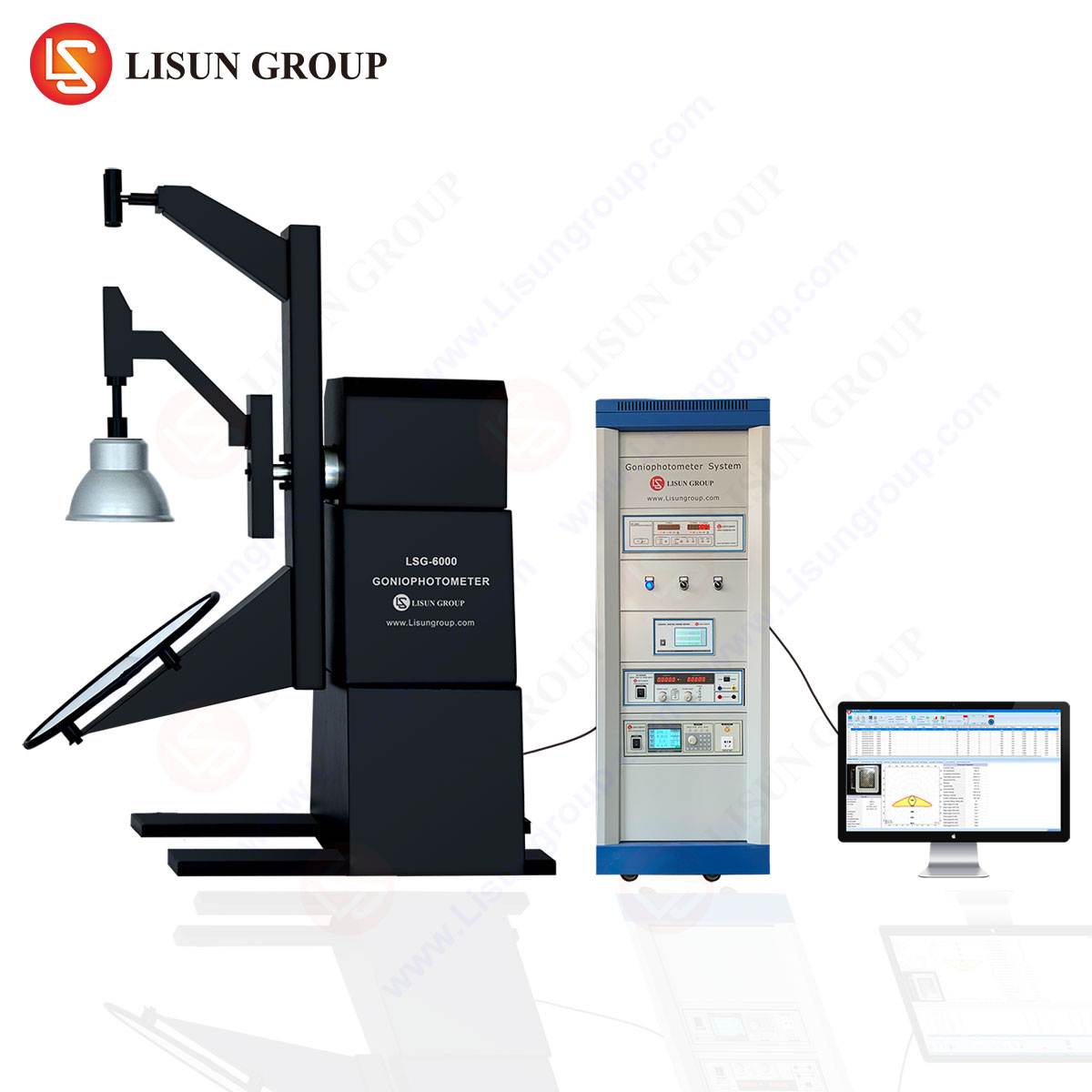



An In-Depth Examination of Goniophotometric Systems for Advanced Photometric Characterization
The precise measurement of light is a cornerstone of modern technology, influencing industries from consumer electronics to urban infrastructure. At the heart of this metrological discipline lies the goniophotometer, an instrument of paramount importance for the comprehensive spatial characterization of luminous flux. This article provides a detailed technical analysis of goniophotometers, with a specific focus on the operational principles, standards compliance, and industrial applications of advanced systems such as the LSG-6000, a benchmark instrument for sale designed to meet the rigorous demands of contemporary photometric testing.
Fundamental Principles of Goniophotometric Measurement
A goniophotometer is an electro-optical system engineered to measure the spatial light distribution of a source, known as its luminous intensity distribution. The core function of the instrument is to precisely manipulate the angular relationship between the light source under test (LSUT) and a calibrated photodetector, capturing luminous intensity data across a spherical coordinate system. The foundational principle is governed by the inverse-square law, which states that the illuminance at a point on a surface perpendicular to the direction of propagation is inversely proportional to the square of the distance from the source, provided the source is a point source. For real-world sources, measurements are conducted at a sufficiently large distance to approximate photometric far-field conditions, a method known as far-field goniophotometry. The instrument systematically rotates the LSUT around its vertical (C-axis: 0° to 360°) and horizontal (Gamma-axis: 0° to 180° or more) axes, building a dense matrix of angular intensity measurements. This dataset is then integrated to calculate total luminous flux, efficacy, and other derived photometric quantities, and is used to generate standardized file formats such as IESNA LM-63 (IES) and EULUMDAT (LDT) for use in lighting design software.
Architectural Design and System Configuration of the LSG-6000
The LSG-6000 represents a state-of-the-art implementation of a moving-detector, fixed-source goniophotometer. This configuration is preferred for its stability and ability to accommodate heavy or complex luminaires. The system’s architecture is comprised of several integrated subsystems. The mechanical structure features a large-radius horizontal arm upon which the photometer head is mounted. This arm rotates through the Gamma-axis with high angular precision, driven by a servo-motor system to ensure smooth and accurate positioning. The LSUT is mounted on a turntable at the center of the system, which provides precise C-axis rotation. The entire apparatus is housed within a darkened chamber to eliminate the influence of ambient light. The photometric subsystem consists of a high-accuracy, spectrally corrected silicon photodiode detector connected to a high-resolution photometer. This subsystem is calibrated against national standard references, traceable to NIST (USA), PTB (Germany), or NPL (UK), ensuring metrological integrity. A centralized computer running dedicated software orchestrates the motion control, data acquisition, and post-processing, enabling fully automated testing sequences and immediate data analysis.
Table 1: Key Specifications of the LSG-6000 Goniophotometer System
| Parameter | Specification |
| :— | :— |
| Photometric Distance | 5m, 10m, 15m, 20m, 25m, 30m (configurable) |
| Gamma Axis Range | -180° to +180° or 0° to 360° (customizable) |
| C Axis Range | 0° to 360° |
| Angular Resolution | ≤ 0.1° |
| Luminous Flux Accuracy | Class L (better than 1.5%) per LM-79-19 |
| Maximum Load Capacity | 100 kg (C-axis turntable) |
| Photometer | Class L(10) / Class A(10) per DIN 5032-7 |
| Compliant Standards | IES LM-79-19, IES LM-80-20, EN 13032-1, CIE 70, CIE 121, CIE S025, ISO/IEC 17025 |
Adherence to International Photometric Testing Standards
The design and operation of the LSG-6000 are rigorously aligned with a comprehensive suite of international standards, which is a critical requirement for global market access and product certification. Its testing protocols are explicitly developed to satisfy IESNA LM-79-19, which prescribes the approved methods for the electrical and photometric testing of solid-state lighting products. This includes the precise measurement of total luminous flux, luminous efficacy (lm/W), and the spatial distribution of luminous intensity. The system also complies with CIE 70, CIE 121, and CIE S025, which provide the international framework for the measurement and reporting of photometric data for luminaires and LEDs. For the European market, conformity with EN 13032-1 (Light and lighting – Measurement and presentation of photometric data of lamps and luminaires) is essential. Furthermore, the system’s precision and calibration protocols support testing in accordance with the stringent requirements of ISO/IEC 17025 for testing and calibration laboratories, making it a suitable centerpiece for an accredited laboratory.
Industrial Applications and Sector-Specific Use Cases
The versatility of advanced goniophotometry is demonstrated by its widespread adoption across numerous high-technology sectors.
In the Lighting Industry and LED & OLED Manufacturing, the LSG-6000 is indispensable for quality control and R&D. Manufacturers use it to validate product performance claims, optimize optical designs for efficiency and specific beam patterns (e.g., flood, spot, asymmetric), and perform binning of LEDs based on spatial flux and color uniformity. For Display Equipment Testing, it is used to characterize the angular luminance and contrast uniformity of displays, ensuring consistent viewing experience across wide angles, a critical factor for televisions, monitors, and automotive displays.
Within the Photovoltaic Industry, the instrument is repurposed to measure the angular response of solar cells and modules, a key parameter in predicting real-world energy yield under varying sun positions. Optical Instrument R&D and Scientific Research Laboratories utilize goniophotometers to characterize lasers, lenses, diffusers, and other optical components, mapping scatter, transmission, and reflection properties with high angular resolution.
Urban Lighting Design professionals rely on the IES files generated by systems like the LSG-6000 to perform accurate simulations of street lighting, architectural façade lighting, and public space illumination, ensuring compliance with dark-sky ordinances and achieving desired aesthetic and safety outcomes. For Stage and Studio Lighting, the detailed beam profile data is crucial for selecting and programming luminaires to achieve specific lighting effects and coverage on set or on stage.
The Medical Lighting Equipment sector demands extreme precision. Goniophotometers verify that surgical lights provide shadow-free, homogenous illumination within a defined field and that phototherapy devices deliver the correct irradiance dosage at specified angles. Finally, in Sensor and Optical Component Production, these systems test the angular sensitivity of photodetectors, IR sensors, and the directional transmission of light guides and fibers.
Comparative Advantages of Modern Goniophotometric Systems
Modern systems like the LSG-6000 offer significant advantages over earlier generations of equipment. The integration of high-torque servo motors and precision encoders ensures exceptional angular accuracy and repeatability, eliminating measurement artifacts. Automated operation drastically reduces testing time and human error, allowing for high-throughput production testing. Advanced software not only controls the hardware but also provides sophisticated data analysis tools, including 3D visualization of photometric solids, false-color diagrams, and instant generation of standard-compliant reports and IES files. The robust mechanical design allows for the testing of a wide range of luminaire sizes and weights, from small LED modules to large high-bay and street lights. The inherent flexibility of the software and hardware platform allows for adaptation to future standards and testing methodologies, protecting the investment.
Integration into a Comprehensive Quality Assurance Workflow
A goniophotometer is rarely a standalone instrument; it is the centerpiece of a holistic photometric testing laboratory. It is often integrated with spectroradiometers for simultaneous spatial and spectral measurements, enabling the calculation of correlated color temperature (CCT) and color rendering index (CRI) across different viewing angles. This is critical for assessing angular color shift in LED products. The system interfaces with power supplies and electrical parameter analyzers to simultaneously measure input voltage, current, and power, thereby automatically calculating efficacy. For environmental testing, the goniophotometer can be installed within a temperature chamber to characterize performance under various thermal conditions, providing essential data for thermal management design and reliability forecasting. The data generated feeds directly into product datasheets, regulatory submissions, and lighting design software, forming a closed-loop quality assurance and product development workflow.
Frequently Asked Questions
Q1: What is the required laboratory environment for installing a large goniophotometer like the LSG-6000?
The installation requires a dedicated, dark, and stable environment. The room must be large enough to accommodate the chosen photometric distance (e.g., a 30m length for a 30m system) and have a stable foundation to prevent vibrations from affecting measurement accuracy. Temperature should be controlled, as photodetector sensitivity can have a minor temperature coefficient.
Q2: How does the system handle the measurement of absolute photometric quantities?
The system is absolutely calibrated using standard lamps of known luminous intensity. These standard lamps are themselves calibrated by a National Metrology Institute (NMI) traceable to the SI unit candela. This calibration factor is applied within the system’s software, ensuring all measurements are traceable to international standards.
Q3: Can the LSG-6000 measure the spatial distribution of colorimetric quantities?
While the core system measures photometric quantities (luminous intensity, illuminance), it can be equipped with an optional spectroradiometer mounted on the moving arm. This allows for hyperspectral measurement at every point, enabling the system to generate full spatial maps of chromaticity coordinates, CCT, CRI, and other colorimetric values.
Q4: What is the typical duration for a complete goniophotometric scan?
The scan time is a function of the angular resolution selected and the size of the luminaire. A high-resolution scan (e.g., 0.1° increments) of a full sphere for a complex luminaire may take several hours. However, for quality control checks with coarser resolution or a defined sector, the process can be completed in tens of minutes. The automation allows tests to run unattended.
Q5: How is data from the goniophotometer used in lighting design software?
The system software exports the measured spatial intensity distribution in the standard IES or LDT file format. These files are then imported into lighting simulation software (e.g., DIALux, Relux, AGi32). The software uses this real-world data to accurately simulate how the luminaire will perform in a virtual environment, predicting illuminance levels, uniformity, and glare before any physical installation occurs.