



Ensuring LM-79 and LM-80 Compliance Using LISUN Photometric Equipment
Introduction to Standardized Photometric and Radiometric Testing
The global transition to solid-state lighting (SSL) technologies, primarily Light Emitting Diodes (LEDs) and Organic Light Emitting Diodes (OLEDs), has necessitated the development of rigorous, standardized testing methodologies. These standards ensure accurate reporting of performance metrics, foster fair market competition, and provide reliable data for designers and engineers. Among the most critical standards established by the Illuminating Engineering Society (IES) are LM-79, Approved Method: Electrical and Photometric Measurements of Solid-State Lighting Products, and LM-80, Approved Method: Measuring Lumen Maintenance of LED Light Sources. Compliance with these standards is not merely a regulatory hurdle but a fundamental requirement for product validation, warranty substantiation, and market acceptance. Achieving such compliance demands instrumentation of exceptional accuracy, repeatability, and adherence to the precise geometric and environmental conditions stipulated by the standards. This article details the technical requirements for LM-79 and LM-80 compliance and elucidates the role of advanced spectroradiometric systems, with a specific focus on the LISUN LMS-6000 series, in executing these critical measurements across diverse industrial applications.
Fundamental Principles of LM-79 and LM-80 Standards
LM-79 defines the procedures for the absolute testing of integrated SSL products under controlled thermal and electrical conditions. It mandates the measurement of total luminous flux (lumens), luminous efficacy (lumens per watt), chromaticity coordinates (CIE x, y, u’, v’), Correlated Color Temperature (CCT), Color Rendering Index (CRI), and spatial distribution of light (intensity distribution). Crucially, LM-79 requires that photometric and colorimetric measurements be performed using an integrating sphere or a goniophotometer, with the device powered under its typical operating conditions. The standard strictly prohibits the use of relative or component-level measurements for final product qualification.
LM-80, conversely, addresses the long-term performance of LED packages, arrays, and modules. It standardizes the method for measuring the lumen depreciation of LED light sources over time at controlled case temperatures (typically 55°C, 85°C, and a third temperature specified by the manufacturer). Data is collected over a minimum of 6,000 hours, with measurements taken at least every 1,000 hours, to project the LED’s lumen maintenance life (e.g., L70, the time to 70% of initial lumens). While LM-80 does not prescribe the specific equipment for the optical measurements, it requires that the same, precisely calibrated spectroradiometric system be used consistently throughout the entire test sequence to ensure data integrity. The derived data is subsequently used in conjunction with the IES TM-21 projection method to estimate long-term lumen maintenance.
Core Instrumentation Requirements for Compliant Testing
The cornerstone of both LM-79 and LM-80 compliance is a high-precision spectroradiometer. Unlike filtered photometers, which rely on a photopic response correction filter, a spectroradiometer measures the absolute spectral power distribution (SPD) of the source across the visible spectrum (typically 380-780nm). All photometric and colorimetric quantities are then computed directly from the SPD via mathematical integration against the CIE standard observer functions. This method eliminates the spectral mismatch errors inherent in filtered photometers, which are particularly problematic for LEDs and OLEDs due to their narrowband or irregular SPDs.
For LM-79, the spectroradiometer is integrated with either a large-diameter integrating sphere (for total flux measurements) or a goniophotometer (for spatial intensity distributions). The sphere must be coated with a highly reflective, spectrally neutral diffuse material (e.g., BaSO₄ or PTFE) and include appropriate baffling to shield the detector from direct illumination from the source. For LM-80 testing, the spectroradiometer is typically coupled with a controlled-temperature environmental chamber and a fixed integrating sphere or optical bench setup. The system must maintain exceptional long-term stability and repeatability, as any drift in the measurement system over the thousands of hours of an LM-80 test would invalidate the lumen maintenance trend data.
The LISUN LMS-6000 Spectroradiometer: Architecture and Technical Specifications
The LISUN LMS-6000 series of high-performance array spectroradiometers is engineered to meet the exacting demands of LM-79 and LM-80 testing. As a representative model, the LMS-6000S provides the core capabilities required for these applications. Its design is centered on a high-linearity, low-noise CCD array detector coupled with a high-resolution fixed grating monochromator. This configuration enables rapid, full-spectrum capture without moving mechanical parts, enhancing measurement speed and long-term reliability—a critical factor for the repeated measurements in LM-80.
Key technical specifications of the LMS-6000S include a wavelength range of 380-780nm, a typical wavelength accuracy of ±0.3nm, and a high dynamic range essential for measuring both very dim and very bright sources. Its optical resolution is better than 2.5nm, sufficient to accurately characterize the narrow spectral peaks of phosphor-converted LEDs and the broad emissions of OLEDs. The instrument’s proprietary optical design and advanced thermal management system ensure signal stability, minimizing baseline drift over extended periods. The LMS-6000S interfaces with dedicated software that automates the calculation of all LM-79 and LM-80 required parameters directly from the measured SPD, including luminous flux, CCT, CRI (Ra, R9), chromaticity coordinates, and peak wavelength.
Application in LM-79 Compliance: Integrating Sphere and Goniophotometer Systems
In an LM-79 integrating sphere system, the LMS-6000S is mounted on the sphere’s detector port. The software manages the self-absorption correction (using an auxiliary lamp standard) and calculates the total luminous flux. For the lighting industry and LED manufacturing, this setup is used for final quality assurance of bulbs, tubes, and integrated luminaires. In urban lighting design, accurate flux and efficacy data are vital for calculating installation efficacy and meeting municipal energy codes. For stage and studio lighting, precise colorimetric data (CCT, Duv, CRI) ensures consistent color rendering under cameras and across different fixtures.
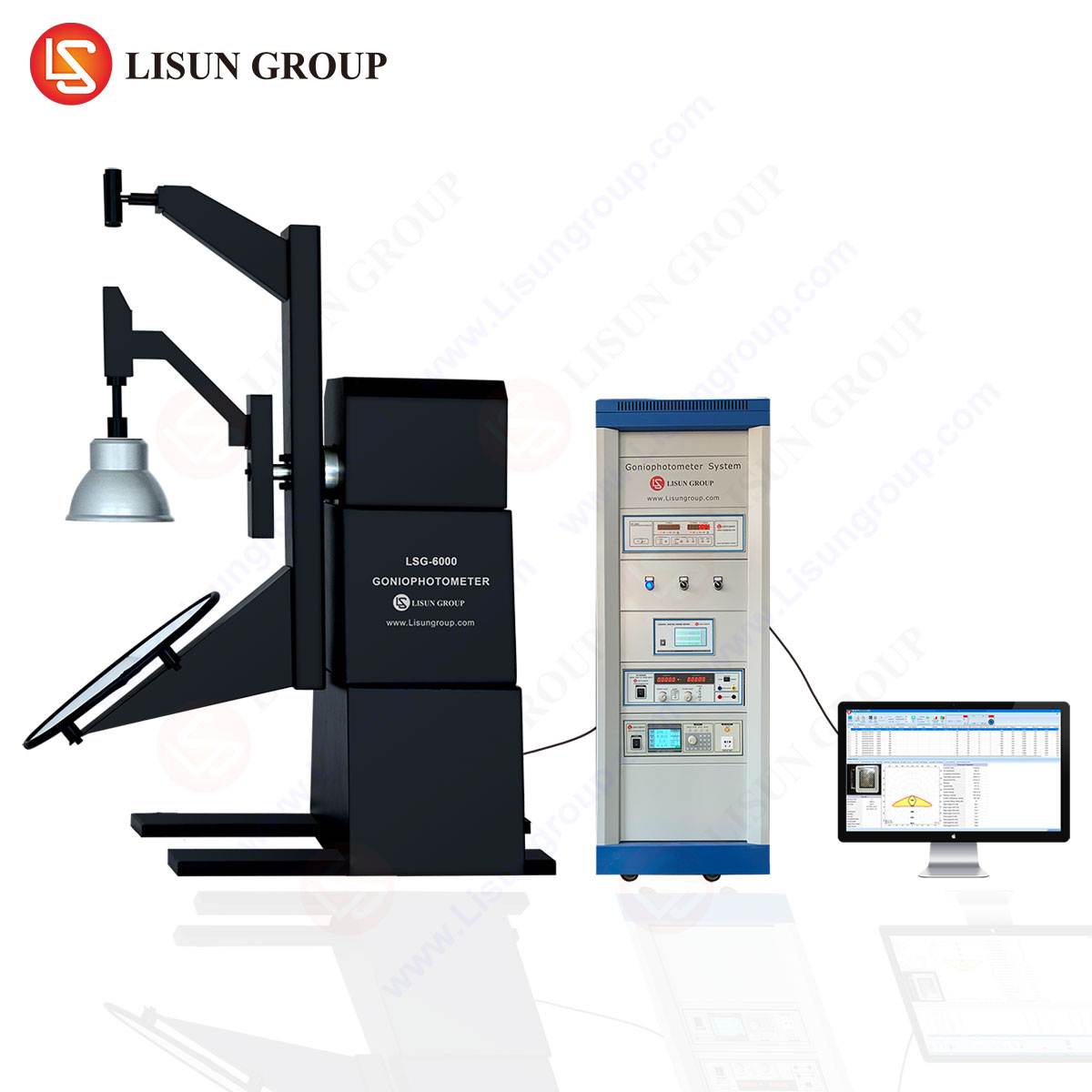
When deployed with a Type C goniophotometer, the LMS-6000S measures the luminous intensity distribution. The spectroradiometer, mounted on the moving arm, captures the SPD at each angular position. This is indispensable for automotive lighting testing, where precise beam patterns, cutoff lines, and signal lamp intensities are regulated by standards such as SAE and ECE. In aerospace and aviation lighting, goniophotometric data validated by a spectroradiometer ensures navigation lights, anti-collision beacons, and cabin lighting meet stringent FAA and EASA specifications for intensity and color.
Critical Role in LM-80 Lumen Maintenance Testing
For LM-80 compliance, measurement consistency is paramount. The LMS-6000S is ideally suited for this application due to its array-based design, which eliminates the wavelength reproducibility errors associated with scanning monochromators. In a typical LM-80 test bench, multiple LED samples are driven in constant-current mode and housed in environmental chambers set to the prescribed case temperatures. At each measurement interval, samples are sequentially presented to the LMS-6000S, which is coupled to an integrating sphere or a precision cosine-corrected input optic.
The system’s speed allows for the efficient testing of large sample matrices common in LED & OLED manufacturing for binning and lifetime qualification. The high repeatability ensures that the observed lumen depreciation is attributable to the LED device itself, not measurement system drift. This reliable data forms the basis for TM-21 projections, which are essential for product warranties in the lighting industry and for reliability assessments in optical instrument R&D and scientific research laboratories studying novel materials and device architectures.
Cross-Industry Applications and Specialized Testing Scenarios
The versatility of a full-spectrum measurement system like the LMS-6000S extends beyond basic LM-79/LM-80 compliance into specialized domains. In display equipment testing, it is used to measure the luminance, chromaticity, and uniformity of LCD, OLED, and micro-LED screens, ensuring compliance with standards like IEC 62341. The photovoltaic industry utilizes spectroradiometers to characterize the spectral irradiance of solar simulators per IEC 60904-9, which is critical for accurate cell efficiency ratings.
In marine and navigation lighting, the system verifies that light colors (red, green, white) conform to the strict chromaticity boundaries defined by the International Association of Marine Aids to Navigation and Lighthouse Authorities (IALA). For medical lighting equipment, such as surgical and examination lights, measurements of CRI, color uniformity, and shadow dilution rely on accurate spectroradiometric data to meet clinical standards (e.g., IEC 60601-2-41). Scientific research laboratories employ these instruments for fundamental studies in photobiology, material photostability, and the development of new light sources.
Competitive Advantages of the LISUN LMS-6000 System for Compliance Testing
The LISUN LMS-6000 series offers distinct advantages in the context of standardized compliance testing. First, its array-based technology provides superior measurement speed and long-term mechanical reliability compared to scanning systems, directly benefiting high-throughput production environments and lengthy LM-80 tests. Second, its high wavelength accuracy and repeatability ensure data integrity across different instruments and over time, a necessity for audit trails and multi-site manufacturing. Third, the integrated software suite is designed with standards compliance as a core function, automating complex calibration routines, correction calculations, and report generation in formats required by regulatory bodies and certification agencies (e.g., ENERGY STAR, DLC). Finally, its modular design allows seamless integration with a wide array of accessories—from various sphere sizes and goniophotometers to specialized fixtures for automotive or display testing—providing a scalable solution for diverse laboratory needs.
Conclusion
Achieving and verifying compliance with IES LM-79 and LM-80 standards is a non-negotiable aspect of developing, manufacturing, and specifying modern SSL products. This process hinges on the use of precise, stable, and standards-aware spectroradiometric equipment. The LISUN LMS-6000 series of spectroradiometers, with its robust array-based architecture, high accuracy, and dedicated software, provides a comprehensive technical solution for executing these critical measurements. Its application spans from fundamental LM-80 lifetime testing in R&D labs to final quality control of complex luminaires for automotive, aerospace, urban, and medical applications, ensuring that performance data is reliable, comparable, and foundational to the continued advancement of lighting technology.
FAQ Section
Q1: Can the LMS-6000S be used for both relative spectral measurements and absolute photometric measurements required by LM-79?
A1: Yes, the LMS-6000S is fundamentally an absolute spectroradiometer. When calibrated against a NIST-traceable standard lamp for spectral irradiance or luminous flux (within an integrating sphere), it provides absolute measurements of spectral power distribution, from which all LM-79 photometric and colorimetric quantities are computed. It can also be used in a relative mode for spectral shape analysis.
Q2: How does the array design of the LMS-6000S benefit long-term LM-80 testing compared to a scanning monochromator system?
A2: The fixed-grating array design has no moving parts, eliminating potential wear and wavelength repositioning errors over thousands of hours of operation. It captures the entire spectrum simultaneously in milliseconds, ensuring each measurement is a true “snapshot” of the LED’s state at that moment. This enhances measurement repeatability and system stability, which are critical for detecting the subtle lumen depreciation trends in LM-80 testing.
Q3: For automotive forward lighting testing in a goniophotometer, is the measurement speed of the LMS-6000S sufficient for dense angular scans?
A3: Absolutely. The fast array capture enables rapid data acquisition at each angular position. This significantly reduces the total scan time for complex beam patterns, improving laboratory throughput while maintaining the high density of data points required for regulatory submission and precise optical analysis of cutoff lines and hot spots.
Q4: Does the system software automatically apply the necessary self-absorption correction when using an integrating sphere for LM-79 testing?
A4: Yes, the dedicated software suite includes fully automated procedures for 4π steradian integrating sphere measurements. It guides the user through the calibration sequence using a standard lamp and the subsequent self-absorption correction measurement using an auxiliary lamp, applying all corrections in real-time to report the absolute total luminous flux of the device under test.
Q5: Can the LMS-6000S measure the expanded metrics like TM-30 (Rf, Rg) or melanopic content for wellness lighting applications?
A5: Yes, because the system measures the full spectral power distribution, it provides the fundamental data required to compute any derived metric. The software can be updated to include calculations for IES TM-30 (Fidelity Index Rf and Gamut Index Rg), melanopic ratio, and other advanced photobiological quantities, making it future-proof for evolving industry standards and research needs.