








Ensuring Compliance and Safety in LED Lighting with Precision Test Instruments
Introduction
The proliferation of Light Emitting Diode (LED) technology across diverse sectors has fundamentally transformed the global lighting landscape. This transition, driven by superior energy efficiency, longevity, and design flexibility, necessitates an equally advanced framework for verification and validation. The performance, safety, and regulatory compliance of LED-based systems are not inherent properties but must be empirically quantified through rigorous photometric, radiometric, and colorimetric testing. Precision test instruments form the cornerstone of this verification process, ensuring that products meet stringent international standards, perform reliably in their intended applications, and do not pose safety risks such as photobiological hazards or electromagnetic interference. This article delineates the critical testing parameters for LED lighting, examines the instrumental methodologies required for accurate measurement, and explores the application of advanced systems, such as integrating sphere spectroradiometers, in upholding quality and compliance across industries.
The Multidimensional Testing Imperative for Solid-State Lighting
Unlike traditional incandescent or fluorescent sources, LEDs are complex optoelectronic systems whose light output is influenced by drive current, thermal management, and material properties. Comprehensive characterization extends beyond simple luminous flux to a matrix of interdependent parameters. Photometric quantities, such as luminous flux (lumens), luminous intensity (candelas), and illuminance (lux), define the perceived brightness and light distribution. Colorimetric properties, including chromaticity coordinates (CIE x,y or u’v’), Correlated Color Temperature (CCT), and Color Rendering Index (CRI) or newer metrics like TM-30 (Rf, Rg), are critical for assessing light quality and consistency. Radiometric measurements, encompassing spectral power distribution (SPD) and irradiance (W/m²), are essential for evaluating non-visual effects, material degradation, and photobiological safety. Furthermore, electrical parameters like power factor, input power, and harmonic current distortion are vital for energy compliance and grid safety. Each industry vertical imposes a unique subset of these requirements, governed by standards from bodies such as the International Electrotechnical Commission (IEC), International Commission on Illumination (CIE), Underwriters Laboratories (UL), and various automotive (SAE) and aviation (FAA, EASA) authorities.
Fundamentals of Integrating Sphere Spectroradiometry
The accurate measurement of total luminous flux and spectral data from omnidirectional or complex-geometry light sources presents a significant challenge. The integrating sphere, a hollow spherical cavity with a highly reflective, diffuse inner coating, provides the foundational solution. Its principle of operation relies on multiple diffuse reflections, creating a uniform radiance distribution across the sphere’s inner surface. A detector, typically a spectroradiometer, samples this uniform illuminance through a baffled port. According to the principle of spatial integration, the signal at the detector is proportional to the total flux entering the sphere, independent of the source’s original spatial distribution.
A spectroradiometer coupled to the sphere analyzes the spectral composition of this integrated light. By dispersing the light via a grating or prism and measuring intensity across wavelengths, it generates a precise SPD. This SPD is the primary data from which all photometric, colorimetric, and radiometric quantities are mathematically derived through convolution with standardized human eye sensitivity functions (e.g., CIE V(λ) for photometry) and other weighting functions. The combination of an integrating sphere and a high-resolution spectroradiometer constitutes a complete system for absolute and relative light measurement, capable of evaluating everything from a single LED chip to a complete luminaire.
The LPCE-3 Integrated Sphere Spectroradiometer System: Architecture and Specifications
The LISUN LPCE-3 High Precision Integrating Sphere Spectroradiometer System exemplifies a modern, integrated solution designed for comprehensive LED testing. The system is engineered to comply with CIE, IEC, and other international standards for photometric, colorimetric, and electrical testing of LED lamps and luminaires.
The core components include a modular integrating sphere, a high-performance CCD array spectroradiometer, a precision constant current/voltage LED power supply, and a master control software suite. The sphere is constructed with a mold-cast, seamless interior coated with a highly stable, diffuse reflectance material (e.g., Spectraflect or BaSO₄), ensuring excellent spatial integration and long-term reflectance stability. The spectroradiometer utilizes a CCD detector with a wavelength range typically spanning from 380nm to 780nm, providing sufficient resolution for accurate color rendering calculations and hazard assessment. A critical feature is the inclusion of an auxiliary lamp system for sphere wall correction, which compensates for self-absorption effects caused by the test sample inside the sphere—a necessary procedure for accurate absolute flux measurement.
Table 1: Representative Specifications of an LPCE-3 Type System
| Parameter | Specification |
| :— | :— |
| Integrating Sphere Diameter | 2m, 1.5m, or 1m (selectable based on sample size) |
| Spectroradiometer Wavelength Range | 380 nm – 780 nm |
| Spectroradiometer Wavelength Accuracy | ± 0.3 nm |
| Photometric Linearity | ± 0.3% |
| Luminous Flux Measurement Accuracy | Class A (per CIE 84-1989) |
| Chromaticity Accuracy (x,y) | ± 0.0005 (standard illuminant A) |
| Electrical Parameter Measurement | Voltage, Current, Power, Power Factor, THD |
| Compliance Standards | CIE 177, CIE-13.3, CIE-84, IEC 60630, IES LM-79 |
Application Across Industry Verticals
The versatility of a precision integrating sphere spectroradiometer system is demonstrated by its critical role in diverse sectors.
In LED & OLED Manufacturing, the system is used for binning—sorting LEDs by flux, chromaticity, and forward voltage—to ensure consistency in mass production. It also validates the performance of finished modules against datasheet claims.
For Automotive Lighting Testing, measurements extend beyond flux and color to include specific photometric distributions mandated by SAE and ECE regulations. The SPD data is crucial for assessing the performance of adaptive driving beams and signal lights under various atmospheric conditions.
In Aerospace and Aviation Lighting, reliability and compliance are paramount. The system tests cockpit panel LEDs, cabin mood lighting, and exterior navigation/strobe lights for compliance with FAA TSOs and EUROCAE standards, ensuring they remain within strict chromaticity boundaries and intensity levels throughout their service life.
Display Equipment Testing relies on colorimetric accuracy. The system calibrates and characterizes the backlight units of LCDs and the pixels of OLED displays, measuring gamut coverage, white point stability, and uniformity.
Within the Photovoltaic Industry, the spectroradiometer function is used independently (without the sphere) to measure the spectral irradiance of solar simulators, ensuring their match to the AM1.5G standard spectrum for accurate solar cell efficiency testing.
Urban Lighting Design projects utilize test data to specify luminaires that meet municipal requirements for illuminance, glare control, and spectral content, the latter being increasingly important for mitigating light pollution and minimizing ecological impact.
In Medical Lighting Equipment, such as surgical lights and phototherapy devices, precise radiometric measurement of irradiance and exact spectral output is a matter of patient safety and treatment efficacy, requiring adherence to strict IEC 60601 standards.
Marine and Navigation Lighting must conform to stringent IALA and COLREGs specifications for luminous range and chromaticity to ensure unambiguous signal recognition at sea. Precision testing verifies performance in harsh environmental conditions.
For Stage and Studio Lighting, where color fidelity and dynamic control are critical, the system profiles LED-based fixtures, creating accurate color profiles for lighting consoles and ensuring consistent color output across different fixture types.
Competitive Advantages of an Integrated System Approach
The LPCE-3 system’s integrated design offers distinct advantages over piecemeal instrument setups. First, it ensures synchronized data acquisition: photometric, colorimetric, and electrical parameters are measured simultaneously under identical operating conditions, eliminating errors from source drift between sequential measurements. Second, the software automation reduces operator error, guiding the user through calibration, self-absorption correction, and the full test sequence while directly generating compliance reports formatted to relevant standards. Third, the use of a spectroradiometer as the primary detector future-proofs the system. As lighting standards evolve—for instance, the adoption of new color fidelity metrics—the underlying SPD data can be re-analyzed with updated software algorithms without requiring hardware changes. Finally, the system’s traceable calibration chain, linking it to national metrology institutes, provides the measurement uncertainty analysis required for credible certification and quality assurance.
Addressing Photobiological Safety Compliance
A critical safety aspect governed by IEC 62471 and its equivalent EN 62471 is the evaluation of photobiological hazards. These standards define exposure limits for actinic UV, UV hazard to the eye, blue-light hazard, thermal retinal hazard, and infrared radiation. A spectroradiometer-based system is the only instrument capable of fully assessing these risks. The software directly computes the weighted spectral irradiance or radiance, comparing it against the standard limits to classify the source into Risk Groups (Exempt, Risk Group 1, 2, or 3). This is indispensable for manufacturers across all industries, from consumer lamps to specialized Optical Instrument R&D and Scientific Research Laboratories, to ensure their products are safe for human exposure.
Conclusion
The assurance of compliance, safety, and performance in LED lighting is an empirical science demanding precision instrumentation. As LED technology continues to advance and permeate increasingly demanding applications, the role of comprehensive test systems becomes more central. Integrating sphere spectroradiometer systems, such as the LPCE-3, provide the necessary metrological foundation. By enabling accurate, efficient, and standards-compliant measurement of the full spectrum of photometric, colorimetric, and radiometric parameters, these instruments empower manufacturers, designers, and researchers to innovate with confidence, ensuring that the benefits of solid-state lighting are realized without compromising on quality, safety, or regulatory adherence.
FAQ Section
Q1: Why is an auxiliary lamp required for sphere wall correction in an integrating sphere system?
When a test sample is placed inside the sphere, it absorbs a portion of the light reflected from the sphere wall, altering the sphere’s overall reflectance compared to its calibrated state with the standard lamp alone. This “self-absorption” effect causes a measurement error. The auxiliary lamp, mounted on the sphere wall, is used in a two-step measurement procedure to quantify and correct for this absorption, ensuring accurate absolute luminous flux measurement.
Q2: Can a system like the LPCE-3 measure the spatial intensity distribution (far-field pattern) of a luminaire?
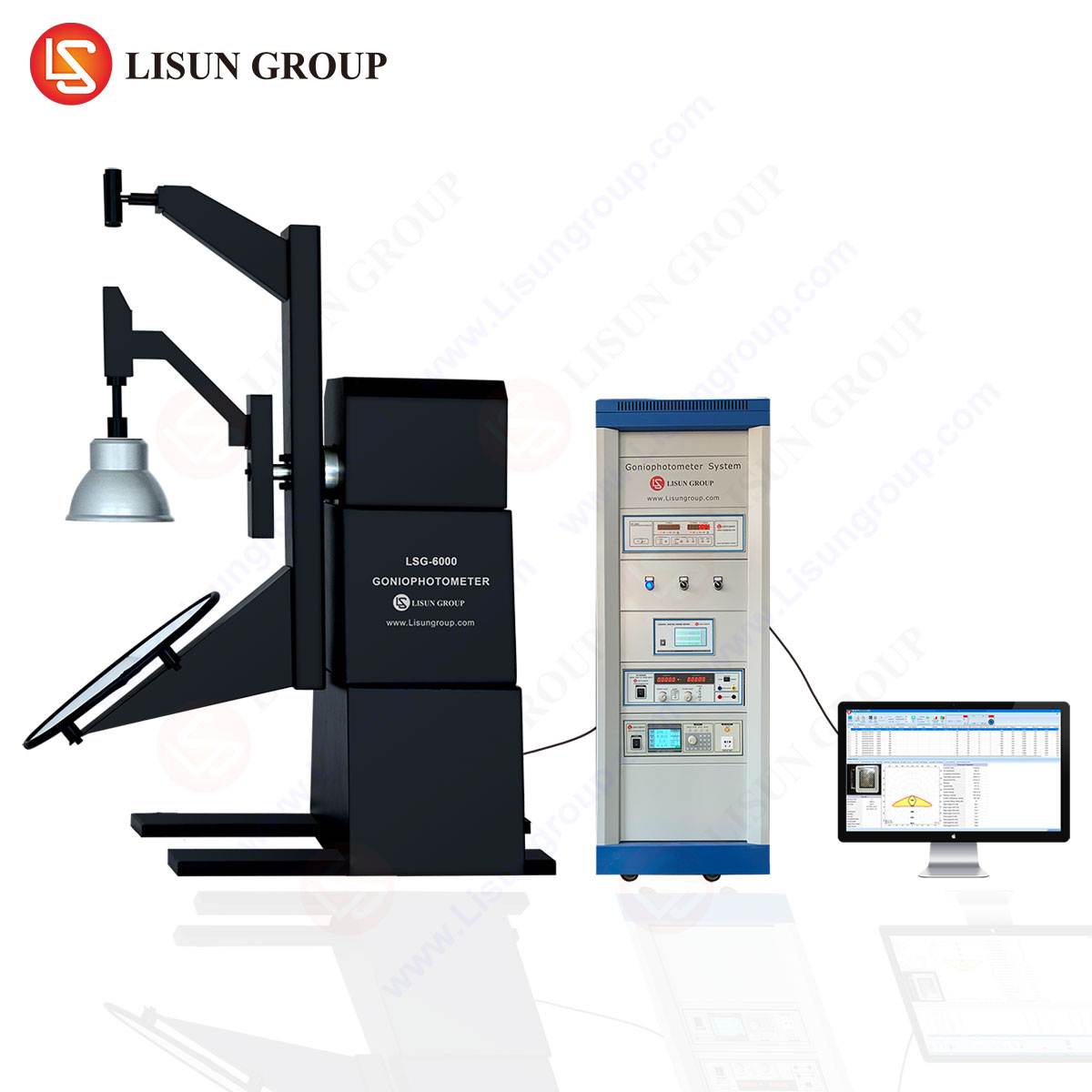
No, an integrating sphere system measures total luminous flux and integrated spectral data. To measure the spatial intensity distribution (photometric “candlepower” curve) and calculate parameters like beam angle, a goniophotometer is required. These are complementary systems; many laboratories use both for complete luminaire characterization.
Q3: How does the system ensure accuracy when testing LEDs with highly directional or unusual beam patterns?
The fundamental principle of the integrating sphere is to spatially integrate all light emitted from the source. As long as the sample is completely inside the sphere and all direct light from the sample strikes the sphere wall before reaching the detector (ensured by the detector baffle), the spatial distribution is rendered irrelevant. The accuracy is governed by the sphere’s coating uniformity and the proper execution of the self-absorption correction.
Q4: What is the significance of measuring the Spectral Power Distribution (SPD) versus using filtered photometers?
An SPD, provided by a spectroradiometer, contains the complete optical fingerprint of the source. From the SPD, all possible photometric, colorimetric, and radiometric quantities can be computed, both current and future metrics. Filtered photometers (e.g., lux meters, color meters) use physical filters to approximate the human eye response; they are less flexible, can suffer from calibration drift, and are incapable of calculating newer metrics like TM-30 or performing photobiological hazard assessments.
Q5: For testing large or high-power luminaires (e.g., streetlights), what sphere size is recommended?
The sphere diameter should be sufficiently large so that the sample’s volume does not exceed approximately 2-5% of the sphere’s volume to minimize self-absorption errors and thermal effects. For a typical streetlight luminaire, a 2-meter diameter sphere is often the minimum recommended size. The sample’s maximum photometric intensity must also be within the linear dynamic range of the spectroradiometer system.