


A Comprehensive Guide to Digital Lux Meters and Advanced Photometric Measurement
Fundamental Principles of Illuminance Measurement
Illuminance, the photometric equivalent of irradiance, quantifies the luminous flux incident on a surface per unit area. Its standard unit is the lux (lx), defined as one lumen per square meter. The measurement of illuminance is a cornerstone in quantifying perceived brightness as experienced by the human eye. This perception is not uniform across the electromagnetic spectrum but is governed by the photopic luminosity function, V(λ), a standardized curve that peaks at 555 nanometers under normal lighting conditions. A fundamental challenge in illuminance measurement lies in the spectral mismatch between this ideal human eye response and the actual spectral sensitivity of the physical sensor within a measurement device.
A conventional digital lux meter employs a silicon photodiode coupled with optical filters. These filters are engineered to correct the photodiode’s inherent spectral response to approximate the V(λ) curve. The accuracy of a lux meter is directly contingent upon the precision of this spectral correction. Even high-quality filtered silicon photodiodes exhibit a mismatch, quantified by the f1′ value, which can lead to significant measurement errors when characterizing light sources with discontinuous or atypical spectral power distributions, such as Light Emitting Diodes (LEDs). This inherent limitation of filtered photodiodes necessitates a more sophisticated approach for applications demanding high spectral accuracy and reliability across diverse light sources.
The Role of Spectroradiometry in High-Fidelity Photometry
To overcome the constraints of traditional lux meters, spectroradiometry provides a definitive solution. A spectroradiometer measures the absolute spectral power distribution (SPD) of a light source across a defined wavelength range. By capturing the complete spectral signature of the illumination, all photometric quantities, including illuminance (in lux), can be calculated with superior accuracy through numerical integration against the standard CIE luminosity functions. This method is agnostic to the source’s spectral characteristics, ensuring consistent and reliable measurements for incandescent, fluorescent, LED, OLED, and laser-based lighting alike.
The LISUN LMS-6000 series of spectroradiometers exemplifies this advanced methodology. These instruments are designed for precision measurement of luminous intensity, chromaticity coordinates, correlated color temperature (CCT), color rendering index (CRI), and illuminance. The core principle involves dispersing incoming light via a high-precision monochromator onto a CCD detector array, enabling the simultaneous capture of a wide spectral band. This allows for the direct computation of lux values from the fundamental spectral data, eliminating the errors associated with filter-based correction.
Technical Specifications of the LISUN LMS-6000 Spectroradiometer Series
The LMS-6000 series comprises several models, including the LMS-6000, LMS-6000F, LMS-6000S, and LMS-6000P, each optimized for specific application requirements. The following table outlines the core specifications that define their performance envelope.
| Parameter | Specification | Note |
|---|---|---|
| Wavelength Range | 380-780nm (Standard) | Optional extensions available (e.g., LMS-6000UV: 200-800nm; LMS-6000SF: 350-800nm). |
| Wavelength Accuracy | ±0.3nm | Critical for precise chromaticity and dominant wavelength calculation. |
| Photometric Accuracy | ±1.5% (f1′<1.5%) | Superior to Class L devices per CIE S 025/E:2015, ensuring traceable calibrations. |
| Illuminance Measurement Range | 0.01 to 200,000 lx | Achievable through the use of programmable attenuators and neutral density filters. |
| Integrating Sphere | Optional, various diameters | For luminous flux (lumen) measurement of total radiant power from a source. |
| Communication Interface | USB, RS-232, Ethernet | Enables seamless integration into automated test stands and quality control systems. |
The high photometric accuracy, characterized by an f1′ value of less than 1.5%, is a key competitive advantage. This low mismatch index ensures that measurements remain consistent regardless of whether the source under test is a warm-white LED, a cool-white fluorescent lamp, or a narrow-band red signal light, a scenario where conventional lux meters often fail.
Comparative Analysis: Filtered Photodiode vs. Spectroradiometric Measurement
The distinction between the two measurement philosophies can be illustrated through specific industry challenges. In the Automotive Lighting Testing sector, the accurate assessment of signal lamps—brake lights, turn indicators, and daytime running lights—is mandated by regulations such as ECE and SAE. These sources are often monochromatic or narrow-band. A filtered lux meter, with a fixed correction, may over- or under-report the illuminance of a red LED by 10% or more compared to its actual visual intensity. A spectroradiometer like the LMS-6000S, by contrast, measures the true SPD and computes the lux value precisely, ensuring compliance and safety.
Similarly, in the Display Equipment Testing industry, the uniformity and color of backlight units (BLUs) for LCDs and the emissive performance of OLED panels must be rigorously characterized. A spectroradiometer can measure the illuminance and chromaticity of individual pixels or zones simultaneously, providing a comprehensive spatial map of performance. This is indispensable for quality control in manufacturing, where consistency is paramount.
Industry-Specific Applications and Use Cases
LED & OLED Manufacturing: In production environments, the LMS-6000F, coupled with an integrating sphere, is used for binning LEDs based on luminous flux and chromaticity. Its high-speed measurement capability allows for rapid sorting of thousands of components per hour, maximizing production yield and ensuring color consistency for final assemblies.
Aerospace and Aviation Lighting: Cockpit displays and panel lighting must meet stringent MIL-STD and DO-160 requirements for luminance and color to ensure readability under all conditions. The LMS-6000 provides the requisite accuracy for certifying that these lighting systems do not produce glare or color shifts that could compromise pilot situational awareness.
Photovoltaic Industry: While focused on radiometric measurement, the spectroradiometer’s ability to characterize the spectral irradiance of natural and artificial light sources is vital for testing solar cells. The LMS-6000 can simulate various solar spectra to evaluate the spectral response and efficiency of photovoltaic modules under different lighting conditions.
Scientific Research Laboratories: In studies of plant growth (photobiology) or material degradation, precise control and measurement of light quality and quantity are essential. The full spectral data from an LMS-6000 enables researchers to correlate specific wavelength bands with biological or chemical effects, going far beyond the simplistic metric of illuminance.
Urban Lighting Design: For smart city projects, the spectral data from the LMS-6000P allows designers to model and measure the photobiological safety of outdoor lighting (per IEC 62471), assess sky glow, and optimize spectral power distribution for public safety and energy efficiency, moving beyond simple illuminance levels on a surface.
Calibration and Traceability for Measurement Integrity
The validity of any photometric measurement is rooted in a unbroken chain of traceability to national metrology institutes. The LISUN LMS-6000 series spectroradiometers are calibrated using standard lamps of known spectral irradiance and chromaticity, traceable to NIST (National Institute of Standards and Technology) or PTB (Physikalisch-Technische Bundesanstalt). Regular calibration intervals, typically annual, are recommended to maintain specified accuracy. The calibration process involves characterizing the wavelength scale, photometric linearity, and absolute spectral response, ensuring that every measurement is both precise and defensible.
Integrating Spectroradiometric Systems for Automated Testing
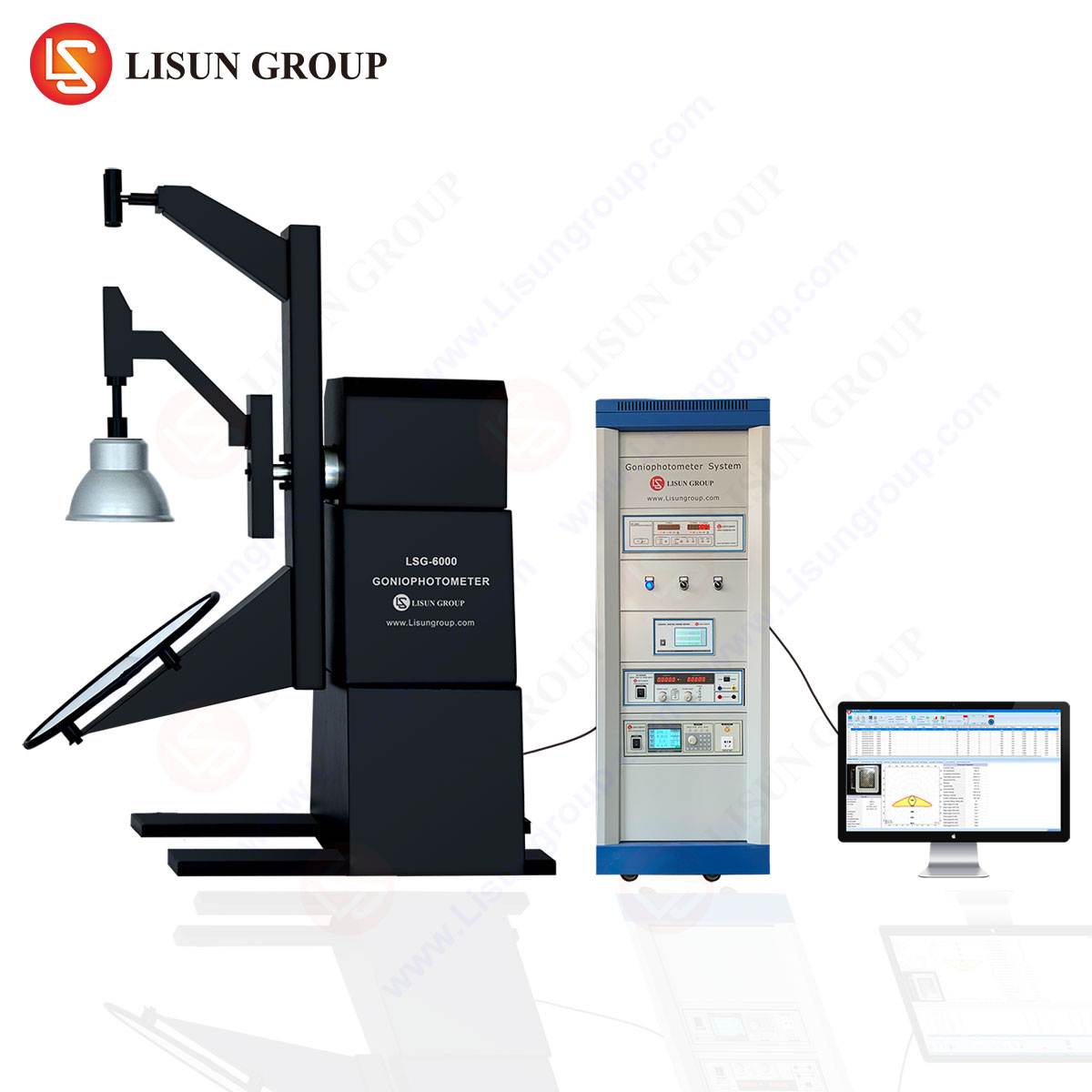
For high-throughput industrial applications, the LMS-6000 is not a standalone device but the core of an integrated system. It can be mounted on a goniophotometer for spatial distribution analysis of light sources, or used with a fiber optic probe for point measurements on complex assemblies like an automotive headlamp or an aircraft instrument panel. Software control via APIs allows for the creation of fully automated test sequences, logging data for statistical process control and generating compliance reports against standards such as IESNA LM-79 and ENERGY STAR.
Frequently Asked Questions
Q1: What is the primary advantage of using a spectroradiometer like the LMS-6000 over a high-quality digital lux meter for routine illuminance checks?
The primary advantage is spectral independence. A spectroradiometer provides fundamentally accurate illuminance readings for any light source, regardless of its spectral composition, by calculating lux from first principles. A conventional lux meter’s accuracy is dependent on how well its filtered response matches the V(λ) curve for the specific source being measured, leading to potential errors with modern, non-incandescent light sources.
Q2: How does the LMS-6000 handle the measurement of very low or very high illuminance levels, such as those found in marine navigation lights or direct sunlight?
The instrument employs a combination of electronic integration time control and optional external, calibrated neutral density filters or attenuators. This extends the dynamic range of the sensitive CCD detector, allowing it to accurately measure from starlight-level illuminance (tens of millilux) up to the intense illumination of direct sunlight (exceeding 100,000 lux) without saturating the sensor or compromising signal-to-noise ratio at low levels.
Q3: In an LED manufacturing context, can the LMS-6000 measure flicker and temporal characteristics?
While the standard LMS-6000 is optimized for steady-state measurement, specialized versions and specific software configurations can support synchronous triggering and high-speed scanning for characterizing temporal light artifacts, including flicker percentage and frequency. For dedicated high-frequency flicker analysis, a photometer with a sufficiently fast temporal response may be recommended as a complementary tool.
Q4: What is the significance of the f1′ value, and why is the <1.5% specification for the LMS-6000 important?
The f1′ value is the spectral mismatch index, quantifying the deviation of the instrument’s relative spectral response from the ideal CIE standard photopic observer V(λ) curve. A lower f1′ value indicates a closer match and therefore higher potential accuracy across diverse light sources. An f1′ < 1.5% places the instrument in a high-accuracy class, minimizing errors when measuring non-standard spectra, which is critical for applications in R&D and compliance testing.