


A Comprehensive Guide to LED Test Equipment: Principles, Standards, and System Integration
Introduction to Photometric and Radiometric Validation for Solid-State Lighting
The ascendancy of Light Emitting Diodes (LEDs) and Organic LEDs (OLEDs) as the dominant illumination technology across diverse sectors has necessitated a parallel evolution in precision measurement equipment. Unlike traditional incandescent sources, LEDs are characterized by narrow-band emission, spectral heterogeneity, directional output, and sensitivity to thermal and electrical operating conditions. Accurate quantification of their photometric, radiometric, and colorimetric parameters is therefore non-trivial and requires specialized instrumentation. This guide delineates the core principles, equipment taxonomy, and application-specific methodologies for comprehensive LED testing, with a focus on integrated sphere-spectroradiometer systems as the benchmark for total flux and spectral measurement.
Fundamental Metrological Principles in Optical Measurement
The foundation of all LED testing rests on the precise discrimination between photometric and radiometric quantities. Radiometry involves the measurement of optical radiation in terms of absolute power (Watts), independent of the human visual response. Photometry, conversely, weights this radiation by the standardized spectral sensitivity of the human eye, the V(λ) function, yielding quantities perceived as “brightness,” such as luminous flux (lumens) and illuminance (lux). Colorimetry further extends this by quantifying the chromaticity coordinates (e.g., CIE 1931 x,y or CIE 1976 u’,v’), correlated color temperature (CCT), and color rendering index (CRI) or the more nuanced TM-30 metrics. The accurate capture of a source’s absolute spectral power distribution (SPD) is the prerequisite for deriving all subsequent photometric and colorimetric values, making spectroradiometry a cornerstone technology.
Taxonomy of Core LED Test Equipment and Function
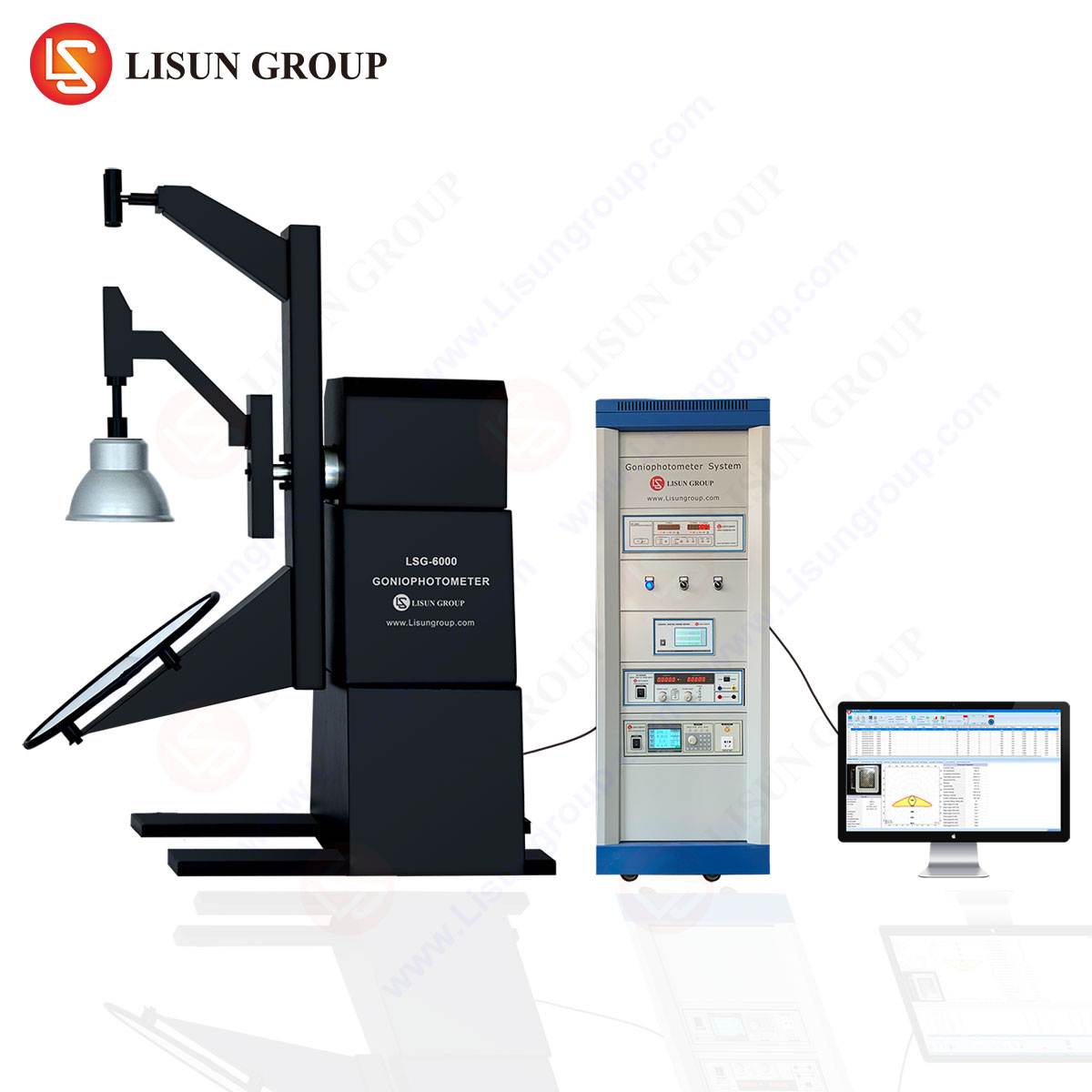
LED test equipment can be categorized by its primary function. Source Measurement Spectroradiometers are designed to measure the SPD of self-luminous objects directly. Array Spectroradiometers, preferred for their speed and stability, utilize a diffraction grating to disperse light onto a CCD or CMOS array, capturing the entire spectrum simultaneously. Scanning Monochromator-Based Systems, while slower, can offer higher spectral resolution for research applications. Integrating Spheres, coated with highly reflective, spectrally neutral materials such as BaSO₄ or PTFE, function as optical diffusers. They spatially integrate the directional output of a light source, producing a uniform radiance at the sphere’s output port, where a spectroradiometer or photometer is attached. This configuration enables the measurement of total luminous flux. Goniophotometers mechanically rotate a detector or the source itself to measure intensity distribution and calculate total flux spatially. Flicker Meters quantify temporal light modulation, critical for health and safety standards. Thermal and Electrical Characterization tools, including precision power supplies, source measure units (SMUs), and thermal chambers, are essential for evaluating performance under specified drive currents and junction temperatures (Tj).
The Integrating Sphere-Spectroradiometer System as a Primary Standard
For the majority of lighting manufacturers and testing laboratories, the combined integrating sphere and spectroradiometer system represents the most efficient and accurate solution for total luminous flux and spectral measurement. The principle is based on the creation of a Lambertian light field within the sphere. Light from the LED source under test (SUT), placed at the sphere’s center, undergoes multiple diffuse reflections. The resulting uniform illuminance on the sphere wall is proportional to the total flux emitted by the SUT. A spectroradiometer, coupled to a side port via an optical fiber, samples this uniform field. The system is calibrated using a standard lamp of known luminous flux and SPD, traceable to national metrology institutes.
Specifications and Operation of the LISUN LPCE-3 Integrated Testing System
The LISUN LPCE-3 High Precision Integrating Sphere Spectroradiometer System exemplifies a turnkey solution for comprehensive LED testing. The system is engineered to conform with key international standards including IESNA LM-79, LM-80, ENERGY STAR, and CIE S 025/E:2015, which specifies requirements for testing LED modules, lamps, and luminaires.
The core components include a modular integrating sphere available in multiple diameters (e.g., 0.5m, 1m, 1.5m, 2m) to accommodate different source sizes and flux ranges, ensuring minimal self-absorption error. The sphere interior utilizes a proprietary, sintered PTFE coating with a reflectance factor >98% from 380nm to 780nm, ensuring high spectral neutrality. The system integrates a high-performance CCD array spectroradiometer, such as the LMS-9000, with a wavelength range typically spanning 380-780nm and an optical resolution of approximately 2.5nm FWHM. This spectroradiometer is responsible for capturing the SPD.
A critical auxiliary lamp, internally mounted within the sphere, is used for implementing the spectral correction method (often referred to as the “4π” or “substitution” method). This procedure corrects for the sphere’s imperfect spatial responsivity and the spectral absorption of the SUT itself, a vital step for accurate measurement, particularly for sources with differing spatial or spectral characteristics from the calibration standard.
The system’s software automates the calibration, measurement, and data analysis workflow. It directly calculates and reports all key parameters from the captured SPD: Total Luminous Flux (lm), Luminous Efficacy (lm/W), Chromaticity Coordinates, CCT (K), CRI (Ra), Peak Wavelength, Dominant Wavelength, Color Purity, and Spectral Power Distribution graphics. For flicker analysis, the system can be augmented with a high-speed photodiode to quantify percent flicker and flicker index.
Industry-Specific Applications and Testing Protocols
- Lighting Industry & LED/OLED Manufacturing: In production lines and QA labs, the LPCE-3 system performs binning according to ANSI C78.377, ensuring LEDs are grouped by chromaticity and flux. It is used for verifying product datasheets, compliance with safety and performance regulations, and conducting LM-80 accelerated lifetime tests for lumen maintenance.
- Automotive Lighting Testing: Beyond total flux, automotive standards (SAE, ECE) require precise measurements of luminous intensity (candelas) for signal functions. While a goniophotometer is used for intensity distribution, the sphere system validates the integrated flux of individual LED modules used in headlamps, daytime running lights (DRLs), and interior lighting, and verifies color specifications for rear combination lamps.
- Aerospace and Aviation Lighting: Testing for aircraft navigation lights, cockpit displays, and cabin lighting adheres to stringent RTCA/DO-160 or MIL-STD environmental and performance standards. The system assesses performance under simulated vibration and temperature extremes, ensuring color consistency and flux output for safety-critical applications.
- Display Equipment Testing: For backlight units (BLUs) in LCDs and micro-LED arrays for direct-view displays, the sphere measures total flux, uniformity of color, and white point stability. It is critical for characterizing the wide color gamut (e.g., DCI-P3, Rec. 2020) capabilities of next-generation displays.
- Photovoltaic Industry: While primarily for emission, spectroradiometers are used in PV to measure the spectral irradiance of solar simulators per IEC 60904-9. The accuracy of these measurements directly impacts the efficiency rating of solar cells.
- Scientific Research Laboratories: In R&D for novel phosphor-converted LEDs, quantum dot LEDs, or UV-C LEDs, high-resolution spectral data is paramount. Researchers use the system to analyze spectral efficiency, Stokes shift losses, and phosphor thermal quenching behavior.
- Urban Lighting Design: Validating the performance of smart city LED luminaires involves measuring not just initial flux and CCT, but also the stability of these parameters under dimming, a key feature of the LPCE-3 system’s dynamic measurement capability.
- Marine and Navigation Lighting: Compliance with International Association of Lighthouse Authorities (IALA) and COLREGs mandates precise chromaticity and intensity for maritime signal lights. The system provides the spectral verification needed for certification.
- Stage and Studio Lighting: For LED-based theatrical and broadcast luminaires, consistent color rendering across dimming levels is essential. The system measures SSI (Spectral Similarity Index) and TM-30 (Rf, Rg) metrics to ensure fixtures match accurately for multi-camera production.
- Medical Lighting Equipment: Surgical and diagnostic lighting must meet high CRI and specific spectral requirements (e.g., for tissue contrast). The system ensures compliance with standards like IEC 60601-2-41, measuring parameters critical for clinical accuracy and patient safety.
Comparative Advantages of Integrated Sphere-Spectroradiometer Systems
The primary advantage of a system like the LPCE-3 is its ability to derive a comprehensive suite of photometric, colorimetric, and spectral data from a single, rapid measurement. This contrasts with sequential measurements using multiple discrete instruments, reducing error propagation and increasing throughput. The integrated spectral correction function is a decisive factor for accuracy, especially when testing sources with large physical size or atypical emission spectra. Furthermore, the software’s direct reporting against industry standards streamlines the certification and quality assurance process, providing auditable data trails for regulatory submissions.
Considerations for System Configuration and Measurement Accuracy
Selecting the correct sphere size is paramount. A sphere too small for the SUT will cause significant spatial non-uniformity and self-absorption error. As a rule, the sphere diameter should be at least 5-10 times the largest dimension of the SUT. The calibration chain’s traceability to a National Metrology Institute (NMI) is non-negotiable for accredited laboratories. Environmental conditions—stable ambient temperature (23°C ±2°C is typical), absence of stray light, and stable power supply—must be rigorously controlled. Regular validation using calibrated reference sources is required to maintain measurement uncertainty budgets.
Future Trends in LED Metrology
The ongoing miniaturization of LEDs, the advent of laser-excited remote phosphor systems, and the proliferation of smart, spectrally tunable lighting pose new metrological challenges. Equipment is evolving towards higher-speed spectroradiometry for real-time production monitoring, hyperspectral imaging for spatial color uniformity mapping, and systems capable of characterizing spatially resolved spectral radiance. The integration of test equipment with IoT platforms for predictive maintenance and data analytics is also an emerging trend, transforming quality control from a pass/fail checkpoint into a continuous optimization process.
FAQ Section
Q1: What is the purpose of the auxiliary lamp inside the integrating sphere in systems like the LPCE-3?
The auxiliary lamp is used to perform the spectral (or spatial) correction procedure. It measures the sphere’s spectral responsivity function with and without the device under test present. By comparing these two measurements, the system software can computationally correct for errors introduced by the physical presence of the test source, which absorbs and scatters light differently than the calibration standard, leading to significantly more accurate total flux readings.
Q2: When should a goniophotometer be used instead of an integrating sphere system?
A goniophotometer is essential when the measurement of luminous intensity distribution (candelas vs. angle) is required, such as for regulatory compliance of automotive headlamps, streetlights, or any luminaire where the directional pattern of light is a specified performance metric. While a sphere measures total flux, a goniometer can compute total flux by mathematically integrating the intensity distribution and is necessary for determining metrics like beam angle, peak intensity, and glare ratings.
Q3: How does the measurement procedure differ for an LED component (e.g., a bare chip on a board) versus an LED luminaire (a complete light fixture)?
For an LED component, it is typically tested at a controlled junction temperature (often 25°C) using a thermal test fixture, and its electrical input is precisely defined. The component is placed in the center of the sphere. A luminaire, however, is tested as a complete product under its own operating conditions, including its own driver, heat sink, and optics. It is usually mounted over the sphere’s entrance port in its intended orientation, measuring the light exiting the fixture (2π geometry). Different sphere port layouts and calibration methods apply to these distinct test geometries.
Q4: Why is spectral resolution important in a spectroradiometer for LED testing, and what is a typical sufficient value?
Spectral resolution determines the instrument’s ability to distinguish fine spectral features, such as narrow emission peaks from blue LED pumps or sharp lines in certain phosphors. Insufficient resolution can artificially smooth the SPD, leading to errors in calculated CCT and, especially, color rendering indices (CRI, Rf). For general LED testing per CIE S 025, a Full Width at Half Maximum (FWHM) resolution of ≤5nm is mandated, with modern array spectroradiometers typically offering ~2-3nm FWHM, which is sufficient for the vast majority of commercial and industrial applications.
Q5: Can an integrating sphere system measure the flicker of an LED source?
A standard sphere-spectroradiometer system measures time-averaged spectral data and cannot capture rapid temporal modulation. However, many systems, including configurable versions of the LPCE-3, can be equipped with a dedicated flicker measurement module. This module uses a high-speed silicon photodiode and data acquisition system to sample light output at frequencies often exceeding 10 kHz, enabling the calculation of percent flicker, flicker index, and frequency as per standards like IEEE PAR1789 and ENERGY STAR requirements.