



Comprehensive Goniophotometric Analysis: Principles, Methodologies, and Advanced Applications in Photometric Verification
Introduction to Spatial Photometric Distribution Measurement
The accurate characterization of a luminaire’s light distribution is a fundamental requirement across numerous scientific and industrial disciplines. Unlike a simple luminous flux measurement, which quantifies total emitted light, understanding how intensity varies with direction is critical for predicting real-world performance. Goniophotometry serves as the definitive methodology for this spatial analysis. A goniophotometer is a precision instrument that measures the luminous intensity distribution of a light source by rotating it through two orthogonal axes (typically C-γ or A-α systems) within a darkroom, capturing data at defined angular increments. This process generates a three-dimensional intensity map, the cornerstone for deriving all key photometric parameters, including luminous flux, efficacy, zonal lumen distribution, and candela curves. The resulting data set is indispensable for applications ranging from compliance testing against international standards to the optimization of optical designs in research and development.
Operational Principles of Type C Goniophotometer Systems
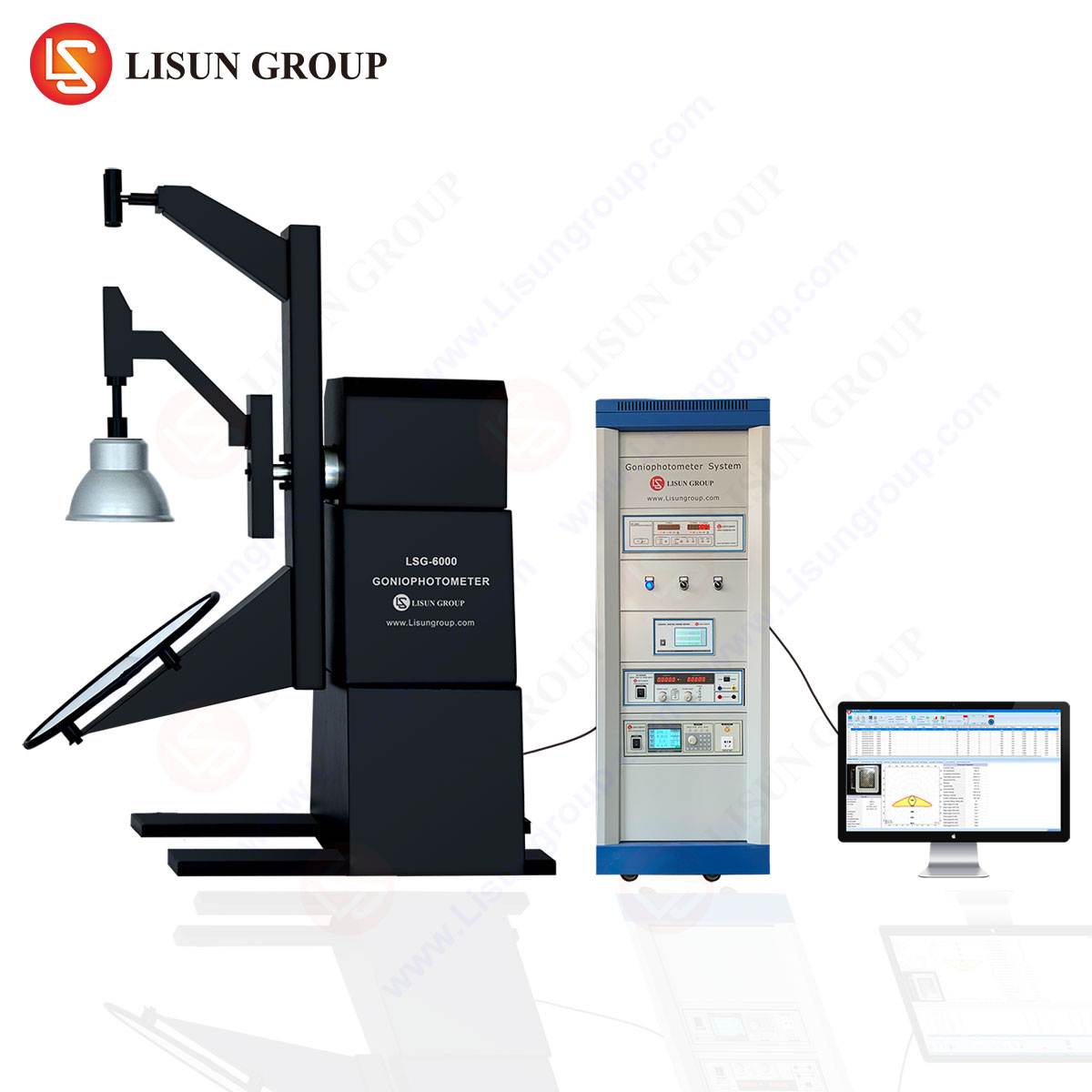
The LSG-6000 Moving Detector Goniophotometer exemplifies the Type C (moving detector) configuration, a design preferred for its high accuracy and versatility with large or complex luminaires. In this system, the luminaire under test (LUT) is mounted at the fixed center of rotation. A high-precision photometric detector, mounted on a mechanized arm, traverses a spherical path around the LUT, maintaining a constant measurement distance as defined by the inverse square law. The LSG-6000 utilizes a dual-axis robotic arm system, enabling continuous and precise positioning across the full 4π steradian solid angle. A reference photometer is often integrated to compensate for potential source flux instability during the extended measurement cycle. The core principle relies on measuring illuminance at a fixed radius and calculating luminous intensity (in candelas) for each angular coordinate pair. This data is then integrated over the entire sphere to compute total luminous flux. The Type C design minimizes errors associated with large luminaires that can perturb the optical field in closed integrating spheres and allows for the measurement of sources with significant heat output or unusual geometries without risk.
Technical Specifications and Capabilities of the LSG-6000 System
The LSG-6000 is engineered for high-precision, laboratory-grade measurements. Its specifications define its application scope and compliance with stringent international standards.
- Measurement Geometry: Type C (moving detector), full 4π steradian measurement capability.
- Measurement Distance: Variable, typically 5m, 8m, or longer, user-configurable to meet specific standard requirements (e.g., IES LM-79-19).
- Angular Resolution: ≤ 0.1° in both horizontal and vertical axes, enabling the capture of fine details in narrow-beam distributions critical for spotlighting or optical component analysis.
- Luminous Intensity Range: 0.001 cd to 2,000,000 cd, accommodating everything from low-level indicator LEDs to high-power stadium floodlights.
- Luminous Flux Accuracy: Superior to ±3% (for standard lamps), traceable to NIST, NPL, or other national metrology institutes.
- Detector System: Utilizes a class L (or better) photometer head with V(λ) correction matching the CIE standard observer function to within f1′ < 3%.
- Supported Standards: The system is designed to comply fully with IEC 60598-1, IEC 60529 (IP testing integration), IESNA LM-79-19, LM-75, EN 13032-1, CIE 70, CIE 121, and ANSI C78.379, among others.
- Automation: Fully automated measurement sequences with software-controlled positioning, data acquisition, and real-time 3D visualization.
Industry Applications and Standards Compliance
Goniophotometric data is the universal language for lighting performance, with specific applications dictated by industry verticals and their governing standards.
-
Lighting Industry & LED/OLED Manufacturing: Compliance with IEC 60598-1 and regional standards like UL 1598 (USA) or AS/NZS 60598 (Australasia) mandates precise photometric safety and performance data. For solid-state lighting, IES LM-79-19 is the essential standard for electrical and photometric measurements of LED products. Manufacturers use goniophotometer data to validate product datasheets, perform binning for color and flux consistency, and design secondary optics. In OLED manufacturing, the near-Lambertian but spatially variable emission profile requires goniophotometry for accurate efficacy calculation and uniformity assessment.
-
Display Equipment Testing: The evaluation of backlight units (BLUs) for LCDs or direct-view LED signage requires analysis of angular luminance uniformity and viewing cone characteristics. Goniophotometry helps quantify contrast ratio degradation at off-axis angles and validates compliance with display-specific standards.
-
Photovoltaic Industry: While primarily for light emission, goniophotometers are adapted to measure the angular responsivity of photovoltaic cells and modules. Understanding the acceptance angle and spatial response to diffuse versus direct light is critical for predicting energy yield in real-world installations.
-
Optical Instrument R&D and Scientific Research: The development of lenses, reflectors, diffusers, and light guides relies on iterative prototyping and verification. Goniophotometry provides the feedback loop to compare simulated optical models (e.g., from Ray Tracing software) with physical samples, accelerating the R&D cycle. In research laboratories, it is used to characterize novel light-emitting materials, biological photonic structures, or experimental light sources.
-
Urban Lighting Design and Medical Lighting Equipment: For urban lighting, standards such as ANSI/IES RP-8-23 for roadway lighting or EN 13201 require detailed intensity distributions to model illuminance and luminance on streets, ensuring safety, uniformity, and minimizing light pollution. In medical lighting, surgical luminaires must comply with stringent standards like IEC 60601-2-41, which specifies depth of illumination, field diameter, and shadow dilution—all parameters derived from goniophotometric measurements.
-
Stage and Studio Lighting & Sensor Production: Theatrical and film lighting fixtures are defined by their beam angles, field angles, and throw distances. Goniophotometry generates the IES or LDT files used in pre-visualization software (e.g., CAST Software WYSIWYG) to accurately plan lighting setups. For sensor and optical component producers, measuring the angular sensitivity of ambient light sensors or the spatial emission pattern of infrared LEDs for LiDAR is a standard quality control procedure.
Analysis of Derived Photometric Quantities and Data Outputs
The raw candela array from a goniophotometer is processed to generate a suite of critical performance metrics and standardized files.
- Luminous Intensity Distribution Curve (CIDC): A polar plot depicting intensity as a function of angle in a principal plane (e.g., 0°, 90°). This is the most direct visualization of the beam shape.
- Isocandela Diagram: A contour map plotted on a spherical projection (often a Lambertian grid), connecting points of equal luminous intensity. This provides a comprehensive 2D representation of the 3D distribution.
- Zonal Lumen Summary: This table divides the total flux into zones (e.g., every 10° cone). It is vital for calculating utilization factors in lighting design software and understanding energy distribution. For example, a streetlight should have minimal flux in the 90-180° zone (towards the sky) to reduce light trespass and pollution.
- Beam Angle and Field Angle: Defined as the angles where intensity falls to 50% and 10% of the maximum central candela, respectively. These are key specifications for directional lighting.
- Output Files: Standardized file formats enable interoperability. The IESNA LM-63 (IES) file format is the industry standard in North America for importing luminaire data into design software like Dialux or AGi32. The European standard is the EULUMDAT (LDT) format. The LSG-6000 software natively exports both.
Comparative Advantages of Robotic Moving-Detector Architecture
The LSG-6000’s moving-detector design confers several distinct advantages over alternative Type A (moving luminaire) or integrating sphere methods, particularly for the industries listed.
- Measurement Fidelity for Large/Heavy Luminaires: The LUT remains stationary, eliminating gravitational effects on the light source’s position or thermal convection patterns. This is crucial for testing large high-bay industrial fixtures, streetlights, or automotive headlamps.
- Uncompromised Thermal Management: Stationary mounting allows the luminaire to operate in its intended thermal state, often with active cooling or heat sinking if necessary. This ensures the photometric data reflects real operating temperatures, a critical factor for LED performance.
- Flexibility for Ancillary Testing: The fixed center facilitates the integration of environmental chambers for temperature/humidity testing (per IEC 60068-2) or water spray apparatus for IP rating verification (IEC 60529) concurrent with photometry.
- Reduced Polarization and Spectral Errors: A single, high-quality detector with a defined spectral responsivity function is used for all measurements, ensuring consistency. In an integrating sphere, the coating’s spectral reflectance can introduce errors, especially for narrow-band LED sources.
Case Study: Validating Urban Luminaire Compliance with ANSI/IES RP-8-23
A practical application involves testing a new LED streetlight luminaire for compliance with ANSI/IES RP-23-23. The LSG-6000 would measure the luminaire at its operational temperature. The software would then generate the IES file. This file is imported into roadway design software, which places the luminaire in a virtual environment according to specified mounting height, spacing, and overhang. The software calculates performance metrics such as:
- Average Maintained Illuminance (Eh,avg)
- Uniformity Ratios (Eh,min / Eh,avg)
- Light Trespass (light falling beyond the roadway)
- Upward Light Ratio (ULR), a key metric for dark-sky initiatives
The goniophotometer data directly enables the designer to adjust the optical design or spacing to meet all regulatory requirements before physical installation, saving significant cost and time.
Conclusion
Goniophotometry remains an indispensable, rigorous science for the objective quantification of light distribution. The evolution from manual to fully automated, robotic systems like the LSG-6000 has enhanced accuracy, repeatability, and throughput. The data derived forms the critical link between product design, regulatory compliance, and effective application across a vast spectrum of industries—from ensuring the safety of a surgical procedure to optimizing the energy efficiency of a city’s infrastructure. As lighting technology continues to advance with increased intelligence and adaptive optics, the role of comprehensive goniophotometric analysis as the foundational verification tool will only become more pronounced.
Frequently Asked Questions (FAQ)
Q1: What is the primary difference between a Type A and a Type C goniophotometer, and when should I choose one over the other?
A Type A (moving luminaire) system rotates the light source itself while keeping the detector fixed. It is often more compact but can be unsuitable for heavy, bulky, or thermally sensitive luminaires where rotation may alter performance. A Type C (moving detector) system, like the LSG-6000, keeps the luminaire stationary and moves the detector around it. This is preferred for large fixtures (streetlights, high-bays), sources requiring external thermal management, or when performing concurrent environmental testing, as it maintains the luminaire’s operational orientation and thermal state.
Q2: Can a goniophotometer measure colorimetric spatial distribution, or is it only for photometry?
While traditional goniophotometers are equipped with photopic (V(λ)) detectors for intensity, advanced systems can be integrated with spectroradiometers. This configuration enables spatial color measurement, allowing for the generation of angular color uniformity data, Correlated Color Temperature (CCT) distribution, and chromaticity shift plots (du’v’). This is essential for applications like display backlighting, architectural lighting where color consistency is critical, and scientific research on color-mixed LED systems.
Q3: How does goniophotometer testing relate to and differ from integrating sphere testing for total luminous flux?
An integrating sphere provides a rapid, single-value measurement of total luminous flux by spatially integrating light through multiple internal reflections. A goniophotometer measures angular intensity and calculates flux through mathematical integration. The goniophotometer method is considered the primary reference method as it is less susceptible to errors from spatial responsivity of the sphere or spectral mismatches, especially for directional sources or those with unusual spectra. Spheres are faster for production line flux binning, while goniophotometers provide the complete spatial performance picture and higher absolute accuracy.
Q4: What preparation is required for a luminaire prior to goniophotometric testing?
The luminaire must be electrically and thermally stabilized. Per standards like IES LM-79, it should be operated at its rated voltage/power until its light output reaches a steady state (typically 30-60 minutes for LEDs). All external influences, such as ambient light and air currents in the darkroom, must be controlled. The luminaire should be mounted in its intended operational orientation (e.g., base-up, base-down) as specified for the test, and any protective glass or diffusers that are part of the final product must be in place.