


A Technical Guide to Selecting Precision Colorimetric Instrumentation
Introduction
In the quantification of light and color, the selection of appropriate measurement instrumentation is a foundational decision that directly impacts data integrity, process control, and compliance with stringent industry standards. While the term “colorimeter” is often used broadly, it is critical to distinguish between true filter-based colorimeters and more advanced spectroradiometers. This article provides a rigorous, application-driven framework for selecting the optimal device, with a focus on the technical specifications and principles that govern performance. We will examine the pivotal role of high-fidelity spectroradiometry, exemplified by instruments such as the LISUN LMS-6000 series, across a spectrum of advanced industrial and scientific domains.
Fundamental Distinctions: Colorimeters versus Spectroradiometers
The primary distinction lies in the underlying measurement principle. A traditional tristimulus colorimeter utilizes three or four optical filters designed to approximate the CIE standard observer color-matching functions. It provides direct readings of colorimetric values such as chromaticity coordinates (x, y, u’, v’), correlated color temperature (CCT), and illuminance. While suitable for basic quality control of sources with known, stable spectral power distributions (SPDs), its inherent limitation is spectral blindness; it cannot detect metamerism, where two sources with different SPDs appear identical under one illuminant but different under another.
A spectroradiometer, in contrast, measures the absolute spectral power distribution of a source across a defined wavelength range. By capturing the complete spectral data, it derives all photometric, radiometric, and colorimetric parameters through computational integration against the CIE functions. This provides unparalleled accuracy, enables spectral analysis for component analysis, and is the only method for evaluating metrics such as Color Rendering Index (CRI), TM-30 (Rf, Rg), and peak wavelength for narrowband emitters like LEDs. For any application requiring spectral fidelity, compliance with international standards, or research into material properties, a spectroradiometer is the necessary tool.
Core Technical Specifications Governing Device Selection
Evaluating an instrument requires a deep understanding of its specification sheet. Key parameters include:
- Wavelength Range: Must encompass all radiant energy of interest. For general lighting, 380-780nm is standard. For UV-A applications (e.g., curing, medical) or deep-red/NIR (e.g., horticulture, IR LEDs), ranges like 200-800nm or 350-1050nm are required.
- Wavelength Accuracy: The deviation of reported wavelength from the true value, typically within ±0.3nm for high-grade instruments. Critical for identifying precise peak emissions.
- Photometric Accuracy: The accuracy of derived photometric quantities (luminous flux, illuminance), often expressed as a percentage deviation from a NIST-traceable standard.
- Spectral Bandwidth (FWHM): The width of the instrument’s spectral response function. A narrower bandwidth (e.g., 2nm) provides higher spectral resolution, essential for measuring narrow peaks of laser diodes or OLED pixels, while a wider bandwidth (e.g., 5nm) offers higher signal-to-noise ratio for low-light measurements.
- Dynamic Range and Stray Light: The ability to measure very dim and very bright signals accurately. Low stray light specification is vital for measuring LEDs with deep spectral valleys or ensuring UV measurements are not contaminated by visible light.
- Cosine Corrector: A diffuser attachment that ensures the instrument’s angular response follows the cosine law, which is mandatory for accurate illuminance measurement under varied incident angles, as in lighting design evaluations.
- Communication and Software: Support for standardized protocols and comprehensive, certified software for data analysis, reporting, and adherence to standards such as CIE, IES, DIN, and ANSI.
The LISUN LMS-6000 Spectroradiometer: A Paradigm for Precision Measurement
The LISUN LMS-6000 series represents a class of high-performance array spectroradiometers designed to meet the exacting demands of modern photometric and colorimetric testing. Its design philosophy centers on laboratory-grade accuracy deployed in both controlled and industrial environments.
Testing Principle and Architecture: The LMS-6000 employs a high-precision concave grating and a scientific-grade CCD detector array. Incoming light, collected via an integrating sphere for luminous flux measurement or a cosine corrector for illuminance, is dispersed by the fixed grating onto the array. This design, without moving mechanical parts, enables rapid, robust, and repeatable full-spectrum capture. The system is calibrated for absolute spectral radiance or irradiance using NIST-traceable standards.
Key Specifications (Representative for LMS-6000 Series):
- Wavelength Range: 380-780nm (standard), with variants extending to 200-800nm or 350-1050nm.
- Wavelength Accuracy: ≤ ±0.3nm.
- Photometric Accuracy: ≤ ±3% (for standard illuminant A).
- Spectral Bandwidth: 2nm (Full Width at Half Maximum).
- Dynamic Range: 1:10,000.
- Stray Light: ≤ 0.1%.
- Cosine Corrector: F2 class, with angular response accuracy within ±3% at 80° incidence.
Industry-Specific Applications and Use Cases
Lighting Industry and LED/OLED Manufacturing: In LED binning, the LMS-6000’s high wavelength accuracy ensures precise chromaticity categorization per ANSI C78.377, minimizing color shift in final assemblies. For OLEDs, its high linearity and sensitivity at low light levels are crucial for characterizing efficiency and color uniformity across panels. It calculates all CRI indices (Ra, R1-R15), TM-30 metrics, and luminous efficacy of radiation (LER).
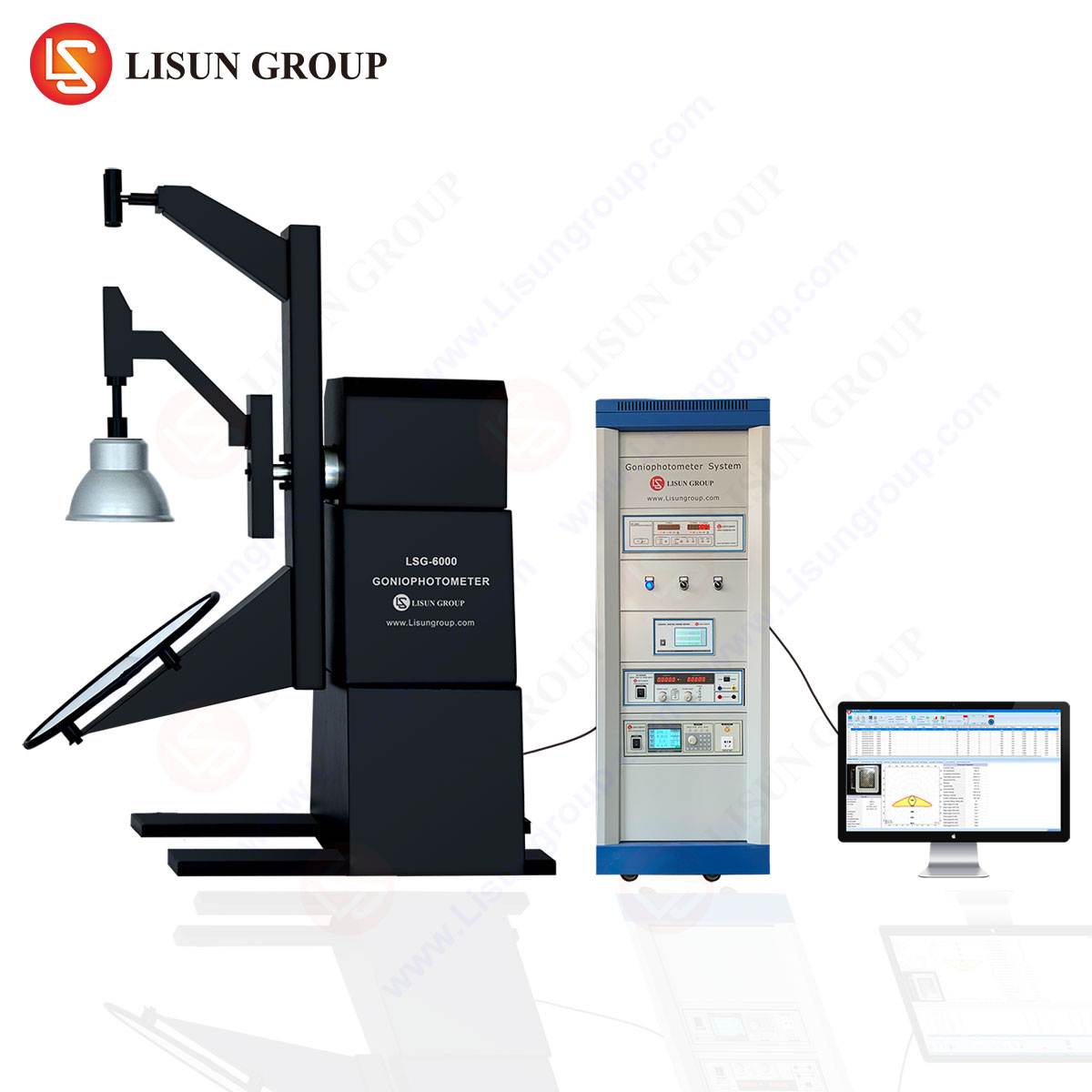
Automotive Lighting Testing: Compliance with ECE/SAE regulations requires precise measurements of luminous intensity (cd), chromaticity of signal lights, and glare. The LMS-6000, when coupled with a goniophotometer, provides the spectral data needed to validate the color coordinates of rear combination lamps and daytime running lights within the stringent boxes defined in standards.
Aerospace, Aviation, and Marine Navigation Lighting: These fields demand absolute reliability. The spectroradiometer verifies that anti-collision beacons, navigation lights, and cockpit displays meet RTCA/DO-160 or ICAO specifications for chromaticity and intensity, which are critical for safety. Its robust design can be adapted for environmental stress testing.
Display Equipment Testing: For LCD, OLED, and micro-LED displays, the instrument measures white point, color gamut (Rec.709, DCI-P3), uniformity, and flicker percentage. The high resolution allows analysis of sub-pixel emission spectra. In the Photovoltaic Industry, it is used to measure the spectral responsivity of solar cells and the SPD of solar simulators per IEC 60904-9, ensuring accurate efficiency ratings.
Optical Instrument R&D and Scientific Research: The device’s low stray light and broad wavelength variants (e.g., LMS-6000UV) facilitate research on UV curing kinetics, fluorescence excitation, and material reflectance/transmittance spectra. In Medical Lighting Equipment testing, it validates surgical light intensity and color rendering as per ISO 9680, and measures the UV output of dermatological treatment devices.
Urban, Stage, and Studio Lighting Design: Beyond verifying basic photometrics, the spectroradiometer enables complex analyses: evaluating the color impact of different streetlight SPDs on the perception of the built environment, or creating and profiling complex multi-channel LED stage lights to ensure consistent color mixing and reproduction under camera.
Competitive Advantages in Application Contexts
The operational advantages of a system like the LMS-6000 become evident in direct application. Its array-based design offers measurement speeds in the millisecond range, enabling real-time monitoring on a production line for 100% LED testing. The absence of moving parts translates to higher long-term repeatability and lower maintenance compared to scanning monochromator systems. The integrated, certified software suite not only automates testing protocols per relevant standards but also allows for deep spectral analysis, enabling engineers to diagnose issues—such as a phosphor deficiency in a white LED or a filter degradation in a signal light—by inspecting the raw SPD, a capability entirely absent in filter colorimeters.
Integrating Measurement Systems into Quality Assurance Workflows
Selecting the instrument is the first step; integrating it into a reproducible workflow is the second. This involves defining the correct measurement geometry (integrating sphere for total flux, collimating lens for luminance, cosine receptor for illuminance), ensuring regular calibration against traceable standards, and controlling environmental variables such as ambient light and temperature. Automated fixture and data handling systems, often controlled by the instrument’s software, are essential for high-throughput industrial applications like LED manufacturing or automotive lamp testing.
Conclusion
The choice between a colorimeter and a spectroradiometer is not merely one of cost but of fundamental technical capability. For applications demanding spectral accuracy, regulatory compliance, and deep diagnostic insight, the spectroradiometer is the unequivocal tool. Instruments engineered to the specifications of the LISUN LMS-6000 series provide the necessary precision, robustness, and analytical depth required across the advanced lighting, display, manufacturing, and scientific research sectors. Informed selection, based on a clear understanding of measurement principles and application requirements, ensures the acquisition of valid, reliable, and actionable data.
FAQ Section
Q1: Can the LMS-6000 series measure both the total luminous flux (in lumens) of an LED and the chromaticity of its emitted light?
Yes, absolutely. When connected to an integrating sphere, the LMS-6000 functions as a spectroradiometric system that captures the full spectral power distribution of the light source inside the sphere. From this SPD, it directly computes total luminous flux (in lumens) through integration, as well as all colorimetric data including chromaticity coordinates (x,y), CCT, and peak wavelength. This is the standard method for accurate LED photometric testing.
Q2: How does the instrument ensure accuracy when measuring sources with very narrow spectral peaks, such as laser diodes or monochromatic LEDs?
The LMS-6000’s combination of high wavelength accuracy (±0.3nm) and a narrow spectral bandwidth (2nm FWHM) is specifically designed for this task. The high wavelength accuracy ensures the reported peak position is correct, while the narrow bandwidth allows the instrument to resolve the sharp peak without artificially broadening it, leading to accurate measurements of dominant wavelength and spectral purity.
Q3: For automotive forward lighting testing, is the standard wavelength range (380-780nm) sufficient?
For most forward lighting (headlamps, fog lamps) where the output is in the visible spectrum, the standard range is sufficient for photometric and colorimetric compliance testing. However, if there is a need to characterize any near-infrared (NIR) components used in sensor-based systems (e.g., for adaptive driving beam systems), a variant with an extended range up to 1050nm would be required.
Q4: What is the significance of the “F2 class” cosine corrector, and when is it necessary?
An F2 class cosine corrector meets a specific accuracy standard (as per CIE and ISO guidelines) for its angular response. It is necessary for any measurement of illuminance (lux) where light may strike the detector at oblique angles, such as in workplace lighting assessments, architectural lighting simulations, or verifying the illumination distribution from a luminaire. It ensures the measurement correctly represents the light incident on a surface.
Q5: How often does the instrument require calibration, and what does the process entail?
Recommended calibration intervals are typically annual for maintaining optimal accuracy, though intensive industrial use may warrant more frequent checks. Calibration involves exposing the spectroradiometer to NIST-traceable standard lamps with known spectral output. The process generates correction coefficients that are applied to all subsequent measurements, ensuring traceability to international standards. The procedure is often supported and documented by the instrument’s software.