


A Technical Treatise on Selecting Color Temperature Measurement Instrumentation
Introduction
The precise quantification of color temperature and correlated color temperature (CCT) is a fundamental requirement across a diverse spectrum of scientific and industrial disciplines. As lighting technologies evolve from traditional incandescent sources to sophisticated solid-state lighting (SSL), including LEDs and OLEDs, and as applications become more demanding—from human-centric lighting to stringent automotive safety standards—the need for accurate, reliable, and application-specific measurement tools has intensified. A color temperature meter, often a subset of spectroradiometric capability, is no longer a simple photometric probe but a critical component in quality assurance, research validation, and regulatory compliance. This document provides a rigorous framework for selecting the appropriate color temperature measurement instrument, detailing technical considerations, application-specific demands, and the pivotal role of advanced spectroradiometers, with specific reference to the LISUN LMS-6000 series as a paradigm of modern measurement solutions.
Fundamental Principles of Color Temperature and Spectroradiometry
Color temperature, expressed in Kelvin (K), describes the chromaticity of a light source by comparing it to the radiation of an ideal black-body radiator. For sources whose chromaticity points do not lie directly on the Planckian locus, Correlated Color Temperature (CCT) is used, defined as the temperature of the black body whose perceived color most closely resembles that of the source. Accurate determination of CCT requires precise measurement of the source’s spectral power distribution (SPD).
The primary methodologies for this measurement are filtered photometers and spectroradiometers. Filtered photometers utilize a set of optical filters approximating the CIE standard observer functions to derive tristimulus values (X, Y, Z) and subsequently calculate chromaticity coordinates and CCT. While potentially cost-effective and fast, their accuracy is inherently limited by the filter mismatch error, especially when measuring narrow-band or discontinuous spectra common in LEDs, which can lead to significant measurement deviations.
Spectroradiometers, in contrast, measure the absolute spectral power distribution across a defined wavelength range. By dispersing light via a diffraction grating or prism and measuring intensity at discrete wavelengths, they construct a complete SPD. All photometric and colorimetric quantities, including CCT, color rendering index (CRI), and chromaticity coordinates (x, y or u’, v’), are then computed through direct integration against the CIE functions. This method provides superior accuracy, especially for non-traditional light sources, and yields a wealth of additional data from a single measurement.
Critical Technical Specifications for Instrument Evaluation
Selecting a meter necessitates a thorough analysis of its technical parameters against application requirements.
Spectral Range and Bandwidth: The instrument’s spectral range must encompass the entire emission profile of the source. For general lighting and display testing, a range of 380 nm to 780 nm is standard. However, applications involving UV-A components (e.g., medical therapy lighting, curing processes) require extension down to 300 nm or below, as offered by the LISUN LMS-6000UV. Conversely, near-infrared (NIR) sensitivity is crucial for photovoltaic industry testing, where the spectral responsivity of solar cells must be evaluated. The spectral bandwidth, or full width at half maximum (FWHM), determines wavelength resolution. A narrower bandwidth (e.g., ≤2 nm) is essential for characterizing narrow emission peaks of laser diodes or specific LED phosphors, whereas a broader bandwidth may suffice for integrated light measurements.
Photometric and Colorimetric Accuracy: Accuracy is paramount. Key metrics include chromaticity accuracy (Δx, Δy) and CCT accuracy. High-performance instruments achieve chromaticity accuracy within ±0.0015 (x, y) or better. This level of precision is mandated in display equipment testing for white point calibration and in LED manufacturing for binning consistency. Accuracy is contingent upon rigorous factory calibration traceable to national metrology institutes (NMIs) and characterized linearity across a wide dynamic range.
Dynamic Range and Stray Light Rejection: The ability to measure very dim and very bright sources without saturating the detector or losing signal in noise is defined by dynamic range, often expressed in orders of magnitude. Stray light rejection—the instrument’s ability to suppress signal from out-of-band wavelengths—is critical when measuring LEDs with dominant peaks, as stray light can artificially inflate values in spectral troughs, skewing colorimetric calculations.
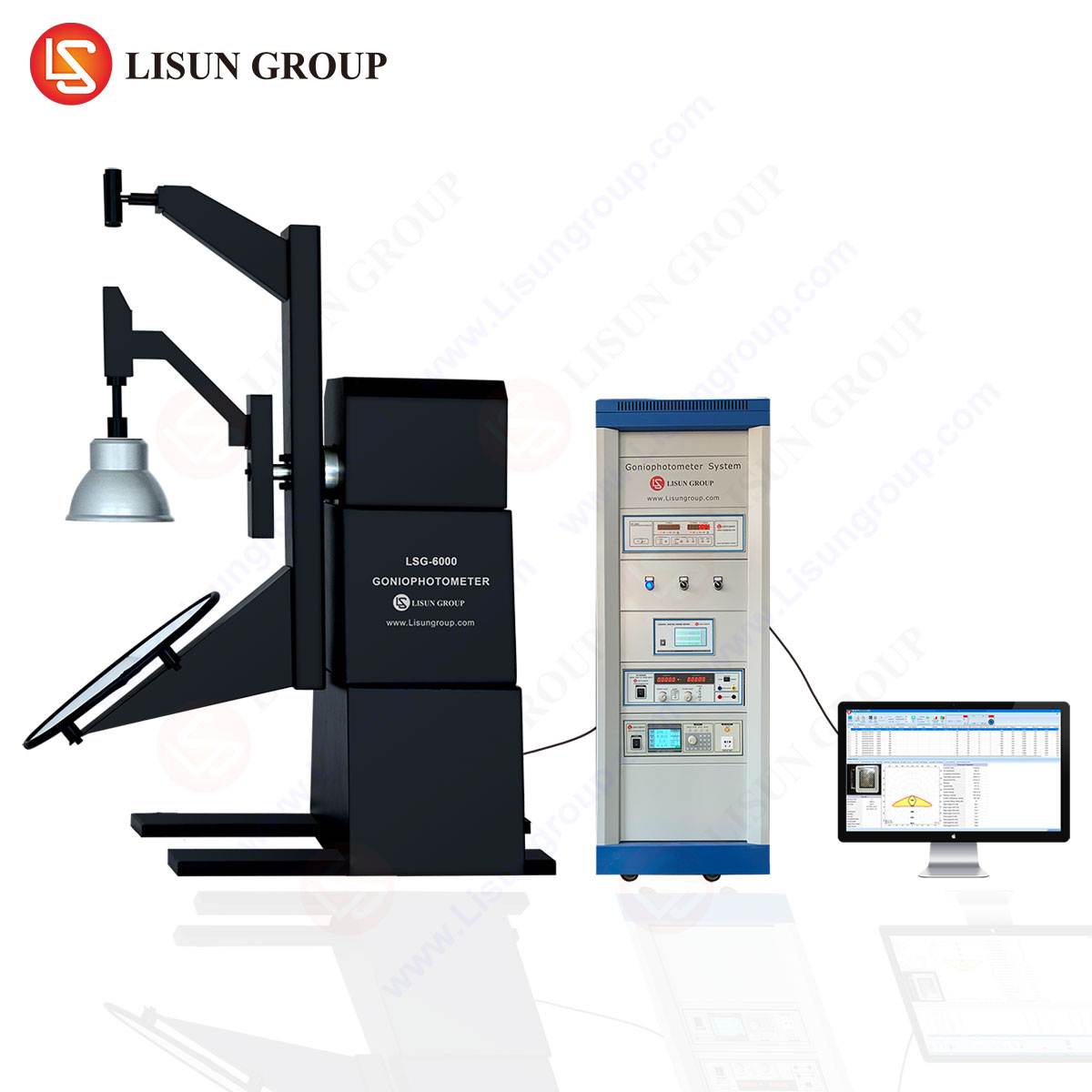
Optical Input Geometry and Accessories: The measurement geometry must conform to relevant standards. For luminance and display testing, a telescopic lens with a very small acceptance angle (e.g., 1° or 0.1°) is required to measure specific screen areas. For total luminous flux and colorimetry of integrated light sources, an integrating sphere coupled via an optical fiber is the standard apparatus, as defined by CIE 84 and IES LM-79. For directional measurements of intensity distributions, as in automotive headlamp or aviation navigation light testing, a goniophotometer system with a spectroradiometer as the detector is necessary.
The LISUN LMS-6000 Series: A Spectroradiometric Platform for Demanding Applications
The LISUN LMS-6000 series represents a comprehensive spectroradiometric platform engineered to meet the exacting requirements of modern industry and research. Each variant is optimized for specific measurement challenges while maintaining a core architecture of high accuracy and reliability.
Core Testing Principle and Architecture: The series employs a high-precision concave grating imaging optical system and a high-sensitivity linear CCD array detector. This design ensures low stray light and excellent wavelength reproducibility. The instruments perform rapid, full-spectrum scanning, capturing the complete SPD from which all photometric, colorimetric, and radiometric quantities are derived algorithmically, ensuring inherent consistency and eliminating filter mismatch error.
Model-Specific Differentiation and Industry Application:
- LMS-6000: The foundational model, offering a standard spectral range (typically 380-780nm) with high accuracy. It is suited for general lighting industry quality control, LED module testing, and scientific research laboratories conducting basic photometric studies.
- LMS-6000F: Optimized for high-speed, flicker analysis. With a significantly enhanced sampling rate, it can capture rapid temporal variations in light output. This is indispensable for the automotive lighting industry (PWM dimming analysis), stage and studio lighting (checking for beat frequencies with cameras), and evaluating the temporal light artifacts (TLAs) of LED drivers.
- LMS-6000S: Designed for high-sensitivity measurements of low-light-level sources. Its enhanced detector and electronics minimize noise, making it ideal for aerospace and aviation lighting testing (cockpit instrument panel illumination, emergency signage), marine navigation lighting (buoy lights, channel markers), and dark sky-compliant urban lighting design.
- LMS-6000P: Tailored for the photovoltaic industry. Its spectral range extends into the near-infrared (e.g., 300-1100nm), covering the critical response range of silicon and other PV cells. It is used to measure the spectral irradiance of solar simulators per IEC 60904-9 and to characterize the spectral responsivity of PV modules.
- LMS-6000UV: Incorporates enhanced UV response. This model is critical for applications involving ultraviolet radiation, such as testing medical lighting equipment for phototherapy (treating jaundice or skin conditions), validating UV curing systems in manufacturing, and monitoring UV content in specialty light sources for scientific research.
- LMS-6000SF: A specialized fusion of high sensitivity and high-speed capabilities. This model addresses niche applications requiring both low-noise measurement of faint signals and the ability to resolve fast events, potentially useful in advanced optical instrument R&D or specific scientific experiments involving pulsed light sources.
Competitive Advantages in Application Contexts:
- LED & OLED Manufacturing: The high chromaticity accuracy ensures precise binning, reducing waste and improving product consistency. The ability to measure CCT, CRI (R1-R15), and peak wavelength with repeatability is vital for production line quality assurance.
- Automotive Lighting Testing: Beyond static color, the LMS-6000F can analyze dynamic signaling functions (turn signals, brake lights) for compliance with UNECE and SAE standards. It can also measure the chromaticity of headlamps across their beam pattern when integrated with a goniophotometer.
- Display Equipment Testing: Used with a narrow-angle lens, it can validate the white point, color gamut, and uniformity of LCD, OLED, and micro-LED displays against standards like ISO 14861 or Electronic Industries Alliance (EIA) protocols.
- Aerospace and Aviation: The sensitivity of the LMS-6000S allows for verification that cockpit lighting meets RTCA/DO-275 requirements for luminance and color, ensuring pilot readability without night vision imaging system (NVIS) interference.
- Scientific Research Laboratories: The platform’s traceable calibration and software development kit (SDK) support custom research, from studying the non-visual effects of light (melanopic ratio) to characterizing novel material luminescence.
Integration with Standardized Testing Systems
A spectroradiometer is rarely used in isolation. Its value is amplified when integrated into standardized test systems. The LMS-6000 series is designed as the core detector for such systems:
- Integrating Sphere Systems: For total luminous flux, radiant flux, and spatial color uniformity measurements (IES LM-79).
- Goniophotometer Systems: For far-field intensity distributions, beam patterns, and spatial colorimetry of directional luminaires (IES LM-75, CIE 121).
- Distribution Luminance & Colorimeters: For near-field luminance and color mapping of displays and light sources with complex emission patterns.
Selection Algorithm: Matching Instrument to Application
The selection process can be distilled into a decision matrix based on primary application drivers:
- Define the Primary Measurand: Is the focus solely on CCT, or are full spectral data, CRI, flicker, or UV/NIR components required?
- Identify the Source Type: Consider the spectral characteristics (broad-spectrum, narrow-band, discontinuous), intensity range (nits, lux, or watts per steradian), and temporal behavior (steady-state, pulsed, modulated).
- Determine the Measurement Geometry: Point-in-space irradiance? Luminance of a small area? Total flux from an integrating sphere?
- Reference Governing Standards: Compliance with IES, CIE, ISO, IEC, SAE, or DIN standards will dictate required accuracy levels, measurement conditions, and reporting formats.
- Evaluate Operational Environment: Will the instrument be used on a stable laboratory bench, a production floor, or in the field? Considerations of portability, ruggedness, and thermal stability become relevant.
Conclusion
The selection of a color temperature meter is a critical technical decision with direct implications for product quality, research validity, and regulatory compliance. While filtered photometers may suffice for limited applications with traditional sources, the complexity and diversity of modern lighting demand the accuracy and versatility of spectroradiometry. Instruments like the LISUN LMS-6000 series, with their model-specific optimizations for speed, sensitivity, and spectral range, provide a future-proof platform capable of addressing the multifaceted challenges presented by industries ranging from automotive safety and medical therapy to aerospace and advanced scientific research. A methodical evaluation of technical specifications against defined application requirements ensures the selection of an instrument that delivers not only data, but trustworthy and actionable insight.
Frequently Asked Questions (FAQ)
Q1: What is the primary advantage of using a spectroradiometer like the LMS-6000 over a traditional color temperature meter with filters?
A1: The primary advantage is the elimination of filter mismatch error. Traditional meters rely on filters that approximate the human eye response and can produce significant inaccuracies when measuring the discontinuous spectra of LEDs or other solid-state sources. A spectroradiometer measures the complete spectral power distribution directly, calculating all colorimetric data mathematically with far greater accuracy and consistency across diverse source types.
Q2: For testing automotive interior lighting and switches, which model would be most appropriate and why?
A2: The LMS-6000S (High-Sensitivity) model is often most appropriate. Automotive interior lighting, such as instrument cluster backlighting or switch illumination, is typically of very low luminance to ensure driver comfort at night. The high-sensitivity detector of the LMS-6000S provides a superior signal-to-noise ratio at these low light levels, enabling accurate and repeatable measurements of chromaticity and luminance as per relevant SAE and OEM specifications.
Q3: Can the LMS-6000P be used for general lighting color quality testing in addition to photovoltaic work?
A3: Yes, the LMS-6000P is fully capable of all standard photometric and colorimetric measurements. Its extended near-infrared (NIR) range does not impede its performance within the visible spectrum (380-780nm). It can accurately measure CCT, CRI, luminous flux, and chromaticity coordinates, making it a versatile instrument for laboratories that work across both lighting and photovoltaic applications.
Q4: How is the instrument calibrated, and what is the recommended recalibration interval?
A4: The LMS-6000 series is factory-calibrated using standard lamps traceable to national metrology institutes (NMIs). The calibration covers wavelength accuracy, photometric linearity, and absolute spectral responsivity. To maintain specified accuracy, an annual recalibration cycle is generally recommended, though the interval may be adjusted based on usage intensity, environmental conditions, and internal quality control requirements.