







A Comprehensive Framework for Lux Level Compliance: Principles, Methodologies, and Instrumentation
Introduction
Achieving and verifying compliance with specified lux levels is a fundamental requirement across a diverse spectrum of industries, from architectural lighting design to the manufacture of safety-critical automotive and aerospace illumination systems. Lux, the SI unit of illuminance, quantifies the luminous flux incident on a surface per unit area. Precise measurement and control of this parameter are not merely matters of regulatory adherence but are critical to ensuring visual performance, energy efficiency, safety, and product quality. This document outlines a rigorous set of best practices for lux level compliance, emphasizing the transition from basic photometric measurement to spectrally resolved radiometric analysis. It details the methodologies, standards, and advanced instrumentation necessary to establish a robust compliance framework, with particular focus on the role of high-precision spectroradiometry as exemplified by the LISUN LMS-6000 series of instruments.
Foundational Principles of Photometric and Radiometric Quantities
The accurate assessment of lux levels is predicated on a clear understanding of the relationship between radiometric and photometric quantities. Radiometry measures optical radiation in terms of absolute power (watts), while photometry weights this radiation according to the spectral sensitivity of the human eye, as defined by the CIE standard photopic luminosity function, V(λ). Illuminance (Ev, in lux) is calculated by integrating the spectral irradiance (Ee,λ in W/m²/nm) over wavelength, weighted by the V(λ) function and the maximum luminous efficacy constant (Km = 683 lm/W).
The formula is expressed as:
Ev = Km ∫ Ee,λ * V(λ) dλ
This fundamental relationship underscores a critical limitation of traditional lux meters, which utilize filtered silicon photodiodes to approximate the V(λ) function. Even high-quality filters exhibit mismatches, leading to errors, particularly when measuring light sources with discontinuous or narrowband spectra, such as Light-Emitting Diodes (LEDs), OLEDs, or laser-based systems. Consequently, best practices for compliance in technologically advanced applications mandate a shift towards spectroradiometric measurement, which captures the full spectral power distribution (SPD) of the source, enabling mathematically perfect photopic weighting and the derivation of a multitude of other photometric and colorimetric parameters.
Establishing a Traceable Measurement Hierarchy
Compliance verification must be rooted in metrological traceability to national or international standards. A hierarchical calibration chain should be established. At its apex are primary standards maintained by National Metrology Institutes (NMIs), such as cryogenic radiometers. These calibrate reference-grade spectroradiometers or standard lamps. Secondary calibration laboratories then use these references to calibrate working standard instruments, which in turn are used to calibrate field measurement devices like the LISUN LMS-6000 series spectroradiometers.
For lux level compliance, the spectroradiometer itself must be calibrated for absolute spectral irradiance using a NMI-traceable standard lamp within a defined uncertainty budget. Regular recalibration intervals, dictated by use frequency and environmental conditions, are mandatory. Furthermore, the geometric configuration of the measurement—the distance, alignment, and field of view—must be strictly controlled and documented, referencing standards such as CIE 70, “The Measurement of Absolute Luminous Intensity Distributions,” or IES LM-79, “Electrical and Photometric Measurements of Solid-State Lighting Products.”
Critical Environmental and Geometric Control Factors
The measured lux level is profoundly influenced by non-instrumental variables. A controlled laboratory environment is ideal for product qualification. Stray light must be minimized through the use of black baffles, shrouds, and non-reflective surfaces. Ambient temperature should be stabilized, as LED output and detector sensitivity are temperature-dependent. For field measurements, such as in urban lighting design or marine navigation light verification, time of day (for natural light exclusion), atmospheric conditions, and reflective surfaces must be accounted for in the compliance report.
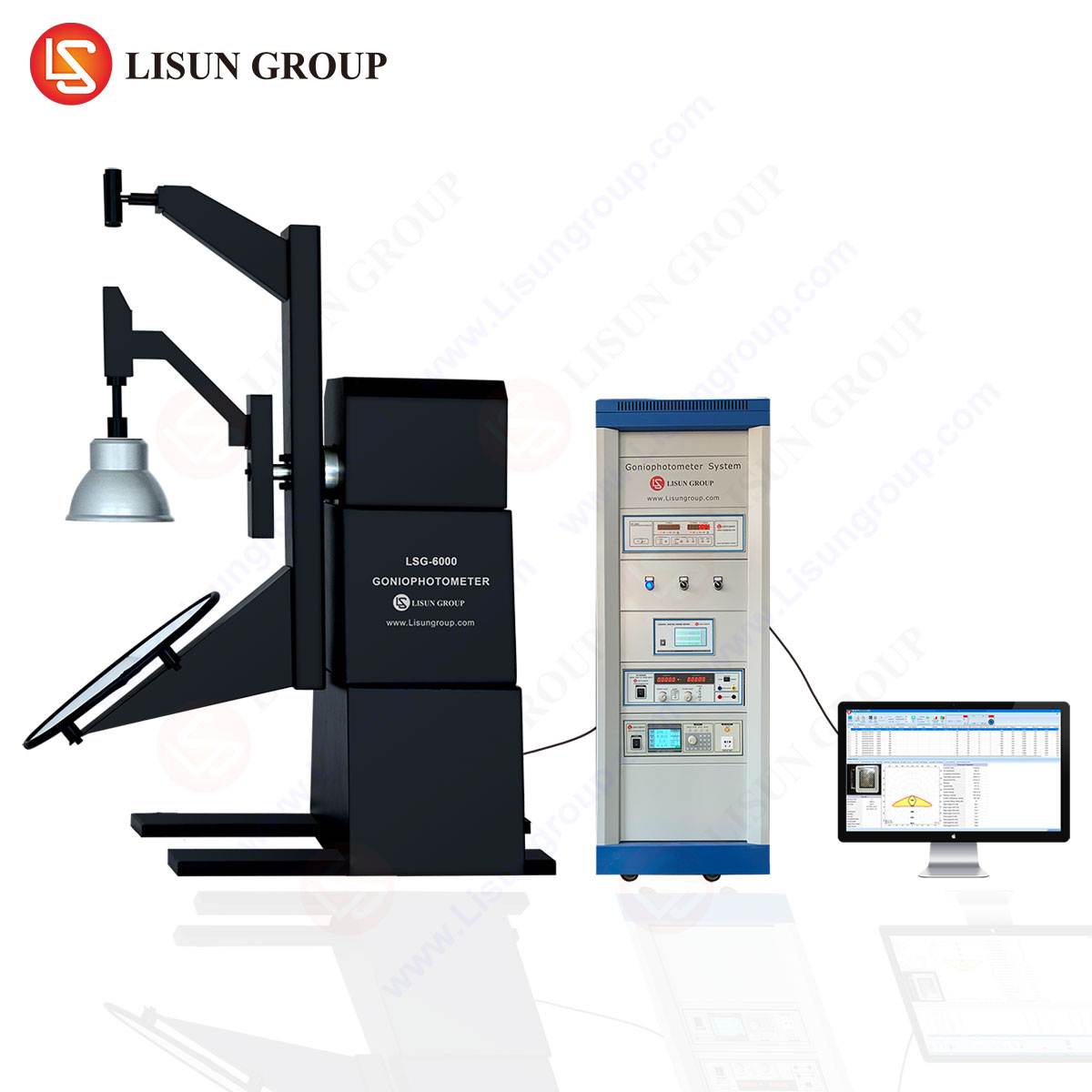
Geometric accuracy is paramount. The detector must be positioned precisely at the plane of interest, often using a optical bench or a purpose-built goniophotometer for spatial distribution measurements. The cosine correction of the input optic—its ability to respond accurately to light incident at oblique angles—must be verified. For applications like automotive headlamp testing (e.g., per SAE J1383 or ECE regulations) or aviation runway light certification (per ICAO Annex 14), the angular positioning of the detector relative to the source is specified to within fractions of a degree.
The Indispensable Role of High-Fidelity Spectroradiometry
Given the spectral diversity of modern light sources, spectroradiometers have transitioned from specialized tools to essential instruments for definitive compliance testing. A device such as the LISUN LMS-6000 series spectroradiometer operates on the principle of diffraction grating spectrometry. Incoming light is collected via an integrating sphere or cosine-corrected input optic, directed through an entrance slit, dispersed by a diffraction grating, and projected onto a high-sensitivity CCD or photodiode array detector. This allows for the simultaneous capture of the entire SPD across its operational wavelength range (e.g., 350-800nm for the LMS-6000S).
The specifications of the instrument directly dictate measurement validity. Key parameters include:
- Wavelength Accuracy: Typically ≤ ±0.3nm, ensuring correct spectral alignment.
- Photometric Linear Dynamic Range: Exceeding 1:10,000 to measure both very low and very high illuminance without range switching errors.
- Stray Light Level: A critical specification, defined as <0.05%, to prevent signal from one wavelength from contaminating the reading at another.
- Cosine Corrector Fidelity: Angular response error should be within ±2% for angles up to 80°, as per CIE 177.
For the LISUN LMS-6000SF model, which incorporates a high-performance back-thinned CCD, the benefits are particularly evident in low-light applications such as photobiological safety testing (IEC 62471), night vision-compatible lighting for aerospace cockpits, or the assessment of emergency and marine navigation lighting. Its enhanced signal-to-noise ratio in the 350-1000nm range allows for confident compliance decisions even at threshold illuminance levels.
Industry-Specific Application Protocols
The implementation of lux compliance best practices varies significantly by sector.
-
LED & OLED Manufacturing and Display Testing: Here, consistency is key. The LMS-6000P, with its pulsed light measurement capability, is engineered for testing pulse-width modulated (PWM) LED drivers and OLED displays. It captures accurate SPD and lux readings from transient signals, ensuring compliance with flicker metrics (IEEE PAR1789) and temporal stability requirements. In display equipment testing, measuring illuminance uniformity (lux variation across a screen surface) with a spectroradiometer paired with a motorized stage is standard practice.
-
Automotive and Aerospace Lighting: Compliance is safety-critical. Testing involves not just peak lux at a point, but the complete luminous intensity distribution. A spectroradiometer mounted on a goniophotometer measures illuminance at hundreds of angular positions to build an iso-lux diagram, verifying compliance with stringent regulatory photometric patterns for headlamps, signal lights, and aircraft anti-collision beacons. The LMS-6000F, with its fast scanning speed, facilitates high-throughput production line testing in these industries.
-
Photovoltaic and Optical Instrument R&D: While focused on irradiance (W/m²), spectroradiometers like the LMS-6000UV (extending into ultraviolet) are used to characterize solar simulators per ASTM E927, where the required spatial uniformity of irradiance (often expressed in lux for certain classes) is a critical compliance metric. In optical instrument calibration, a stable, spectrally characterized light source with known lux output is essential.
-
Urban, Medical, and Stage Lighting: Designers and engineers must balance performance with standards. Urban lighting must comply with CIE, IES, or national standards (e.g., EN 13201) for roadways and public spaces, requiring in-situ lux measurements. Medical lighting for surgical suites (ISO 9680) mandates specific illuminance levels and color rendering properties, derived from spectral data. Stage and studio lighting relies on spectroradiometers to match lights for color temperature and intensity, ensuring consistent lux levels across a set as captured by cameras.
Data Integrity, Reporting, and Continuous Validation
A compliance measurement is only as credible as its documentation. Every test report must include, as a minimum: instrument identification and calibration certificate details; environmental conditions (temperature, humidity); geometric setup diagram; measurement uncertainty budget; raw and processed spectral data; and the final lux value with associated uncertainty. Automated software, such as that provided with the LISUN LMS-6000 series, which directly references CIE and other standard observer functions, minimizes calculation errors.
A regime of continuous validation is a best practice. This includes regular performance checks using stable, internal or external reference sources to monitor instrument drift. Participation in inter-laboratory comparisons or proficiency testing schemes provides an external benchmark for measurement accuracy and reinforces the integrity of the compliance framework.
Conclusion
Lux level compliance has evolved from a simple meter reading to a sophisticated, traceable, and data-intensive process. The spectral shift in lighting technology necessitates a commensurate shift in measurement technology. Adherence to the best practices outlined—grounded in fundamental photometric principles, enforced through rigorous calibration and geometric control, and executed with high-fidelity spectroradiometers like the LISUN LMS-6000 series—provides the only defensible foundation for compliance across the lighting, manufacturing, automotive, aerospace, and scientific research industries. By capturing the complete spectral signature of a source, these instruments transform lux compliance from a point-in-time check into a comprehensive, future-proofed quality assurance protocol.
FAQ Section
Q1: What is the primary advantage of using a spectroradiometer like the LMS-6000S over a high-quality lux meter for compliance testing?
A1: A traditional lux meter uses a physical filter to approximate the human eye’s sensitivity (V(λ) function), which can lead to significant errors when measuring non-continuous spectra like those from LEDs or narrowband sources. A spectroradiometer measures the complete spectral power distribution (SPD). It then calculates lux mathematically by applying the perfect digital V(λ) function to the SPD, eliminating filter mismatch error and providing inherently accurate photometric data for any light source type.
Q2: For testing pulse-width modulated (PWM) automotive interior lights or LED displays, which instrument specification is most critical?
A2: The ability to accurately capture the transient light output is paramount. A standard spectroradiometer with a long integration time will average the signal, yielding an incorrect lux reading. The LISUN LMS-6000P model is specifically designed with pulsed light measurement technology, featuring ultra-short integration times (down to microseconds) and precise synchronization to capture the true peak and temporal characteristics of the pulsed emission, which is essential for flicker analysis and dynamic contrast compliance.
Q3: In a production environment for LED module testing, speed is essential. Can a spectroradiometer provide the necessary throughput?
A3: Yes, models like the LISUN LMS-6000F are engineered for high-speed testing. Utilizing a high-sensitivity array detector and optimized data processing algorithms, it can perform a full spectral scan and compute lux, chromaticity, and other parameters in milliseconds. This makes it suitable for integration into automated production lines for 100% inspection or high-frequency sampling without becoming a bottleneck.
Q4: How does the LMS-6000SF’s back-thinned CCD detector benefit low-light compliance testing, such as for aviation panel lighting or emergency exit signs?
A4: A back-thinned CCD has a significantly higher quantum efficiency (particularly in the UV and near-infrared) and lower noise compared to conventional front-illuminated detectors. This results in a superior signal-to-noise ratio (SNR) when measuring very low illuminance levels. For safety-critical applications where lux thresholds are defined at minimal values—ensuring visibility without causing glare or night vision adaptation issues—the enhanced SNR of the LMS-6000SF provides the measurement confidence required for definitive compliance judgment.
Q5: When performing in-situ compliance checks for a street lighting installation, what are the key steps to ensure measurement validity?
A5: Key steps include: 1) Using a spectroradiometer with a high-fidelity cosine corrector to account for light incident from all angles. 2) Conducting measurements during night-time hours to eliminate ambient daylight. 3) Documenting the exact measurement point (e.g., on the roadway grid) as per the relevant standard (e.g., EN 13201). 4) Allowing the lights to stabilize at operating temperature. 5) Verifying the instrument’s calibration with a portable standard source before and after the survey. 6) Recording environmental conditions and any potential light obstructions.