





Advancements in Photometric Characterization Through Automated Goniophotometry
Abstract
The precise measurement of spatial light distribution is a critical requirement across numerous industries, from solid-state lighting to optical engineering. Traditional manual goniophotometry, while foundational, is constrained by significant limitations in measurement duration, repeatability, and data resolution. The advent of fully automated goniophotometry systems represents a paradigm shift, enabling comprehensive and accurate luminous intensity distribution analysis with unprecedented efficiency. This article delineates the technical benefits of automated goniophotometry, with a specific examination of the LISUN LSG-6000 system, its operational principles, compliance with international standards, and its transformative impact on diverse industrial and research applications.
Fundamental Principles of Goniophotometric Measurement
Goniophotometry is the science of measuring the angular distribution of light emitted from a source, known as its luminous intensity distribution. The core principle involves rotating a photodetector around a fixed light source, or vice versa, across two orthogonal axes: the vertical (C-axis, or gamma angle) and the horizontal (γ-axis, or C-plane). By systematically capturing luminous flux measurements at discrete angular increments, a three-dimensional representation of the source’s photometric performance is constructed. This data set, often referred to as the luminous intensity distribution curve, is fundamental for deriving key photometric parameters, including total luminous flux (lumens), beam angle, zonal lumen distribution, and luminance. The accuracy and utility of this data are entirely dependent on the precision of the angular positioning, the stability of the light source, and the calibration of the detector. Automated systems refine this process by integrating computer-controlled stepper motors, real-time data acquisition hardware, and sophisticated software algorithms to execute complex measurement sequences without manual intervention, thereby eliminating human error and drastically reducing acquisition time.
Quantitative Enhancements in Measurement Throughput and Operational Efficiency
The transition from manual to automated goniophotometry yields a direct and substantial improvement in operational efficiency. A comprehensive photometric test that might require several hours of meticulous manual operation can be completed in a matter of minutes with an automated system. This acceleration is primarily attributable to the high-speed, coordinated movement of the robotic positioning arms and the instantaneous logging of data points. For high-volume production environments, such as LED & OLED manufacturing facilities, this throughput is not merely a convenience but a critical production metric. The ability to perform 100% quality control on finished luminaires, or to characterize a new LED module design across multiple drive currents and thermal conditions within a single work shift, directly translates to faster time-to-market and reduced labor costs. The LISUN LSG-6000, for instance, employs a fully automated dual-axis rotation mechanism with a maximum angular speed that allows for rapid scanning of the full 4π steradian solid angle. This system’s architecture is designed for continuous operation in laboratory and production settings, enabling the unattended testing of multiple luminaires through batch processing scripts.
Elimination of Anthropogenic Error and Assurance of Data Integrity
Human operators introduce inherent variability into measurement processes. In manual goniophotometry, inconsistencies in angular positioning, timing of readings, and data transcription can lead to significant discrepancies between tests, even on the same device under test (DUT). Automated goniophotometry systems eradicate these sources of error. The angular positioning is dictated by high-resolution encoders with arc-minute accuracy, ensuring that each measurement corresponds precisely to its intended coordinate. The synchronization between the detector’s data stream and the goniometer’s position is handled digitally, with timestamps controlled by the system’s master clock. This level of control ensures that the data integrity is maintained throughout the entire measurement cycle. For scientific research laboratories and optical instrument R&D departments, this reproducibility is paramount. When validating a new optical design for a medical lighting device, such as a surgical light, the data must be unequivocally reliable and repeatable to meet stringent regulatory submissions. The LSG-6000’s software architecture logs all system parameters, including ambient temperature and power supply stability, providing a complete audit trail for each test.
High-Resolution Angular Mapping for Sophisticated Optical Analysis
The capabilities of automated systems extend beyond speed and accuracy to the granularity of data acquisition. Manual methods are inherently limited to a coarse angular grid due to practical time constraints. Automated goniophotometers can be programmed to capture data at very fine angular increments—often as small as 0.1°—creating a high-resolution map of the luminous intensity distribution. This high-density data set is indispensable for analyzing complex optical systems. In the display equipment testing industry, for example, characterizing the viewing angle performance of an OLED panel requires detecting subtle changes in luminance and color uniformity that occur over very small angular ranges. Similarly, in the production of sensors and optical components, such as Fresnel lenses or light guides, a high-resolution goniometric scan can reveal microscopic defects or imperfections in the optical surface that would be invisible with a coarser measurement grid. The LSG-6000 supports user-definable measurement plans, allowing engineers to specify dense measurement grids in critical angular regions (e.g., within the main beam) and sparser grids in less critical areas, optimizing the balance between data resolution and test duration.
Integration with Spectral and Colorimetric Radiometry
Modern lighting applications demand more than just photometric data; color quality, consistency, and spectral power distribution are equally critical performance indicators. Advanced automated goniophotometry systems can be equipped with array spectroradiometers, transforming them into versatile spectrogoniophotometers. This integration allows for the simultaneous measurement of photometric quantities (luminous intensity, illuminance) and spectroradiometric quantities (chromaticity coordinates, correlated color temperature – CCT, Color Rendering Index – CRI, and spectral flux) as a function of angle. This capability is essential for the development of high-quality LED products, where angular color shift—a variation in CCT or chromaticity across the beam—is a common challenge. In urban lighting design, understanding the spectral distribution of a streetlamp at different angles is crucial for predicting its environmental impact, such as skyglow and effects on wildlife. The LISUN LSG-6000 system is designed with modularity in mind, allowing for seamless integration with high-precision spectroradiometers from manufacturers like Instrument Systems or Photo Research, enabling it to comply with standards such as IESNA LM-79 and IEC 62612, which prescribe methods for testing LED lamps and modules.
Adherence to Global Photometric and Safety Standards
The commercialization of lighting products in international markets necessitates compliance with a complex framework of technical and safety standards. Automated goniophotometers are engineered to perform tests in strict accordance with these protocols. Key international standards referenced in product verification include:
- IEC 60598-1: Luminaires – General requirements and tests.
- IESNA LM-79: Electrical and Photometric Measurements of Solid-State Lighting Products.
- ANSI C78.377: Specifications for the Chromaticity of Solid-State Lighting Products.
- DIN 5032-7: Photometric measurements – Part 7: Conditions of measurement for light sources and luminaires.
- CIE 70: The Measurement of Absolute Luminous Intensity Distributions.
The LISUN LSG-6000 is explicitly designed to meet the requirements of these and other national standards. Its software includes pre-configured test routines for common standards, automating the specific measurement geometries, data processing, and report generation mandated by the protocol. This ensures that test results from different laboratories are comparable and that products are certified for sale in regions including North America (UL, DLC), Europe (CE, ENEC), and others.
Application in Specialized Lighting Domains: Medical and Entertainment
The benefits of automated goniophotometry are particularly pronounced in highly specialized lighting domains where performance is non-negotiable. In the medical lighting equipment sector, devices such as operating theater lights and dental curing lights have extremely stringent requirements for beam homogeneity, intensity, and color temperature. An automated system can map the illuminance distribution across a simulated surgical plane with high precision, ensuring there are no hot spots or shadows that could compromise a medical procedure. For stage and studio lighting, the precise shaping of light beams is an art form. Automated goniophotometry allows manufacturers of ellipsoidal reflector spotlights, Fresnel lenses, and moving-head fixtures to precisely characterize gobo projection, field flatness, and soft-edge falloff, providing lighting designers with accurate data sheets for creative planning.
The LISUN LSG-6000: A System for Demanding Metrological Applications
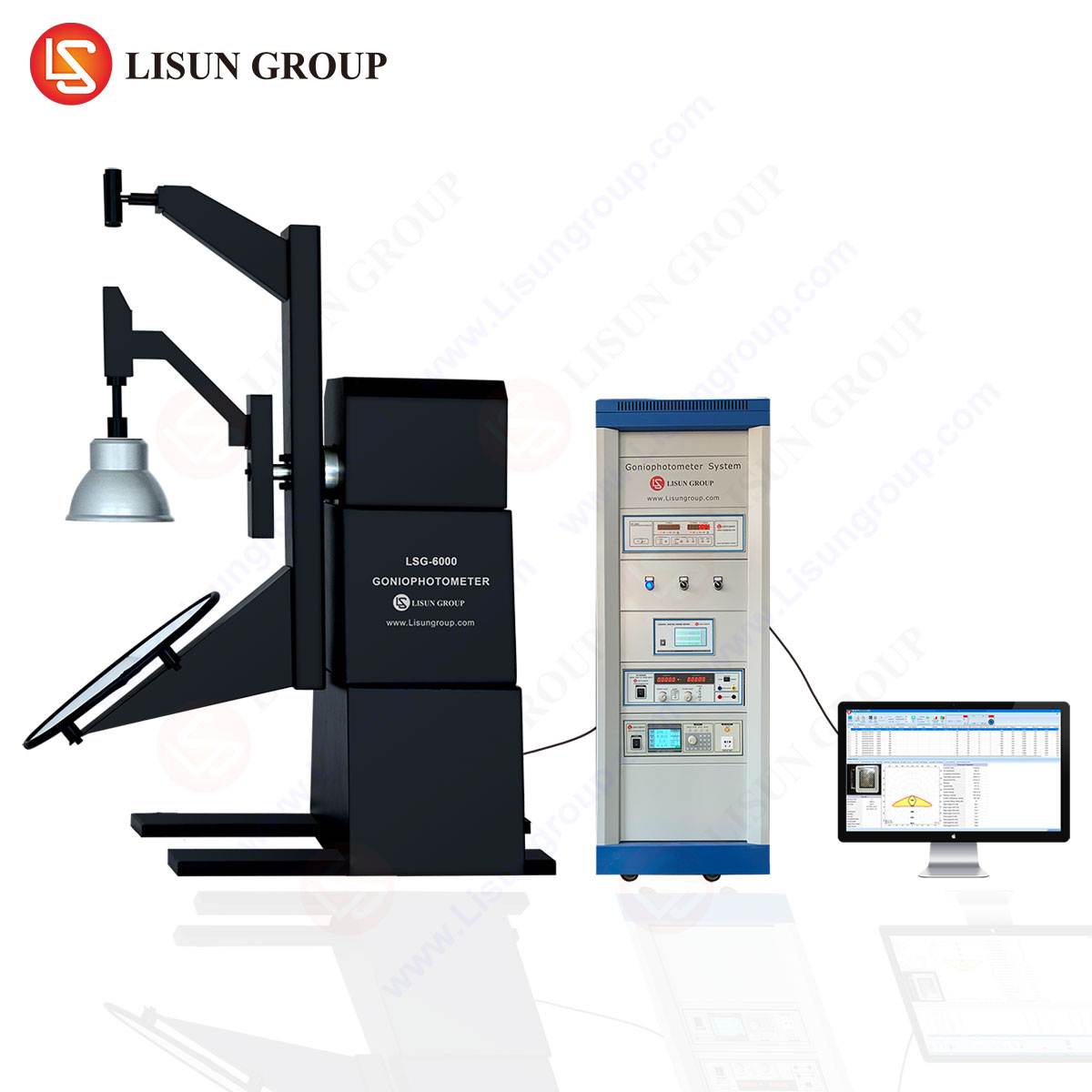
The LISUN LSG-6000 represents a state-of-the-art implementation of automated goniophotometry, designed for high-accuracy applications in research, development, and quality control. Its specifications and competitive advantages are outlined below.
Key Specifications:
- Measurement Geometry: Type C (luminaires rotate in both C and γ axes), per CIE 70 recommendations.
- Angular Range: C-axis: 0° to 360° (continuous); γ-axis: -180° to +180° (or custom based on model).
- Angular Accuracy: ≤ ±0.2°.
- Distance Range: Photometer head to DUT is variable, typically 5m to 30m, to satisfy the far-field condition (inverse square law).
- Max DUT Weight: Capable of handling luminaires up to 50kg, suitable for large streetlights and high-bay industrial fixtures.
- Detector System: Compatible with high-precision photometers and spectroradiometers (e.g., LISUN’s LMS-9000 series).
- Compliance: Software pre-loaded with test routines for IEC, IESNA, CIE, ANSI, and DIN standards.
Testing Principle: The LSG-6000 operates on the far-field distance principle. The luminaire is mounted at the center of the goniometer and rotated while a fixed, distant photometer measures the luminous intensity. The distance is maintained to be at least five times the maximum dimension of the DUT to ensure accurate intensity measurements free from near-field effects. The system software controls the entire process, from motion control and data acquisition to the calculation of derived quantities and the generation of standardized test reports, including IES/LDT files.
Competitive Advantages:
- Robust Mechanical Structure: A rigid, vibration-damped frame ensures stable and precise positioning, even with heavy or asymmetrical luminaires, which is critical for reproducible results.
- Advanced Thermal Management: The system can be integrated with a programmable power supply and thermal monitoring to characterize the DUT under realistic thermal conditions, a critical factor for LED performance.
- Comprehensive Data Export: Beyond standard reports, the system exports raw data and industry-standard IES files, which are essential for use in lighting simulation software like Dialux and Relux, bridging the gap between laboratory measurement and real-world application in urban lighting design and architectural planning.
Facilitating Research and Development in Photovoltaics and Advanced Optics
The utility of automated goniophotometry extends beyond traditional lighting. In the photovoltaic industry, these systems are used to characterize the angular response of solar cells and modules. The incident light response of a photovoltaic cell is not perfectly Lambertian; its efficiency varies with the angle of incidence of sunlight. An automated goniophotometer can map this angular efficiency, providing vital data for optimizing the tilt and tracking systems of solar installations. In the realm of advanced optics R&D, the technology is used to measure the Bidirectional Reflectance Distribution Function (BRDF) and Bidirectional Transmittance Distribution Function (BTDF) of materials, which describe how light is scattered by a surface. This is critical for developing anti-reflective coatings, specialized diffusers, and optical components for aerospace and defense applications.
Frequently Asked Questions (FAQ)
Q1: What is the significance of the far-field measurement distance in systems like the LSG-6000?
A1: The far-field condition, typically defined as a distance at least five times the maximum dimension of the light source, is necessary to apply the inverse square law accurately for calculating luminous intensity. In the near-field, the source cannot be treated as a point source, and intensity calculations would be erroneous. The LSG-6000’s variable distance capability ensures this critical condition is met for a wide range of luminaire sizes.
Q2: How does an automated goniophotometer handle the testing of asymmetrical luminaires, such as street lights with a Type II or Type III distribution?
A2: The system software does not differentiate between symmetrical and asymmetrical luminaires. It executes a pre-defined measurement grid across the full C- and γ-planes. For an asymmetrical luminaire, the resulting luminous intensity distribution data will naturally reflect its non-uniform pattern. The software algorithms are designed to process this data correctly, generating accurate polar curves and iso-candela diagrams that accurately represent the asymmetric distribution.
Q3: Can the LSG-6000 be used to generate IES files for lighting simulation software?
A3: Yes, this is a core function. Upon completion of a photometric test, the LSG-6000’s software processes the raw angular intensity data and generates a standard IES (Illuminating Engineering Society) file. This file contains a digital description of the luminaire’s light distribution and is the universal format used by lighting design software (e.g., Dialux, AGi32) to simulate how the fixture will perform in a virtual architectural space.
Q4: What are the critical environmental controls required for accurate goniophotometric measurements?
A4: The measurement environment must be a darkroom to eliminate stray light. Temperature stabilization is crucial, especially for LED testing, as luminous flux and chromaticity are temperature-dependent. The DUT should be powered by a stable, low-ripple DC or programmable AC power source. Furthermore, the system requires periodic calibration against a standard reference lamp traceable to a national metrology institute (e.g., NIST, PTB) to ensure absolute photometric accuracy.