


The Role of Automated Goniophotometry in Advanced Photometric Characterization
Abstract
The precise measurement of spatial light distribution is a critical requirement across numerous technological sectors, from solid-state lighting to optical component manufacturing. Automated goniophotometry has emerged as the definitive methodology for acquiring comprehensive luminous intensity data, enabling the characterization of a luminaire’s performance with unprecedented accuracy and efficiency. This article examines the technical principles, international standards compliance, and industrial applications of modern automated goniophotometer solutions, with a specific focus on the implementation and capabilities of the LSG-6000 goniophotometer system. The discourse will cover its operational mechanics, adherence to global testing protocols, and its pivotal role in driving innovation and quality assurance in lighting and related photonic industries.
Fundamental Principles of Goniophotometric Measurement
A goniophotometer functions on the principle of measuring the luminous intensity distribution of a light source by systematically repositioning a photodetector relative to the source, or vice versa, across spherical coordinate angles. The term itself is derived from the Greek words gonia (angle) and phos (light). In an automated configuration, this process is executed with high-precision robotic arms or a moving arch mechanism, controlled by sophisticated software. The primary objective is to capture the luminous intensity, in candelas (cd), for a comprehensive set of vertical (C-planes) and horizontal (γ-planes) angles, effectively mapping the light’s behavior in three-dimensional space.
The core measurement involves calculating the luminous intensity, I(θ, φ), at each angular coordinate. This is derived from the illuminance, E, measured by the detector at a fixed distance, d, from the source, using the inverse square law approximation for far-field conditions: I(θ, φ) = E(θ, φ) * d². The resulting dataset allows for the computation of all key photometric parameters, including total luminous flux (lumens), efficacy (lumens per watt), beam angles, and zonal lumen distribution. The automation of this process eliminates human error, drastically reduces measurement time from hours to minutes, and enables the collection of high-resolution data points that would be impractical manually.
Architectural Design and Kinematic Configurations of the LSG-6000 System
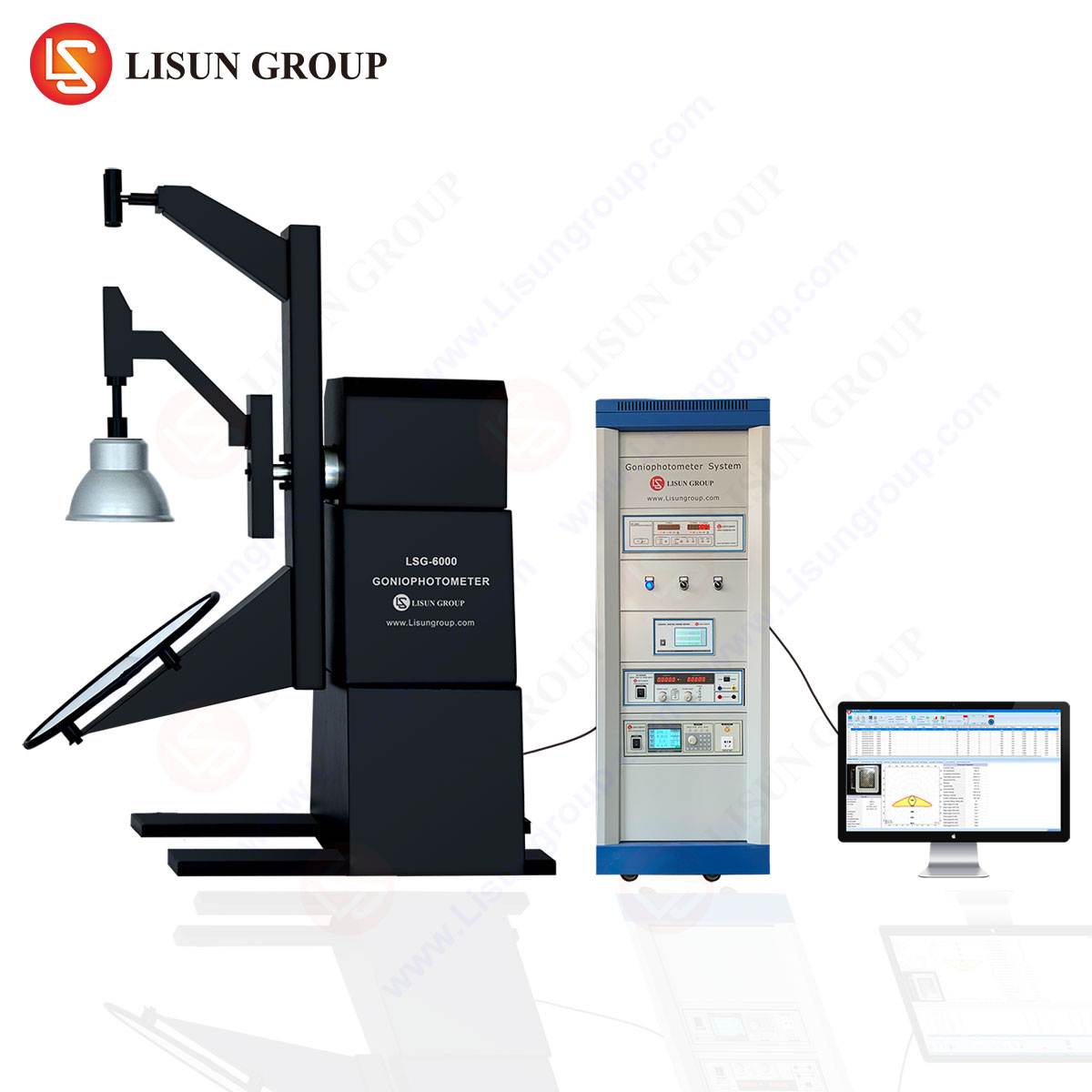
The LSG-6000 represents a Type C goniophotometer, a configuration where the luminaire under test rotates around its own photometric center in both the horizontal and vertical axes, while the photodetector remains stationary at a fixed distance. This design is particularly advantageous for testing heavy or large luminaires, as the detector does not require movement, simplifying the calibration and stability of the optical path. The system is engineered with a large diameter to accommodate a wide range of product sizes, from small LED modules to sizable streetlights and industrial high-bay fixtures.
The kinematic system of the LSG-6000 employs a dual-axis rotation mechanism. The primary axis provides continuous 360-degree rotation (C-angle), while the secondary axis facilitates a near-180-degree tilt (γ-angle). This allows the device to sample virtually every point on the imaginary sphere surrounding the test sample. The mechanical structure is constructed from rigid, low-vibration materials to ensure positional accuracy and repeatability. High-torque, servo-driven motors coupled with precision encoders guarantee angular resolution finer than 0.1°, which is essential for capturing sharp beam cut-offs and detailed intensity distributions. The system’s robust design minimizes deflection and maintains the critical alignment between the test sample’s photometric center and the axes of rotation, a fundamental prerequisite for accurate far-field measurements.
Adherence to International Photometric Standards and Protocols
Compliance with international standards is non-negotiable for any testing equipment used in product development and certification. The LSG-6000 is designed and validated to meet the stringent requirements of several key international and national standards, ensuring its applicability in global markets.
- IEC 60598-1: This standard specifies general requirements for luminaires. Accurate goniophotometric data is essential for verifying compliance with clauses related to photometric safety and performance claims.
- IESNA LM-79: An approved method for the electrical and photometric testing of solid-state lighting products. The LSG-6000 directly facilitates the photometric testing portion of LM-79, providing the total luminous flux and intensity distribution required for Energy Star and DesignLights Consortium (DLC) reporting in North America.
- CIE 70, CIE 121, CIE S025: These publications from the International Commission on Illumination (CIE) define the fundamental methods for measuring the photometric characteristics of lamps and luminaires. The LSG-6000 adheres to the principles outlined in these documents, ensuring scientific rigor.
- DIN EN 13032-4: This European standard specifically addresses the quality of goniophotometer measurements and the format for electronic data exchange (EULUMDAT, IES), which the LSG-6000 software supports natively.
The system’s calibration chain is traceable to national metrology institutes (NMI), such as NIST (USA) or PTB (Germany), providing the foundational accuracy required for standards compliance. The integrated software automates the entire testing sequence, from positioning and data acquisition to the generation of standardized report formats, streamlining the certification process for manufacturers.
Application in LED and OLED Manufacturing and Quality Control
In the highly competitive LED and OLED manufacturing sector, goniophotometry is indispensable for binning, performance validation, and failure analysis. The spatial color uniformity and angular color shift (Δu’v’) of LED packages and OLED panels are critical quality metrics, especially for display backlighting and architectural lighting applications. The LSG-6000 can be integrated with a high-precision spectroradiometer, enabling it to perform spatially resolved spectral measurements.
During production, samples from different batches are tested to verify that their luminous flux and chromaticity coordinates fall within specified bins. The automated system can measure hundreds of angular points, providing a full spatial color map that reveals inconsistencies in phosphor deposition or micro-lens geometry that would be invisible in an integrating sphere measurement. For OLEDs, which are Lambertian emitters by nature, verifying the conformance to this ideal distribution and identifying any mura (unevenness) effects is crucial. The data generated allows manufacturers to refine their deposition and encapsulation processes, leading to higher yields and more consistent product performance.
Optimizing Urban and Architectural Lighting Design through Photometric Data
The efficacy and visual comfort of urban lighting schemes—from street lighting to façade illumination—are directly dependent on the photometric performance of the constituent luminaires. Urban lighting designers rely on accurate goniophotometric data in standardized file formats (e.g., IES, LDT) to simulate lighting scenarios in software like DIALux, Relux, and AGi32.
Using data from an LSG-6000, designers can accurately predict illuminance levels on road surfaces, assess glare indices for pedestrian and driver safety, and model the luminance distribution of a building’s exterior. For example, a streetlight’s photometric file informs the software of its light output, beam shape, and cut-off angles, allowing for the precise calculation of spacing between poles, mounting heights, and overall uniformity ratios to meet standards such as ANSI/IES RP-8 for roadways. This data-driven approach prevents over-lighting, reduces energy consumption, and minimizes light trespass and skyglow, supporting the principles of dark-sky-friendly lighting design.
Advanced Testing for Display Equipment and Optical Components
The performance of display equipment, including LCDs, projection systems, and augmented/virtual reality (AR/VR) headsets, is heavily influenced by the angular performance of their optical components. Backlight units (BLUs), light guides, diffuser plates, and optical films must exhibit specific spatial light distributions to achieve desired viewing angles, brightness, and contrast ratios.
An automated goniophotometer like the LSG-6000 is used to characterize these components with high angular resolution. For a BLU, the system measures the viewing angle cone and the uniformity of luminance across its surface from different angles. This is critical for ensuring that a television or monitor has a consistent picture without color or brightness shift when viewed off-axis. In the production of optical components such as lenses, Fresnel lenses, and reflectors, the system verifies that the manufactured part’s beam shaping properties match its optical design specifications, a process vital for quality assurance in sensor systems and scientific instrumentation.
Supporting Research and Development in Photovoltaic and Sensor Technologies
While primarily a tool for emissive light sources, the principles of goniophotometry are also applied in the characterization of light-receiving devices. In photovoltaic (PV) research, the angular response of solar cells is a key parameter. The efficiency of a solar cell can vary significantly with the angle of incidence of sunlight. The LSG-6000 can be configured with a stable, calibrated light source to illuminate a PV cell mounted on its rotating stage, measuring the cell’s short-circuit current as a function of incident angle. This data is crucial for optimizing the positioning of fixed solar panels and for developing sun-tracking algorithms.
Similarly, in the production of optical sensors—from simple photodiodes to complex LiDAR receivers—understanding the angular sensitivity is fundamental. A sensor may need a wide field of view or a very narrow, collimated acceptance angle. The goniophotometer provides the definitive map of responsivity versus angle, enabling engineers to calibrate sensors and validate the performance of integrated optical elements like lenses and apertures.
Technical Specifications and Operational Advantages of the LSG-6000 System
The LSG-6000 is engineered to deliver laboratory-grade accuracy in a robust, production-friendly platform. Its specifications are tailored to meet the diverse demands of the industries previously discussed.
Table 1: Key Specifications of the LSG-6000 Goniophotometer
| Parameter | Specification |
| :— | :— |
| Goniophotometer Type | Type C (Moving Luminaire) |
| Measurement Distance | Variable, typically 5m to 30m (customizable) |
| Luminous Flux Range | 0.1 lm to 2,000,000 lm |
| Angular Resolution | ≤ 0.1° |
| Measurement Uncertainty | < 3% (for luminous flux, k=2) |
| Maximum Sample Weight | 50 kg (standard), higher capacities available |
| Maximum Sample Dimensions | Customizable based on arch diameter |
| Compliance Standards | IEC 60598-1, IESNA LM-79, CIE 70, CIE 121, CIE S025, DIN EN 13032-4 |
The competitive advantages of the LSG-6000 are multi-faceted. Its Type C configuration is inherently more stable for large samples, as the sensitive detector remains fixed. The system’s software provides not only full automation but also advanced data analysis features, including 3D isolux diagrams, candela distribution curves, and direct export to major lighting design software formats. The modular design allows for integration with spectroradiometers and colorimeters for full spatial-color characterization, making it a versatile solution for both routine quality control and advanced research and development applications.
Frequently Asked Questions (FAQ)
Q1: What is the primary difference between a Type A, Type B, and Type C goniophotometer, and why is the LSG-6000 a Type C?
Type A systems rotate the sample in the horizontal plane and the detector in the vertical plane. Type B systems rotate the sample in the vertical plane and the detector in the horizontal plane. A Type C system, like the LSG-6000, rotates the sample in both horizontal and vertical axes while the detector remains stationary. The Type C configuration is preferred for testing heavy or bulky luminaires because it eliminates the need to move the often-fragile and precise detection system, ensuring greater mechanical stability and measurement consistency.
Q2: Can the LSG-6000 measure the spatial color uniformity of an LED module?
Yes, when equipped with an optional spectroradiometer or a tristimulus colorimeter mounted at the detector position, the LSG-6000 can perform spatially resolved spectral measurements. It can generate data on correlated color temperature (CCT), chromaticity coordinates (x, y or u’, v’), and color rendering index (CRI) as a function of angle, providing a complete map of angular color shift (Δu’v’) and spatial color consistency.
Q3: How does the system ensure that the measurement distance is sufficient for far-field conditions?
Far-field conditions, where the inverse square law holds true, are generally considered to be at a distance greater than five times the maximum dimension of the light source. The LSG-6000 is typically configured with a measurement distance (e.g., 10m, 15m, 30m) that is specified based on the maximum intended sample size to ensure compliance with this criterion. The system software can also apply near-field corrections if required for specific applications, though for most standard luminaire testing, operating in the far-field is the prescribed method.
Q4: What file formats does the system generate, and how are they used in lighting design?
The LSG-6000 software automatically generates industry-standard photometric data files, primarily the IES (Illuminating Engineering Society) and EULUMDAT (LDT) formats. These files contain the complete intensity distribution data of the tested luminaire. Lighting designers import these files into simulation software (e.g., DIALux, Relux, AGi32) to create accurate digital twins of the luminaires, enabling them to design and visualize entire lighting schemes, calculate illuminance levels, and ensure compliance with project specifications and energy codes before any physical installation takes place.