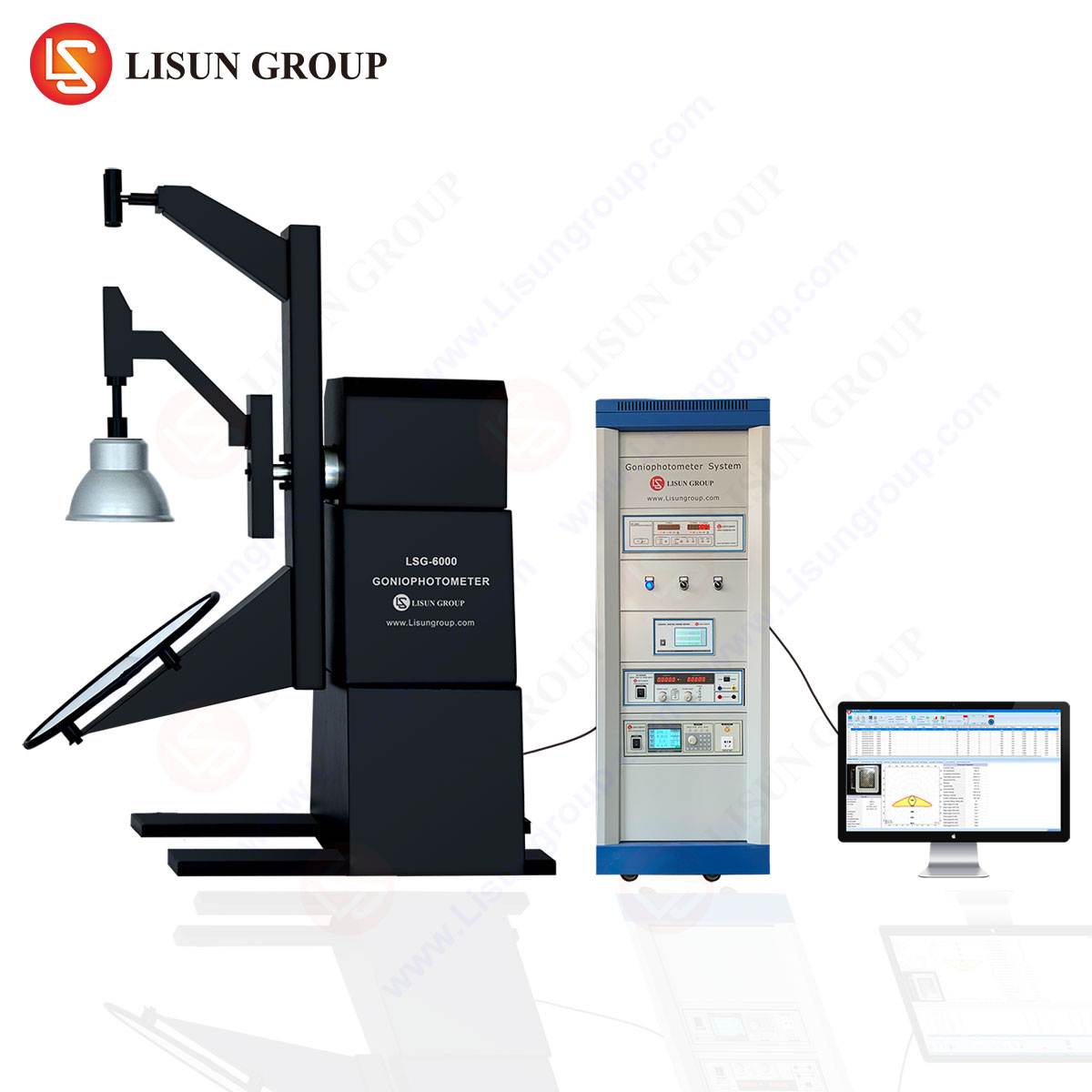



A Comprehensive Analysis of Goniophotometric Systems for Advanced Luminous Flux Measurement
Abstract
The accurate characterization of light-emitting diodes (LEDs) and solid-state lighting (SSL) products necessitates sophisticated measurement techniques that transcend simple photometric parameters. Goniophotometry, the cornerstone of spatially resolved photometry, provides the definitive methodology for quantifying the total luminous flux and spatial distribution of light from a source. This article delineates the critical applications of goniophotometer systems across diverse industries, with a technical examination of the LSG-6000 goniophotometer. We explore its operational principles, compliance with international standards such as IEC, IESNA, and CIE, and its pivotal role in ensuring product quality, driving innovation, and enabling precise lighting design.
Fundamentals of Goniophotometric Measurement
Goniophotometry is a measurement technique that determines the photometric characteristics of a light source by assessing its luminous intensity distribution as a function of angle. Unlike integrating spheres, which capture total flux but provide no spatial information, a goniophotometer rotates either the light source or a detector around one or more axes, mapping the light’s intensity in three-dimensional space. The fundamental principle involves measuring luminous intensity at numerous discrete angular positions (C-γ or A-α coordinate systems as per CIE 121:1996). The total luminous flux (Φ), measured in lumens (lm), is then computed by integrating the measured intensity over the entire solid sphere surrounding the source. This process yields a comprehensive dataset, including the luminous intensity distribution curve (LIDC), zonal lumen summary, and efficiency metrics, which are indispensable for both quality control and application-specific design.
Architectural Configuration of the LSG-6000 Goniophotometer System
The LSG-6000 represents a Type C, variable geometry goniophotometer, a design optimized for high-precision measurement of luminaires and integrated LED lamps. Its architecture is engineered for stability, repeatability, and minimization of measurement uncertainty. The system operates on the principle of a moving detector and a fixed light source position, which is crucial for testing luminaires whose photometric center may be ambiguous or whose performance is sensitive to orientation.
Key specifications of the LSG-6000 include a large working distance, typically exceeding 10 meters, to satisfy the far-field condition for most commercial and industrial luminaires. It employs a high-sensitivity, spectroradiometric-grade detector mounted on a robotic arm capable of traversing both horizontal (γ: 0° to 360°) and vertical (C: -90° to +90° or 0° to 180°) axes with an angular resolution finer than 0.1°. This configuration allows for complete 4π steradian measurement. The system is housed within a darkened, non-reflective chamber to eliminate stray light. A critical component is the spectroradiometer, which enables not only photopic (V(λ)-corrected) measurements but also colorimetric analysis, including Correlated Color Temperature (CCT), Color Rendering Index (CRI), and chromaticity coordinates (x, y), as defined by CIE 13.3-1995 and CIE 15:2004.
Adherence to International Photometric Standards
Compliance with globally recognized standards is a non-negotiable requirement for any testing instrumentation used in commercial production and certification. The LSG-6000 is designed to meet or exceed the stringent requirements outlined in several pivotal documents:
- IEC 60598-1: “Luminaires – Part 1: General requirements and tests” mandates specific photometric testing to verify safety and performance claims.
- IESNA LM-79-19: “Approved Method: Electrical and Photometric Measurements of Solid-State Lighting Products” explicitly describes the use of goniophotometers for total luminous flux measurement of SSL products, detailing the required measurement geometry and data reporting.
- CIE 70-1987 / CIE 121-1996: These publications from the International Commission on Illumination provide the foundational methodology for the measurement of luminous flux and the distribution of luminous intensity.
- ANSI C78.377 & ENERGY STAR: For SSL products sold in North America, compliance with these specifications for chromaticity and spatial uniformity of color is critical, which the LSG-6000 verifies through its integrated spectroradiometric capabilities.
By automating test sequences and data processing according to these standards, the LSG-6000 ensures that manufacturers can consistently generate reports that are valid for international market access and certification bodies like UL, DLC, and TÜV.
Applications in LED and OLED Manufacturing Quality Assurance
In the high-volume production environment of LED and OLED manufacturing, statistical process control is paramount. The LSG-6000 serves as a master reference system for sampling and auditing production batches. It is used to verify key performance indicators (KPIs) such as luminous efficacy (lm/W), which directly impacts product energy efficiency ratings. Furthermore, it identifies manufacturing variances, including inconsistencies in phosphor coating in pc-LEDs or micro-lens array alignment, which manifest as anomalies in the LIDC. For OLED panels, which are inherently Lambertian sources, the goniophotometer confirms the uniformity of this distribution and detects any angular color shift, a common failure mode that affects visual quality. By correlating goniophotometric data with binning parameters, manufacturers can achieve tighter performance tolerances, leading to higher product consistency and customer satisfaction.
Precision in Display Equipment and Backlight Unit Testing
The performance of liquid crystal displays (LCDs), including monitors, televisions, and automotive infotainment screens, is heavily dependent on their backlight units (BLUs), which are predominantly LED-based. The LSG-6000 is instrumental in characterizing the angular luminance and chromaticity uniformity of these BLUs. A non-uniform LIDC can result in display artifacts such as vignetting (corner dimming) or color casts at off-axis viewing angles. By mapping the spatial light output, engineers can refine the design of light guides, diffuser plates, and reflector films to achieve a perfectly uniform viewing experience. The system’s ability to measure at very low luminance levels with high signal-to-noise ratio is essential for testing displays with high dynamic range (HDR) capabilities.
Validating Performance in Medical and Therapeutic Lighting
Medical lighting applications, from surgical luminaires to phototherapy devices, demand extreme precision and reliability. Standards such as IEC 60601-2-41 and 60601-2-50 specify stringent requirements for illumination levels, field uniformity, and shadow management in operating theater lights. The LSG-6000 provides the empirical data required to validate that a surgical light meets its depth-of-field and diopter specifications. For dermatological phototherapy devices employing LEDs, the accurate measurement of irradiance (W/m²) and its spatial distribution across the treatment area is critical for ensuring patient safety and treatment efficacy. The system’s spectroradiometer can be configured to measure absolute spectral irradiance, confirming that the emitted wavelengths fall within the therapeutic window.
Optimizing Luminous Environments in Urban and Architectural Design
Urban lighting design transcends mere illumination; it encompasses public safety, aesthetic enhancement, and light pollution mitigation. The Dark-Sky Association and various national regulations (e.g., EN 13201 series in Europe) impose limits on upward waste light and glare. The LSG-6000 enables lighting designers and municipal engineers to precisely model the light trespass and obtrusive light from a proposed luminaire before deployment. By analyzing the LIDC, designers can select or design luminaires with sharp cut-off angles and specific beam patterns that direct light only where needed, thereby reducing energy consumption and environmental impact while improving visual comfort for citizens.
Calibration and Development in Optical Instrumentation and Sensor Production
The production of optical instruments, such as light meters, cameras, and ambient light sensors, requires reference light sources with known and stable spatial and spectral output. The LSG-6000 acts as a calibration source for these devices. For instance, when developing a new image sensor, the angular response of its microlenses and color filters must be characterized. By placing the sensor at the center of the goniophotometer and using a stable, calibrated light source, engineers can map the sensor’s angular sensitivity, a critical parameter for correcting vignetting in digital imaging pipelines. Similarly, the production of cosine-corrected diffusers for photometric sensors is validated by verifying their adherence to the ideal cosine angular response curve using this system.
Ensuring Consistency in Stage, Studio, and Entertainment Lighting
In entertainment lighting, the beam characteristics of an LED profile spotlight or wash luminaire are its primary artistic tools. Parameters such as field angle, beam angle, and the shape of the LIDC (e.g., flat-top, peaky, or oval) define the fixture’s performance. The LSG-6000 provides the quantitative data that lighting designers use to create equipment schedules and pre-visualize lighting plots. Manufacturers of these fixtures use the system to ensure that every unit of a given model produces an identical beam profile and color output, which is essential for creating seamless washes of light on stage or film set. Compliance with standards like ANSI E1.54 is supported.
Supporting Research and Development in Photovoltaic and Novel Light Sources
While not a direct application, the principles of goniophotometry are applied in the photovoltaic (PV) industry to measure the angular dependence of solar cell response. Research laboratories utilize similar robotic arms and detector systems to map the incidence angle modifier (IAM) of PV modules, which affects their real-world energy yield. In fundamental optical R&D, the LSG-6000 is used to characterize novel light sources such as quantum-dot LEDs (QLEDs), perovskite LEDs, and micro-LED arrays. For these emerging technologies, understanding the relationship between nanoscale structure and macroscopic light emission pattern is vital, and the LSG-6000 provides the critical bridge between micro-fabrication and application performance.
Comparative Advantages of a Fixed-Position Goniophotometer Design
The LSG-6000’s fixed-position luminaire design offers distinct advantages over rotating mirror (Type A) or rotating luminaire (Type B) systems. Firstly, it eliminates errors associated with gravitational effects on the luminaire’s internal components (e.g., heat sink orientation affecting LED junction temperature, or shifting of loose phosphor in remote-phosphor designs). Secondly, it allows for the testing of luminaires with cables, heat management systems, or form factors that are incompatible with rotation. Thirdly, it enables the measurement of temperature-sensitive parameters in a stable thermal state, as the luminaire remains stationary and can be powered under controlled conditions throughout the test cycle. This results in lower measurement uncertainty and data that more accurately reflects in-situ performance.
Frequently Asked Questions (FAQ)
Q1: What is the primary distinction between using an integrating sphere and a goniophotometer for total luminous flux measurement?
An integrating sphere provides a rapid measurement of total luminous flux by spatially integrating the light within a reflective cavity. However, it offers no information on the spatial distribution of that light and its accuracy can be compromised for non-diffuse sources or those with significant spectral or spatial mismatch with the calibration standard. A goniophotometer measures the luminous intensity at every angle and mathematically integrates it to derive the total flux, providing a more fundamentally accurate and comprehensive result, including the complete intensity distribution, which is critical for application design.
Q2: How does the LSG-6000 account for the self-absorption error that is a known issue in integrating sphere measurements?
Self-absorption error, where the presence of the test sample alters the sphere’s spatial reflectance properties, is a significant source of uncertainty in sphere measurements, particularly for large or asymmetrical luminaires. The LSG-6000, being a goniophotometer, is immune to this error. Its measurement principle does not rely on a reflective cavity but on direct measurement of intensity in a far-field, dark environment, thereby eliminating the physical interaction between the sample and the measurement chamber that causes self-absorption.
Q3: For which types of light sources is a goniophotometer like the LSG-6000 an indispensable tool, as opposed to merely beneficial?
A goniophotometer is indispensable for any directional light source or luminaire where the application is defined by its beam pattern. This includes streetlights, downlights, spotlights, automotive headlamps, projectors, and stage lighting. It is also critical for measuring sources where angular color uniformity is a key performance metric, such as OLEDs, large-area LED panels, and displays. For truly diffuse, near-Lambertian sources, an integrating sphere may suffice for flux measurement, but the goniophotometer still provides the definitive validation.
Q4: What are the key environmental control factors required for operating a high-precision goniophotometer like the LSG-6000?
Stable ambient conditions are crucial. The laboratory must maintain a constant temperature (typically 25 ± 1°C) as LED output and detector sensitivity are temperature-dependent. Air drafts must be minimized to prevent cooling of the luminaire under test, as its junction temperature directly affects luminous flux and color. The chamber must be completely light-tight to prevent stray light from contaminating the signal. Furthermore, a stable and clean AC power supply, often with linear regulators, is required to power both the instrument and the device under test without introducing electrical noise.
Q5: Can the LSG-6000 measure the spatial distribution of spectral power, or is it limited to photometric quantities?
While a basic goniophotometer may be limited to photopic measurements using a V(λ)-filtered detector, the LSG-6000 is typically equipped with or can be integrated with a high-precision spectroradiometer. This configuration allows it to perform spatially resolved spectral measurements. At each angular position, the full spectrum (e.g., 380nm to 780nm) is captured. This enables the calculation of photometric, colorimetric, and radiometric quantities (like irradiance) as a function of angle, which is essential for analyzing angular color shift and for applications in non-visual photobiology and radiometry.