





Advanced Lumen Measurement Techniques: Integrating Sphere Spectroradiometry for Modern Photometric and Radiometric Characterization
Introduction
The precise quantification of luminous flux, measured in lumens, remains a fundamental requirement across a diverse spectrum of industries. As lighting technologies evolve from traditional incandescent sources to sophisticated solid-state lighting (SSL), including complex LED arrays, OLED panels, and hybrid systems, the methodologies for accurate lumen measurement must correspondingly advance. Simple photometer measurements are insufficient for characterizing modern light sources, which often exhibit spatial non-uniformity, spectral variance, and thermal dependence. This necessitates an integrated approach combining geometric integration, spectral analysis, and standardized procedures. Advanced lumen measurement techniques, centered on integrating sphere spectroradiometer systems, have become the de facto standard for laboratory-grade accuracy, providing not only total luminous flux but also a comprehensive suite of photometric, colorimetric, and radiometric data critical for research, development, quality assurance, and regulatory compliance.
The Imperative of Spatial and Spectral Integration in Flux Measurement
The primary challenge in measuring total luminous flux lies in capturing all light emitted in every direction (4π steradians). A photodetector placed at a fixed point will only register intensity from a limited solid angle, making it impossible to directly measure the integrated output of an omnidirectional or asymmetrical source. The integrating sphere, a hollow spherical cavity with a highly reflective, diffuse coating, solves this through geometric principles. Light introduced into the sphere undergoes multiple diffuse reflections, creating a uniform radiance distribution across the sphere’s inner wall. A detector, shielded from direct illumination by a baffle, then measures this uniform irradiance, which is proportional to the total flux of the source. This spatial integration is the first critical pillar of advanced lumen measurement.
The second pillar is spectral correction. The sphere’s coating reflectance and the detector’s responsivity are not perfectly uniform across the visible spectrum. A traditional photometer with a V(λ)-filter attempts to match the human eye’s photopic response but can introduce significant errors for sources with discontinuous spectra, such as LEDs. Spectroradiometry addresses this by measuring the spectral power distribution (SPD) of the light within the sphere. By convolving the measured SPD with the CIE standard luminous efficiency function V(λ), luminous flux is computed with high spectral fidelity. This method inherently provides correlated color temperature (CCT), color rendering index (CRI), chromaticity coordinates, and other colorimetric parameters, transforming a flux measurement into a complete optical characterization.
Architectural Components of a Modern Integrating Sphere Spectroradiometer System
A state-of-the-art measurement system is an engineered synergy of optical, mechanical, and electronic components. The sphere itself is constructed from two hemispheres, typically with a barium sulfate (BaSO₄) or proprietary polytetrafluoroethylene (PTFE)-based coating offering reflectance values exceeding 95% across 380-780nm. An internal baffle system, strategically positioned between the source port and the detector port, is essential to prevent first-reflection errors. The spectroradiometer comprises a diffraction grating, a slit, and a charge-coupled device (CCD) or photodiode array detector, offering wavelength accuracy within ±0.3nm and high optical resolution. The system is completed by a precision power supply for the test source, a standard reference lamp calibrated by a national metrology institute (NMI), and specialized software for system calibration, data acquisition, and analysis compliant with standards such as IES LM-79, CIE S025, and DIN 5032-6.
The LPCE-3 Integrating Sphere Spectroradiometer System: A Technical Exposition
The LPCE-3 system exemplifies the application of these advanced techniques. It is designed for the precise testing of single LEDs, LED modules, and other small luminaires. The system employs a compact, high-reflectance integrating sphere coupled with a high-resolution array spectroradiometer.
-
Testing Principle: The methodology follows a substitution-based, spectroradiometric approach. A NMI-calibrated standard lamp of known luminous flux is first energized at the sphere’s center. The system software records the spectral data, establishing a calibration coefficient that accounts for sphere efficiency, detector responsivity, and optical path characteristics. The standard lamp is then replaced with the device under test (DUT), operated at its specified thermal and electrical conditions. The software computes the DUT’s total luminous flux by comparing its measured spectral irradiance to the stored calibration data, applying the necessary geometric and spectral corrections.
-
Key Specifications:
- Integrating Sphere: Diameter options (e.g., 0.5m, 1m, 1.5m, 2m) to accommodate different source sizes and maintain adequate spatial integration. Coated with a highly stable diffuse reflective material.
- Spectroradiometer: Wavelength range typically 380-780nm (extendable for UV/IR applications), wavelength accuracy ≤±0.3nm, and fast scanning speed for dynamic measurements.
- Measurement Parameters: Luminous Flux (lm), Luminous Efficacy (lm/W), CCT (K), CRI (Ra), Chromaticity Coordinates (x,y and u’,v’), Peak Wavelength, Dominant Wavelength, Spectral Power Distribution, and FWHM.
- Compliance: Adheres to IES LM-79-19, IES LM-80-20, CIE 177, CIE 13.3, CIE 15, and ANSI C78.377.
-
Competitive Advantages: The LPCE-3 system’s architecture minimizes self-absorption error—a common artifact where a test source absorbs its own reflected light—through optimized sphere size-to-DUT ratios and baffle design. Its software integrates real-time temperature monitoring via a thermal probe, allowing for data correction or stabilization criteria, which is crucial for LED testing. The automated calibration routine and user-configurable test reports streamline workflow in high-throughput environments like manufacturing quality control labs.
Industry-Specific Applications and Use Cases
LED & OLED Manufacturing: In production lines, the LPCE-3 system performs binning based on flux and chromaticity to ensure color and brightness consistency. It is used for verifying datasheet claims, conducting stress testing (LM-80), and evaluating phosphor performance in phosphor-converted LEDs.
Automotive Lighting Testing: Beyond total flux for signal lamps, the system’s spectral data is critical for measuring the photobiological safety of high-intensity headlamps (according to IEC 62471) and ensuring the precise color of rear combination lamps per ECE/SAE regulations.
Aerospace and Aviation Lighting: For cockpit panels, navigation lights, and cabin illumination, the system validates compliance with stringent RTCA/DO-160 or MIL-STD-3009 requirements for luminance, color, and flicker under varying voltage and temperature conditions.
Display Equipment Testing: It characterizes the luminous output and color gamut of LED backlight units (BLUs) for LCDs and the emissive properties of OLED display modules, providing essential data for uniformity calibration.
Photovoltaic Industry: While primarily for visible light, spectroradiometer systems are used to calibrate solar simulators per IEC 60904-9, measuring the spectral match to the AM1.5G standard, which directly impacts the accuracy of solar cell efficiency measurements.
Scientific Research Laboratories: Researchers utilize such systems to study the efficacy of novel luminescent materials, the aging characteristics of light sources, and human-centric lighting parameters like melanopic lux.
Urban Lighting Design: For smart city applications, designers use spectral flux data to model the environmental impact of street lighting, minimizing blue-light pollution while meeting illuminance standards.
Marine and Navigation Lighting: Testing ensures that maritime signal lights meet the International Association of Lighthouse Authorities (IALA) recommendations for luminous intensity and color to ensure unambiguous signaling at sea.
Medical Lighting Equipment: The precise spectral measurement is vital for surgical lights (ISO 9680) to evaluate color rendering for tissue differentiation and for phototherapy devices to verify their therapeutic spectral output.
Overcoming Measurement Challenges: Thermal, Electrical, and Spatial Considerations
Advanced measurement protocols must account for several confounding variables. LED flux output is strongly dependent on junction temperature. The LPCE-3 system often incorporates a constant-current power supply and allows for a stabilization period before measurement, with software logging data only after thermal equilibrium is indicated. Electrical parameters (forward voltage, current) are monitored simultaneously to ensure the DUT is operating at its specified electrical point.
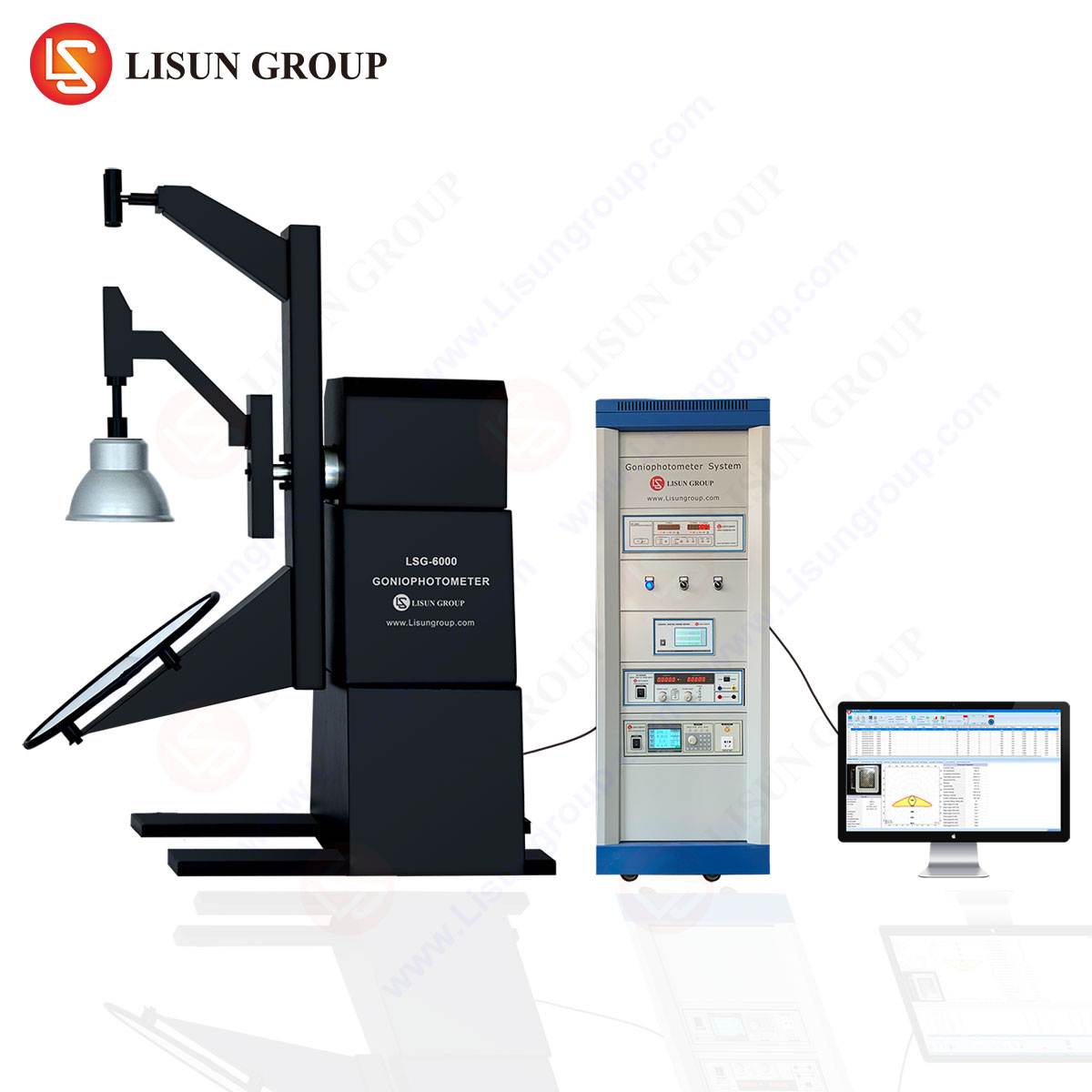
For luminaires with significant size relative to the sphere, spatial non-uniformity of the sphere’s response becomes a concern. The use of auxiliary lamps, as described in the CIE 84:1989 standard, can correct for this spatial non-uniformity error. Furthermore, for sources with pronounced directional output (e.g., spotlights), a goniophotometer may be the preferred tool, though spectroradiometer-integrated spheres remain optimal for omnidirectional and diffuse sources.
Data Integrity and Traceability to International Standards
The validity of any advanced measurement hinges on metrological traceability. The calibration chain for an integrating sphere system begins with the NMI-calibrated standard lamp, whose luminous flux and SPD are known with low uncertainty. Regular calibration of this reference lamp, and of the spectroradiometer’s wavelength scale using mercury or argon emission lines, is mandatory. System validation is performed using stable, intermediate check standards. All measurement results should be reported with an associated uncertainty budget, considering components such as sphere multiplier uncertainty, standard lamp uncertainty, spectral mismatch, temperature instability, and electronic noise, typically aiming for expanded uncertainties (k=2) below 3% for luminous flux.
Future Trajectories: Beyond Total Luminous Flux
The frontier of lumen measurement is expanding. There is growing demand for systems that can measure flicker (percent flicker and flicker index per IEEE PAR1789), temporal light artifacts, and modulated light output for visible light communication (VLC) systems. The definition of lumen itself is being scrutinized in the context of mesopic vision for outdoor applications. Next-generation systems will likely integrate faster spectroradiometers, advanced thermal management chambers, and machine learning algorithms for predictive maintenance and automated anomaly detection during testing, further solidifying the role of the integrating sphere spectroradiometer as the cornerstone of advanced photometric characterization.
FAQ
Q1: What is the primary advantage of using a spectroradiometer inside an integrating sphere over a traditional photometer with a V(λ) filter?
A spectroradiometer measures the complete spectral power distribution of the light. This allows for mathematically perfect application of the V(λ) function, eliminating spectral mismatch error which is significant for narrow-band sources like LEDs. It also simultaneously provides full colorimetric data (CCT, CRI, chromaticity), which a photometer cannot.
Q2: How does the size of the integrating sphere affect measurement accuracy?
Sphere size must be selected relative to the physical size of the device under test. A general rule is that the sphere diameter should be at least 5-10 times the largest dimension of the DUT. An undersized sphere leads to increased self-absorption error and spatial non-uniformity, elevating measurement uncertainty. Systems like the LPCE-3 offer multiple sphere sizes to match different application scales.
Q3: Why is temperature control and monitoring critical during LED lumen measurement?
The luminous flux and chromaticity of an LED are highly sensitive to its junction temperature. A measurement taken before the LED reaches thermal equilibrium will be inaccurate and non-repeatable. Advanced systems incorporate thermal probes and software that either waits for stabilization or applies temperature-correction algorithms based on known thermal coefficients.
Q4: Can the LPCE-3 system test flashing or pulsed LED signals, as used in automotive or aviation?
Yes, with appropriate system configuration. This requires a spectroradiometer with a sufficiently fast scan rate or trigger function synchronized to the pulse, and software capable of capturing and analyzing time-resolved spectral data. This allows measurement of peak flux and analysis of temporal characteristics during the pulse.
Q5: What is the purpose of the baffle inside the integrating sphere?
The baffle is a critical opaque shield placed between the light source port and the detector port. Its function is to prevent any light rays emitted directly from the source from reaching the detector. The detector must only measure light that has undergone multiple diffuse reflections, ensuring it measures the spatially integrated flux, not a direct beam, which would invalidate the principle of spatial averaging.